← All women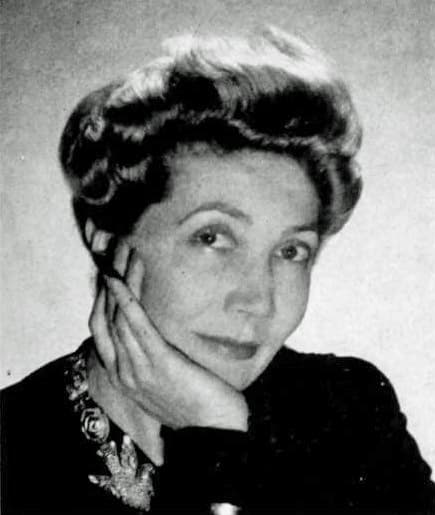
American · Arts
Dorothy Liebes
October 14, 1897 – September 20, 1972
Early Life and Background
Dorothy Wright Liebes (born Dorothy Wright) was an American textile designer and weaver whose work profoundly shaped mid‑twentieth‑century design in the United States.[1][3] She was born on October 14, 1897, in Santa Rosa, California, to Frederick L. Wright, a chemistry professor, and Bessie (often cited as Elizabeth) Calderwood Wright, a teacher.[1][6][7] Growing up in Northern California in a family that valued education and science, she was encouraged to pursue rigorous study and developed an early interest in art and teaching.
Liebes initially trained as an art educator. She studied art education at San Jose State Teachers College (then a teachers college serving Santa Rosa and San Jose), focusing on painting.[5][6][7] A professor reportedly remarked that her paintings resembled textiles, prompting her to explore weaving as a medium.[5][7] This observation became a pivotal moment: it redirected her trajectory from two‑dimensional painting toward the tactile world of fiber and structure.
To deepen her skills, she took weaving classes at Chicago’s Hull‑House, a progressive settlement house that offered arts and crafts education to immigrants and working people.[5][7] Hull‑House exposed her to social reform networks and reinforced the idea that design could have social as well as aesthetic value. She later completed a second bachelor’s degree in decorative art, architecture, and applied textile design at the University of California, Berkeley, where she studied tapestry techniques and developed a sophisticated understanding of materials and structure.[5][6][7]
Liebes went on to earn a master’s degree in art education at Columbia University’s Teachers College in New York, expanding her knowledge of pedagogy and modern art.[5][7][10] This combination of West Coast craft training, architectural exposure, and East Coast academic study gave her an unusually broad foundation. It would allow her to move fluidly between handweaving, industrial production, teaching, and high‑level design consulting.
Career Beginnings and Development
After periods of study and teaching art in California public schools, Liebes gradually shifted her focus toward weaving as a professional practice.[6][7] By 1929 she had established her first weaving studio in San Francisco, filling her home with looms and materials and creating custom textiles for local architects and designers.[1][10] San Francisco’s vibrant architectural scene in the late 1920s, coupled with the city’s openness to experimentation, provided fertile ground for her emerging career.
Her breakthrough came with architect Timothy Pflueger, a leading figure in West Coast modernism. Liebes was commissioned to design the color scheme and draperies for Pflueger’s San Francisco Stock Exchange Building, which opened on October 29, 1929, the day of the stock market crash.[5] This was her first major architectural commission, and it demonstrated her ability to integrate textiles into monumental interiors in ways that were both visually striking and functionally appropriate. In an era when such work was largely controlled by male architects and decorators, her role was notable.
Through the early 1930s she built her reputation by working on banks, theaters, and other public buildings in California. She was known for her bold use of color and her willingness to incorporate unconventional materials into her weavings. In 1934 she formalized her practice as Dorothy Liebes Design, Inc., establishing a studio business that would eventually employ a team of weavers and assistants.[7][8][10] Her studio produced custom handwoven fabrics for architects, interior designers, and fashion houses, and she cultivated a clientele that valued distinctive, modern textiles.
Liebes refined what would become known as the “Liebes Look”: vivid color combinations, lush textures, and often a touch of metallic shimmer.[3][4][7] She experimented with materials such as metal threads, bamboo, leather, ticker tape, and cellophane, integrating them with wool, cotton, and silk. Her understanding of color theory, informed by her art education, allowed her to orchestrate complex palettes that enlivened interiors and garments.
Major Works, Commissions, and Industrial Collaborations
By the mid‑1930s, Liebes had begun to secure major exhibition and fair commissions. The Golden Gate International Exposition (GGIE) on Treasure Island was officially authorized by the California legislature and President Franklin D. Roosevelt on February 18, 1936.[12] Liebes was later appointed director of the Decorative Arts Pavilion and commissioned to design textiles and color schemes for the exposition, which opened in 1939.[2][6][12] Her work there helped present an image of California and the United States as centers of modern design, using textiles to articulate the fair’s themes of progress and international exchange.
International recognition followed. At the Paris International Exhibition of Arts and Techniques in Modern Life, which opened on May 25, 1937, Liebes’s woven panel “Schiaparelli” received a gold medal.[5] Named in tribute to fashion designer Elsa Schiaparelli, the piece showcased her daring use of color and texture and aligned textile design with avant‑garde fashion. This award placed her on the global stage and signaled that American textile designers could rival European modernists.
In the late 1930s and 1940s, Liebes expanded into industrial collaboration. Around January 15, 1940, her first line of power‑loomed fabrics for Goodall‑Sanford Mills was introduced.[19] Working as a consultant, she translated the aesthetics of handwoven cloth—irregular textures, strong color contrasts, and visible structure—into fabrics that could be mass‑produced. This collaboration is often cited as pioneering in its demonstration that industrial textiles could retain a handmade appearance.[2][3]
Throughout the 1940s, she worked extensively with Goodall‑Sanford and other manufacturers, helping popularize the "handloomed look" in commercially available fabrics for apparel and interior decoration.[2][3] Her embrace of new fibers such as rayon and later nylon reflected broader technological changes and positioned her at the forefront of material innovation. She also served in the 1950s as a design consultant to DuPont, promoting synthetic fibers and advising on their aesthetic potential in modern textiles.[2][3]
Liebes’s architectural and institutional commissions grew in stature. By March 1, 1950, her New York studio had completed custom handwoven textiles for the interiors of the United Nations Headquarters, contributing to dining and meeting spaces within the new complex.[3] Her fabrics brought color and warmth to an emblematic site of postwar diplomacy. She also provided textiles for banks, hotels, and cultural institutions, including projects associated with designers like Frank Lloyd Wright and Raymond Loewy.[2][3][6]
Commercial transportation became another arena for her influence. By late September 1955 she had completed designs for power‑loomed drapery fabrics used in United Airlines interiors.[3] Her textiles helped modernize aircraft cabins and related spaces, demonstrating how design could shape the experience of air travel. In subsequent years she collaborated on interiors for Hilton Hotels and other corporate clients, integrating her textiles into the emerging language of mid‑century hospitality.[2][3]
Liebes also contributed to film and fashion. Fashion designers including Pauline Trigère, Adrian, and Bonnie Cashin incorporated her fabrics into garments that epitomized American style.[3] Her textiles appeared in Hollywood films and high‑end ready‑to‑wear, further disseminating her aesthetic to a wide audience. She worked on projects that ranged from custom couture fabrics to lines intended for broader markets.
Awards, Honors, and Recognition
Over the course of her career, Dorothy Liebes received numerous honors reflecting both artistic acclaim and professional recognition. The gold medal awarded for her "Schiaparelli" panel at the 1937 Paris International Exhibition was an early international validation of her work.[5]
Her exhibition record was strong. On April 17, 1957, the San Francisco Museum of Art opened "Dorothy Liebes: Textiles", a solo exhibition showcasing her designs and marking one of the earliest major museum shows devoted to a modern American textile designer.[5] The exhibition demonstrated institutional acknowledgment of textiles as a central component of modern design, placing her work in dialogue with other mid‑century art forms.
Professional bodies also recognized her contributions. On April 27, 1967, Liebes was awarded the Medal for Distinguished Service by the American Institute of Architects (AIA).[5] This distinction, usually reserved for individuals who make significant contributions to the architectural profession or the built environment, highlighted the importance of her collaborations with architects and her role in shaping interior spaces through color and textile design.[3][6]
Contemporary publications lauded her work. House and Garden famously described her as "the greatest weaver alive," noting that she had broadened textile horizons "as no one before her".[10] She was widely known as the "mother of modern weaving", a title repeated in later accounts and exhibition materials.[1][2][3]
Her fabrics were collected and exhibited by major museums, including the Victoria and Albert Museum in London and institutions in the United States.[6] Archival holdings, such as the Archives of American Art at the Smithsonian, preserve her papers and document her extensive professional activities.[9]
Personal Life
Liebes’s personal life intersected with her professional trajectory in significant ways. She married Leon Liebes, heir to a San Francisco department store, in 1928.[7][10] The marriage ended in divorce, but the relationship connected her to retail networks and may have facilitated early contacts with clients interested in modern textiles.[10]
Following her divorce, she increasingly oriented her life around her studio practice and travel. She visited France, Sweden, Italy, Mexico, Guatemala, Japan, and India, studying traditional weaving techniques and collecting materials.[7] These journeys exposed her to global craft traditions and informed the eclectic mix of influences visible in her work—from Persian tapestry techniques to Scandinavian modernism and indigenous American and Asian textile practices.
While accounts vary on the details of her domestic arrangements, most sources emphasize her identity as an independent professional woman. She balanced teaching, consulting, and studio management, and she trained assistants and apprentices who would themselves become designers. There is limited evidence regarding children in the major sources, which focus primarily on her career rather than her family life.[1][6][10]
Legacy and Historical Impact
Dorothy Liebes’s legacy is multifaceted. She is widely credited with helping to define the look of American mid‑century modernism through textiles.[1][2][3] Her "Liebes Look"—bold, saturated color; rich, often nubby texture; and glints of metallic or unconventional materials—became closely associated with modern interiors in the United States from the 1930s through the 1960s.[3][4]
One of her most important contributions was to bridge the gap between studio craft and industrial production. Her collaborations with Goodall‑Sanford Mills and other manufacturers demonstrated that mass‑produced fabrics could incorporate design sophistication and a handwoven aesthetic.[2][3] This helped establish a model for designer‑industry partnerships that became commonplace in the later twentieth century, influencing figures in textiles, furniture, and product design.
Liebes also played a crucial role in elevating textiles within architectural and interior design. By working closely with architects such as Frank Lloyd Wright, Henry Dreyfuss, Donald Deskey, Raymond Loewy, and Samuel Marx, she integrated textiles into the conceptual framework of buildings rather than treating them as afterthoughts.[3][6] Her contributions to the San Francisco Stock Exchange Building, the Golden Gate International Exposition, United Nations Headquarters, and corporate interiors for airlines and hotels show how textiles can shape spatial experience and reinforce architectural intent.
As a woman operating in male‑dominated fields, Liebes helped expand the professional possibilities for women designers. She achieved high‑profile commissions, worked as a consultant for major corporations, and received prestigious awards such as the AIA Medal for Distinguished Service.[5] Her visibility and success provided a precedent for later generations of women in design and architecture.
Her influence continues to be reassessed in contemporary scholarship and exhibitions. The Cooper Hewitt, Smithsonian Design Museum’s exhibition "A Dark, A Light, A Bright: The Designs of Dorothy Liebes" and its accompanying research have reintroduced her work to new audiences, positioning her within broader narratives of twentieth‑century design.[3][6][13][15] Writers and historians highlight how her practice complicates Eurocentric accounts centered on institutions like the Bauhaus, underscoring the importance of American and particularly West Coast contributions.
Liebes’s emphasis on color and material experimentation resonates with current interest in sensory design and sustainable craft. Her willingness to use recycled materials such as ticker tape and her engagement with global weaving traditions anticipate contemporary concerns about resourcefulness and cultural exchange in design.
Later Life and Death
In the 1950s, Liebes relocated her primary studio operations to New York City, positioning herself closer to major corporate clients, fashion houses, and museums.[7][8][10] She continued to produce custom handwoven textiles while broadening her industrial collaborations. Through the 1960s she remained active, influencing commercial and institutional interiors through projects with companies such as United Airlines and Hilton Hotels.[2][3][5]
Even as tastes shifted in the late 1960s and early 1970s, Liebes’s work retained its relevance. Her expertise in color and her understanding of fiber behavior kept her in demand as a consultant. She maintained professional networks and saw her designs installed in prominent venues in the United States and abroad.[6]
Dorothy Wright Liebes died on September 20, 1972, in New York City, reportedly at Lenox Hill Hospital, at the age of 74.[1][10] The New York Times obituary the following day emphasized her status as a pioneering American artisan who integrated handcraft into mass production and noted that her fabrics had been featured in museums and recognized internationally.[10] It highlighted her vibrant hues and unconventional materials and reiterated her reputation as one of the great weavers of her time.
Following her death, her papers and samples became part of archival and museum collections, ensuring that scholars could study her processes and designs.[9] Renewed interest in her work in the twenty‑first century, including books and exhibitions, has solidified her place in the history of modern design. She is now widely remembered as a key figure who helped shape the visual and tactile language of mid‑century America and as a woman whose career exemplified the possibilities of combining craft, industry, and modern aesthetics.
Dated achievements
10 indexed.
- Oct141897Arts
Birth of Dorothy Wright Liebes
Dorothy Wright Liebes was born in New York City, later becoming one of the most influential American textile designers of the 20th century.
View details Dorothy Liebes - Wikipedia - Oct291929Arts
First major architectural commission: San Francisco Stock Exchange Building
Liebes's first major commission—color scheme and draperies for Timothy Pflueger's SF Stock Exchange Building—opened October 29, 1929, launching her career.