← All women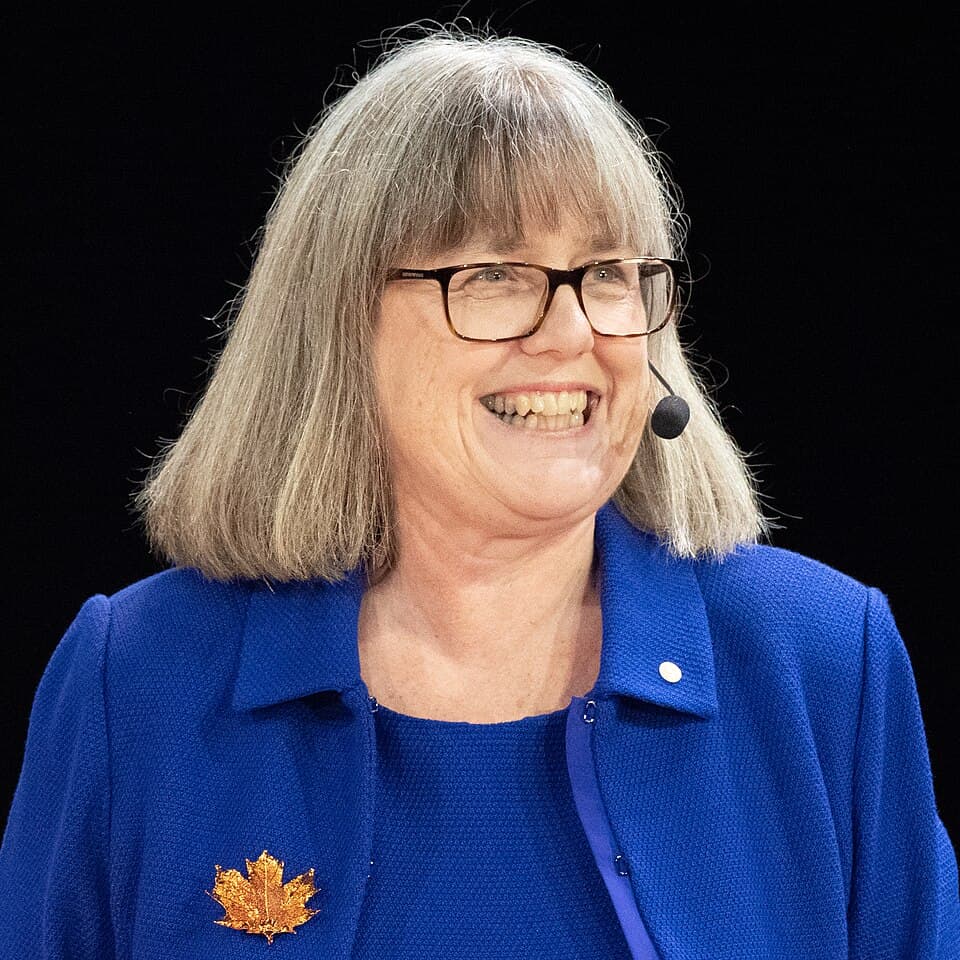
Canadian · Science
Donna Strickland
May 27, 1959 – present
Early Life and Background
Donna Theo Strickland was born on 27 May 1959 in Guelph, Ontario, Canada, a small city in southwestern Ontario known for its strong educational institutions and engineering industries.[4][9][1] She grew up in a supportive family environment that valued learning and encouraged curiosity about how things work. Biographical accounts note that she developed an early interest in mathematics and science, gravitating toward physics as she progressed through school.[9][1]
Strickland attended local schools in Guelph during a period when the participation of women in physics was still limited, and female role models in advanced research were relatively rare.[1] She has recalled being drawn to problem-solving and the conceptual elegance of physical laws, interests that helped guide her choice of university studies.[9] Canada in the 1970s was investing in scientific and technical education, providing opportunities for talented students, including women, to enter engineering and physics programs.
After completing her secondary education, Strickland enrolled at McMaster University in Hamilton, Ontario, where she studied engineering physics.[1][4] She graduated with a Bachelor of Engineering in engineering physics in 1981, gaining a solid foundation in both theoretical and applied physics that prepared her for advanced study in optics and lasers.[1][4] Her choice of engineering physics, a demanding and male‑dominated field, reflected her interest in applying physical principles to practical systems.
Graduate Education and Formative Research
Following her undergraduate degree, Strickland pursued graduate study in the United States, joining the University of Rochester in New York to specialize in optics and laser physics.[4][7][12] Rochester was, and remains, a major center for optical science, with strong links to both academic research and industrial applications. Strickland entered the Institute of Optics, working toward a PhD in physics (optics).[1][9]
At Rochester, her doctoral supervisor was Gérard Mourou, a French‑born physicist who was exploring ways to push lasers to ever higher peak powers.[4][9][12] Laser technology in the early 1980s faced a fundamental limitation: when intense pulses were amplified, optical materials could be damaged, preventing further increases in peak power.[4] Mourou proposed a technique in which laser pulses would be stretched in time before amplification and later compressed, and Strickland took up the challenge of turning this concept into a practical method.[4][9][12]
During her doctoral research, Strickland focused on developing what became known as chirped pulse amplification (CPA).[4][9] The method involves three key steps: first, an ultrashort laser pulse is chirped—that is, stretched out in time by sending it through a device that separates its different frequency components. With the pulse lengthened, its peak power is greatly reduced, allowing the use of conventional amplifiers without damaging them. After amplification, the pulse is sent through another dispersive system that reverses the chirp, recompressing it to an extremely short duration and producing a pulse with very high peak intensity.[4][9][8]
This technique allowed Strickland and Mourou to circumvent the damage threshold of optical materials while achieving unprecedented peak powers. In 1985, they successfully demonstrated CPA experimentally, generating ultrashort, high‑intensity pulses that significantly exceeded previous limits.[4][9] Strickland’s implementation of the idea was central to transforming CPA from a theoretical proposal into a robust laboratory technique.
Strickland completed her PhD at the University of Rochester in 1989, with a dissertation based on her CPA research.[1][7] The work she carried out as a graduate student would eventually be recognized as one of the most important developments in laser physics of the late 20th century, although the full impact was realized gradually over subsequent decades.[4][12]
Chirped Pulse Amplification and Major Scientific Contributions
The first formal presentation of Strickland’s key work came with the publication of her first scientific paper on CPA on 1 December 1985.[2] In this paper, co‑authored with Mourou, she described the full method of stretching, amplifying, and recompressing laser pulses, detailing the experimental setup and demonstrating that CPA could produce ultrashort pulses with far greater peak power than had been achievable.[2][4][9] This publication is often cited as the foundational document of CPA and marked Strickland’s debut in the scientific literature.
Chirped pulse amplification quickly proved to be a transformative technology. The ability to generate extremely high‑intensity, ultrashort pulses opened new regimes in nonlinear optics and plasma physics, enabling experiments that probe matter under extreme electromagnetic fields.[4][8] Over time, CPA‑based laser systems became the basis for compact high‑power lasers used in research laboratories around the world. These systems made it possible to explore strong‑field phenomena, to generate high‑harmonic radiation, and to investigate the behavior of electrons and atoms on femtosecond and attosecond timescales.[4][9]
Beyond fundamental physics, CPA enabled important practical applications. One of the most widely known is in corrective eye surgery, especially LASIK procedures, where ultrashort laser pulses can remove tissue with high precision and minimal thermal damage.[6][4] High‑intensity CPA lasers are also used for micromachining and cutting hard materials such as glass, including components for mobile phone screens, as well as for drilling and surface structuring in industrial manufacturing.[14][4] In medicine, ultra‑intense pulses contribute to techniques for minimally invasive surgery and for imaging and diagnostics.
Strickland’s role in the development of CPA was initially less visible than that of some senior figures in laser physics, reflecting broader patterns of recognition in science. However, over the years, her contributions became increasingly acknowledged in the optics community. She was recognized as a pioneer of pulsed lasers and cited for enabling the most intense laser pulses ever produced.[4][8]
Career Development and Positions
After completing her PhD, Strickland continued to work in laser science and ultrafast optics. She held research and academic positions that allowed her to deepen her expertise and contribute to the growing field of high‑intensity lasers.[1][8] In 1997, she joined the University of Waterloo in Ontario, becoming a member of the Department of Physics and Astronomy.[1][4] Waterloo, known for its strengths in engineering, mathematics, and computer science, provided a fertile environment for her work.
At Waterloo, Strickland established a research program in ultrafast laser science.[21][1] Her group focused on generating and characterizing complex pulsed laser fields, exploring the physics of nonlinear propagation and pulse shaping, and developing techniques for high‑intensity beams with tailored temporal and spatial profiles.[21] She taught courses in optics and laser physics, supervised graduate students, and contributed to the university’s growing reputation in photonics.
Despite her major contributions, Strickland remained at the rank of associate professor for many years.[2] When she was awarded the Nobel Prize in 2018, media coverage frequently remarked on the fact that she had not yet been promoted to full professor, highlighting issues about academic promotion processes and the visibility of women’s achievements in universities.[2][5] The University of Waterloo later updated her profile to reflect her Nobel laureate status and her leadership in ultrafast optics.[21]
Strickland also became active in professional societies. She served in leadership roles within the Optical Society of America, now known as Optica, and was elected a Fellow of the society.[7][8] Her engagement with Optica helped shape the direction of research and policy in the optics community and provided a platform for advocating greater recognition of women in photonics.
Nobel Prize in Physics and International Recognition
On 2 October 2018, the Royal Swedish Academy of Sciences announced that Donna Strickland had been awarded the Nobel Prize in Physics, sharing the prize with Gérard Mourou and Arthur Ashkin.[1][4][8] The citation honored “their method of generating high‑intensity, ultra‑short optical pulses,” referring to CPA for Strickland and Mourou and to optical tweezers for Ashkin.[4] Half of the prize was awarded to Ashkin for his work on optical tweezers, and the other half was shared between Strickland and Mourou for CPA.[4][8]
This announcement marked Strickland as a central figure in modern laser physics. The Nobel committee emphasized that CPA had “opened new areas of research and led to broad industrial and medical applications.”[5][4] The award recognized the way in which a relatively simple but powerful idea—stretching and compressing laser pulses to avoid material damage—had reshaped both basic and applied optics.
The Nobel Prize carried particular historical significance in terms of gender and nationality. Strickland became only the third woman ever to receive the Nobel Prize in Physics, following Marie Curie in 1903 and Maria Goeppert Mayer in 1963.[1][10] She was also the first woman in 55 years to win the physics Nobel, ending a long period during which no female physicist had been recognized with the prize.[5][10][11][12] Canadian and international media highlighted that she was the first Canadian woman to receive a Nobel in Physics, underscoring her place in Canadian scientific history.[3][5][6]
On 10 December 2018, Strickland formally received the Nobel Prize medal and diploma at the Nobel Prize Award Ceremony in Stockholm.[4][6] She delivered a Nobel lecture describing the development of CPA and its far‑reaching impact, and at the Nobel banquet she began her speech by referencing the song "Girls Just Want to Have Fun" to express the enjoyment she found in developing new laser pulses.[13] These appearances brought her work to a broad audience beyond the optics community.
International organizations also celebrated her achievement. UNESCO issued a statement on 2 October 2018 noting that Strickland was the first woman in 55 years to be awarded the Nobel Prize in Physics and emphasizing the importance of her recognition for women in science.[10] Media outlets such as the BBC and CBC profiled her as a "laser jock" and highlighted her role in co‑inventing CPA.[3][5][6]
Later Career, Honors, and Institutional Roles
After the Nobel Prize, Strickland’s profile in the global scientific community rose sharply. She continued her research at the University of Waterloo, focusing on ultrafast laser systems and complex pulse structures, and she became a prominent speaker on the value of fundamental research and science literacy.[21][15] She gave major lectures, including the Ta-You Wu Lecture in physics at the University of Michigan, where her story was used to highlight the importance of understanding science within society.[15]
On 12 April 2019, Strickland was elected as an ordinary member of the Pontifical Academy of Sciences, an independent scientific body based in the Vatican that includes leading scientists from around the world.[19] The Academy’s profile of her notes her pioneering work on CPA and her standing as a Nobel laureate. Membership in the Academy is a significant honor, reflecting scientific excellence and international recognition, and women remain a minority within its ranks.[19]
Strickland has received numerous other awards and honors. She has been recognized by universities, scientific societies, and governments for her contributions to optics and her role as a trailblazing woman physicist.[7][8] For example, in 2022 she received the inaugural Rev. Joseph Carrier Science Medal from the University of Notre Dame, which cited her Nobel‑winning work on CPA and its impact on eye surgery and smartphone manufacturing.[14]
Institutions closely associated with her career have also updated their records to reflect her achievements. On 5 November 2020, the University of Waterloo updated her departmental profile to emphasize her Nobel laureate status and her specialization in ultrafast laser science.[21] On 26 April 2024, the Pontifical Academy of Sciences updated her biographical entry to highlight her Nobel Prize and CPA work, ensuring that an authoritative account of her career is available to scholars and the public.[19]
The University of Rochester, where she did her PhD, has also celebrated her legacy. On 22 October 2019, it published a detailed profile, "Donna Theo Strickland (b. 1959)," describing her development of CPA during her graduate studies and her subsequent Nobel recognition. The article situates her work within Rochester’s long tradition in optical science, reinforcing the historical importance of her doctoral research.[7]
Personal Life
Publicly available biographical sources focus primarily on Strickland’s scientific career and do not provide extensive detail about her private life. She is described as a Canadian physicist based at the University of Waterloo, where she balances research, teaching, and public engagement.[1][4][21] In interviews, she has emphasized the intrinsic enjoyment she finds in experimental physics and laser development, portraying herself as someone driven by curiosity and the excitement of discovery rather than by external honors.[2][13]
Strickland has discussed her experiences as a woman in physics, noting surprise at the attention paid to her gender after the Nobel Prize and expressing the view that scientists should primarily be evaluated on their work.[2][3] She has also stressed that "no-one should be told they can’t" pursue their interests, encouraging young people, including girls, to follow their curiosity in science.[11] These comments, while not details of her family life, shed light on her personal philosophy and commitment to inclusivity in science.
Legacy and Historical Impact
Donna Strickland’s legacy rests on both her scientific contributions and her role as a trailblazer for women in physics. Scientifically, her co‑development of chirped pulse amplification is widely regarded as a cornerstone of modern ultrafast laser technology.[4][9][8] CPA has enabled peak powers that reach into the petawatt regime in large facilities and supports compact high‑intensity lasers in university laboratories. It has become so central to the field that many contemporary high‑power laser systems are described simply as CPA lasers.
Her work has had a broad impact on applications ranging from LASIK eye surgery and other medical procedures to precision micromachining and industrial materials processing.[6][14] In fundamental science, CPA lasers are indispensable for exploring strong‑field physics, generating attosecond pulses, and studying ultrafast dynamics in atoms, molecules, and solids.[4][9] These capabilities have, in turn, influenced adjacent fields such as plasma physics, high‑energy density science, and advanced imaging technologies.
In terms of women’s history, Strickland’s 2018 Nobel Prize represents a significant milestone. She is only the third woman to receive the physics Nobel and the first woman in 55 years to do so.[1][10][12] This long gap underscores the historical underrecognition of women’s contributions in physics. Her recognition has prompted renewed scrutiny of nomination and selection processes for major awards and has been used by organizations such as UNESCO to advocate for greater gender equality in science.[10][11]
Strickland’s career also illustrates the possibility of conducting transformative research within public universities and outside the most elite institutions traditionally associated with Nobel laureates. Her trajectory—from undergraduate studies in engineering physics in Canada to graduate research in optics at Rochester and a professorship at Waterloo—demonstrates how international collaboration and strong institutional support can enable breakthroughs regardless of geography.[4][7][21]
Within professional societies, Strickland has helped shape conversations about the culture of optics and photonics, serving as a leader and role model. Her visibility as a successful woman laser physicist has encouraged efforts to diversify the field, including initiatives to highlight historical and contemporary contributions of women scientists.[8][7]
Later Life and Continuing Influence
As of the mid‑2020s, Donna Strickland remains an active researcher and educator at the University of WaterlooPontifical Academy of Sciences and her role in international lectures and conferences keep her at the forefront of global discussions about science and society.[19][15]
Strickland’s public engagement, including talks about the nature of scientific discovery and the importance of curiosity, has made her an influential voice in debates about science literacy.[15] She has emphasized that major breakthroughs often arise from fundamental research whose practical applications are not immediately obvious, using CPA as an example of how curiosity-driven work can later revolutionize technology and medicine.
Her story continues to inspire students and researchers, particularly women and underrepresented groups in physics, who see in her career a demonstration that excellence in experimental science can emerge from persistence, creativity, and enjoyment of the work itself. Strickland’s place in the history of physics and women’s history is secure: she is a pioneering laser physicist whose doctoral research helped reshape the world’s understanding and use of light, and whose recognition has challenged long-standing patterns of exclusion in scientific honors.
Dated achievements
9 indexed.
- May271959Science
Birth of Donna Strickland
Donna Theo Strickland was born in Guelph, Ontario, Canada, later becoming a pioneer of laser physics and Nobel laureate.
View details Wikipedia: Donna Strickland - Dec011985Science
Publication of first chirped pulse amplification (CPA) paper
Strickland and Gérard Mourou published their landmark paper on chirped pulse amplification, founding modern ultrafast laser science.