← All women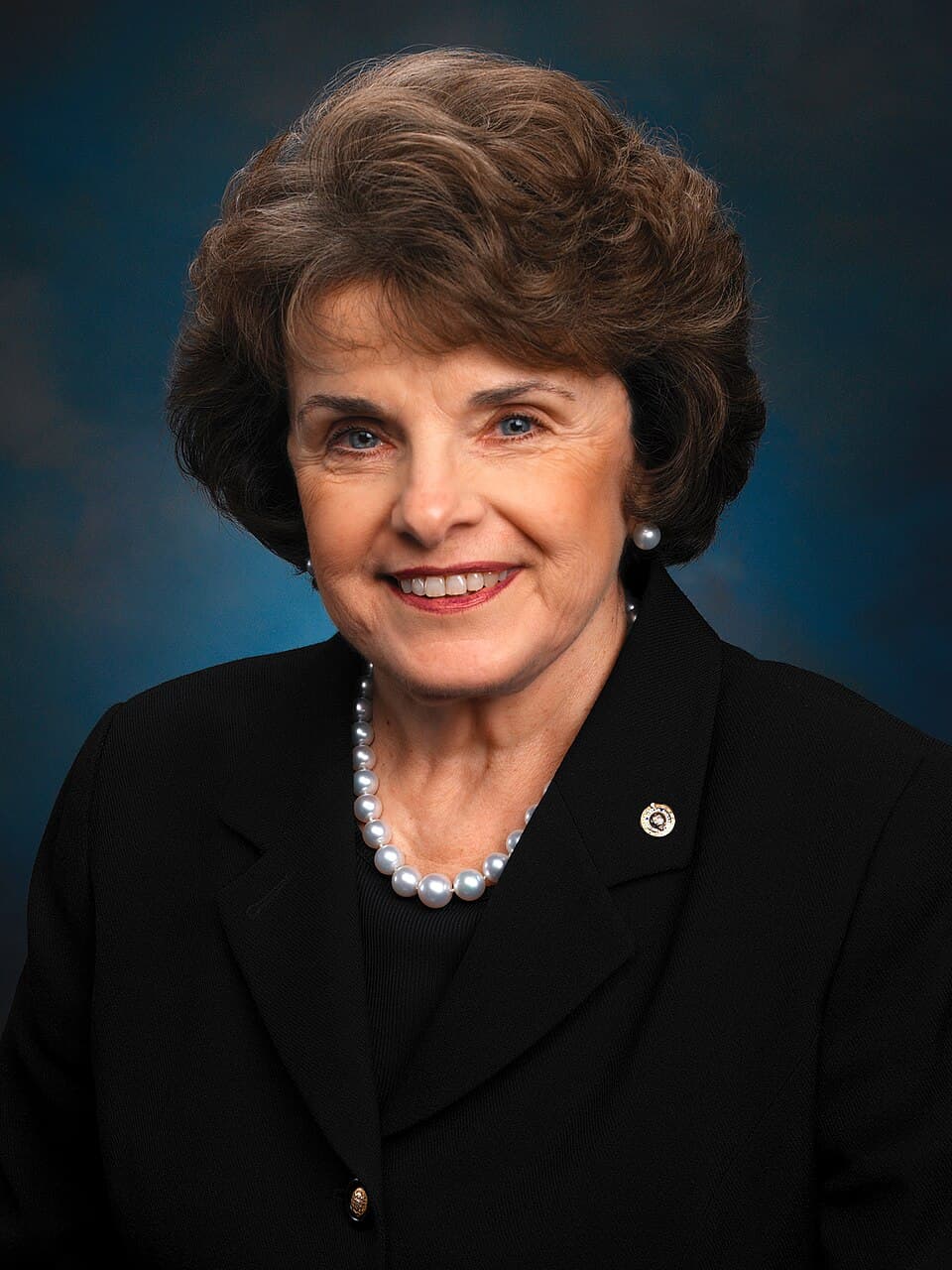
American · Politics · Law
Dianne Feinstein
June 22, 1933 – September 29, 2023
Early Life and Background
Dianne Emiel Goldman, later known as Dianne Feinstein, was born on June 22, 1933, in San Francisco, California, the eldest of three daughters of Leon and Betty Goldman.[1][6] Her father was a prominent surgeon and professor at the University of California, San Francisco, and her mother, of Russian ancestry, struggled with mental illness, creating a childhood marked by both privilege and instability.[1] Feinstein was raised in a Jewish family of Polish, German, and Russian descent and attended Catholic and Jewish schools, reflecting the religious and cultural diversity that would shape her later political outlook.[1][12]
Feinstein attended the prestigious Convent of the Sacred Heart High School in San Francisco and then enrolled at Stanford University, where she earned a B.A. in history in 1955.[1][2][4] At Stanford she developed an interest in public affairs and government, studying the dynamics of political power and social change in postwar America. These academic experiences, combined with her exposure to San Francisco’s complex urban environment, laid the intellectual groundwork for her entry into public service.
As a young woman, Feinstein faced the gender expectations of the mid‑20th century, when professional careers for women—especially in politics—were rare. Nonetheless, she pursued public life, influenced by mentors and early roles in civic organizations, and began to see politics as a way to address the inequities and vulnerabilities she had observed in her own family and community.
Career Beginnings and Development
Before holding elected office, Feinstein entered public service through appointed positions. In the 1960s she served on the California Women’s Board of Terms and Parole, dealing with issues of criminal justice and rehabilitation and gaining firsthand exposure to the consequences of policy on individual lives.[1] This work honed her interest in law and order, a theme that would recur throughout her career.
Feinstein’s first major electoral breakthrough came in 1969, when she was elected to the San Francisco Board of Supervisors, the city’s legislative body.[1][3] She was the first woman ever elected to the Board without having first been appointed, a significant gender milestone in local politics.[1] On January 8, 1969, she was sworn in, marking the start of her formal political career.[1] The following year, on January 8, 1970, she became president of the Board of Supervisors, the first woman to hold that position.[1][10]
Throughout the 1970s, Feinstein became a central figure in San Francisco government. She was reelected to the Board in 1971 and served multiple terms, building a reputation as a pragmatic, business‑friendly yet socially liberal politician.[1] She ran unsuccessfully for mayor in 1975, a defeat that underscored both the difficulty women faced in winning executive office and the volatile nature of city politics.[1] Despite the loss, she remained on the Board, deepening her experience in urban governance.
Mayor of San Francisco
Feinstein’s life and career changed dramatically on November 27, 1978, when former supervisor Dan White assassinated Mayor George Moscone and supervisor Harvey Milk at San Francisco City Hall.[1][3] As president of the Board of Supervisors, Feinstein discovered Milk’s body and then announced the deaths to the public. Under the city charter, she was sworn in that day as acting mayor, becoming the first woman mayor of San Francisco.[1]
Her accession came in the midst of profound trauma and political turmoil. San Francisco faced intense debates over LGBTQ+ rights, development, and public safety. Feinstein’s steady, composed leadership helped calm the city following the assassinations and the subsequent controversy over White’s trial. She prioritized restoring order, strengthening law enforcement, and managing the city’s finances, while attempting to balance downtown business interests with neighborhood concerns.[1]
On December 4, 1979, Feinstein won a special election for mayor, becoming the first woman elected mayor of San Francisco and securing a popular mandate for her leadership.[1][6] She was reelected in 1983 and served as mayor until 1988, making her one of the city’s longest‑serving mayors.[1][4] Her administration oversaw major downtown redevelopment, including the growth of high‑rise office towers, and sought to revitalize the city’s economic base.
Feinstein also confronted the emerging AIDS crisis, which struck San Francisco’s gay community with particular force. Her response—criticized by some activists as too cautious—nonetheless involved expanding public health efforts and navigating the politics of stigma and fear. In 1983, she survived an attempted recall, solidifying her political standing and demonstrating voter confidence in her leadership.[1] She helped bring the 1984 Democratic National Convention to San Francisco and was seriously considered as a possible vice‑presidential running mate for Democratic nominee Walter Mondale, though Geraldine Ferraro was ultimately chosen.[1]
Transition to Statewide Politics
Term‑limited out of the mayoralty in 1988, Feinstein turned her attention to statewide office. In 1990, she ran for governor of California as a Democrat. On June 5, 1990, she won the Democratic primary, becoming the party’s first female nominee for governor.[1] She lost the general election to Republican Pete Wilson, but the campaign elevated her profile across California and demonstrated the viability of women candidates for the state’s highest executive office.[1][3]
Feinstein’s gubernatorial run laid the groundwork for her eventual Senate career. The networks, fundraising base, and name recognition she built would prove critical when a Senate seat opened following Wilson’s resignation.
U.S. Senate Career: Entry and Early Years
In 1992, Feinstein ran in a special election to fill the remainder of Wilson’s unexpired Senate term. On November 3, 1992, she won the race, becoming the first woman U.S. senator from California.[1][2] That same day, Democrat Barbara Boxer won election to California’s other Senate seat. Together they made California the first state represented by two women senators, a milestone in the "Year of the Woman" that saw a surge in female congressional representation.[3][11][15]
Feinstein took office shortly thereafter and quickly positioned herself as a centrist Democrat, combining support for environmental protection and gun control with pragmatic stances on national security and business regulation.[1][3] Early in her Senate career she joined key committees, including Judiciary and Intelligence, and focused heavily on issues such as crime, infrastructure, and port security.[3]
On November 9, 1993, Feinstein became the first woman to serve on the Senate Judiciary Committee.[1][3] This committee is responsible for vetting federal judges and Supreme Court nominees and for drafting major civil‑rights and criminal‑justice legislation. Her appointment broke a longstanding gender barrier in one of the Senate’s most powerful panels.
Major Legislative Work: Gun Control and Crime Policy
Feinstein’s most famous legislative achievement is the Federal Assault Weapons Ban, enacted as part of the Violent Crime Control and Law Enforcement Act of 1994. Drawing on her experiences with gun violence—including the Moscone–Milk assassinations—Feinstein authored and championed the assault‑weapons provision, which banned the manufacture for civilian use of certain semiautomatic firearms defined as assault weapons and restricted high‑capacity magazines.[1][3][6] On September 13, 1994, President Bill Clinton signed the crime bill and the ban into law.[1]
The law was controversial, facing opposition from gun‑rights advocates and debates over its effectiveness. Nonetheless, it represented the most significant federal gun‑control measure of its era and cemented Feinstein’s reputation as one of the nation’s leading advocates of gun regulation. The ban included a 10‑year sunset clause and expired in 2004, after which Feinstein repeatedly introduced legislation seeking to reinstate or strengthen it.[1]
Beyond gun policy, Feinstein worked on crime and security issues more broadly, supporting measures to bolster law enforcement and enhance port and border security.[3] Her approach often blended concern for public safety with civil‑liberties considerations, particularly in the context of terrorism and surveillance in the post‑9/11 era.
Committee Leadership and Institutional Roles
Over time Feinstein rose to significant leadership positions within the Senate. On January 4, 2007, she became chair of the Senate Rules and Administration Committee, the first woman to hold that post.[1][4] The committee oversees Senate procedure, administration, and certain aspects of federal elections.
On January 4, 2008, Feinstein was appointed chair of the Joint Congressional Committee on Inaugural Ceremonies for the 2009 presidential inauguration, again becoming the first woman to chair the committee.[1] This position placed her at the center of planning for the inauguration of President Barack Obama.
When the 111th Congress convened on January 6, 2009, Feinstein became chair of the Senate Select Committee on Intelligence, the first woman to lead that body.[3] The Intelligence Committee oversees the CIA, NSA, and other agencies, and deals with highly classified matters of national security.
Her role in inaugural ceremonies culminated on January 20, 2009, when she presided over Obama’s first presidential inauguration, becoming the first woman to preside over a U.S. presidential inauguration.[1][12] Before a global audience, she opened and guided the proceedings for the historic swearing‑in of the nation’s first Black president.
Intelligence Oversight and the CIA Torture Report
As Intelligence Committee chair, Feinstein played a central role in congressional oversight of the U.S. intelligence community. Following revelations about the CIA’s post‑9/11 detention and interrogation program—including the use of torture—Feinstein led a multiyear investigation into the agency’s practices.[3]
On March 7, 2013, Feinstein sent a formal letter to President Obama and the CIA objecting to the agency’s access to Senate computer systems used by committee staff to review CIA documents.[1] This dispute intensified in 2014, when Feinstein accused the CIA on the Senate floor of spying on the committee, raising constitutional questions about separation of powers and legislative independence.[1]
The investigation produced a 6,700‑page classified report on the CIA’s program, and on December 9, 2014, Feinstein released a 525‑page executive summary to the public.[1][3] The report detailed the use of "enhanced interrogation techniques" such as waterboarding, sleep deprivation, and other abusive methods. Feinstein argued that publishing the summary was necessary to ensure such practices would never recur and to maintain the moral credibility of the United States.[3]
The release of the report marked one of the most significant acts of congressional oversight and disclosure regarding covert activities in U.S. history. It underscored Feinstein’s role as a key figure in defining the ethical boundaries of national security policy and demonstrated the capacity of a woman leader to challenge powerful security institutions.
Judiciary Committee Leadership and Later Senate Work
Feinstein’s long association with the Senate Judiciary Committee culminated in her becoming the ranking member (top Democrat) on January 3, 2017, the first woman to hold that leadership position.[1][4] In this role she led Democratic responses to judicial nominations and major legal policy debates.
Feinstein played visible roles in several high‑profile Supreme Court confirmation hearings, including those of Neil Gorsuch, Brett Kavanaugh, and Amy Coney Barrett, where she navigated contentious partisan divides. Her handling of the Kavanaugh hearings—particularly her management of Christine Blasey Ford’s allegations—sparked intense scrutiny and criticism from different political directions, revealing the pressures placed on senior women lawmakers in moments of national controversy.[1]
Outside of judiciary matters, Feinstein worked on environmental policy, including coauthoring bipartisan legislation in 2001 to improve fuel‑economy standards for vehicles, described by her office as the first congressional action on global warming.[1] She also pursued water‑resource legislation for California, sought to protect desert landscapes, and supported measures related to forest management and climate resilience.
Awards, Honors, and Recognition
Throughout her career, Feinstein received numerous accolades recognizing her public service and barrier‑breaking role. She was frequently cited as one of the most influential women in American politics and appeared on lists of powerful lawmakers and policy leaders.[6] Her leadership on gun control and intelligence oversight drew awards and commendations from advocacy organizations and think tanks, while her role in urban governance earned recognition from municipal and civic groups.
Most notably, Feinstein’s tenure itself became an honor of sorts: by January 5, 2022, she had served 30 consecutive years in the Senate and was widely recognized as the longest‑serving woman in U.S. Senate history.[9][15] This distinction reflected both her electoral resilience and the historical significance of her presence in a chamber that had long excluded women.
Personal Life
Feinstein’s personal life included three marriages. She married Jack Berman, a colleague from the San Francisco district attorney’s office, in the 1950s; they had one daughter, Katherine, born in 1957.[1] The couple later divorced. Feinstein subsequently married Bertram Feinstein, a neurosurgeon, who died in 1978.[1] She later married Richard C. Blum, an investment banker and philanthropist, in 1980; Blum became a well‑known figure in finance and served on the University of California Board of Regents.[1] He died in 2022.
Feinstein’s Judaism remained an important part of her identity, though she attended Catholic school and operated in a largely secular political sphere.[12] She occasionally faced antisemitic attacks during campaigns and spoke about the intersection of her Jewish heritage with her commitment to public service.[1]
Feinstein was known for her work ethic, attention to detail, and reserved public demeanor. Colleagues often described her as tough and pragmatic, combining a centrist approach with strong feelings about certain issues, particularly gun violence and national security.[3][9]
Legacy and Historical Impact
Dianne Feinstein’s legacy is multifaceted, spanning urban governance, statewide politics, and national legislative leadership. As San Francisco’s first woman mayor and the first woman elected to that office, she helped normalize women’s executive leadership in major American cities. She steered the city through trauma following the Moscone–Milk assassinations and through complex economic and social changes in the 1980s.[1][6]
As the first woman U.S. senator from California and part of the first female senatorial duo from any state, Feinstein symbolized the shift toward gender integration in federal legislative power.[1][2][11] Her work on gun control—and particularly the assault weapons ban—made her a central figure in national debates over firearms and public safety.[3]
Feinstein’s roles as the first woman on and later first woman ranking member of the Senate Judiciary Committee, first woman chair of the Senate Rules Committee, first woman chair of the Intelligence Committee, and first woman to preside over a presidential inauguration collectively represent a series of institutional breakthroughs.[1][3][4] These positions placed a woman at the heart of crucial domains: judicial politics, electoral rules, national security, and constitutional ceremony.
Her leadership in releasing the CIA torture report’s executive summary in 2014 has enduring significance for human‑rights and rule‑of‑law advocates.[1][3] It demonstrated that congressional oversight can penetrate secrecy and that women leaders can be central actors in confronting state abuses.
At the same time, Feinstein’s legacy is contested. Critics from the left argued that her centrism and support for certain security policies failed to go far enough in protecting civil liberties, while some on the right saw her gun‑control efforts as overreach.[9][11] Late in her career, concerns about her health and cognitive capacity prompted debates over age, representation, and accountability in the Senate.[9][17]
Nonetheless, within the broader arc of women’s political history, Feinstein stands as a consequential figure whose career helped transform expectations of women’s roles at every level of government—from city halls to the most secretive corners of national security oversight.
Later Life and Death
In her final years, Feinstein continued to serve in the Senate amid growing public discussion of her health. Reports described episodes of memory loss and prolonged absences due to illness, including a serious bout of shingles in 2023.[9][17] These concerns prompted calls from some Democrats and commentators for her retirement, even as she insisted on fulfilling her term.
On February 14, 2023, Feinstein announced that she would not seek reelection in 2024, framing the decision as an orderly conclusion to a long career rather than an immediate departure from office.[1][4] She continued to vote and participate in Senate business, though on a more limited basis.
On September 28, 2023, Feinstein cast her final vote in the Senate on a short‑term government funding bill.[1][17] In the early hours of September 29, 2023, she died at her home in Washington, D.C., at the age of 90.[1][9][12] Her office and news outlets reported that she had passed away while still in office, making her one of the few senators in modern times to die during their term.
At the time of her death, Feinstein was the longest‑serving woman in U.S. Senate history and the oldest sitting member of Congress.[7][9][15] Tributes from colleagues emphasized her trailblazing role, her devotion to public service, and her impact on issues ranging from gun control to intelligence oversight. Her death prompted appointment of a successor to complete her term and intensified discussions about generational turnover and the future of California’s political leadership.
Feinstein’s career, from her birth in 1933 San Francisco to her death in Washington in 2023, encapsulates a transformative period in American politics when women moved from the margins to the center of power. Her life story remains a key chapter in any almanac of women’s history, illustrating both the possibilities and complexities that accompany pioneering roles in public life.
Dated achievements
21 indexed.
- Jun221933Politics
Birth in San Francisco
Dianne Emiel Goldman (later Feinstein) was born in San Francisco, California, becoming the eldest child of Betty and Leon Goldman.
View details Dianne Feinstein - Wikipedia - Jan081969Politics
Sworn in to San Francisco Board of Supervisors
Feinstein was the first woman elected to the San Francisco Board of Supervisors without prior appointment.