← All women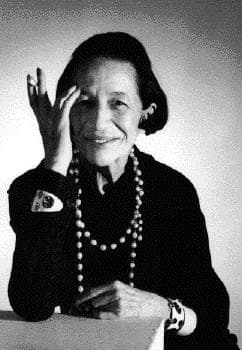
American · Arts
Diana Vreeland
July 29, 1903 – August 22, 1989
Early Life and Background
Diana Vreeland, born Diana Dalziel, entered the world in Paris in 1903, the elder daughter of British stockbroker Frederick Young Dalziel and American socialite Emily Key Hoffman.[1][10][15] Raised in a cosmopolitan, upper‑class environment, she spent her early years between Paris and New York, immersed in the rituals of transatlantic society. Her family’s position connected her to prominent circles, including the milieu of the Duke and Duchess of Windsor, with whom she later maintained a close relationship.[16]
Her childhood, however, was emotionally difficult. Biographical accounts and interviews emphasize that her mother frequently criticized her looks, telling her she was "ugly" and favoring her younger sister.[14] This painful dynamic deeply affected Vreeland’s sense of self but also pushed her toward a personal philosophy of beauty that celebrated imagination, exaggeration, and individuality rather than conventional prettiness. She later claimed that her mother’s remarks drove her to invent herself and seek beauty in unexpected places.
Vreeland’s formal education was limited and sporadic. Like many girls of her class in the early 20th century, she was educated in finishing schools and private lessons rather than academic institutions, with emphasis on languages, music, and social accomplishments.[10][15] She studied dance and at one point performed in the chorus of the dancer and entertainer Josephine Baker, an experience that exposed her to avant‑garde performance and racialized spectacle in interwar Europe.[18] These formative experiences cultivated her love of movement, costume, and theatricality, which later shaped her editorial eye.
Marriage, Social Life, and Early Career Development
In the 1920s, Vreeland moved to New York, where she married Thomas Reed Vreeland, an international banker, in 1924.[15] The couple’s marriage produced two sons, Thomas Reed Jr. and Frederick Dalziel Vreeland.[15] Their social and professional life took them to London in 1929, where Diana continued to cultivate a glamorous social persona, frequenting elite gatherings and deepening her engagement with fashion.[8] Her role during these years was primarily that of society wife and mother, but she already exhibited the sharp eye and dramatic flair that would define her later career.
When the Vreelands returned to New York in the mid‑1930s—sources note 1934 as a key year—Diana’s personal style began to attract professional attention.[3] At a party, Carmel Snow, the influential editor‑in‑chief of Harper’s Bazaar, admired Vreeland’s striking outfit and presence. Snow reportedly told her, "Why don’t you come and work for us?" and soon hired her onto the magazine’s editorial staff in 1936.[1][11][12] This invitation marked Vreeland’s transition from fashionable society figure to professional arbiter of style.
Harper’s Bazaar: Columnist and Fashion Editor
Vreeland began her publishing career in 1936 as a columnist for Harper’s Bazaar.[2][11] Her first major contribution was the imaginative column titled "Why Don’t You?", which debuted in the March 1936 issue.[11][14] In it, she proposed whimsical, often extravagant suggestions—"Why don’t you tie black velvet bows on your wrists?"—that urged readers to view everyday life as a stage and themselves as protagonists in a stylish drama. The column quickly became a hallmark of the magazine and a platform for Vreeland’s distinctive voice.
By 1941, she had been promoted to fashion editor at Harper’s Bazaar, gaining extensive control over styling, photography, and the selection of models and themes.[1] Working with photographers such as Louise Dahl‑Wolfe and Richard Avedon, she pushed the magazine toward bold visual experiments, outdoor shoots, and narratives that emphasized movement, personality, and context instead of static studio poses. She was an early champion of models in blue jeans, flat thong sandals, and, notably, the bikini.[3]
Her tenure at Harper’s Bazaar from 1936 to 1962 coincided with wartime austerity, postwar prosperity, and the early stirrings of youth culture.[11] Vreeland responded by using fantasy and glamour to offer readers escape and inspiration. She featured adventurous travel imagery, theatrical styling, and international influences, helping Americans imagine themselves within a larger world of modern style.
A landmark moment in her Bazaar career came with the June 1947 issue, in which the magazine published what later accounts describe as its first photograph of a woman in a bikini, under Vreeland’s editorial direction.[9][11] At a time when U.S. norms remained conservative, this image helped legitimize the bikini in American fashion media and signaled Vreeland’s readiness to embrace controversial European trends.
Move to Vogue and Editorial Innovations
After more than two decades at Harper’s Bazaar, Vreeland moved to American Vogue. Sources indicate that she joined Vogue’s staff in the early 1960s, and by 1962 she had become editor‑in‑chief.[1][2] Her leadership at Vogue lasted through much of the decade—German sources specify 1963–1971—and coincided with profound cultural upheaval.[4]
At Vogue, Vreeland amplified the experimental tendencies she had cultivated at Bazaar. She embraced bold color, unusual camera angles, and location shoots that placed fashion within dynamic urban and natural settings. She featured models and subjects whose look did not conform to traditional standards of beauty, including Twiggy, the young British model with a boyish figure and wide eyes whom she helped introduce to an American audience.[12] Vreeland’s Vogue became known for its visionary spreads and willingness to feature unconventional women as style leaders.
One of her most influential editorial decisions occurred with the July 1962 cover of American Vogue, which featured film star Sophia Loren.[12] Later accounts describe this as the first celebrity cover of any major fashion magazine, replacing anonymous models or illustrations with a recognizable public figure. This move anticipated the now‑standard practice of celebrity covers and helped cement the link between fashion media and the entertainment industry.
Vreeland’s Vogue also engaged deeply with the emerging youth culture. In 1965, she coined the term "youthquake" to describe the seismic impact of young people on fashion, music, and attitude.[2] The term captured the spirit of the 1960s and has since been recognized by dictionaries as a significant cultural neologism. Her framing of the decade highlighted the ways in which teenagers and young adults, especially in London and New York, were driving trends in hemlines, fabrics, and lifestyle.
Her editorial approach repositioned Vogue from a guide to established society taste into a laboratory of cultural experimentation. She cultivated collaborations with photographers such as Richard Avedon and Guy Bourdin and gave space to designers like Yves Saint Laurent and Courrèges, who embodied the new modernism. Under her direction, Vogue became a touchstone for fashion’s intersection with art, cinema, and social change.
Later Magazine Work and Cultural Firsts
While Vreeland is most closely associated with Vogue during the 1960s, her broader editorial influence extended beyond a single title. For example, the July 1964 issue of Harper’s Bazaar under her influence featured what later coverage identifies as the first photograph of Mick Jagger in a fashion magazine.[9][12] At the time, Jagger and the Rolling Stones were emerging rock musicians, not yet entrenched icons. Vreeland’s willingness to feature a young male rocker in a women’s fashion publication signaled an early recognition of rock music’s style power.
This and similar decisions demonstrated her knack for sensing cultural shifts—toward youth, music, and celebrity—and integrating them into fashion narratives. She treated musicians, actors, and unconventional personalities as carriers of style, not merely as entertainers, helping to expand the range of who could be considered a fashion subject.
Vreeland left Vogue in 1968, amid changing management and evolving corporate priorities.[1][5] Shortly thereafter, she began a new phase of her career as special consultant to the Costume Institute at the Metropolitan Museum of Art in New York.[1][5] This transition marked a shift from magazine editing to museum curation but preserved her central role as a storyteller and tastemaker.
The Costume Institute and Fashion as Exhibition Art
Vreeland’s appointment as special consultant to the Metropolitan Museum of Art’s Costume Institute in the late 1960s inaugurated a new era for fashion exhibitions.[1][10] Prior to her involvement, many museum costume shows were primarily didactic displays of historical garments. Vreeland introduced a theatrical, narrative‑driven approach that treated fashion as a form of visual and experiential art.
Her first major exhibition at the Met, "The World of Balenciaga", opened on 28 November 1973.[9] Dedicated to Spanish couturier Cristóbal Balenciaga, whom Vreeland admired for his architectural silhouettes and technical mastery, the show presented garments in dramatic lighting, vivid color environments, and striking arrangements. It invited visitors to experience the emotional and aesthetic impact of Balenciaga’s designs rather than simply study them as historical artifacts.
In 1974, she organized "Romantic and Glamorous Hollywood Design", another landmark exhibition at the Costume Institute.[1][9] This show celebrated the costumes of classic Hollywood cinema, connecting fashion to film mythology and star personas. It helped position fashion exhibitions as major public events and contributed to the development of the Met’s now famous gala culture around Costume Institute shows, in which celebrities and designers promote exhibitions through high‑profile benefits.
Through these and subsequent exhibitions, Vreeland demonstrated that fashion belonged within museum walls as serious cultural production. Her curatorial work elevated the status of designers and costume makers, many of whom primarily served female clientele, and brought a wider audience into dialogue with the history of dress. The theatricality of her shows influenced exhibition design worldwide, inspiring later curators to treat clothing as performative sculpture.
Major Works and Publications
Beyond her editorial and curatorial achievements, Vreeland contributed to fashion literature and autobiographical writing. In 1984, she published her autobiography D.V., reflecting on her life in fashion and her relationships with figures such as the Duke and Duchess of Windsor, Jacqueline Kennedy Onassis, and Coco Chanel.[1][16][18] The book, written in her distinctive, anecdotal style, offers insight into her philosophy of style, her memories of interwar and postwar society, and her methods as an editor and curator.
Her sayings and aphorisms—"Without it, you’re nobody," she once said of style—have been widely quoted in fashion journalism and scholarship.[11] She contributed essays and commentary to various publications, reinforcing her reputation as an articulate advocate for originality and fantasy in dress.
Her life and work have also been the subject of later biographical and documentary treatments, including Amanda Mackenzie Stuart’s biography Empress of Fashion: A Life of Diana Vreeland and the documentary film Diana Vreeland: The Eye Has to Travel.[13][6] These works helped cement her status as a central figure in 20th‑century fashion history and introduced her story to new generations.
Awards, Honors, and Recognition
Vreeland’s influence was formally acknowledged during her lifetime. In 1964, she was named to the International Best Dressed List Hall of Fame, an honor that recognized her as not only an editor of style but a personal exemplar of it.[2][5][19] The list, compiled by fashion journalists and industry insiders, highlighted individuals whose wardrobe and bearing epitomized international chic.
Her work at Vogue and the Met earned her broad respect within the fashion world, and she became a widely recognized public figure. Journalists dubbed her the "Empress of Fashion," a title that reflected both her authority and her theatrical persona.[12][14] Posthumous tributes, including museum retrospectives and critical essays, have continued to celebrate her role in expanding the boundaries of fashion editing and exhibition.
Institutional recognition also came through the preservation of her papers. The New York Public Library holds the Diana Vreeland Papers, documenting her professional, social, and family life and underscoring her significance as a cultural figure worthy of archival attention.[15] These archives provide historians with detailed insight into her editorial processes, networks, and personal reflections.
Personal Life and Relationships
Vreeland’s personal life intertwined closely with her professional persona. Her marriage to Thomas Reed Vreeland was long‑lasting; she often described him as the great love of her life.[3][15] Together they navigated years of international travel and social engagement, and Thomas’s financial career provided the economic stability that allowed Diana to cultivate her social and later editorial roles.
The couple raised two sons, Thomas Jr. and Frederick, and Vreeland balanced motherhood with a demanding career in magazine publishing. Her home environments were famously theatrical; she decorated rooms in bold colors and patterns that reflected her editorial tastes. Visitors described her apartments as extensions of her pages—spaces where fantasy, color, and curated objects created a total aesthetic experience.
Vreeland maintained friendships and professional relationships with many prominent figures, including the Duke and Duchess of Windsor, Jacqueline Kennedy Onassis, Coco Chanel, and leading photographers and designers.[16][18] These relationships provided her with insider access to elite fashion and political circles and offered material for her editorial narratives. At the same time, her often imperious manner and uncompromising judgments could strain collaborations, reinforcing her image as a formidable, larger‑than‑life figure.
Legacy and Historical Impact
Diana Vreeland’s historical significance lies in her transformation of fashion editing from a descriptive, service‑oriented craft into an imaginative, narrative discipline. At Harper’s Bazaar and Vogue, she championed photography and styling that told stories, evoked emotions, and celebrated individuality. She encouraged readers to pursue style as self‑expression rather than mere conformity to trends.
Her work helped legitimize unconventional beauty, opening doors for models and subjects whose features, bodies, or backgrounds did not match traditional ideals. By promoting figures like Twiggy and spotlighting the bikini, she contributed to shifting standards of what could be considered desirable or stylish.[3][12] Her concept of "youthquake" articulated the power of young women and men in driving cultural change.
As a curator at the Costume Institute, Vreeland fundamentally altered how museums present fashion. Her theatrical exhibitions demonstrated that garments could be experienced as art, narrative, and performance. This approach has influenced later blockbuster shows at the Met and other institutions and helped integrate fashion into mainstream museum programming.[1][9][10]
Vreeland also shaped the broader ecosystem of celebrity and fashion. By putting Sophia Loren on a Vogue cover and featuring Mick Jagger in Bazaar, she validated celebrities and musicians as fashion subjects and helped build the now‑ubiquitous synergy between entertainment and style media.[12] This legacy is visible in today’s celebrity‑driven covers and fashion campaigns.
Her personality—marked by dramatic pronouncements, red‑lacquered interiors, and striking personal style—made her herself a cultural icon. She became a reference point for later editors and designers, a symbol of the editor as artist, not merely organizer. Historians of women’s history often cite her as an example of a woman who leveraged social position, aesthetic intuition, and editorial skill to gain authority in a field historically shaped by male designers and publishers.
Later Life and Death
In her later years, Vreeland continued to work on exhibitions and projects at the Costume Institute while reflecting on her life through interviews and writings. The publication of her autobiography D.V. in 1984 allowed her to narrate her own career in her characteristic, anecdotal style.[1][16] She remained a visible figure in fashion circles, attending events and maintaining relationships with designers, models, and society figures.
Her health declined in the late 1980s. On 22 August 1989, Diana Vreeland died in New York City, reportedly of a heart attack at Lenox Hill Hospital on the Upper East Side.[1][2][5] She was 85 or 86 years old, depending on the birth year adopted by different sources, and had lived in New York for many years. Obituaries and tributes across international media commemorated her as one of the most influential fashion editors in history.
After her death, interest in her work remained strong. The preservation of her archives, the publication of biographies, and the release of the documentary Diana Vreeland: The Eye Has to Travel introduced her life story to new audiences and reinforced her status as a central figure in fashion history.[6][18] Her legacy endures in the continued theatricality of fashion imagery, the prominence of celebrity covers, and the blockbuster nature of museum fashion exhibitions.
For women’s history, Vreeland’s life illustrates the ways in which a woman, armed primarily with taste, imagination, and social acumen, could become a major cultural architect. She leveraged editorial and curatorial roles to redefine how society sees clothing, beauty, and the female body, leaving a lasting imprint on both the fashion industry and visual culture more broadly.
Dated achievements
8 indexed.
- Jul291903Science
Birth of Diana Vreeland
Diana Vreeland is born in Paris, France, to American parents, later becoming one of the most influential fashion editors of the 20th century.
View details Britannica: Diana Vreeland - Mar011936Science
Debut of "Why Don't You?" column in Harper's Bazaar
Harper's Bazaar publishes Vreeland's first 'Why Don't You?' column in March 1936, launching her career as a fashion columnist.