← All women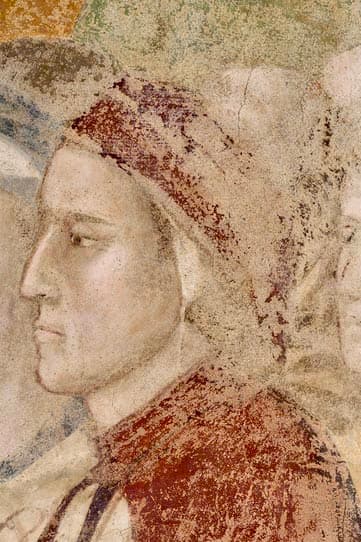
Italian · Literature
Dante Alighieri
May 21, 1265 – September 14, 1321
Early life and background
Dante Alighieri was born in Florence in 1265, most likely in late May, into a family with modest noble pretensions and a place in the complex civic world of the city-state.[1][2][15] His full baptismal name is usually given as Durante di Alighiero degli Alighieri, though the poet came to be known simply as Dante.[1][17] Florence in the later thirteenth century was divided by factional conflict, especially the long struggle between Guelf and Ghibelline interests, and that unstable political environment shaped Dante’s outlook from the beginning.[2][3]
His father, Alighiero di Bellincione, belonged to the minor urban elite, and Dante appears to have received an education that went beyond the basics of grammar and rhetoric to include literature, philosophy, and the intellectual traditions available in late medieval Tuscany.[1][5][6] Later sources and Dante’s own writing suggest familiarity with Latin authors, scholastic thought, and the vernacular lyric tradition, all of which would become visible in his mature work. Around 1274, according to his retrospective account, he first encountered Beatrice Portinari, a meeting that would become central to his poetic imagination and to the spiritual architecture of his later writings.[18]
Marriage, family, and early public life
Dante was betrothed and later married Gemma Donati, a member of an important Florentine family, probably in the mid-1280s.[10][11] The marriage connected him to another prominent urban lineage, reflecting the social and political networks that structured Florentine life. They had several children, including Pietro, Jacopo, and Antonia; the latter is often identified with the nun Sister Beatrice.[1][10] Although his personal writings are dominated by the idealized figure of Beatrice Portinari, his marriage to Gemma belonged to the practical world of Florentine alliances and family duty rather than literary romance.
Dante entered public life in a city where citizenship, faction, and officeholding were inseparable. By the 1290s he had begun to participate in Florence’s political institutions, while also pursuing poetry and intellectual self-fashioning.[1][3][10] The death of Beatrice in 1290 profoundly affected him and gave new direction to his writing, turning his love poetry toward memory, mourning, and spiritual interpretation.[3][5][18] In the years that followed, Dante developed a literary voice that joined personal experience to philosophical aspiration.
Literary beginnings and Vita nuova
By about 1294, Dante had composed Vita nuova (New Life), a work that combines prose commentary with lyric poems in a form that was innovative for Italian literature.[1][3][9] The book recounts his love for Beatrice and frames it as a spiritual and poetic education. Its structure allowed Dante to reinterpret the lyric tradition through introspection, narrative, and theological reflection, making it one of the most important early works in the development of Italian prose literature.
Vita nuova also reveals Dante’s ambition to raise vernacular writing to a level of dignity traditionally reserved for Latin. That decision had lasting cultural consequences. By demonstrating that Italian could carry subtle philosophical and emotional expression, Dante helped establish the literary authority of the Tuscan vernacular. Later generations would regard this as one of his greatest achievements, even before the completion of the Divine Comedy.
Political career and exile
Dante’s career was shaped as much by politics as by poetry. He became involved in Florentine government at a time when the city was divided by internal conflict and by the broader struggle between papal and imperial authority.[2][3][10] In 1300 he served as one of Florence’s priors, a high civic office that placed him at the center of city politics.[1][10] His political commitments aligned him with one faction within the Guelf world, but the shifting balance of power eventually turned against him.
In 1302 Dante was condemned to exile from Florence after political upheaval and factional reprisals.[1][3][10] He never returned to his native city. Exile was not only a personal catastrophe but also a formative condition for his mature work. Cut off from Florence, Dante lived under the protection of patrons in various Italian courts, and the experience of displacement sharpened his reflections on justice, authority, and human frailty. The bitterness of exile reverberates throughout his writings, especially in his portrayals of civic corruption and moral disorder.
Although exile deprived him of office and home, it also gave Dante the broader perspective from which he composed his greatest work. He turned political suffering into literary vision, using the language of loss to define both individual responsibility and public failure. This transformation of personal injury into universal art is one reason his writing remained so influential in later centuries.
The Divine Comedy and literary maturity
Between about 1308 and 1321, Dante composed the Divine Comedy, originally called Comedìa, his vast three-part poem of Hell, Purgatory, and Paradise.[1][3][9][16][18] Widely regarded as one of the greatest works of world literature, the poem presents a visionary journey through the Christian afterlife while also engaging politics, philosophy, ethics, history, and personal memory.[1][2][3][10] Its architecture is encyclopedic and its language carefully controlled, yet it remains deeply dramatic and emotionally immediate.
The poem’s importance lies not only in its scale but in its literary method. Dante wrote in the vernacular rather than in Latin, proving that Italian could serve as a language of the highest intellectual and artistic ambition.[1][16] He also fused classical learning with Christian theology, placing historical figures, enemies, friends, popes, emperors, and poets into a moral universe ordered by divine justice. The result became a foundational text for Italian literature and a central reference point for European literary culture.
Dante completed the final parts of the poem near the end of his life, and it is generally understood that the work was substantially finished before his death in 1321.[1][3][10][16] Later tradition attached the adjective divina to the title, a sign of the reverence the poem quickly inspired. Through the centuries, the Comedy helped standardize literary Italian, influenced countless writers and artists, and became a symbol of the moral seriousness of literature itself.
Other writings and intellectual legacy
Although the Divine Comedy became his enduring masterpiece, Dante also wrote important works of lyric poetry, prose, and political theory.[1][2][10][12] His writings reflect the breadth of medieval learned culture: love poetry, ethical reasoning, civic concern, and theological speculation. He was interested not only in private feeling but in the relation between individual souls and the structure of society. This combination made him distinctive among medieval authors and helped secure his reputation as both poet and thinker.
His major works include the unfinished treatise Convivio, the Latin treatise De vulgari eloquentia, and the political work Monarchia, each of which shows his effort to systematize language, ethics, or political authority.[1][10] Even where the exact chronology of composition is uncertain, these texts demonstrate Dante’s desire to place vernacular poetry within a larger intellectual framework. They also show his commitment to the dignity of human reason and the moral responsibilities of civic life.
Personal relationships and character
Dante’s most famous personal relationship was with Beatrice Portinari, who appears both in his early lyric poetry and as a guiding presence in the Divine Comedy.[1][3][5][18] Their relationship, whether historical, literary, or both, became one of the defining motifs of European love literature. In Dante’s hands, Beatrice is not simply an object of romantic devotion but a figure of spiritual elevation, linking earthly desire to heavenly grace. That transformation had a profound influence on later poets.
At the same time, the historical Dante was a husband, father, and political actor whose life was bound to the obligations and dangers of civic society.[10][11] His exile, patronage relationships, and involvement in diplomacy reveal a man deeply embedded in the political realities of his age. The tension between public life and private aspiration gives his biography much of its enduring complexity.
Later life, final mission, and death
In his final years Dante lived in Ravenna under the protection of Guido Novello da Polenta.[5][6][11] In 1321 he was sent on a diplomatic mission to Venice, and on his return he fell ill.[6] He died in Ravenna on 14 September 1321, according to the tradition preserved by early biographers and reiterated by later scholarship.[1][2][4][6][8]
His death in exile gave symbolic force to a life already marked by displacement. Florence later regretted the loss of its greatest poet, but Ravenna kept his body and tomb. The location of his burial became an enduring reminder that the poet whose language would come to define Italian literary identity died outside the city that had expelled him. That irony has never ceased to shape the story of Dante’s afterlife in cultural memory.
Recognition and historical impact
Dante was not the recipient of modern prizes or honors, but his reputation quickly became monumental in literary history.[1][2][3][5][10] He came to be regarded as the greatest Italian poet and, in many traditions, one of the greatest writers of all time. His work helped establish Tuscan Italian as the basis of standard literary Italian, and his poetic synthesis of theology, philosophy, politics, and autobiography influenced writers, artists, and thinkers from the Renaissance onward.
The Divine Comedy remains central to classrooms, scholarship, translation, and artistic adaptation. Dante’s imagination has generated commentary for seven centuries, and his figures, images, and moral landscapes continue to circulate far beyond Italy. His work endures because it addresses enduring questions: how to judge human action, how to understand suffering, how language can order experience, and how art can transform personal exile into universal meaning.
For all these reasons, Dante Alighieri occupies a singular place in world literature. He is a poet of the Middle Ages whose influence belongs to every later era, and a writer whose life story is inseparable from the history of the language he helped shape.
Dated achievements
1 indexed.
- Sep141321Literature
Death of Dante Alighieri in Ravenna
Dante Alighieri died in Ravenna, Italy, likely during the night of 13–14 September 1321, shortly after returning from a diplomatic mission to Venice.
View details Dante Alighieri - Britannica