← All women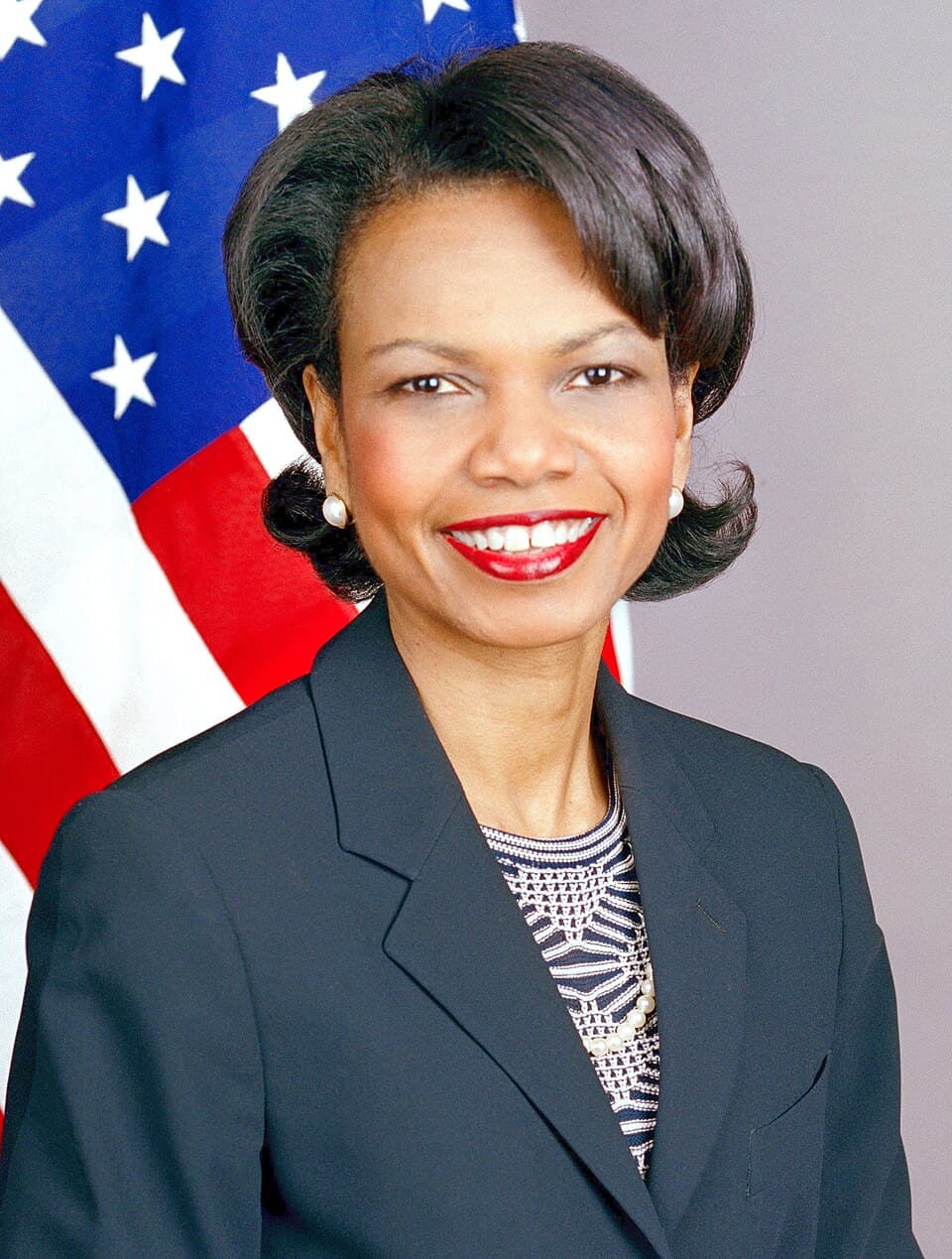
American · Politics
Condoleezza Rice
November 14, 1954 – present
Early Life and Background
Condoleezza Rice was born on November 14, 1954, in Birmingham, Alabama, then one of the most violently segregated cities in the United States.[2][3][4][6][11] She is the only child of John Wesley Rice Jr., a Presbyterian minister, guidance counselor, and later academic dean, and Angelena Ray Rice, a teacher of music, science, and oratory.[4][6][9][10][11] Her given name derives from the Italian musical term "con dolcezza," meaning "with sweetness," reflecting her parents’ deep love of music.[4][6]
Rice grew up in a Black middle‑class household that emphasized education, discipline, and faith as tools to confront the constraints of Jim Crow segregation.[6][9][11] Her parents shielded her as much as possible from racial humiliation, steering her toward excellence in academics and classical piano. She took rigorous lessons and initially dreamed of becoming a concert pianist.[6] The civil rights struggle was not distant: Birmingham was the site of church bombings, brutal crackdowns on protests, and national attention on racial injustice during her childhood.[6][11] These experiences later informed her views on democracy, security, and the responsibilities of government.
Rice attended local segregated schools in Birmingham and later in Denver, Colorado, after her family moved west.[4][6][11] She was an exceptionally gifted student and a prodigious musician. Yet a pivotal moment occurred in her teens when she realized that the competition for a top career as a concert pianist would be extraordinarily fierce and that her chances, even with talent, were uncertain. A course in international politics at the University of Denver introduced her to Soviet studies and shifted her ambitions toward political science and international relations.[2][3][4][6][11]
Education and Academic Formation
Rice entered the University of Denver at age 15 and completed a Bachelor of Arts in political science in 1974, graduating magna cum laude and being elected to Phi Beta Kappa.[2][3][4][6][11] She continued to specialize in Soviet and Eastern European affairs, studying under notable scholars including Josef Korbel, the father of future Secretary of State Madeleine Albright.[2][3][11] Korbel’s influence was crucial in shaping her interest in the Soviet Union and international security.
In 1975, Rice earned a master’s degree in political science from the University of Notre Dame.[2][4][6][11] She then returned to the University of Denver for doctoral work, spending time in 1979 studying Russian at Moscow State University, which deepened her linguistic and cultural understanding of the USSR.[6][11] She received her Ph.D. in political science from Denver’s Graduate School of International Studies in 1981.[1][2][4][6][11] Her dissertation and early scholarship focused on the military and political dynamics of the Soviet Union, particularly its relationship with Eastern Europe.
Rice’s academic path was unusual both for a woman and for an African American in the field of high‑level strategic studies during the Cold War. She acquired expertise in an area dominated by male scholars and policymakers.[6][11] This specialization would later position her to serve at the apex of U.S. foreign‑policy decision‑making.
Career Beginnings at Stanford and in Government
After completing her doctorate, Rice joined Stanford University as an assistant professor of political science in 1981–82.[1][2][5][6][11] She quickly developed a reputation as a rigorous teacher and a leading expert on Soviet military and political affairs. Her research addressed topics such as the role of the Warsaw Pact and Soviet decision‑making, and she published widely in academic journals and policy venues.[2][3][11]
Rice took on increasing responsibilities at Stanford, eventually becoming a tenured professor. She also began to intersect with government service. In 1987, she served as an advisor to the Joint Chiefs of Staff, offering analysis on Soviet and Eastern European issues.[1][11] In 1989, she joined the National Security Council staff as director of Soviet and East European Affairs and special assistant to President George H.W. Bush, playing a role in managing U.S. policy during the final phase of the Cold War and German reunification.[1][2][6][11]
Her blend of academic and policy experience made her a rare figure able to bridge analytical rigor with practical diplomacy. Returning to Stanford after service in the Bush administration, she continued teaching and took on leadership roles within the university.[2][5][6][11]
Provost of Stanford University
In 1993, Rice was selected as provost of Stanford University, becoming the first woman, the first African American, and the youngest person to hold the position.[5][6][11] As provost and chief budget and academic officer, she oversaw the university’s finances and academic programs during a challenging period marked by budget deficits and debates over curriculum and campus diversity.
Rice led significant budget reforms and helped bring Stanford back into sound financial condition.[5][6] Her tenure as provost demonstrated her capacity for institutional management and strategic decision‑making, skills that would later prove crucial in the high‑pressure environment of national security.
Her success at one of America’s premier universities was notable in women’s and African American history, signaling that Black women could ascend to top leadership roles in elite academic institutions traditionally dominated by white men.[6]
National Security Advisor: 2001–2005
Rice’s national prominence grew sharply in the early 2000s. In 2000, President‑elect George W. Bush named her National Security Advisor‑designate, making her the first woman and first African American chosen for that role.[4][6][11] She formally took office in January 2001January 22, 2001Assistant to the President for National Security Affairs, she coordinated foreign policy among the Departments of State and Defense, the intelligence community, and other agencies.[1][5][11]
Rice’s tenure as National Security Advisor was defined by the September 11, 2001 terrorist attacks. She was at the center of the administration’s immediate response and the subsequent development of a new U.S. national security strategy, including the war in Afghanistan, the establishment of the Department of Homeland Security, and the articulation of a doctrine of pre‑emption.[2][3][8][11]
She became one of the leading advocates for the 2003 invasion of Iraq, arguing that the threat posed by Saddam Hussein’s regime and weapons of mass destruction required decisive action.[3][8][11] Rice was a principal voice in making the case for war to Congress, allies, and the American public, a role that brought both influence and controversy.
As the first woman to serve as National Security Advisor, Rice was the highest‑ranking woman in U.S. national security policymaking at the time, operating within a traditionally male‑dominated sphere.[1][5][6][11] Her service from 2001 to 2005 helped normalize women’s leadership at the top of security policy, although she faced intense scrutiny and criticism, particularly over intelligence assessments and the conduct of the Iraq War.
Secretary of State: 2005–2009
In November 2004, President Bush nominated Rice to be Secretary of State, and the Senate confirmed her by a vote of 85–13 on January 26, 200566th Secretary of State.[1][2][5] Rice was the first African‑American woman to hold the office and only the second woman, after Madeleine Albright.[1][2][5][6]
As Secretary of State from 2005 to 2009, Rice faced a complex foreign‑policy landscape shaped by ongoing conflicts in Iraq and Afghanistan, strained transatlantic relations, rising concerns about Iran’s and North Korea’s nuclear programs, and challenges in Russia and the Middle East.[1][2][3][5] She pursued what she termed "transformational diplomacy," advocating for democratic reform, human rights, and stronger partnerships, while also defending the administration’s controversial policies.
Rice played a central role in multilateral negotiations, including efforts to revive the Middle East peace process, work with the "Quartet" on Israeli‑Palestinian issues, and participate in six‑party talks aimed at addressing North Korea’s nuclear activities.[2][3] She also engaged extensively with European and Asian allies to manage differences over Iraq and security strategy.
One symbolic highlight of her tenure occurred on September 5, 2008, when she visited Tripoli and met with Libyan leader Muammar Gaddafi, becoming the first U.S. Secretary of State to visit Libya since 1953
Rice left office on January 20, 2009, at the end of the Bush administration.[1][2] She had served as one of the most visible faces of U.S. foreign policy during a turbulent era and remained a polarizing figure, celebrated by some for her historic achievements and criticized by others for her role in contested security decisions. Alongside her governmental service, Rice has been a prolific author and commentator on international affairs. Her books and co‑authored works include analyses of the Soviet Union and Eastern Europe and reflections on U.S. foreign policy and her own life story.[2][3][11] Titles such as Uncertain Allegiance: The Soviet Union and the Czechoslovak Army showcase her academic expertise, while later works, including memoirs, provide insight into her time in government. Rice’s scholarship is characterized by careful attention to institutional and military structures, leadership dynamics, and the interplay between domestic politics and foreign policy. Her academic contributions helped shape understanding of Soviet and post‑Soviet security issues and served as a bridge for students and policymakers between theoretical analysis and practical strategy.[2][3][11] After leaving government service, Rice returned to Stanford University. In 2010, she joined the faculty of the Stanford Graduate School of Business and became a senior fellow at the Hoover Institution, continuing her involvement in foreign policy and education.[5][6] She also served as a professor of political science and a senior fellow at the Freeman Spogli Institute for International Studies.[5] Rice is the Denning Professor in Global Business and the Economy at the Graduate School of Business and a senior fellow on public policy at Hoover.[5][12] In 2020, she became the 8th director of the Hoover Institution, a prominent public‑policy think tank at Stanford.[3][5][12] In this role, she oversees research and outreach on domestic and international policy and continues to shape conservative and centrist discourse on governance, economics, and security. She is also a founding partner of Rice, Hadley, Gates & Manuel LLC, an international strategic consulting firm advising companies on political and economic risk.[5][12] Her post‑government career has combined academic leadership, policy analysis, corporate governance, and public speaking. Rice’s achievements have been recognized by numerous awards and honors. Her pioneering roles as the first woman National Security Advisor and first African‑American woman Secretary of State are themselves historic distinctions acknowledged by scholars, journalists, and institutional histories.[1][2][4][5][6] She has received honorary degrees from universities and awards from organizations recognizing her public service and leadership.[2][6][9][11] On April 30, 2015, she received the Horatio Alger Award, honoring her for overcoming adversity and contributing to society through education and public service.[9] The Horatio Alger Association emphasizes stories of perseverance, and Rice’s trajectory from segregated Birmingham to high office fit squarely within this narrative. Her selection in 2012 as one of the first female members of Augusta National Golf Club also functioned as a symbolic honor, recognizing her stature in public life and her passion for golf while marking a major shift in sports‑institution inclusivity.[6] Media and historical accounts frequently cite Rice as a trailblazing figure in both politics and women’s history. Rice has never married and has no children, a personal choice that has occasionally drawn public attention given traditional expectations for women.[3][11] She has consistently maintained a strong separation between her public role and private life, emphasizing professional achievements over personal disclosures. Music remains central to her identity. Rice is an accomplished pianist who has performed with professional orchestras and at notable events, including playing with cellist Yo‑Yo Ma at the 2002 National Medal of Arts and National Humanities Medal ceremony.[2][3][6][11] She continues to practice and perform, often describing piano as an essential source of discipline and joy. Her interests extend to sports, particularly golf and football. Rice is a dedicated football fan and has served on the College Football Playoff selection committee, bringing her analytical skills to the evaluation of teams.[3] Her induction into Augusta National reflects a long‑standing engagement with golf. Rice also serves on the boards of various organizations, including educational and youth‑focused groups such as the Boys & Girls Clubs of America, reflecting her commitment to mentoring and opportunity for young people.[6][9] Condoleezza Rice occupies a distinctive place in U.S. and global history. As the first woman National Security Advisor and the first African‑American woman Secretary of State, she broke major barriers in national security and diplomacy.[1][2][5][6][11] Her ascent from a segregated childhood in Birmingham to positions central to decisions about war, peace, and international order exemplifies the possibilities opened by civil rights reforms and educational opportunity, while also highlighting the exceptional perseverance required of women of color. Rice’s tenure in government coincided with some of the most consequential—and contested—foreign‑policy decisions of the early twenty‑first century. She helped shape the U.S. response to the 9/11 attacks, the wars in Afghanistan and Iraq, and efforts to counter proliferation and terrorism.[2][3][8][11] Supporters credit her with a clear strategic vision and strong advocacy for democracy promotion; critics highlight her role in flawed intelligence assessments and the costs of military interventions. In academic and institutional history, her service as provost of Stanford and later director of the Hoover Institution illustrates the integration of Black women into top leadership of elite universities and think tanks.[5][6][12] Her example has been cited by advocates for diversity as evidence that structural barriers can be challenged, though she herself often stresses individual responsibility and merit. Her admission to Augusta National Golf Club and participation in high‑profile boards and committees show that her influence extends into cultural and sporting institutions, contributing to broader shifts in gender inclusion.[6][9] She has become a symbol of Black female leadership in domains previously closed to women. Rice’s legacy is thus multifaceted: she is a trailblazer in women’s and African American history, a key participant in controversial foreign‑policy decisions, and a continuing voice in debates about America’s role in the world. Historians and biographers, including works such as Elisabeth Bumiller’s Condoleezza Rice: An American Life, continue to assess her impact on both U.S. policy and the broader story of who leads in American public life.[2][3][8] Since leaving office in 2009, Rice has remained active in public affairs, education, and commentary. At Stanford and Hoover, she mentors students, lectures on foreign policy and leadership, and participates in research and policy discussions.[5][12] Her role as Hoover’s director places her at the center of debates about governance, economics, and international security in the United States. Rice regularly appears in media as an analyst on global issues, ranging from Russia and China to the Middle East and American domestic politics.[3][12] She has supported initiatives to strengthen civic education and public understanding of American institutions, emphasizing the importance of democratic resilience. Events such as her participation on January 19, 2017, in the portrait unveiling of former Secretary of State Colin Powell at the U.S. Capitol reflect her ongoing connection to the community of former senior officials and her place in the institutional memory of the State Department.[1] She continues to serve on corporate boards and advisory councils, further extending her influence into business and civil society.[6][9] As of the mid‑2020s, Rice remains a living figure whose career offers a rich case study for scholars of women’s history, race and politics, and U.S. foreign policy. Her story is frequently taught in courses on American government and international relations, and she is often cited as an example of how expertise, education, and political opportunity can converge to lift individuals from marginalized communities into global leadership roles.[2][3][6][11]Major Works, Publications, and Intellectual Contributions
Return to Stanford and Hoover Institution Leadership
Awards, Honors, and Recognition
Personal Life
Legacy and Historical Impact
Later Life and Continuing Influence
Dated achievements
10 indexed.
- Nov141954Science
Birth in Birmingham, Alabama
Condoleezza Rice is born in Birmingham, Alabama, the only child of John and Angelena Rice.
View details Condoleezza Rice - National Women's History Museum - Jan222001Science
Sworn in as First Woman and First African American National Security Advisor
Rice is sworn in as U.S. National Security Advisor, becoming the first woman and first African American to hold the office.