← All women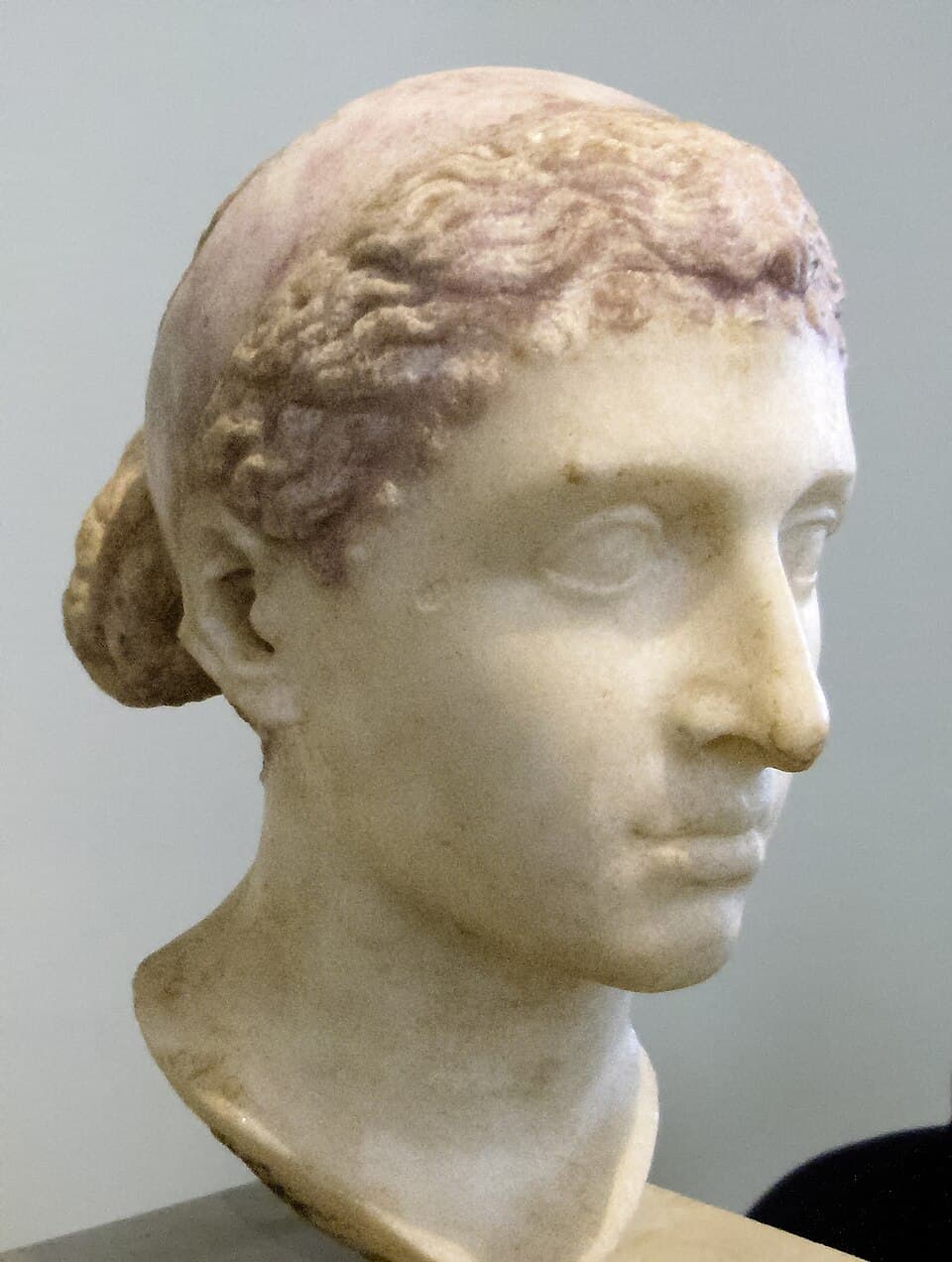
Egyptian · Politics
Cleopatra VII Philopator
January 1, 69 – August 12, 30
Early Life and Background
Cleopatra VII Thea Philopator ("father-loving goddess") was born in 69 BCE in Alexandria, Egypt, the capital of the Ptolemaic Kingdom and one of the great intellectual centers of the Hellenistic world.[1][2][10] She belonged to the Macedonian Greek dynasty founded by Ptolemy I, a general of Alexander the Great, which had ruled Egypt since the late fourth century BCE.[1][2][14] Her father was almost certainly Ptolemy XII Neos Dionysos, nicknamed Auletes ("flute player"), while her mother was likely his sister Cleopatra VI Tryphaena or possibly an Egyptian noblewoman, reflecting the dynasty’s practice of sibling marriage and the blending of Greek and Egyptian elites.[6]
Cleopatra grew up in a court marked by financial difficulties, diplomatic dependence on Rome, and intense dynastic rivalry. Ptolemy XII’s rule was unstable; to secure his throne he paid enormous sums to Roman power brokers, deepening Egypt’s debts and provoking opposition among both Alexandrians and Roman politicians.[2][14] These tensions resulted in periods of exile and restoration for her father, exposing Cleopatra as a child to the fragility of kingship and to the decisive role of Roman intervention in Egyptian affairs.[2][10]
Unlike many of her predecessors, Cleopatra appears to have embraced both the Greek and Egyptian aspects of her identity. Ancient sources emphasize her education and intelligence: she was described as highly learned, capable of speaking several languages, and renowned more for her wit and charisma than for her physical beauty.[1][2][14] She is said to have been the first of the Ptolemies to learn the Egyptian language, a symbolic choice that strengthened her position as pharaoh in the eyes of her subjects and differentiated her from earlier monarchs who ruled largely as Greek kings over an Egyptian population.[1][14]
Ascent to Power and Early Reign
Cleopatra’s path to power was shaped by her father’s troubled reign. After Ptolemy XII was deposed and exiled, the Alexandrian elite briefly installed Cleopatra’s elder sister Cleopatra VI Tryphaena, and later Berenice IV, as rulers.[2][5] With Roman help, Ptolemy XII eventually returned and executed Berenice IV, underscoring the lethal nature of dynastic politics.[2] When he died, probably in 51 BCE, Cleopatra and her younger brother Ptolemy XIII were designated co-rulers, consistent with Ptolemaic custom.[2][5][6]
Cleopatra thus became queen of Egypt at about eighteen years old, sharing the throne nominally with Ptolemy XIII but acting as the dominant partner in governance.[2][14][15] Early in her reign she appears on official documents and coinage without her brother’s name, suggesting an attempt to rule in her own right.[2] Her first recorded governmental action occurred in 51 BCE, when she organized ceremonies for a new Buchis bull, a sacred animal associated with the god Montu, demonstrating her engagement with Egyptian religious traditions and temple networks.[6] This act helped secure priestly support and reinforced her image as a legitimate pharaoh, not merely a Greek queen.
Cleopatra’s initial years of rule were difficult. Egypt faced famine, economic strain, and increasing Roman pressure. Internally, her assertiveness alienated court factions who favored Ptolemy XIII, leading to political conflict. By 48 BCE, Cleopatra was driven from Alexandria by supporters of her brother and forced to regroup in the eastern Mediterranean or in Upper Egypt, while Ptolemy XIII’s advisors, notably the powerful eunuch Pothinus, controlled the capital.[2][14] This dynastic struggle set the stage for her encounter with Roman power and for one of antiquity’s most famous political alliances.
Alliance with Julius Caesar
In 48 BCE, the Roman civil war between Julius Caesar and Pompey spilled into Egypt. Pompey, fleeing defeat, sought refuge with Ptolemy XIII but was assassinated on the young king’s orders, ostensibly to curry favor with Caesar.[1][2][14] When Caesar arrived in Alexandria, he was offended by the murder of his rival and took an active role in Egyptian politics, seeking to stabilize the kingdom and secure Rome’s interests.[1][2]
Cleopatra seized this opportunity. According to later literary accounts, she arranged a dramatic meeting with Caesar—famously described as entering the palace hidden in a carpet or bedroll—though the precise details are uncertain. What is clear is that she won Caesar’s support in the dynastic dispute.[1][2][14] Caesar backed Cleopatra’s claim to joint rule with Ptolemy XIII, triggering the Alexandrian War, a conflict between Caesar’s forces and those of the king’s advisors.[2]
During this struggle, Caesar and Cleopatra were besieged in the royal quarter but ultimately prevailed with reinforcements. Ptolemy XIII drowned in the Nile while fleeing battle, and Caesar installed Cleopatra as ruler alongside another younger brother, Ptolemy XIV, under Roman protection.[1][2] This alliance was both political and personal: Cleopatra became Caesar’s companion, and in 47 BCE she bore a son, Ptolemy XV Caesarion, widely believed in antiquity to be Caesar’s child.[1][2][10]
Caesar’s support reshaped Cleopatra’s position dramatically. With Roman backing, she secured her throne and gained control over additional territories, including Cyprus from 47 BCE, strengthening Egypt’s resources and strategic reach.[6] Her rule during this period was characterized by active diplomacy, efforts to stabilize the economy, and symbolic programs combining Greek and Egyptian royal ideology, often presenting herself as a living Isis, the mother-goddess, in art and cult.[1][4]
Visit to Rome and International Profile
In 46 BCE, Cleopatra traveled to Rome, accompanied by her brother-consort Ptolemy XIV and her infant son Caesarion.[1][2][14] She stayed in Rome as an elite foreign guest, likely residing in one of Caesar’s villas near the Tiber. Her presence was politically charged: she was both a client monarch and the visibly favored partner of Caesar.
During her time in Rome, a golden statue of Cleopatra was reportedly erected in the Temple of Venus Genetrix, part of Caesar’s forum complex, signaling her prominence in Caesar’s political and religious imagery.[1][2] The statue, representing her as a queen and possibly as a goddess, both honored her and provoked comment among Romans uneasy about monarchic symbolism and foreign influence.
Cleopatra’s stay allowed her to observe Roman politics at close range and to cultivate relationships that might benefit Egypt. At the same time, Roman authors later depicted her residence as emblematic of Caesar’s alleged decadence and orientalizing tastes, contributing to her image as a dangerous foreign queen in Roman propaganda.[2] Nonetheless, for Cleopatra, the Rome visit reinforced her international profile and underscored Egypt’s role in the wider Mediterranean power system.
Return to Egypt and the Post-Caesar World
Cleopatra returned to Egypt before Caesar’s assassination in 44 BCE15 March 44 BCE, Caesar was killed in Rome, plunging the Roman Republic into renewed civil war. For Cleopatra, the loss of her principal patron posed grave risks. She responded by consolidating her position at home, where she likely arranged the death of Ptolemy XIV—probably by poisoning—and elevated her son Caesarion as co-ruler, thereby claiming continuity with Caesar and securing her dynasty’s future.[1][2]
In the complex Roman power struggle that followed, Cleopatra initially maintained a cautious stance. She provided limited support to Roman factions when it served Egyptian interests but avoided full commitment until the balance of power became clearer. By the early 40s BCE, Rome was effectively ruled by the Second Triumvirate: Octavian (Caesar’s adopted heir), Mark Antony, and Lepidus.
Cleopatra’s strategic goal during these years appears to have been the preservation, and if possible expansion, of Egypt’s autonomy and wealth. She relied on Egypt’s agricultural productivity, particularly grain exports, and on control of eastern Mediterranean trade routes, to remain an indispensable partner or counterweight to Roman leaders.[4][6]
Alliance and Relationship with Mark Antony
In 42 BCE, Mark Antony, then one of the most powerful men in the Roman world, summoned Cleopatra and other eastern rulers to meet him in Tarsus, in Cilicia.[2][14] Cleopatra’s arrival was staged with extreme magnificence: later accounts describe her sailing up the Cydnus River in a richly adorned barge, dressed as Aphrodite, to impress Antony and assert Egypt’s status.[1][2] Behind the spectacle lay serious political negotiations over tribute, support, and regional order.
Cleopatra and Antony soon formed a close political and personal partnership. For Cleopatra, Antony offered renewed Roman backing against internal and external threats, while Antony needed Egypt’s wealth to fund his wars, especially his planned campaign against Parthia.[2][4][14] Their relationship produced at least three children: Alexander Helios, Cleopatra Selene, and Ptolemy Philadelphus.[1][2]
Over the later 40s and 30s BCE, Cleopatra’s influence within Antony’s eastern sphere grew. In 37 BCE, she received control over Cyprus, Libya, and Coele-Syria, significantly expanding her territorial rule and reinforcing the vision of an eastern coalition under Antony and Cleopatra as a counterweight to Octavian’s power in the West.[6] Cleopatra supported Antony’s campaigns financially and logistically, while continuing to govern Egypt as an effectively autonomous kingdom.
Their partnership culminated in a controversial display at the so‑called Donations of Alexandria, where Antony publicly granted territories to Cleopatra and their children, and honored her with regal titles, including “Queen of Kings.” Roman critics, especially in Octavian’s camp, used these events to portray Antony as subservient to a foreign queen and to depict Cleopatra as a threat to Roman liberty.[1][2]
Government, Economy, and Cultural Patronage
Cleopatra’s reign, lasting from about 51 to 30 BCE, was one of active governance rather than mere royal pageantry.[2][14][15] She ruled through a combination of traditional Ptolemaic institutions and personal networks, working closely with temple elites and administrators. Despite limited direct evidence, surviving documents and coinage suggest she intervened in tax policy, legal disputes, and appointments, aiming to stabilize state finances after her father’s costly dependence on Rome.[6][14]
Economically, Egypt under Cleopatra remained a major supplier of grain to the Mediterranean. She leveraged this resource to maintain bargaining power with Rome, knowing that food shortages could destabilize urban populations and armies.[4] She also oversaw monetary reforms and issued coins bearing her image, often with bilingual Greek and Egyptian symbolism, projecting an image of a ruler at once Hellenistic and pharaonic.[4][6]
Cleopatra was likewise a patron of scholarship and the arts. Alexandria, with its famed Library and Museum, remained a central intellectual hub, and Cleopatra’s court is depicted in later traditions as a place of learning and refinement.[12] Her cultivation of learned circles, and her own reputation as an educated, multilingual queen, contributed to Alexandria’s cultural prestige and to the long-lasting association of her reign with sophistication and literary creativity.[1][14]
The Actium Campaign and Downfall
Tensions between Antony and Octavian eventually led to open war. The conflict focused on Antony’s relations with Cleopatra and on questions of Roman sovereignty over the East. In 31 BCE, their joint forces confronted Octavian’s fleet at the Battle of Actium off the western coast of Greece.[1][2]
Actium ended in a decisive defeat for Antony and Cleopatra. Ancient accounts describe Cleopatra’s fleet withdrawing from the battle, followed by Antony, leading to the disintegration of their naval position.[1][2] The reasons for the retreat remain debated—some suggest a strategic escape to protect Egypt’s remaining forces, others emphasize panic and miscommunication—but the result was catastrophic for their cause.
After Actium, their political position collapsed. Over the course of 30 BCE, Octavian advanced on Egypt, while support for Antony and Cleopatra dwindled.[1][2] Facing invasion and internal defections, they retreated to Alexandria in a last attempt to defend their kingdom. Antony’s forces were ultimately defeated, and he died—by his own hand, according to tradition—after receiving false news of Cleopatra’s suicide.[1][2]
Cleopatra sought to negotiate with Octavian, perhaps hoping to preserve Egypt for her children or at least secure her own survival. However, Octavian aimed to remove Egypt’s independent monarchy and present Cleopatra’s defeat as a triumph validating his new authority. When it became clear that she would be paraded in Rome as a captive and that her children’s future was uncertain, Cleopatra chose death over humiliation.[2][14]
Later Life, Death, and Succession
Cleopatra’s death in August 30 BCE ended nearly three centuries of Ptolemaic rule.[1][2][9][10] Ancient sources attribute her death to suicide, traditionally by the bite of an asp, though alternative explanations such as poisoned ointments or other methods have been proposed by modern scholars. The precise day of her death is disputed in the traditions, with dates of 10, 12, or 30 August appearing in various accounts, so most modern reference works list only the month and year.[1][9]
Following her death, her eldest son Caesarion was captured and killed on Octavian’s orders, removing a potential rival who claimed descent from Julius Caesar.[1][2] Her surviving children by Antony—Alexander Helios, Cleopatra Selene, and Ptolemy Philadelphus—were taken to Rome and displayed in Octavian’s triumph but later raised in the household of Octavia, Octavian’s sister and Antony’s former wife.[1][2] Cleopatra Selene eventually married King Juba II of Mauretania, spreading elements of Ptolemaic culture into North Africa.
With Egypt annexed as a Roman province under Octavian’s personal control, its wealth became a foundation for his power. The fall of Cleopatra’s regime thus directly supported Octavian’s transformation into Augustus, Rome’s first emperor, and marked the end of the Hellenistic period that had begun with Alexander the Great.[1][9]
Legacy and Historical Impact
Cleopatra’s historical significance is multifaceted. Politically, she was the last active monarch of the Ptolemaic Kingdom of Egypt and a key figure in the final crisis of the Roman Republic.[1][2][4] For nearly two decades, she maintained Egypt’s autonomy amid Roman civil wars, using alliances with Caesar and Antony to preserve her throne and expand her territories.[4][6] Her decisions and alliances influenced the balance of power in the Mediterranean and contributed directly to the rise of the Roman Empire.
As a ruler, Cleopatra has been reassessed in modern scholarship as a shrewd diplomat, accomplished linguist, and strategist, rather than merely a romantic figure.[4][14][16][17] She navigated gender norms that limited women’s visibility in formal politics by leveraging royal ideology, personal charisma, and dynastic traditions of sibling marriage, appearing on coinage and in cult as a sovereign in her own right.
In cultural memory, Cleopatra became a powerful symbol. Roman propaganda, especially that of Octavian, portrayed her as a dangerous foreign temptress undermining Roman virtue, a narrative that long shaped Western perceptions.[2][11] Later authors, most famously William Shakespeare in Antony and Cleopatra, recast her as a complex tragic heroine whose love and political ambitions are inseparable. Modern literature, theater, and film have continued to reinterpret her life, with the 1963 film Cleopatra starring Elizabeth Taylor becoming a landmark in popular culture.[7][11]
For women’s history, Cleopatra stands as one of antiquity’s most prominent female rulers. Her rule demonstrates that women could exercise sovereign authority, command fleets and armies, and conduct high‑level diplomacy in the ancient Mediterranean, even though hostile sources often framed their power in terms of seduction rather than skill. Contemporary historians emphasize her ability to use the tools available to her—dynastic marriage, cultic symbolism, economic leverage—to influence events on a global scale.[4][16]
Cleopatra’s life also illustrates the tension between historical reality and later myth. The scarcity of Egyptian and Alexandrian sources, combined with the predominance of Roman accounts written by her political enemies, means that much of what is "known" about her is filtered through hostile eyes. Modern scholarship therefore attempts to reconstruct her reign using coins, inscriptions, papyri, and comparative analysis, revealing a ruler who was pragmatic, adaptable, and deeply engaged with the complexities of her age.[4][6][16]
Ultimately, Cleopatra’s reign marks the hinge between the Hellenistic kingdoms and the Roman imperial order. Her efforts to maintain Egypt as an independent, culturally vibrant kingdom shaped the late history of the eastern Mediterranean, and her dramatic life and death have ensured that she remains one of the most enduring figures in world history.
Dated achievements
2 indexed.
- Aug1230Politics
Death of Cleopatra VII
Cleopatra died in Alexandria in 30 BCE; the exact cause of death remains debated.
View details Biography.com - Cleopatra VII - Jan0169Politics
Birth of Cleopatra VII Philopator
Cleopatra VII was born in Alexandria, Egypt, in 69 BCE.
View details