← All women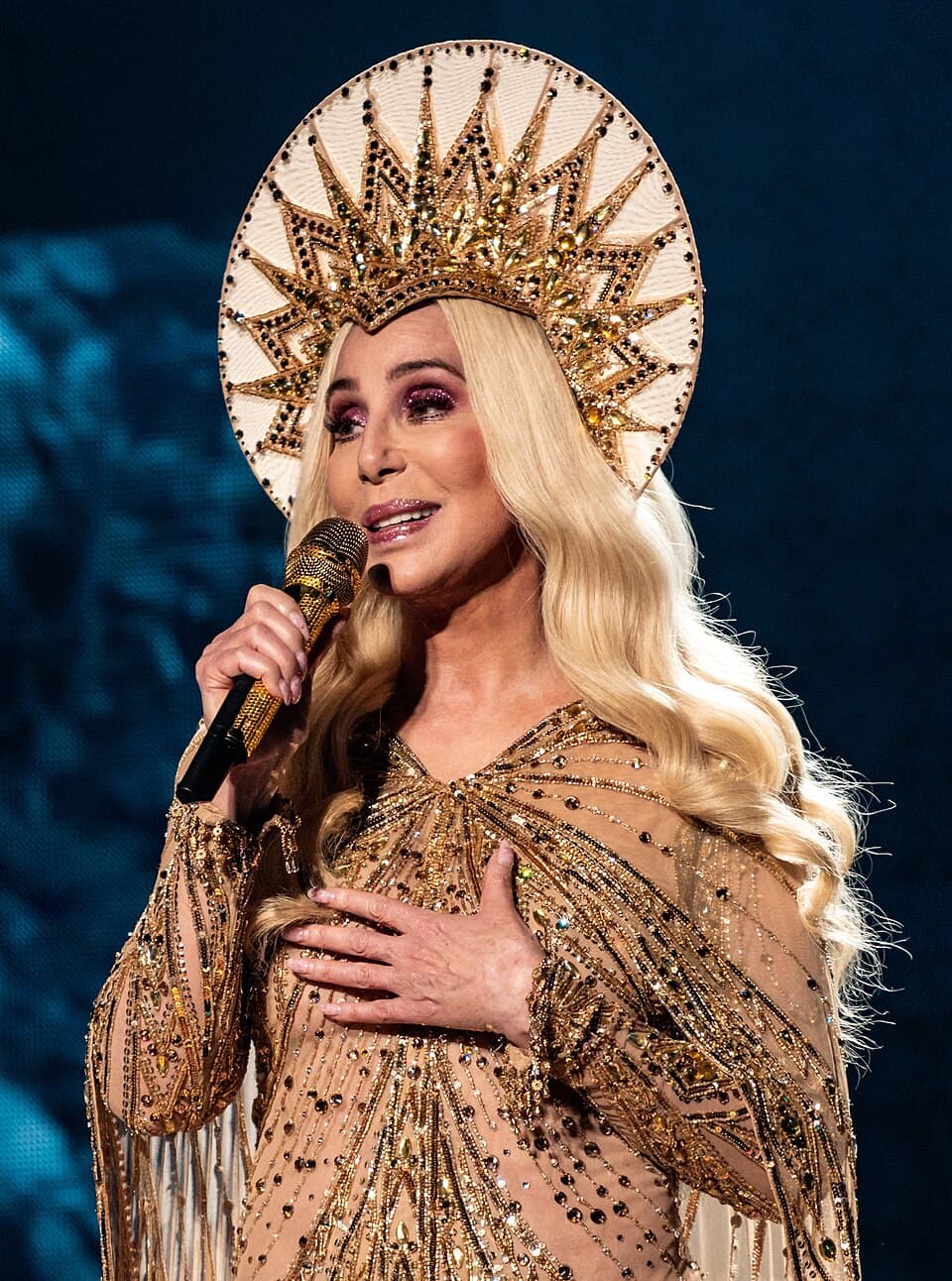
American · Arts
Cher
May 20, 1946 – present
Early Life and Background
Cher, born Cherilyn Sarkisian on 20 May 1946 in El Centro, California, is an American singer, actress, and television personality often dubbed the “Goddess of Pop.”[1][2] She was born to Georgia Holt, a model, singer, and occasional actress, and John Sarkisian, a truck driver of Armenian descent.[1][3] Her parents’ relationship was unstable, and they divorced when she was very young, resulting in a childhood marked by frequent moves and financial hardship.[1][3]
Cher’s mother later married and divorced several times, and Cher spent part of her youth in Los Angeles and other parts of California, experiencing a patchwork family environment.[1] She struggled in school, in part due to dyslexia, and often felt out of place, but she showed an early interest in performance, inspired by her mother’s musical ambitions and Hollywood connections.[3][11] At age sixteen, she dropped out of high school and moved to Los Angeles, determined to pursue a career in entertainment.[11]
While in Los Angeles, Cher took acting classes and worked various jobs, including as a club dancer. Her immersion in the city’s music scene led her to meet figures connected to producer Phil Spector’s recording operations, where she began singing backup on sessions, gaining early studio experience.[1][4]
Career Beginnings and Rise with Sonny & Cher
Cher’s professional break came after she met Sonny Bono, a songwriter and production assistant working with Phil Spector, in 1962–1963.[1][4] The two developed both a personal and professional relationship, and Cher initially worked as a backing vocalist on Spector‑produced tracks, including recordings for the Ronettes and other acts.[1]
In 1963, she released her first single, “Ringo, I Love You”, under the pseudonym Bonnie Jo Mason, marking her debut as a recording artist, though the record saw limited success.[1] Sonny and Cher married in 1964, and soon began performing as a duo.[1][4] They styled themselves in countercultural fashion—fringe vests, bell‑bottoms, and long hair—and developed a folk‑rock sound that contrasted with more polished pop styles of the era.[1][6]
Their breakthrough came with the 1965 release of “I Got You Babe”, written by Bono and produced in the Spectorian style.[1][4] The single became an international hit and a counterculture anthem, reaching No. 1 on the US Billboard Hot 100 in August 1965 and topping charts in several other countries.[1][4] It established Sonny & Cher as major figures in mid‑1960s pop and introduced Cher’s distinctive contralto voice to a wide audience.
Following the single’s success, their album “Look at Us” climbed charts internationally, including achieving a No. 1 position in the United Kingdom.[1] The duo recorded other hits such as “Baby Don’t Go” and “The Beat Goes On”, and Cher also began releasing solo material, including the album “All I Really Want to Do.”[1]
Transition to Solo Stardom
By the late 1960s and early 1970s, Cher was increasingly recognized as an individual star. Her solo career accelerated with narrative pop singles that tackled themes of marginalization and identity. In 1971, she released “Gypsys, Tramps & Thieves”, a song about a girl from a travelling show who faces prejudice and exploitation.[1] The single reached No. 1 on the Billboard Hot 100 and simultaneously topped the Canadian singles chart, becoming the first documented single by a solo artist to hold both positions at once.[1]
Cher followed up with “Half‑Breed” (1973), which addressed racism against a woman of mixed Native American and white heritage, and “Dark Lady” (1974), a melodramatic story song involving jealousy and murder.[1][4] Both songs reached No. 1 on the US charts, and by 1974 she was noted as the female artist with the most Billboard No. 1 singles at that time.[1] These records, marked by strong storytelling and a focus on women on the margins, helped differentiate Cher from other pop singers and built her reputation for taking risks with subject matter.
Television Fame: The Sonny & Cher Comedy Hour
Parallel to her recording success, Cher rose to national television prominence with “The Sonny & Cher Comedy Hour”, which premiered on CBS in 1971.[1] The variety show combined musical performances with comedy sketches and playful exchanges between Sonny and Cher, showcasing her timing, wit, and flair for spectacle.[1] Cher’s elaborate costumes—often designed by Bob Mackie—became a defining feature, pushing boundaries for what female performers could wear on primetime television.
The show earned strong ratings and multiple Emmy nominations, and in 1973 Cher won a Golden Globe Award for Best Actress in a Television Series – Musical or Comedy for her work on the program.[1][2] The series reinforced her image as both glamorous and sharp‑tongued, presenting a woman who could joke about gender roles and fame while embodying a new kind of TV celebrity.
After her marriage to Sonny Bono broke down, the original show was cancelled in 1974. Cher briefly hosted her own variety series, “Cher,” and later reunited professionally with Sonny for “The Sonny & Cher Show” from 1976 to 1977, though their partnership never fully regained its original momentum.[1]
Reinvention in Music: Rock, Disco, and Pop
Throughout the late 1970s and 1980s, Cher repeatedly reinvented her musical style. In 1975 she signed a high‑profile recording deal with Warner Bros., releasing albums experimenting with rock and pop elements.[1] In 1979, she turned to disco with the album “Take Me Home”, whose title track became a hit and established her as a club‑oriented performer.[1][4]
In the 1980s, Cher shifted toward rock, collaborating with writers and producers who positioned her within the mainstream rock landscape. Albums such as “Cher” (1987) and “Heart of Stone” (1989) yielded hits like “I Found Someone,” “If I Could Turn Back Time,” and “Just Like Jesse James.”[1] Her 1989 single “If I Could Turn Back Time” attracted controversy—and attention—for its video featuring her in a revealing outfit performing aboard a US Navy battleship, a demonstration of how she used fashion and spectacle to challenge norms.
By the 1990s, Cher embraced contemporary pop and adult contemporary sounds, maintaining chart presence with songs such as “Love and Understanding” and ballads that showcased her vocal power.[1]
Acting Career and Major Film Roles
Cher’s transition into serious acting began in the late 1970s and early 1980s. After her Broadway debut in Robert Altman’s production of “Come Back to the 5 & Dime, Jimmy Dean, Jimmy Dean” in 1982, she earned a Drama Desk Award nomination for Outstanding Actress in a Play, signaling her acceptance by theatre critics.[1]
Her film career advanced with roles in “Silkwood” (1983), directed by Mike Nichols, where she played Dolly Pelliker, a working‑class woman and friend of nuclear whistleblower Karen Silkwood, portrayed by Meryl Streep.[1][4] Cher’s performance earned her an Academy Award nomination for Best Supporting Actress, confirming her viability as a dramatic film actress.
She continued with significant roles in “Mask” (1985), playing the mother of a boy with a severe craniofacial condition, and “The Witches of Eastwick” (1987), a darkly comic fantasy co‑starring Susan Sarandon and Michelle Pfeiffer.[1] Her most celebrated role came in “Moonstruck” (1987), a romantic comedy directed by Norman Jewison, where she portrayed Loretta Castorini, a widowed bookkeeper in a Brooklyn Italian American family.[1][2]
For “Moonstruck,” Cher won the Golden Globe Award for Best Actress in a Motion Picture – Musical or Comedy and, in 1988, the Academy Award for Best Actress, solidifying her status as a leading film actress.[1][2][4] The film became a classic of the genre, and Loretta’s character, combining practicality with romantic vulnerability, is widely considered one of Cher’s defining roles.
Later Film Work and Stage Projects
After her Oscar win, Cher alternated between music and screen projects. She appeared in films such as “Mermaids” (1990) and took on fewer acting roles in the 1990s, partly due to health issues and the demands of touring.[1][4] She later returned to cinema with the musical “Burlesque” (2010), alongside Christina Aguilera, where she played Tess, the owner of a struggling nightclub.[1]
In 2018, Cher joined the ensemble cast of “Mamma Mia! Here We Go Again”, performing ABBA songs and portraying Ruby, the glamorous mother of Meryl Streep’s character.[1][2] Capitalizing on this moment, she released the album “Dancing Queen” in 2018, a collection of ABBA covers that extended her recording career into yet another decade.[1]
“Believe” and Late‑Career Musical Resurgence
Cher’s most dramatic musical resurgence came with the 1998 release of the single “Believe” and the album of the same name.[1][4] The track combined dance‑pop with electronic production and prominently used Auto‑Tune on her vocals as a creative effect, producing a distinctive, robotic sound.[1] "Believe" topped charts around the world, including the UK Singles Chart and the US Billboard Hot Dance Club Play chart, and became one of the best‑selling singles of all time.[1]
At the 41st Annual Grammy Awards in February 1999, Cher won the Grammy Award for Best Dance Recording for "Believe," acknowledging her influence on late‑1990s dance‑pop.[1] The song’s pioneering use of Auto‑Tune is widely credited with popularizing the technology as a stylistic device in mainstream music, shaping the sound of early 21st‑century pop and hip‑hop.[1]
The success of "Believe" revitalized Cher’s recording career, leading to further albums and tours and demonstrating that a woman in her fifties could dominate charts in a youth‑oriented market. The song has since been embraced as an empowerment anthem, frequently associated with themes of resilience and self‑assertion.
Awards, Honors, and Recognition
Cher’s career has been recognized with numerous awards and honors across music, television, and film. She has received one Academy Award for Best Actress, one Grammy Award (plus additional nominations), three Golden Globe Awards, and an Emmy Award for her television work.[1][2][4] Her discography has sold over 100 million records worldwide, placing her among the best‑selling music artists in history.[1][10]
In addition to competitive awards, Cher has received lifetime achievement honors, including the Billboard Icon Award in 2017 and the Kennedy Center Honors announced for the 2018–2019 cycle.[1][2] She has been inducted into the Rock and Roll Hall of Fame as part of Sonny & Cher, reflecting the duo’s contributions to the 1960s pop landscape.[1][10]
Her impact on fashion has been recognized by the Council of Fashion Designers of America (CFDA), which awarded her a Board of Directors’ Tribute in 2017 for her role as a style icon, particularly through her collaborations with designer Bob Mackie.[1][10]
Cher’s handprints and footprints were immortalized at Grauman’s Chinese Theatre in Hollywood in 2010, acknowledging her status as a cinematic and cultural figure.[1][11]
Personal Life
Cher’s personal life has often been intertwined with her public persona. She married Sonny Bono in 1964; their relationship and professional partnership were central to her early career.[1][3][4] The couple had one child, Chaz Bono (born Chastity Bono in 1969).[3][4] Their marriage ended in divorce in 1975.[1]
Later in 1975, Cher married musician Gregg Allman of the Allman Brothers Band.[1][3][4] The relationship was turbulent, affected by Allman’s struggles with substance abuse, and they divorced in 1979. They had one son, Elijah Blue Allman, born in 1976.[3][4]
Cher has been open about health challenges, including chronic fatigue syndrome and other issues that have intermittently affected her ability to tour.[4] She has also spoken publicly about social and political issues, particularly LGBTQ+ rights, expressing support for her child Chaz during his gender transition and advocating for greater acceptance.[4]
Her romantic life and family relationships have been covered extensively in the media, yet Cher has often emphasized her independence and self‑reliance, describing herself as someone who makes her own decisions about career and image.[1][4]
Legacy and Historical Impact
Cher’s legacy is multifaceted, spanning at least seven decades of popular culture. She is widely recognized as a trailblazer for women in entertainment, demonstrating that a female performer can sustain relevance through continual reinvention.[1][10] Her contralto voice, androgynous styling in certain eras, and bold fashion choices have influenced generations of artists.
Musically, Cher has moved from 1960s folk‑rock and pop to 1970s narrative singles addressing social issues, 1970s disco, 1980s rock, and 1990s–2000s dance‑pop, illustrating the evolution of popular music through her catalog.[1] Her chart achievements include being the only solo artist to have No. 1 singles on US Billboard charts in seven consecutive decades, from the 1960s through the 2020s, a unique record in chart history.[1][7]
Her experimental use of Auto‑Tune on "Believe" significantly altered the sonic landscape of pop and hip‑hop, making digital vocal manipulation a widely accepted artistic tool.[1] In visual culture, her partnership with Bob Mackie and her television and stage costumes helped expand ideas about gender presentation, glamour, and body display on mainstream platforms.
As an actress, Cher contributed to broader representation of working‑class women and middle‑aged female protagonists, particularly through roles in "Silkwood" and "Moonstruck."[1][2] Her portrayal of Loretta Castorini remains a touchstone for discussions of romantic comedy and women’s agency in film.
Beyond entertainment, Cher has engaged in philanthropy and advocacy, supporting causes ranging from health and humanitarian relief to LGBTQ+ rights.[4] Her outspoken presence on social issues, especially through interviews and later social media, has reinforced her image as a resilient, politically conscious figure.
Later Life and Ongoing Career
In the 21st century, Cher has continued to tour, record, and appear in media. She launched major concert tours, including the "Living Proof: The Farewell Tour" in the early 2000s, which extended over multiple years and demonstrated the enduring demand for her live performances.[1][4] Her Las Vegas residencies and international tours have brought her catalog to new audiences.
In the 2010s and 2020s, Cher maintained visibility through performances at major events, including the 2017 Billboard Music Awards, and through new recordings such as her Christmas‑themed projects.[11] Her 2023 single "DJ Play a Christmas Song" reached No. 1 on the Billboard Adult Contemporary chart, contributing to her seven‑decade streak of Billboard No. 1s.[7]
As of the mid‑2020s, Cher remains active, with projects in music and potential memoir writing. She is frequently cited in media and scholarship as a prime example of an entertainer whose career illustrates the intersections of gender, technology, fashion, and aging in popular culture.[1][4]
Her enduring presence, combined with a record of artistic experimentation and barrier‑breaking chart longevity, ensures her status as one of the most significant women in the history of modern entertainment.
Dated achievements
21 indexed.
- May201946Science
Birth of Cher
Cherilyn Sarkisian, later known as Cher, is born in El Centro, California.
View details Cher - Wikipedia - Aug141965Science
"I Got You Babe" hits No. 1 on Billboard Hot 100
Sonny & Cher's signature duet reaches No. 1 on the US Billboard Hot 100, launching their stardom.
View details