← All women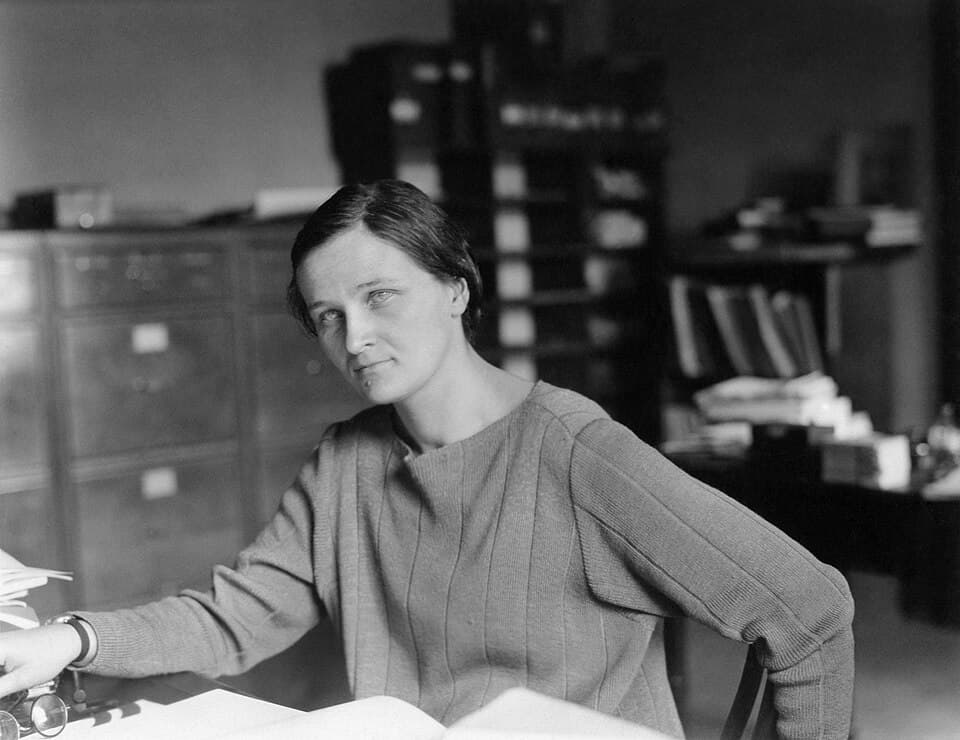
British, American · Science
Cecilia Payne-Gaposchkin
May 10, 1900 – December 7, 1979
Early Life and Family Background
Cecilia Helena Payne was born on 10 May 1900 in Wendover, Buckinghamshire, England.[2][5] She was the eldest of three children of Edward John Payne, a London barrister and historian, and Emma Leonora Payne, an artist.[4][8] When Cecilia was four, her father died, leaving her mother to raise the children alone.[5][7][8] This early loss shaped Cecilia’s sense of independence and responsibility, and her mother’s determination to support her education proved crucial to her later scientific career.
Payne showed strong intellectual promise from an early age. She attended local schools before winning a scholarship to St Paul’s Girls’ School in London, one of the few institutions that offered girls advanced scientific instruction.[5][9] At St Paul’s she encountered inspiring women science teachers and first became seriously interested in astronomy, experiences that were formative in an era when girls were discouraged from pursuing higher mathematics or physical science.
Education and Formative Influences
Inspired by a public lecture given by the astronomer Arthur Eddington on his 1919 expedition to test Einstein’s theory of general relativity, Payne decided to study science at university.[2][5][9] In 1919 she won a scholarship to Newnham College, Cambridge, one of Cambridge University’s women’s colleges, where she read natural sciences.[2][5] At Cambridge she studied physics, chemistry, and botany, and came into contact with leading scientists who were shaping the emerging fields of quantum theory and astrophysics.
Cambidge, however, did not award degrees to women at the time. Payne completed the requirements for a degree but received only a "certificate" rather than an official Cambridge degree, illustrating the institutional barriers confronting women scholars in the early 20th century.[2][5][9] This experience of excelling academically without formal recognition would recur in her later career at Harvard.
Move to Harvard and Early Career
In 1923, Payne emigrated to the United States to work at the Harvard College Observatory (HCO), attracted by the opportunity to pursue astrophysical research under director Harlow Shapley
On 1 October 1923 she submitted an article to the Astrophysical Journal proposing that the spectral sequence of stars primarily reflects differences in temperature rather than fundamentally different chemical compositions.[15] This early publication marked her first significant contribution to astrophysics and set the stage for her doctoral work on stellar atmospheres. Encouraged by Shapley, Payne enrolled formally as a graduate student through Radcliffe College, the women’s college affiliated with Harvard, since Harvard itself did not yet grant degrees to women.[5][9] By early 1925 she had completed her Ph.D. thesis, "Stellar Atmospheres: A Contribution to the Observational Study of High Temperature in the Reversing Layers of Stars."[3][14][9] In this thesis, Payne brought together quantum theory, atomic physics, and observational spectroscopy. Using Meghnad Saha’s thermal ionization equation, she calculated how the strengths of spectral lines depend on temperature, pressure, and ionization state.[14] Applying these methods to extensive stellar spectra from Harvard’s plate collection, she derived both stellar temperatures and chemical abundances. Her analysis led to a revolutionary conclusion: stars are composed predominantly of hydrogen and helium, with heavier elements present only in trace amounts.[2][9][14] Contrary to the prevailing assumption that the Sun and stars had compositions similar to Earth, she demonstrated that apparent differences among stellar spectra are due mainly to physical conditions—especially temperature—rather than major differences in elemental makeup.[15] Payne’s thesis is widely regarded as one of the most brilliant ever written in astronomy. It provided the first systematic, quantitative determination of stellar composition and established the chemical homogeneity of the visible universe.[3][9] Her work founded the modern field of stellar atmospheres and reshaped astrophysics by linking observational data to quantum and atomic theory. Despite the strength of her results, senior astronomer Henry Norris Russell initially advised her to downplay her abundance conclusions in the published version, fearing they might be in error.[2][9][15] For some years, her most radical claims were presented cautiously. However, later work by Russell and others independently confirmed her findings, leading Russell to acknowledge that "the most brilliant PhD thesis ever written in astronomy" had been hers.[3] In 1925, Radcliffe College awarded Payne a Ph.D. in astronomy for her thesis, making her the first person ever to receive a doctorate in astronomy from Harvard/Radcliffe and the first woman to do so.[1][9][10] Because Harvard did not formally grant doctorates to women, the degree was issued through Radcliffe, underscoring both her achievement and the institutional constraints on women’s education. This milestone represented a double breakthrough. Intellectually, it validated a thesis that had rewritten the understanding of stellar composition. Institutionally, it broke a gender barrier by demonstrating that a woman could complete a doctoral program in a highly mathematical and physical science. Her degree helped open the way for later generations of women astronomers and physicists. After her thesis, Payne-Gaposchkin turned much of her attention to variable stars, including novae and other types of pulsating or eruptive stars. Throughout the 1930s she became a leading authority in this field, using Harvard’s extensive plate archives to catalog and analyze variable stars in the Milky Way and neighboring galaxies.[5][14] In 1933 she co‑authored early work on variable stars with Russian-born astrophysicist Sergei Gaposchkin, who had come to Harvard after political upheaval in Europe.[5] Their collaborative studies investigated the light curves and distribution of novae and other variables, contributing to understanding the structure of the Galaxy and the behavior of stellar populations.[5][11] In 1934, Cecilia married Sergei Gaposchkin and adopted the hyphenated surname Payne-Gaposchkin in her scientific publications.[2][11] Their partnership produced substantial joint research and several major monographs. In 1938 she published The Stars of High Luminosity, based on extensive observations of luminous stars, which provided important insights into stellar evolution and galactic structure.[1][11] During World War II and afterward, she and Sergei continued to compile massive catalogs of variable stars, particularly in the Magellanic Clouds and the Milky Way’s halo. In 1943 Payne-Gaposchkin published her influential book Variable Stars, synthesizing decades of observations and analysis.[1][11] This work helped establish variable stars as powerful tools for probing the structure and scale of the Galaxy, building on and extending Henrietta Leavitt’s earlier discovery of the period–luminosity relation for Cepheids. Payne-Gaposchkin’s data and interpretations supported the emerging picture of a large, complex Milky Way and contributed to the broader field of stellar populations and galactic astronomy. Payne-Gaposchkin became an American citizen in 1931, solidifying her long‑term commitment to work at Harvard and in the United States.[11] Yet for many years her professional status lagged behind her scientific contributions. She held titles such as "assistant" and "lecturer," and her pay was significantly lower than that of male colleagues with comparable or lesser achievements.[5][9][14] Despite these inequities, she continued to produce an extraordinary volume of research, training generations of students and serving as a central figure in Harvard’s astronomical community. Her reputation grew internationally; in 1936 she was elected to the American Philosophical Society, one of the United States’ oldest learned societies, where she was described as "the most prominent woman astronomer of all time."[4] Institutional recognition of Payne-Gaposchkin’s contributions came slowly but decisively during the 1950s. In 1956 she was promoted to full professor in Harvard’s Faculty of Arts and Sciences, becoming the first woman to be promoted to a full professorship from within that faculty and the first woman full professor of astronomy at Harvard.[1][2][14] This promotion was a landmark in the history of women in American academia. Harvard had long employed women as "computers" and researchers at the College Observatory but had not previously granted them senior faculty rank. Payne-Gaposchkin’s elevation to full professor demonstrated that a woman scientist could attain the highest academic position and helped challenge entrenched attitudes about women’s roles in science and higher education.[1][2] Later in 1956 she was appointed chair of Harvard’s Department of Astronomy, becoming the first woman to chair a department in the Faculty of Arts and Sciences.[1][2][6] As department chair, she oversaw faculty hiring, curriculum, and research direction, helping to guide Harvard astronomy through a period of rapid development that included the advent of radio astronomy and space-based observation. Her leadership provided an important example of women’s capacity to hold senior administrative and intellectual authority in a major research university. Over the course of her career, Payne-Gaposchkin received numerous honors that reflected the scientific community’s growing appreciation of her work. She was awarded the Annie J. Cannon Prize of the American Astronomical Society for outstanding research by a woman astronomer, recognizing her contributions to the understanding of stellar atmospheres and variable stars.[1][11] In 1976 the American Astronomical Society presented her with its highest honor, the Henry Norris Russell Prize, acknowledging her lifetime achievements in astrophysics and symbolically rectifying Russell’s earlier hesitation about her abundance conclusions.[8] Internationally, her impact was recognized in astronomical nomenclature. In 1977, the main‑belt asteroid 2039 Payne-Gaposchkin was named in her honor, inscribing her name permanently among the catalogued bodies of the solar system.[1][2][8] Later, a volcanic feature on Venus, Payne-Gaposchkin Patera, was also named for her, further reflecting her status as a scientist whose work extended to fundamental questions about stars and planets.[2][8] Multiple biographical and historical accounts, including profiles by the National Women’s History Museum and the Science History Institute, now highlight her role as the astronomer who "discovered the chemical makeup of stars" and revolutionized our understanding of the universe.[1][9][19] Payne-Gaposchkin’s personal life was closely intertwined with her scientific career. Her 1934 marriage to Sergei Gaposchkin created a partnership in which both spouses were active researchers, jointly publishing work on variable stars and novae.[2][5] They had three children, and Cecilia balanced family responsibilities with a demanding research and teaching schedule, at a time when few supports existed for women scientists with families. Colleagues and students remembered her as intellectually intense but warm, deeply committed to teaching, and generous with her time.[20] She mentored many younger astronomers, including women who followed her path into advanced astronomical research. Her own experience of exclusion from formal degrees at Cambridge and from equal status at Harvard made her particularly aware of the challenges facing women in science. Payne-Gaposchkin formally retired from her Harvard professorship in 1966, but she remained active in research and writing for more than a decade afterward.[1][8] She continued to analyze variable stars and to reflect on the history and philosophy of science, occasionally publishing essays and giving talks. Her later years were spent largely in the Boston and Cambridge area, where she maintained close ties to Harvard College Observatory and its community. Even after retirement, she was recognized as a central figure in the history of astrophysics. The growing presence of women in astronomy and physics during the 1960s and 1970s owed much to the paths she had helped open and to the example she set as a woman who had reached the top ranks of academic science despite systemic barriers. Cecilia Payne-Gaposchkin died of lung cancer on 7 December 1979, in Massachusetts; sources variously specify Cambridge or nearby Tewksbury, but agree on the date and cause.[1][2][5][13] She was 79 years old. Obituaries described her as "a pioneering astrophysicist and probably the most eminent woman astronomer of all time," emphasizing the breadth and depth of her contributions to astronomy.[3] Her death marked the end of a remarkable career that had spanned the era from early photographic plate astronomy to the threshold of space telescopes. At Harvard, her passing also symbolized the conclusion of the observatory’s long chapter in which women "computers" and astronomers had quietly built much of modern astrophysics. Payne-Gaposchkin’s legacy is multifaceted, encompassing scientific discovery, institutional change, and the advancement of women in science. Modern profiles of Payne-Gaposchkin emphasize that "if you know that the Sun is made of hydrogen atoms fusing into helium, it’s because of her," highlighting how deeply her work has penetrated both scientific understanding and popular science education.[8] The naming of asteroid 2039 Payne-Gaposchkin and Venusian feature Payne-Gaposchkin Patera ensures that her name is literally written into the cosmos she helped to explain.[2][8] In the broader historical arc, Cecilia Payne-Gaposchkin stands as one of the architects of 20th‑century astrophysics and as a central figure in the story of women’s long struggle for full participation and recognition in science.Groundbreaking Ph.D. and the Composition of the Stars
First Ph.D. in Astronomy from Radcliffe/Harvard
Research on Variable Stars and the Structure of the Galaxy
Citizenship and Professional Standing
First Woman Full Professor and Department Chair at Harvard
Awards, Honors, and Recognition
Personal Life
Later Career and Retirement
Death
Legacy and Historical Impact
Dated achievements
9 indexed.
- May101900Science
Birth of Cecilia Payne-Gaposchkin
Cecilia Helena Payne (later Payne-Gaposchkin) was born in Wendover, Buckinghamshire, England.
View details Wikipedia - Oct011923Science
Early work on stellar spectra submitted
Cecilia Payne submitted work on stellar spectra and composition to the Astrophysical Journal.