← All women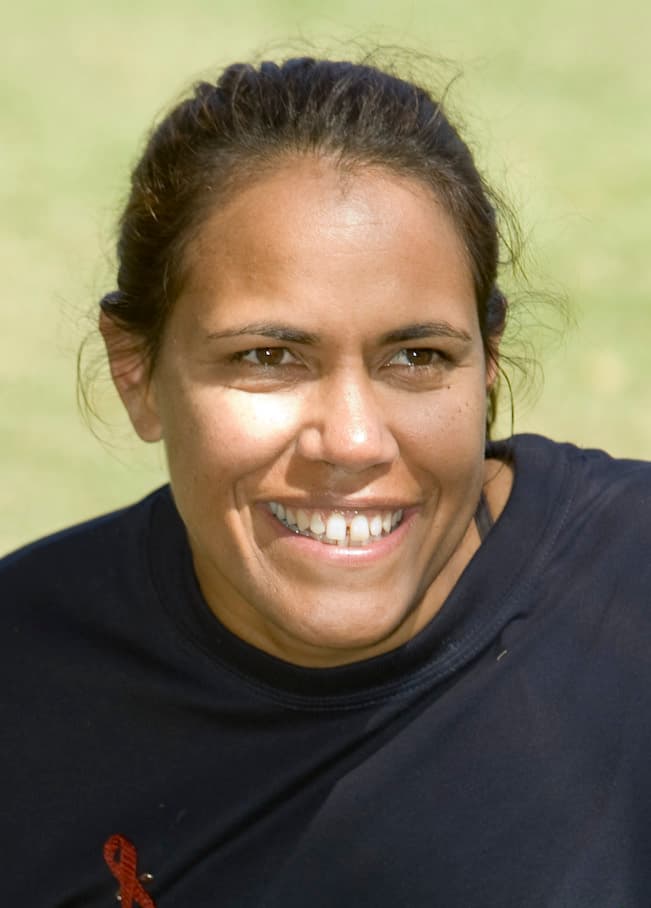
Australian · Sports · Activism
Cathy Freeman
February 16, 1973 – present
Early Life and Background
Catherine Astrid Salome "Cathy" Freeman was born on 16 February 1973 in the coastal suburb of Slade Point, Mackay, in Queensland, Australia.[5][6][8] She is of Aboriginal heritage from two nations: through her mother Cecilia she belongs to the Kuku Yalanji people of far north Queensland, and through her father Norman she is connected to the Birri Gubba (often rendered Burri Gubba) people of central Queensland.[16][17] Freeman grew up in a large family, with several siblings and half‑siblings, in circumstances shaped by the legacies of colonialism, socio‑economic disadvantage, and government assimilation policies that affected Aboriginal communities across the mid‑twentieth century.[6]
Her parents separated when she was young; Freeman’s mother later married Bruce Barber, who became both her stepfather and first athletics coach.[9][17] The family lived in public housing and often struggled financially, and Freeman has spoken about the racism and exclusion she experienced as an Aboriginal child in regional Queensland.[6] These early challenges helped form the resilience and determination that characterised her later career, and they deeply informed her commitment to reconciliation and improved opportunities for Indigenous children.
Freeman showed exceptional athletic ability from an early age. At eight she won her first gold medal at a school athletics championship and quickly developed an ambition to become an Olympic champion.[15][16][17] Under Barber’s guidance she joined athletics clubs and began structured training, competing across sprint distances and the high jump. By the age of fourteen she had already won national titles in the high jump and the 100, 200, and 400 metres, indicating a breadth of talent unusual even among elite juniors.[17]
Educationally, Freeman attended schools in Mackay before obtaining a scholarship to Fairholme College, a private girls’ boarding school in Toowoomba, where she could access better training facilities and competition opportunities.[2][8] Balancing study with high‑level sport, she later pursued tertiary education at the University of Melbourne, reflecting her ongoing interest in life beyond athletics.[2]
Career Beginnings and Development
Freeman’s emergence onto the national athletics scene came in the late 1980s. In 1988, she first competed at a national meet during the Australian Schools Championships, a key step from regional competitions into the broader Australian athletics circuit.[14] Her performances attracted attention from coaches and selectors impressed by her speed, competitive temperament, and versatility across distances.
By 1990, Freeman had become one of the country’s leading young sprinters. She won multiple national junior titles and was recognised as Aboriginal Athlete of the Year, an award she received again in 1991, underscoring her rapid rise as an Indigenous sporting figure.[14] In January 1990 she was selected for the Australian team to the Auckland Commonwealth Games, where at age sixteen she ran in the women’s 4×100 m relay and helped secure a gold medal.[3][14][17] This victory made her the first Indigenous Australian to win a gold medal at an international sporting event and the first Aboriginal person to win Commonwealth Games gold.[14][17]
On 26 January 1990 she was named Young Australian of the Year, highlighting her as a national role model while still a teenager.[8] These honours signalled that Freeman’s career would be watched closely not only for its athletic promise but also for its broader social implications. Her Aboriginal identity, competence, and poise drew media interest that increasingly framed her as an emblem of a changing, more inclusive Australia.
In 1992, Freeman’s trajectory advanced to the global stage when she was selected for the Barcelona Olympic Games. Competing in the women’s 400 m heats, she became the first Aboriginal track and field athlete, and the first Aboriginal woman, to represent Australia at the Olympics.[5][8][13] While she did not progress to the final, the experience gave her crucial exposure to elite international competition and confirmed that she could compete alongside the world’s best.
Rise to International Prominence
The mid‑1990s saw Freeman evolve from promising Olympian to world‑class star. At the 1994 Commonwealth Games in Victoria, Canada, she delivered a breakthrough series of performances. On 25 August 1994 she won gold in the women’s 200 m, demonstrating speed and versatility across sprint distances.[3][13] Two days later, on 27 August, she captured gold in the 400 m and famously carried the Aboriginal flag during her victory lap, a bold and controversial act at a time when the flag was strongly associated with land rights activism.[13][14]
While officials initially criticised her for displaying a flag other than the Australian national flag, Freeman’s gesture resonated deeply with Aboriginal communities and many non‑Indigenous supporters, who saw it as a proud assertion of identity. The moment has been widely interpreted as a key cultural turning point, with a young Aboriginal woman insisting that her heritage be visible on an international sporting stage.[13][14] On 28 August, she added a silver medal in the 4×100 m relay, completing a highly successful Games.[3]
Freeman’s domestic performances were equally impressive. On 2 March 1996 at the Australian Championships in Melbourne, she ran the women’s 400 m in 49.85 seconds, becoming the first Australian woman to break the 50‑second barrier for the distance.[13][15] This landmark achievement confirmed her as a serious medal contender for the upcoming Atlanta Olympics.
At the 1996 Atlanta Olympic Games, Freeman realised much of this potential. In the women’s 400 m final on 29 July 1996, she ran a spectacular 48.63 seconds, finishing second to France’s Marie‑José Pérec.[1][12][15] The time set a Commonwealth record and placed Freeman among the fastest women in history over 400 m.[2][12] More importantly for Australia, the silver medal made her the first Aboriginal athlete to win an Olympic medal in an individual event.[1][15]
Freeman had long set herself the goal of running 48.60 seconds, a target she famously wrote on the back of an airsickness bag after being eliminated in the 1993 World Championships.[15] Her near‑achievement of this goal at Atlanta highlighted her capacity for long‑term planning and psychological resilience. The silver medal cemented her status as an international star and intensified expectations that she would win gold at the next Olympics.
World Championships Dominance
Following Atlanta, Freeman entered a period of sustained dominance in the 400 m. The 1997 season saw her win all but one 400 m race and arrive at the World Championships in Athens as the favourite.[14][15] On 7 August 1997, she won gold in the women’s 400 m, becoming the first Aboriginal woman to hold a world athletics title.[1][8][15]
The Athens victory represented both personal and historical milestones. It elevated Freeman from Olympic medallist to world champion and placed an Aboriginal woman at the pinnacle of global athletics—a position rarely held by Indigenous athletes from any country. Her success contributed to increasing recognition, within Australia and internationally, of Indigenous athletes’ capacity to excel at the highest levels when given adequate support.
Freeman consolidated this dominance at the 1999 World Championships in Seville. On 26 August 1999, she defended her title by again winning gold in the women’s 400 m, an achievement that confirmed her as the world’s leading 400 m runner heading into the Sydney Olympics.[1][8][15] Her back‑to‑back world titles placed her among an elite group of athletes able to maintain supremacy across multiple championship cycles.
In the late 1990s, Freeman also continued to excel at the national level, winning numerous Australian titles across the 100, 200, and 400 m. The National Archives of Australia notes that she amassed 14 national titles across these distances during her career.[14] These domestic successes provided a foundation for her global achievements and kept her in close contact with Australian fans, particularly young people who increasingly saw her as a role model.
Sydney 2000: Flame‑Lighter and Olympic Champion
Freeman’s career reached its emotional and symbolic peak at the 2000 Sydney Olympic Games. She was already widely viewed as the face of the Games, both for her athletic credentials and her significance in reconciliation debates.
On 15 September 2000, during the Opening Ceremony, Freeman was chosen to light the Olympic Flame, becoming the first Aboriginal Australian to perform this role at an Olympic Games.[2][8][15] The moment featured her standing atop a pool of water, torch in hand, igniting a ring that rose to form the cauldron. The imagery of an Aboriginal woman igniting the Games in her home country was widely interpreted as a statement of inclusion and recognition after generations of Indigenous marginalisation.[7][14]
In the months preceding the Olympics, Freeman further demonstrated her athletic readiness by winning both the 200 m and 400 m national titles at Stadium Australia in February 2000.[14] These victories confirmed her status as favourite for the Olympic 400 m.
On 25 September 2000, Freeman ran in the women’s 400 m final at Sydney. Wearing a distinctive full‑body suit designed to minimise aerodynamic drag and coping with enormous public expectation, she executed a tactically sound race, accelerating through the final bend to pull clear of her rivals. She crossed the line first, securing Olympic gold and becoming the first Indigenous Australian to win an individual Olympic gold medal; the victory was also Australia’s 100th Olympic gold.[1][2][15]
Following the race, Freeman again carried both the Australian and Aboriginal flags on her victory lap, echoing her 1994 Commonwealth Games gesture but now on the most prominent possible stage.[2][14] The dual‑flag image became one of the defining symbols of the Games and of contemporary Australian history, representing both national pride and the ongoing process of reconciliation. Museums and educational institutions, including the National Museum of Australia and the National Archives, have since treated this moment as a "defining" or "signature" episode in Australian sport and culture.[7][14]
Awards, Honours, and Recognition
Freeman’s sporting achievements were accompanied by numerous awards and honours. In addition to her Young Australian of the Year title in 1990, she was named Australian of the Year on 26 January 1998, becoming the only person to hold both titles.[8] The honour reflected her success as a world champion and her role as a symbol of reconciliation.
She was appointed a Member of the Order of Australia (OAM) for service to athletics, although sources typically list the honour without specifying the exact investiture date.[8] Her contributions have also been recognised at state and institutional levels, including profiles by the Victorian Government and entries in national biographical collections.[5][8]
Internationally, Freeman received the ESPN Arthur Ashe Courage and Humanitarian Award on 11 July 2001, acknowledging her bravery in promoting Aboriginal identity and reconciliation through sport and her humanitarian commitments.[10][18] The award linked her to a global tradition of athlete‑activists who address social injustice.
In the realm of sporting institutions, Freeman was inducted into the Sport Australia Hall of Fame on 13 October 2005, officially recognising her as one of the nation’s greatest athletes.[13] Athletics Australia also honours her within its own Hall of Fame, emphasising her impact on the sport domestically.[9][13]
In subsequent years, Freeman has been featured in numerous commemorative and educational projects. The National Museum of Australia includes her Sydney 2000 victory as a "defining moment" in Australian history.[7] The National Archives presents learning resources centred on her life and achievements.[14] Encyclopedias, women’s history collections, and international media continue to spotlight her story as a case study in the intersection of sport, gender, race, and national identity.[1][6][10]
Advocacy, Foundation Work, and Later Career
After Sydney 2000, Freeman continued to compete for several seasons but gradually shifted her focus toward advocacy and community work. She announced her retirement from athletics in 2003, drawing a close to a career that had made her Australia’s greatest athletics star of the 1990s and early 2000s.[14][15]
That same year, Freeman founded the Cathy Freeman Foundation, aimed at improving educational outcomes for Indigenous children in remote communities.[6][18] The foundation worked primarily in Queensland communities, partnering with schools and families to increase school attendance, retention, and achievement. Freeman emphasised that education was key to providing Aboriginal children with opportunities and agency in a society still marked by inequity.
Although the foundation later wound up operations, its initiatives and philosophy influenced wider debates about Indigenous education policy. Freeman has remained active as a speaker and advocate, discussing issues of identity, representation, and the pressures associated with being a national symbol.[6][18] Her experiences as an elite athlete navigating media scrutiny and cultural expectation inform her contributions to conversations about mental health, resilience, and support structures for Indigenous youth.
Personal Life
Freeman’s personal life has intersected with her public career in various ways, though detailed accounts remain relatively private. She has married and later separated, and she became a mother, experiences that contributed to her decision to step away from competitive athletics and focus on family and community endeavours.[2][6] Biographical sources emphasise that her post‑retirement years have centred on maintaining personal well‑being and balancing family responsibilities with ongoing advocacy work.
As a high‑profile Aboriginal woman, Freeman has often spoken about the internal pressures of being seen as a symbol for her people and the nation. She has acknowledged the challenges of living up to expectations while managing ordinary human experiences—grief, joy, relationships, and parenting.[6][18] These reflections have further humanised her in the public eye and have made her story a valuable resource in discussions of athlete welfare and identity.
Legacy and Historical Impact
Cathy Freeman’s legacy extends far beyond the medals she won. As an athlete, she ranks among the greatest 400 m runners of her generation. Her personal best of 48.63 seconds, set at the 1996 Atlanta Olympics, continues to place her among the fastest women ever in the event and stands as the Oceania record.[2][12] She claimed two World Championships 400 m titles (1997 and 1999), an Olympic gold and silver, three Commonwealth Games golds, and numerous national titles.[1][14]
However, Freeman’s historical significance lies equally in her role as a symbol of Indigenous pride and national reconciliation. Her 1994 Commonwealth Games victory lap with the Aboriginal flag, her lighting of the Sydney 2000 Olympic Flame, and her Sydney 2000 400 m victory carrying both Australian and Aboriginal flags together, form a visual narrative of an Aboriginal woman asserting presence and belonging at the heart of the nation’s public life.[2][13][14]
For Aboriginal Australians, Freeman’s achievements demonstrated that it is possible to succeed spectacularly within institutions historically associated with exclusion, while still asserting cultural identity. Her success helped inspire subsequent generations of Indigenous athletes in athletics and other sports, including rugby league, AFL, and netball, who cite her as a trailblazer.[14][17]
In the context of women’s history, Freeman stands alongside figures such as Billie Jean King, Serena Williams, and Wilma Rudolph in illustrating how women athletes from marginalised communities can reshape public understandings of gender and race. She broke performance barriers, such as the sub‑50‑second 400 m, and symbolic barriers, such as being the first Aboriginal Australian to light the Olympic Flame and to win individual Olympic gold.[2][8][15]
Educational institutions and historians increasingly treat her story as a case study in modern Australian identity. The National Museum of Australia lists her Olympic victory as a defining moment; school curricula and research portals examine her life in relation to reconciliation, sports history, and Indigenous representation.[7][14] Her narrative is used to encourage discussion about structural inequality, the power of role models, and the complexities of national celebration on dates like Australia Day.
In the 2020s, media and commemorative projects continue to revisit Freeman’s achievements, particularly during anniversaries of the Sydney Games and in collections focused on women and Indigenous leaders.[3][7][14] Her image lighting the cauldron and her dual‑flag victory lap remain enduring icons of Australian culture.
Later Life and Continuing Influence
Since retiring from competition, Freeman has largely stepped back from front‑line activism but remains a respected public figure. She participates selectively in media interviews, documentaries, and speaking engagements, often emphasising themes of resilience, education, and reconciliation.[6][18] Her voice carries weight in national conversations about Indigenous issues, though she has expressed a desire to live a more private life after the intensity of her athletic career.
Freeman’s continuing influence can be seen in the esteem with which she is held by the Australian public. She is regularly included in lists of the country’s greatest athletes and most important Aboriginal figures, and her story is featured in women’s‑history and Indigenous‑history collections.[1][7][14] For many Australians, her Sydney 2000 victory remains one of the most memorable sporting moments of their lifetimes, symbolising not only athletic excellence but also hopes for a more just and inclusive society.
As of the mid‑2020s, Freeman is alive and her legacy continues to evolve as new generations reinterpret her story. Her achievements and advocacy remain integral to understanding contemporary Australia, Indigenous representation in sport, and the ways in which one woman’s pursuit of excellence reshaped national narratives about identity, belonging, and reconciliation.
Dated achievements
16 indexed.
- Feb161973Science
Birth of Cathy Freeman
Catherine Astrid Salome Freeman was born in Mackay, Queensland, Australia.
View details Britannica: Cathy Freeman - Jan271990Science
First Indigenous Australian to win gold at an international sporting event
Aged 16, Freeman won 4x100m relay gold at the Auckland Commonwealth Games, the first Indigenous Australian to win international gold.