← All women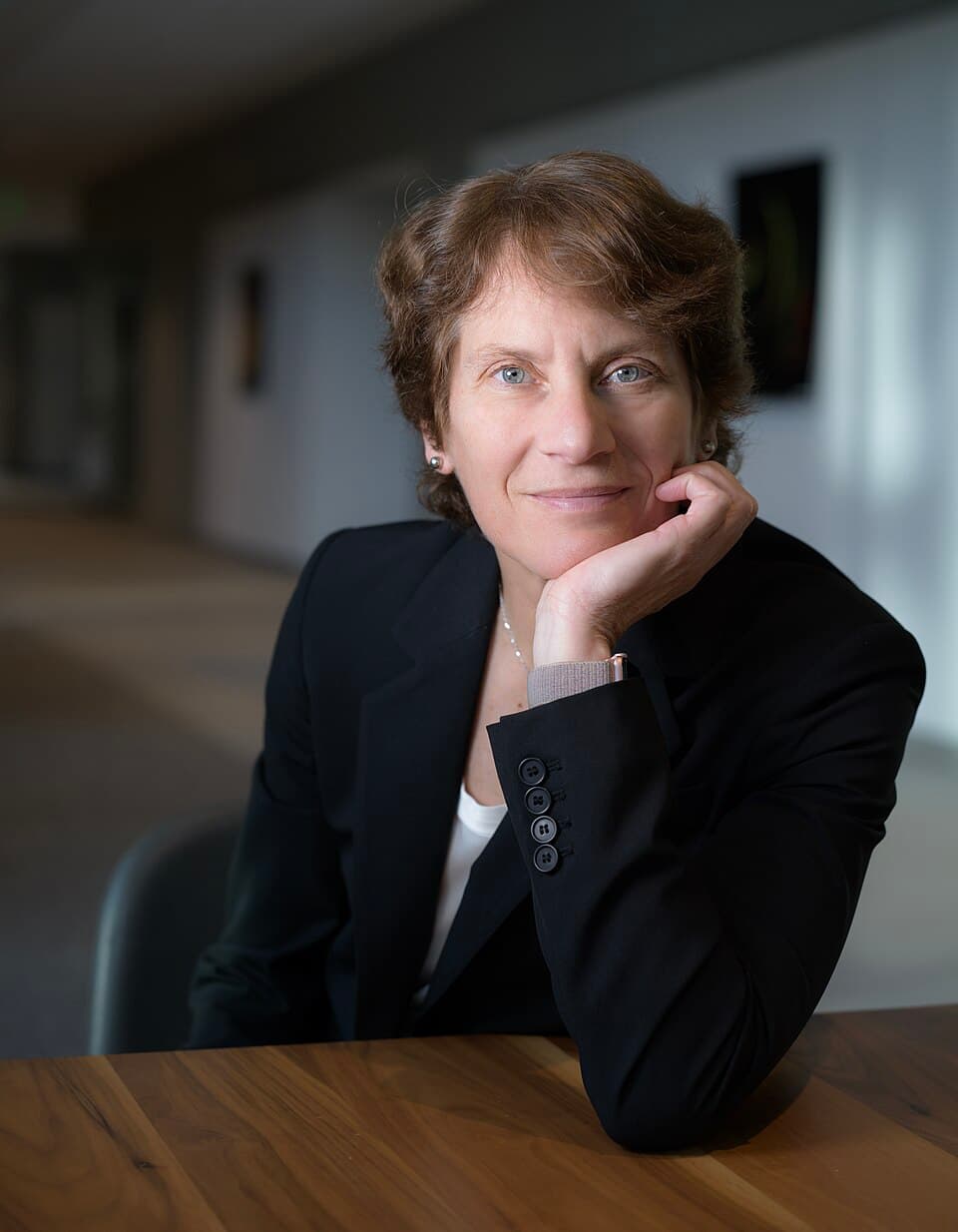
American · Science · Medicine
Carolyn Bertozzi
October 10, 1966 – present
Early life and education
Carolyn Ruth Bertozzi was born on October 10, 1966, in Boston, Massachusetts, and raised in a family that encouraged scientific curiosity. Sources describe her as growing up in an intellectually supportive environment in which science was valued, a context that helped shape the interdisciplinary outlook that later defined her career. She has said in interviews and institutional profiles that her path into chemistry developed from a combination of strong mathematical and scientific interests and an appetite for solving practical biological problems. That combination would become the hallmark of her research style.
Bertozzi attended Harvard University, where she earned her A.B. in chemistry in 1988. While at Harvard, she also developed a lively extracurricular life, including playing music in a heavy metal band with Tom Morello. Her undergraduate years are often remembered not only for academic excellence but also for the breadth of her interests, a reminder that scientific talent and creativity can flourish alongside the arts. After Harvard, she pursued doctoral study at the University of California, Berkeley, earning her Ph.D. in chemistry in 1993. Berkeley proved decisive for her development as a researcher, since it placed her in an environment where chemistry, biology, and biomedicine increasingly intersected.
Early career and Berkeley years
After completing her doctorate, Bertozzi built an academic career at the University of California, Berkeley, where she joined the faculty in 1996. At Berkeley she established the laboratory that would become one of the world’s leading centers for chemical biology. Her early work focused on glycobiology, especially the synthesis and study of glycan analogs, molecules that help scientists understand how carbohydrates function on the surfaces of cells. This research was technically demanding because glycans are structurally complex and difficult to manipulate, but it proved crucial to later advances in disease biology and molecular imaging.
By the late 1990s and early 2000s, Bertozzi was becoming known for applying synthetic chemistry to biological questions in ways that few researchers had attempted. Her work challenged the separation between chemistry and biology by showing that molecules could be designed to operate selectively in living systems. In 2000, she was appointed an Howard Hughes Medical Institute Investigator, an honor that signaled the national significance of her research program and gave her additional support for high-risk, high-reward science. That same period saw the growth of her patent activity, reflecting a rare combination of academic creativity and translational ambition.
Bioorthogonal chemistry and scientific breakthrough
In the early 2000s, Bertozzi became the leading architect of what she would call bioorthogonal chemistry. The term describes chemical reactions that can take place inside living organisms without interfering with native biochemical processes. This was a profound conceptual breakthrough. Traditional chemical reactions often fail in the crowded, delicate environment of a cell, where unintended side reactions can destroy biological function. Bertozzi and her collaborators designed reactions that could circumvent that problem, enabling scientists to label, image, and manipulate biomolecules inside living systems.
The importance of this advance cannot be overstated. Bioorthogonal chemistry helped open new ways to study disease pathways, glycobiology, and cellular behavior in real time. It also created tools for biomedical applications such as imaging, diagnostics, and targeted therapy development. Bertozzi’s contributions were not a single isolated discovery but a sustained program of invention: her patents on chemoselective ligation and biomolecule modification document the growth of this platform between 2000 and 2005. In 2005, the U.S. Patent and Trademark Office issued a foundational patent for “Compositions and methods for modification of biomolecules”, helping establish the intellectual property base for what became a major scientific field.
Recognition and honors
Bertozzi’s scientific impact was increasingly recognized by major institutions. In 2005, she was elected to the American Academy of Arts and Sciences. In 2008, she was elected to the National Academy of Sciences, one of the highest honors in U.S. science. These academy elections reflected not only the novelty of her chemistry but also the broad influence of her interdisciplinary work.
Her honors also highlighted a broader shift in the recognition of women scientists and inventors. On June 2, 2010, she became the first woman to win the Lemelson-MIT Prize, a major barrier-breaking moment in the history of invention awards. The prize acknowledged her as an inventor whose methods had transformed research practices in chemistry and biology. In 2013, she was elected a Fellow of the National Academy of Inventors, and in 2017 she was inducted into the National Inventors Hall of Fame, honors that underscored the practical and technological reach of her work.
After moving to Stanford University in 2014, Bertozzi continued to expand her scientific and institutional leadership. At Stanford she became the Anne T. and Robert M. Bass Professor and played a central role in the university’s chemistry, engineering, and medicine ecosystem. Her Stanford appointment also positioned her to help build a major center for translational science and human health.
The culmination of this trajectory came in 2022, when Bertozzi was awarded the Nobel Prize in Chemistry jointly with Morten P. Meldal and K. Barry Sharpless for the development of click chemistry and bioorthogonal chemistry. Institutional commentary has also recognized her as the first openly gay woman to receive a Nobel Prize in the sciences, a milestone of historical importance for LGBTQ+ representation in scientific achievement. The Nobel Prize confirmed the global significance of the chemistry she had developed over decades of sustained experimentation and collaboration.
Research themes and inventions
Bertozzi’s research has centered on glycobiology, chemical biology, and the design of molecular tools that can operate in living systems. Her lab has studied glycan expression in disease and created chemical methods for labeling cell surfaces, imaging biological processes, and exploring how carbohydrates influence health and disease. These methods have proved useful in cancer research, immunology, infectious disease studies, and drug development.
Her inventorship record is unusually large for a chemist of her generation. By March 2024, patent analyses documented more than 100 granted U.S. patents and nearly 300 global filings under her name. That figure reflects a career not only of foundational discovery but also of repeated translation into deployable technologies. Bertozzi’s work demonstrates how modern chemistry can shape medicine through tools that are both conceptually elegant and practically useful.
Personal life
Bertozzi has been publicly identified as an openly gay scientist and has been a visible advocate and role model for LGBTQ+ people in science. Public institutional profiles describe her as an advocate for diversity. In keeping with the available source material, specific details of marriage, children, or long-term partnerships are not reliably documented here and are therefore omitted. Her public identity has nonetheless mattered historically because visibility at the highest levels of science can alter who is imagined as belonging in those spaces.
Legacy and historical impact
Carolyn Bertozzi’s historical importance lies in her creation of bioorthogonal chemistry, a field that changed how scientists study living systems. Before her work, chemistry and biology were often treated as separate domains with limited practical overlap. Bertozzi helped collapse that divide by designing reactions that could be used inside cells and organisms without disrupting life processes. This enabled a new generation of experiments in imaging, cell-surface biology, and targeted molecular intervention.
Her legacy also includes institutional and cultural change. She became a highly visible woman leader in chemistry, won major awards that had rarely gone to women before her, and became a model for scientists who work across traditional disciplinary boundaries. Her Nobel Prize, patent portfolio, academy elections, and induction into the National Inventors Hall of Fame together show a career that has influenced both knowledge and practice. In the history of women in science, Bertozzi stands as a figure whose achievements were not confined to one discovery but instead reshaped an entire area of modern chemistry and biomedical research.
Dated achievements
18 indexed.
- Oct101966Science
Birth of Carolyn Ruth Bertozzi
Carolyn Ruth Bertozzi was born in Boston, Massachusetts, USA, to a physics professor father, beginning a life that would lead to Nobel Prize-winning chemistry.
View details Carolyn Bertozzi - Wikipedia - Sep012000Science
Appointed Howard Hughes Medical Institute Investigator
Bertozzi was named an HHMI Investigator in 2000, a prestigious position supporting her innovative research program in chemical biology.