← All women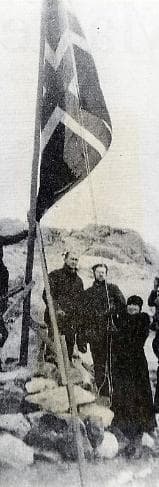
Danish, Norwegian · Exploration
Caroline Mikkelsen
November 20, 1906 – September 15, 1998
Early Life and Background
Caroline Mikkelsen was born on 20 November 1906 in Denmark, then part of the Kingdom of Denmark.[1][2][4] Little is recorded in the historical literature about her childhood, family background, or formal education. Available biographical notes generally limit themselves to stating her year and country of birth, reflecting the broader tendency in polar history to focus on expedition narratives rather than the domestic lives of participants.[1][2][3][10]
Denmark and neighboring Norway were, in the early twentieth century, deeply connected to maritime industries and polar exploration. Norwegian expeditions in particular, such as those led by Roald Amundsen and other whaling magnates, had made the Southern Ocean and Antarctic waters familiar arenas of national ambition.[8][10] It was within this milieu that Caroline’s life eventually intersected with the whaling industry and polar travel.
At some point before the mid‑1930s, Caroline married the Norwegian whaling captain Klarius Mikkelsen and moved from Denmark to Norway.[1][2][3][10][14] The exact date and circumstances of their marriage are not documented in the sources, but multiple national-language encyclopedias agree that she relocated to Norway after marrying him.[1][2][3][5] Through this marriage she entered the world of Norwegian commercial whaling and exploration, which would ultimately provide the context for her historic Antarctic journey.
Career Beginnings and Development
Caroline Mikkelsen is not known to have held a formal professional role in exploration or science; rather, her historical importance arises from her participation in a specific voyage as the wife of a ship’s captain. In the 1934–1935 Antarctic season, she accompanied her husband aboard the Norwegian whaling vessel M/S Thorshavn, part of an expedition sponsored by the influential whaling magnate Lars Christensen.[4][8][10]
Christensen financed a series of voyages intended both to exploit whaling grounds and to discover and map coastal territories that could potentially be claimed by Norway.[4][8][12] The Thorshavn was one of several vessels deployed for this dual commercial and exploratory purpose. The presence of Caroline on such a voyage was unusual at the time, as women were generally excluded from polar expeditions and whaling operations, which were seen as harsh, male-only environments.[12][19]
Sources indicate that she traveled aboard the Thorshavn during the winter of 1934–1935, when the ship operated in Antarctic waters searching for new land along the coast that might be annexed.[4][8][10] The literature does not provide a precise departure date from Norway or arrival date in Antarctic waters; instead, it describes the voyage broadly as taking place during that season.[4][8] Within this framework, Caroline’s role was as a passenger and participant in shore activities rather than as a professional navigator or scientist.
Major Antarctic Accomplishment
Mikkelsen’s enduring claim to historical significance centers on a single, well-documented event: her landing in Antarctica on 20 February 1935. On that day, the Thorshavn was operating near the Vestfold Hills, a coastal region of East Antarctica situated close to where Australia’s Davis Station would later be built.[1][4][8]
Accounts from the expedition, later confirmed by historical and geographical research, relate that Caroline joined her husband and several crew members in a small boat that left the Thorshavn and approached a nearby shore.[1][4][10] The landing site was long thought to be part of the Antarctic mainland. However, later work on the region’s geography clarified that they went ashore on an island in the Tryne Island group, just off the continental coast.[1][8][19]
Upon landing, the group participated in building a cairn—a stone monument—on the site, and they raised the Norwegian flag to assert Norway’s interest in the territory in line with Christensen’s ambitions.[1][4][8] Caroline assisted in these activities, making her more than a passive observer. The cairn marked the landing and served as a visual symbol of Norway’s exploratory and quasi‑territorial presence. Later documentation, including official records and historical surveys of the Vestfold Hills region, tied this cairn to the Thorshavn expedition and to Mikkelsen’s participation.[8][19]
This 20 February 1935 landing is now widely considered the first recorded instance of a woman setting foot in Antarctica.[1][2][4][10][15] Guinness World Records explicitly dates the achievement to 20 February 1935 and names Caroline Mikkelsen as the woman who first set foot on Antarctica.[15] English, Norwegian, Spanish, Japanese, Maltese, and other language versions of Wikipedia echo this assessment, noting her as the first woman to go ashore in the Antarctic region.[1][2][4][5][6]
Later geographic scrutiny revealed that the landing site was not strictly on the continental landmass but on a nearby island. As a result, modern accounts carefully distinguish Mikkelsen’s achievement from that of Ingrid Christensen, who is credited as the first woman to set foot on the Antarctic mainland in 1937.[1][4][6][12] Nonetheless, the consensus remains that Mikkelsen was the first woman documented to set foot anywhere in Antarctica, whether mainland or offshore islands.
Awards, Honors, and Recognition
Caroline Mikkelsen’s name has been memorialized primarily through geographic nomenclature rather than formal medals or institutional prizes. A prominent coastal feature, Mount Caroline Mikkelsen (also referred to as Mount Karoline Mikkelsen), along the Ingrid Christensen Coast in Princess Elizabeth Land, was named in her honor.[4][8] This mountain appears in international gazetteers and mapping resources, symbolically anchoring her name in the Antarctic landscape she helped make historically significant.
The naming of Mount Caroline Mikkelsen is commonly dated to the 1930s, following or in conjunction with the voyages sponsored by Lars Christensen, though sources do not specify an exact day.[4][8] The choice to commemorate her in this way reflects recognition by the Norwegian and international polar communities that her participation in the 1935 landing was noteworthy for the history of gender and exploration.
Beyond geographic honors, modern institutions have highlighted her achievement in educational and commemorative contexts. The Guinness World Records entry, "First woman to set foot on Antarctica," formally recognizes her record and reinforces the date and circumstances of her landing.[15] Contemporary outreach by organizations such as national Antarctic programs and polar research websites also feature her story. For example, Australia’s Antarctic Division discusses her 1935 voyage and landing in its historical notes about Davis Station and the Vestfold Hills region.[8] The AntarcticGlaciers.org educational site similarly profiles Mikkelsen in a section on people linked to Antarctic history, emphasizing her role as the first woman to go ashore.[19]
These forms of recognition, while not awards in the traditional sense, contribute to an evolving historiography that increasingly foregrounds women’s roles in polar exploration. They ensure that Mikkelsen’s name appears alongside those of male explorers and patrons who shaped mid‑twentieth‑century Antarctic activity.
Personal Life
The sources provide only limited glimpses into Caroline Mikkelsen’s personal life. It is known that she married Klarius Mikkelsen, a Norwegian whaling captain, and moved from Denmark to Norway following their marriage.[1][2][3][10][14] Klarius commanded whaling and whale‑oil tankers for the Norwegian industry, including the Thorshavn, which was central to Caroline’s Antarctic experience.[8][10][16]
Later in life, Caroline married again; several encyclopedic entries note that she subsequently took the surname Mandel (sometimes spelled "Mandel" or "Mandel" in transliteration), indicating a second marriage.[1][5][6] The dates and details of this later marriage, including her spouse’s identity and whether she had children, are not documented in the available sources. This lack of detail is typical for many historical figures whose public significance is tied to a single event rather than a sustained public career.
Retrospective accounts mention that she lived a relatively quiet life after her Antarctic voyage, with few public statements about the expedition until decades later.[7][19] In these narratives, her personal life remains largely in the background, overshadowed by the symbolic meaning later attributed to the 1935 landing. It is clear, however, that she spent much of her adult life in Norway and died there in 1998.[4][11]
Legacy and Historical Impact
The legacy of Caroline Mikkelsen lies above all in her role as the first recorded woman to set foot in Antarctica and in the subsequent reassessment of women’s participation in polar exploration. For much of the twentieth century, polar history was written in ways that emphasized male explorers, captains, and scientists, often omitting or marginalizing women’s involvement. Mikkelsen’s story illustrates how a woman, initially present as a captain’s wife, nonetheless entered the historical record as a barrier‑breaking figure.[1][2][4][10]
Her 1935 landing has become a key date in timelines tracing the gradual inclusion of women in Antarctic travel and research. Educational articles on the "first women" in Antarctica typically begin with Caroline Mikkelsen’s landing, then move to Ingrid Christensen’s 1937 mainland landing and the later arrival of women scientists in the mid‑twentieth century.[12][19] This sequence highlights the shift from symbolic presence—women accompanying husbands or patrons—toward substantive scientific and logistical roles.
The clarification that Mikkelsen landed on an island rather than the mainland has prompted historians to refine their language without diminishing the importance of her achievement.[1][8][19] As a result, careful distinctions are now made between the "first woman to set foot in Antarctica" (Mikkelsen) and the "first woman to stand on the Antarctic mainland" (Christensen).[1][4][6][12] These distinctions are important for geographic accuracy and for understanding how different forms of "firsts" are recognized in exploration history.
Mount Caroline Mikkelsen on the Ingrid Christensen Coast stands as a geographic embodiment of her legacy.[4][8] Its presence in maps and gazetteers ensures that her name remains physically inscribed in the Antarctic environment. In addition, modern commemorations—from Guinness World Records to national Antarctic programs and popular history articles—continue to recount her story, often as part of broader efforts to recover women’s contributions that were long overlooked.[8][10][19]
Her life also illustrates the long delay between an historical act and its full recognition. Some accounts note that she did not speak publicly about her Antarctic voyage until roughly sixty years later, suggesting that her own perception of the event may have differed from the symbolic importance later assigned to it.[7][19] This gap underscores how historical significance can grow over time as scholars and institutions revisit past records with new questions about gender and representation.
Later Life and Death
After the 1935 Thorshavn expedition, Caroline Mikkelsen largely disappeared from the public record for several decades. The available sources indicate that she lived in Norway, at some point remarried and took the surname Mandel, and did not prominently engage in further exploration or public lecturing about Antarctica.[1][5][6] Her life seems to have followed a private trajectory, even as her 1935 landing gradually gained recognition among polar historians.
Accounts by institutions such as the Royal Society and Antarctic history websites mention that Mikkelsen spoke about her Antarctic voyage only around sixty years after the event, although they do not specify a precise date.[7][19] This late recollection coincided with a period when historians were reexamining women’s roles in science and exploration and when Antarctic programs were increasingly documenting their own histories.
Caroline Mikkelsen died on 15 September 1998 in Norway.[2][4][6][11] Multilingual encyclopedic sources agree on this date and location, recording her age as 91 or 92, depending on the method of calculation.[2][4][11] Her death closed the life of a woman whose public legacy depended heavily on a single event but whose story has become emblematic of the broader struggle for recognition of women in exploration.
In the years since her death, articles, educational pieces, and social media commemorations have increasingly highlighted Mikkelsen each year on 20 February, marking the anniversary of her landing.[10][17] These acknowledgments, alongside the continued presence of Mount Caroline Mikkelsen on maps and in gazetteers, ensure that her contribution to Antarctic history remains visible to scholars, students, and the general public.
Dated achievements
3 indexed.
- Nov201906Science
Birth of Caroline Mikkelsen
Caroline Mikkelsen was born in Denmark, later becoming a Danish-Norwegian explorer known for early Antarctic exploration.
View details Caroline Mikkelsen - Wikipedia - Feb201935Exploration
First recorded woman to set foot in Antarctica
Caroline Mikkelsen landed from the whaling ship M/S Thorshavn on an island near the Vestfold Hills, becoming the first woman recorded to set foot in Antarctica.