← All women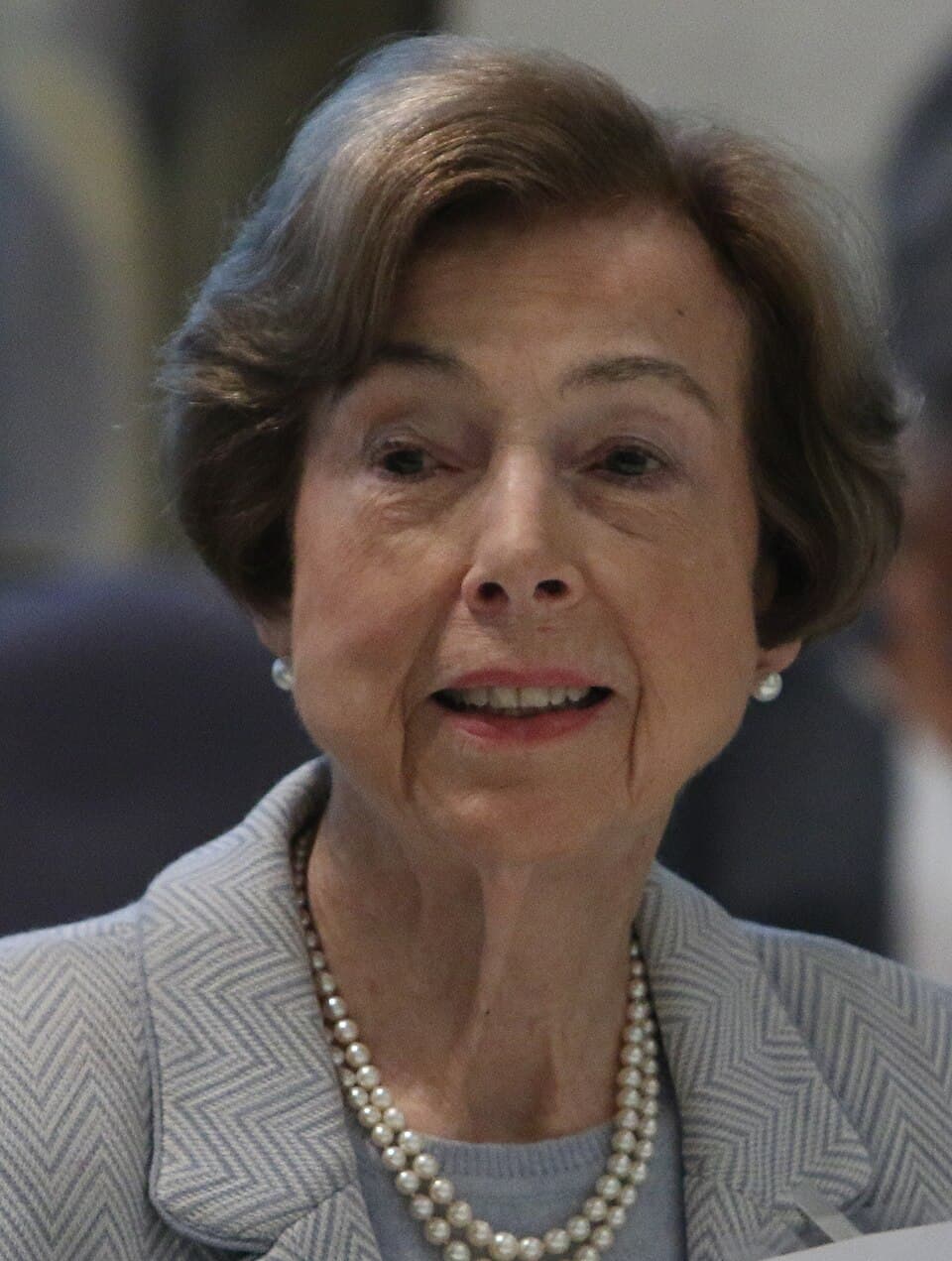
American · Politics · Law
Carla Anderson Hills
January 3, 1934 – present
Early Life and Background
Carla Anderson Hills was born on January 3, 1934, in Los Angeles, California, the daughter of Carl H. Anderson and Edith (Hume) Anderson.[5][9][12] Growing up in Southern California in the midst of the Great Depression and its aftermath, she came of age in a region undergoing rapid urbanization and social change. Her parents’ encouragement of education and achievement helped set her on a path that would be unusual for women of her generation: a career in law and high government office.[5]
After completing her early schooling, Hills pursued higher education at institutions that would become central to her development as a lawyer and policymaker. She studied at St Hilda’s College, Oxford in 1954, gaining exposure to comparative legal and political traditions.[9][12] She then earned her A.B. degree from Stanford University in 1955, a time when relatively few women attended elite universities and even fewer planned to enter the legal profession.[3][9][12]
Hills continued on to Yale Law School, where she received her LL.B. degree in 1958.[2][3][8][9] Yale’s law program placed her among the leading legal minds of her generation and gave her rigorous training in federal practice, litigation, and statutory interpretation. In an era when law schools had only small numbers of female students, Hills’s success there foreshadowed her later ability to navigate male‑dominated professional environments in both law and government.
Legal Training and Early Career
Upon graduating from Yale, Hills was admitted to the California bar in 1959.[3][8][9] She began her legal career as an Assistant United States Attorney in Los Angeles, serving from 1959 to 1961 according to primary biographical materials from the Gerald R. Ford Administration.[9][6][12] In this role, she represented the federal government in civil and criminal matters, gaining courtroom experience and familiarity with federal law enforcement and regulatory practice.
After her service as an Assistant U.S. Attorney, Hills entered private practice. By the early 1960s she had become a partner at the Los Angeles law firm that later operated under the name Munger, Tolles, Hills & Rickershauser.[6][9][12] She remained in private practice from approximately 1962 until March 1974, focusing on complex civil litigation, federal civil procedure, and antitrust matters.[6][9][12] Her work in this period included co‑authoring Federal Civil Practice (1961) and editing and co‑authoring Antitrust Advisor (1971), publications that reflected her expertise in federal civil procedure and competition law.[9]
In addition to her practice, Hills contributed to legal education. She served as an adjunct professor at the University of California, Los Angeles (UCLA) in the spring of 1972, teaching courses related to her areas of specialization.[9][12] She also held roles such as trustee of Pomona College, demonstrating an early engagement with higher education governance.[12]
Entrance into High-Level Government Service
Hills’s entry into high‑level federal government service came in the early 1970s, a period of expanding roles for women but still profound gender disparities in senior positions. By 1974, she had been appointed Assistant Attorney General in charge of the Civil Division of the U.S. Department of Justice.[3][6][12] In this position, she oversaw the division responsible for representing the United States in a wide range of civil litigation, including cases involving constitutional challenges, federal statutes, and regulatory actions.
As the head of the Civil Division, Hills was one of the highest‑ranking women in the Justice Department and one of the few women heading a major legal unit within the federal government.[6][13] Her appointment reflected recognition of her legal acumen and managerial ability, and it placed her at the center of important disputes over federal authority and policy implementation.
Secretary of Housing and Urban Development (1975–1977)
In February 1975, President Gerald R. Ford nominated Hills to serve as Secretary of Housing and Urban Development (HUD).[5][1] The nomination was formally made on February 13, 1975, according to detailed historical and oral‑history accounts.[5][1] Following Senate consideration and confirmation, Hills was sworn in on March 10, 1975, becoming the 5th HUD Secretary, the first woman to lead the department, and only the third woman ever to serve in a U.S. presidential Cabinet.[2][4][7][11]
As HUD Secretary, Hills presided over the implementation of the Housing and Community Development Act of 1974, which introduced major new programs that would shape federal policy for decades. Among these were the Section 8 housing assistance program, providing rent subsidies to help low‑income households access private rental housing, and the Community Development Block Grant (CDBG) program, which consolidated multiple categorical grants into flexible funding for cities and localities to pursue community development.[3][6] Contemporary HUD and later retrospective accounts emphasize Hills’s role in overseeing the early implementation of these initiatives.[1][6]
Hills’s tenure at HUD from 1975 to 1977 coincided with fiscal pressures and evolving debates about urban policy, racial equity, and the federal government’s responsibility for housing.[2][3][7] She sought to streamline programs and emphasize local control, consistent with broader trends in federal policy during the mid‑1970s. As one of the few women in the Cabinet, she also served as a visible symbol of the gradual inclusion of women in top executive roles.
Hills left the HUD post at the conclusion of the Ford Administration in 1977.[2][3][13] Although her term was relatively brief, the programs implemented under her leadership—especially Section 8 and CDBG—became enduring pillars of U.S. housing and community development policy.
Return to Law and Corporate Leadership
After leaving HUD, Hills returned to private practice and corporate governance. She resumed her work as a lawyer, bringing to clients substantial experience in federal policy and regulation. She later became Chairman and Chief Executive Officer of Hills & Company, International Consultants, a firm advising businesses on global trade and investment.[1]
Hills also served on numerous corporate boards. Notably, she joined the board of Chevron, one of the world’s largest energy companies. In a later oral‑history interview, Hills recounted that she was the first woman to serve on Chevron’s board of directors, underscoring her trailblazing role in corporate governance within the energy sector.[1][13] She also held board memberships with other major corporations and nonprofits, extending her influence beyond government into the private sector.
United States Trade Representative (1989–1993)
In 1989, President George H. W. Bush selected Hills for a major international economic post. On August 11, 1989, Bush announced his intent to nominate her as United States Trade Representative (USTR).[2][13] Following confirmation, Hills was sworn in on November 1, 1989 as the 10th USTR.[2][13]
Hills’s appointment was historically significant. She became the first woman to hold the USTR position and, according to contemporaneous characterizations, the first person to have served in both a Cabinet office (HUD Secretary) and a Cabinet‑rank position (USTR).[2][4][11] As USTR, she was a member of the president’s Cabinet and his principal advisor on international trade policy, as well as the chief U.S. trade negotiator.[1][6]
During her term from 1989 to 1993, Hills played a central role in major trade negotiations. She was a key architect of the North American Free Trade Agreement (NAFTA), negotiating with Canada and Mexico over tariff reductions, market access, and rules affecting investment and services.[6][13] She also represented the United States in the Uruguay Round of the General Agreement on Tariffs and Trade (GATT), which sought to expand the global trade regime to cover services, intellectual property, and agricultural trade.[6]
Hills’s work as USTR required navigating intense domestic and international debates over globalization, labor standards, and environmental protections. Her leadership in these negotiations placed her at the center of decisions that would shape the trajectory of North American and global trade in the late twentieth century.
Later Public Roles and Policy Influence
After leaving the USTR post in 1993, Hills continued to exert influence on international trade and foreign policy. She remained active through Hills & Company, International Consultants, advising businesses and governments on trade, investment, and regulatory issues.[1]
Hills also became deeply involved in foreign policy think tanks and nonprofit organizations. She served on the board of the Council on Foreign Relations (CFR), and by the 2000s she was reported as serving as co‑chair of the organization alongside Robert Rubin, helping guide its programs and discussions on global economic and security issues.[7][13] Her participation in CFR and other institutions reflected a continued commitment to shaping debate over trade, globalization, and U.S. engagement with the world.
In addition, Hills served on numerous corporate and nonprofit boards across sectors, including finance, energy, and education, reflecting a broad portfolio of leadership roles.[13] Through these positions, she helped integrate legal and policy perspectives into corporate and institutional governance and advocated for open markets and international cooperation.
Awards, Honors, and Recognition
Hills’s contributions to housing policy, law, and trade have been recognized by a variety of institutions. In October 2008, Affordable Housing Finance inducted her into its Affordable Housing Hall of Fame, citing her influence on housing programs and affordable housing production as HUD Secretary.[1] The honor reflected the enduring importance of Section 8 and CDBG and acknowledged her role in their early implementation.
Her pioneering status as a woman Cabinet officer and trade representative has been highlighted in legal and historical projects. Yale Law Women included Hills in its Portraits Project, documenting her career as a trailblazing alumna of Yale Law School and emphasizing her accomplishments as HUD Secretary and USTR.[2] The American Bar Association’s Women Trailblazers in the Law project produced an extensive oral history with Hills, further cementing her place in the history of women in the legal profession.[13]
On International Women’s Day, March 8, 2012, the U.S. Department of Housing and Urban Development publicly recognized Hills as the first woman to lead HUD and as an important figure in implementing Section 8 and CDBG, reaffirming her pioneering role in federal housing policy.[1] This institutional recognition underscored the continuing relevance of her service decades after she left office.
Personal Life
Carla Anderson married Roderick M. Hills, a lawyer and public official who later served as Chairman of the U.S. Securities and Exchange Commission (SEC).[9][12][13] The couple had four children
Hills’s marriage to a fellow high‑ranking legal and regulatory figure created a household firmly embedded in the world of federal policymaking. While the available sources focus primarily on her professional accomplishments, they indicate that family and professional spheres were intertwined, as is common among couples engaged in public service. Carla Anderson Hills’s legacy is multifaceted. In women’s history, she is notable as the first woman Secretary of Housing and Urban Development, the third woman Cabinet member, and the first woman United States Trade Representative.[2][4][7][11] Contemporary descriptions also credit her as the first person to serve in both a Cabinet and Cabinet‑rank position.[2][4] Her career demonstrates how a woman with strong legal training could ascend to leadership roles in both domestic policy and international trade. In housing and urban policy, Hills’s tenure at HUD is closely associated with the early implementation of Section 8 and CDBG, programs that have become central to federal efforts to support low-income renters and local community development.[3][6] Her work helped institutionalize mechanisms that allow households to access private rental markets and communities to tailor development strategies to local needs. In international trade, Hills’s term as USTR from 1989 to 1993 placed her at the center of negotiations that reshaped global and regional trade rules, including the Uruguay Round and NAFTA.[6][13] Supporters and critics alike acknowledge the significance of these agreements in expanding trade flows and altering the economic landscape of North America and the broader world. Hills’s career also has symbolic importance. She broke gender barriers in the Justice Department, HUD, the USTR office, and corporate boardrooms, including energy-sector governance at Chevron. Her path from Yale Law School to Cabinet and corporate leadership has served as a model for subsequent generations of women lawyers seeking careers in government, international affairs, and business. Biographical references in the 2000s and 2010s consistently describe Carla Anderson Hills as living and active in public and corporate affairs.[1][2][6][13] She has continued her involvement with Hills & Company, the Council on Foreign Relations, and other boards and advisory roles, providing counsel on trade, investment, and globalization. Her papers, covering the period from roughly 1965 to 2003, are preserved in archival collections such as the Carla Anderson Hills papers described by the Online Archive of California, providing rich documentation of her public service and policy work.[6] These materials, together with oral histories and institutional biographies, ensure that historians, legal scholars, and students can study her contributions to law, housing policy, and international trade. As of the most recent sources, Hills remains one of the earliest‑serving living former U.S. Cabinet members, linking current debates on trade and housing to the policy environment of the 1970s and late Cold War era.[2] Her career stands as a testament to the ways in which women’s participation in law and government has expanded, and to the lasting impact that such participation can have on domestic and international policy frameworks.Legacy and Historical Impact
Later Life and Status
Dated achievements
9 indexed.
- Jan031934Law
Birth of Carla Anderson Hills
Carla Anderson Hills was born in Los Angeles, California, later becoming a trailblazing lawyer and U.S. government official.
View details Carla Anderson Hills - Britannica - Feb131975Politics
Nominated as U.S. Secretary of Housing and Urban Development
President Gerald Ford formally nominated Carla Anderson Hills to be the 5th U.S. Secretary of Housing and Urban Development.