← All women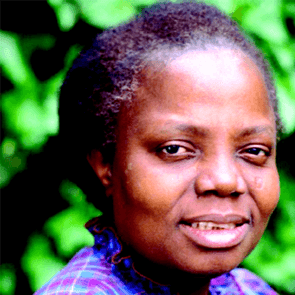
Nigerian, British · Literature · Activism
Buchi Emecheta
July 21, 1944 – January 25, 2017
Early Life and Background
Florence Onyebuchi "Buchi" Emecheta was born on 21 July 1944 in Yaba, near Lagos, Nigeria, to Igbo Christian parents, Alice Ogbanje Emecheta (née Okwuekwuhe) and Jeremy Nwabudinke Emecheta, a railway worker. Her family originated from Umuezeokolo Odeanta village in Ibusa, an old Igbo kingdom in present-day Delta State.[10][1][2] Growing up in a modest household in colonial Nigeria, she experienced both the possibilities and limitations faced by girls in a society undergoing rapid political and social change.
Emecheta’s father valued education and managed to send her to an all-girls missionary school, which was unusual for many girls of her generation.[3][10] However, after his death her schooling was interrupted, and she was withdrawn from secondary education so the family could direct scarce resources elsewhere.[3] This early loss and the truncation of her formal education left a deep impression. Throughout her later writing, she would return to the theme of how girls’ educational opportunities are sacrificed for others, and how education can become a path to freedom for women.
Her upbringing in Lagos exposed her to both urban life and traditional Igbo customs. She also lived for periods in her parents’ home community of Ibusa, giving her intimate knowledge of village structures, family obligations, and customary practices such as bride price—all of which would later feature prominently in her fiction. The tensions between urban and rural, colonial administration and indigenous authority, and Christian missionary values and local beliefs formed a complex backdrop for her developing consciousness as a writer.
Marriage, Migration, and Formative Struggles
At approximately 16 years old, soon after leaving school, Emecheta married Sylvester Onwordi, a fellow Nigerian.[2][6][11] The marriage quickly proved difficult. She had two children in Nigeria and, as was common for aspiring professionals in the early postcolonial period, her husband travelled to London to study. In 1962, Emecheta followed him to Britain by boat, bringing their children with her, expecting to study librarianship for two years before returning home.[2][6]
Instead, she found herself living in cramped conditions in London and confronting the realities of racism, economic hardship, and marital abuse. She gave birth to three more children, bringing the total to five, and had to abandon her own professional aspirations to care for them.[6][11] Her husband’s controlling and violent behaviour escalated, culminating in a notorious incident in which he burned the manuscript of her first novel—an act that, paradoxically, confirmed for her how important writing had become.[6][3]
By the mid-1960s Emecheta resolved to leave the marriage. Taking her children, she set out to build an independent life in Britain. She worked in various jobs, including in the British Museum Library, while pursuing further education and writing at night.[2][6] The struggles of this period—living in London council housing, navigating the welfare system, and supporting five children alone—provided the raw material for her early autobiographical fiction. They also made her acutely aware of how social policies and structural racism affected migrant women, themes that would become central to her literary work.
Career Beginnings and Development
Emecheta’s determination to write survived both the burning of her manuscript and the constraints of her daily life. She reconstructed the destroyed novel and continued producing stories and articles, submitting them to publishers and newspapers. Her first major breakthrough came with the publication of In the Ditch in 1972, based on her experiences as a single mother living in a London council estate.[11][1] The book was initially serialized in the New Statesman, then published as a novel by Allison & Busby, a London-based independent press known for supporting Black authors.
In the Ditch offered a candid portrayal of poverty, bureaucratic indifference, and the stigma attached to welfare mothers in Britain. It was unusual not only for its frankness but also because it presented these issues from the perspective of a Black African woman, at a time when Black British women’s voices were largely absent from mainstream fiction. The book established Emecheta as a new literary presence and attracted critical attention to her work.
Two years later, in 1974, she published Second-Class Citizen, which expanded on the story begun in In the Ditch.[1][4][11] The novel follows Adah, a Nigerian woman who emigrates to Britain, faces the devaluation of her qualifications, encounters racism in housing and employment, and endures an abusive husband while striving to become a writer. Drawing heavily on Emecheta’s own experiences, the book exposes the intersecting oppressions of race, gender, and class that produced a sense of being a “second-class citizen” in British society. It quickly became one of her best-known works and remains central to analyses of Black British women’s writing.
During the mid-1970s, Emecheta continued to publish prolifically. The Bride Price appeared in 1976, based partly on her grandmother’s life in Ibuza.[1][4] In this novel, she explores the Igbo custom of bride price and its implications for women’s autonomy, highlighting how the economic value assigned to a bride can constrain her choices in marriage and life. The following year, The Slave Girl (1977) turned to 1920s Nigeria, depicting domestic slavery and its impact on the lives of young girls within a hierarchical household.[1][4] Both works broadened Emecheta’s scope beyond the migrant experience to encompass historical and cultural critiques of Nigerian society.
By 1979 she published The Joys of Motherhood, which would become her most widely studied novel.[1][2][11] Set between Ibuza and Lagos, it follows Nnu Ego, an Igbo woman whose worth is measured by her capacity to bear children. The novel scrutinizes the romanticized notion that motherhood is inherently fulfilling, instead portraying the sacrifices and disappointments that can accompany the role in both traditional and rapidly urbanizing settings. It resonated with readers and scholars across disciplines and secured Emecheta’s reputation as a major voice in African and feminist literature.
Major Works and Themes
Across her career, Emecheta wrote more than 20 books, including novels, autobiographical texts, children’s books, plays, and essays.[14][9][5] Among her later novels are Double Yoke (1983), set in a Nigerian university and dealing with campus life, gender relations, and the clash between traditional expectations and modern aspirations.[4][7] In The New Tribe (1996), she turned to questions of identity, adoption, and race in Britain through the story of a Nigerian boy raised by a white British family.[4] These works demonstrate her continued interest in how individuals negotiate multiple cultural identities across Nigerian and British contexts.
Recurring themes in Emecheta’s writing include:
- Child slavery and domestic servitude: especially in The Slave Girl, where she portrays the psychological and social implications of enslavement for girls.[1][14]
- Motherhood: explored critically in The Joys of Motherhood, which questions idealized visions of maternal self-sacrifice.[1][2]
- Female independence and education: present throughout her work, where education is repeatedly depicted as a route to autonomy and self-definition for women.[1][5]
- Migration and racism: particularly in In the Ditch and Second-Class Citizen, which chart the experiences of Nigerian migrants in Britain and the structural discrimination they face.[1][6]
- Tradition versus modernity: a central tension in novels set in Nigeria, where customs such as bride price and patriarchal authority are juxtaposed with changing social realities.[2][14]
Stylistically, Emecheta’s prose is often described as accessible, documentary, and unsentimental. She drew heavily on her own life and those of women around her, blending personal testimony with fictional narrative to illuminate broader social structures. Critics have noted that her work does not simply condemn tradition or celebrate modernity; rather, it examines how women navigate pressures from both spheres and make choices within constrained circumstances.
Academic Work, Publishing, and Public Engagement
Alongside her writing, Emecheta pursued academic study. After arriving in Britain, she became a student at London University, where she read sociology.[7] This training informed her analytical approach to social structures in her fiction, particularly in relation to class, gender, and migration.
Emecheta also contributed articles and stories to British newspapers and magazines, including the New Statesman, and worked in educational and advisory roles.[5] She lectured in the United States and Europe, participating in conferences and university courses on African literature and women’s writing. Her presence in academic circles helped bring African women’s perspectives into curricula that had previously focused on male or Western authors.
In later years, she founded a small publishing company aimed at supporting Black writers, reflecting her commitment to creating channels for underrepresented voices.[5] She served as a member of various literary and cultural organizations and was active in discussions about the representation of African women in literature and media. Although she often resisted being labelled a "feminist," insisting, "I work toward the liberation of women but I’m not a feminist, I’m just a woman," she was widely regarded as a major figure in feminist and women’s studies.[9]
Awards, Honours, and Recognition
Emecheta’s work garnered considerable critical acclaim from the 1970s onward. In reviews and scholarly studies, she has been described as one of Nigeria’s most distinguished literary figures and "to date the most important female African writer" by some commentators.[3][13] Her novels became standard texts in courses on African literature, gender studies, and postcolonial theory across the world.
In 2005, she was appointed an Officer of the Order of the British Empire (OBE) for services to literature, a national honour recognizing her contributions to British and global letters.[1][8][9] This recognition was particularly meaningful given that much of her work exposed the hardships faced by Black and immigrant women in Britain; the honour signaled a growing institutional acknowledgment of the importance of such narratives.
Throughout her career, Emecheta also received various academic distinctions, including honorary degrees and invitations as visiting writer or lecturer at universities.[5] Her books won critical awards and featured on influential reading lists in Africa and the diaspora. Scholars and fellow writers have repeatedly emphasized her role in opening space for African women’s voices and in shaping the emergent field of Black British women’s writing.
Personal Life and Identity
Emecheta’s personal life was marked by resilience in the face of adversity. Her early marriage to Sylvester Onwordi, the birth of five children, and the decision to leave an abusive relationship in a foreign country forced her to confront the practical realities of survival as a single mother. She often wrote at night, after long days of paid work and caregiving, demonstrating a remarkable commitment to her craft.[6][5]
Her experience as a Nigerian woman in Britain shaped her sense of identity. While deeply rooted in Igbo culture and frequently returning to Nigeria in her fiction, she spent most of her adult life in the United Kingdom and is frequently described as a Nigerian-British writer.[3] This dual perspective allowed her to critique both Nigerian and British societies, highlighting forms of patriarchy and racism in each.
Emecheta was widely quoted for her nuanced stance on feminism. Though she rejected the label, she consistently articulated a commitment to women’s liberation and the importance of women’s autonomy, particularly through education and economic independence.[9][5] Her position reflected both generational differences in how feminism was understood and a desire not to be confined by Western categorizations, even as she contributed substantially to feminist thought.
Legacy and Historical Impact
Buchi Emecheta occupies a central place in the history of women’s and African literature. Critics have characterized her as "the first successful black woman novelist living in Britain after 1948," underlining her pioneering role in a literary landscape that had marginalized Black women’s voices.[1][14] Her success demonstrated that stories centered on African women’s lives—whether in Nigeria or the diaspora—could reach international audiences and reshape understandings of gender and race.
Her novels are widely taught in universities across Africa, Europe, and North America. Second-Class Citizen and The Joys of Motherhood in particular have become core texts in courses on migration, motherhood, and postcolonial feminism.[1][2] Scholars use her work to examine issues such as domestic violence, welfare policy, colonial and postcolonial governance, and the intersection of race, gender, and class in everyday life.
In African feminist discourse, Emecheta is recognized for foregrounding women’s everyday experiences—childbearing, household labour, marital negotiations, and community ties—as sites where power is exercised and contested. She challenged both patriarchal customs and simplistic Western portrayals of African women, insisting on the complexity of their motivations and the structural constraints they face.
Her influence extends beyond the academy. Many later African and Black British women writers have cited Emecheta as a trailblazer whose work made their own careers possible. She contributed to a broader cultural shift in which African women are more visible as authors, scholars, and cultural critics. As a result, her novels continue to be reprinted, translated, and adapted, keeping her voice present in contemporary debates about gender and social justice.
Later Life and Death
In her later years, Emecheta remained based in London, continuing to write and participate in literary and academic events, though at a slower pace than during her most prolific decades. She maintained ties with Nigeria and with African literary networks, and her works were frequently discussed at conferences and in journals devoted to African and women’s writing.
On 25 January 2017, Emecheta died in her sleep at her home in London following complications of a stroke, at the age of 72.[11][7][2] News of her death was reported by major outlets such as the BBC, and tributes poured in from writers, scholars, and readers across the globe. Obituaries emphasized her role as a champion of girls and women, her exploration of the challenges of motherhood and migration, and her insistence on the value of women’s voices.[7]
Her death marked the end of a remarkable journey from a girl in Yaba whose education was cut short, to a single mother in London writing by night, to an internationally recognized novelist and recipient of a British state honour. In the years since, renewed efforts have been made to preserve and circulate her work, including reissues of her major novels and scholarly assessments of her contribution.
Buchi Emecheta’s life and writing remain a touchstone in women’s history and postcolonial literature. Her stories continue to speak to readers navigating questions of identity, belonging, and justice, ensuring that her legacy endures well beyond her lifetime.
Dated achievements
8 indexed.
- Jul211944Literature
Birth of Buchi Emecheta
Buchi Emecheta was born in Yaba, Lagos, Nigeria, to Igbo parents.
View details Buchi Emecheta - Britannica Biography - Jan011972Literature
Publication of "In the Ditch"
Emecheta’s first novel, "In the Ditch," was published, detailing life as a Nigerian single mother in Britain.