← All women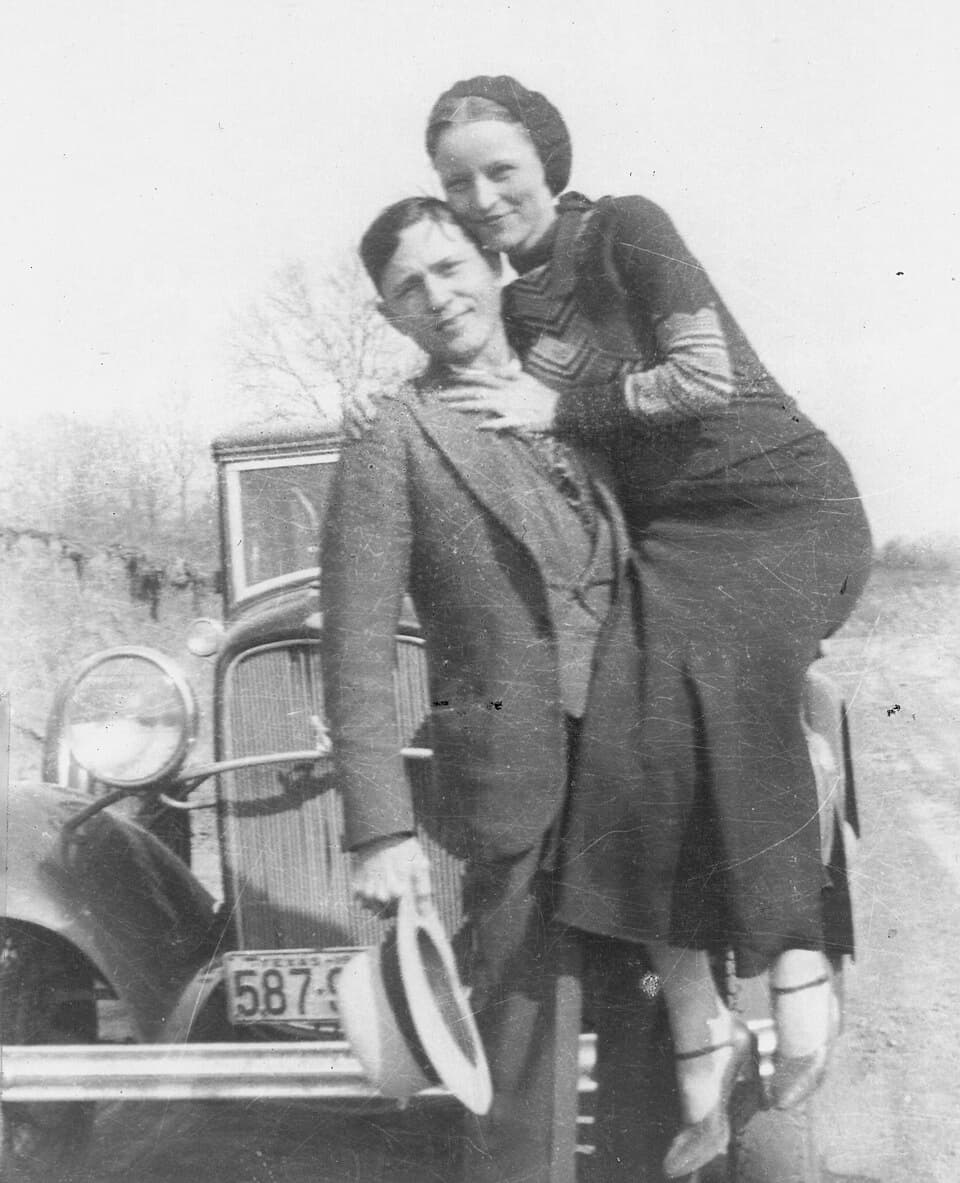
American · Politics
Bonnie Parker
October 1, 1910 – May 23, 1934
Early Life and Background
Bonnie Elizabeth Parker was born on October 1, 1910, in the small farming community of Rowena, Texas, as the second of three children in a working‑class family.[10][1][15] Her father, often identified as Charles or Henry Parker, worked as a bricklayer, and her mother, Emma Parker, managed the household. When Bonnie was about four years old, her father died suddenly, leaving Emma a widow with three young children to support.[1][15]
Following this loss, Emma Parker moved the family to the Dallas area, settling in a neighborhood sometimes referred to as Cement City or West Dallas, an industrial, low‑income district on the city’s outskirts.[1][8] Growing up there exposed Bonnie to urban poverty and social instability that would intensify during the economic downturn of the late 1920s and the Great Depression. Teachers and acquaintances later remembered her as bright, talkative, and imaginative, with a tendency to seek attention and engage in mischief.[15][8]
Parker reportedly excelled in school and showed particular aptitude for writing and dramatic expression. Some accounts note that she won classroom or local accolades for her compositions and had ambitions to become an actress or writer.[3][8] As a teenager, she also worked at a café, where she met people from various walks of life, including workers, drifters, and eventually, criminals. Her early environment—characterized by modest education, limited economic prospects, and exposure to street culture—provided the backdrop against which her later choices unfolded.
Marriage and Early Adulthood
At age sixteen, in 1926, Bonnie Parker married Roy Thornton, a local young man with a reputation for minor criminal activity.[1][2][8] The marriage quickly proved unstable. Thornton was frequently away, involved in burglaries and other offenses, and was eventually sentenced to a long prison term. Despite the breakdown of the relationship, Bonnie and Roy never formally divorced, and she remained legally married to Thornton throughout her later partnership with Clyde Barrow.[2][9]
During her early adulthood, Parker held low‑wage jobs, including work as a waitress and possibly as a seamstress or in similar service roles that were common for young women of her background.[3][8] She also studied or showed interest in stenography, an office skill that offered some hope of modest upward mobility. These efforts were constrained by the broader economic conditions of the late 1920s, as opportunities for poor women in Texas were limited and often precarious.
Emotionally and socially, this period was marked by frustration and disappointment. Thornton’s imprisonment left Bonnie with a failed marriage and few resources. The combination of personal upheaval and structural economic hardship has been highlighted by historians as part of the context that made the companionship and excitement offered by Clyde Barrow particularly compelling when she met him.
Meeting Clyde Barrow and Entry into Crime
Bonnie Parker met Clyde Barrow in 1930 in West Dallas, when she was nineteen and he was twenty‑one.[9][11] Accounts differ on the exact circumstances, but many suggest that they were introduced through mutual friends or encountered one another at a house gathering. The attraction between them was immediate, and their relationship quickly deepened into a powerful emotional bond.
Shortly after their meeting, Barrow was arrested for burglary and sentenced to prison in the Texas penal system.[3][9] During his incarceration, Bonnie reportedly visited him and maintained contact, reinforcing their connection. Barrow’s experiences in prison—where he later claimed to have endured brutal treatment—hardened him and intensified his resentment toward law enforcement and the state prison system.
Upon Barrow’s release in 1932, he reunited with Bonnie and began organizing a small gang to undertake robberies and other crimes across Texas and neighboring states.[9][11] Parker, still legally married to Roy Thornton but emotionally committed to Clyde, chose to join him, thereby entering into a life that would increasingly center on evading law enforcement and committing armed robberies. Scholars note that her decision reflected both personal loyalty and the limited legitimate options available to her, though the extent of her agency and enthusiasm for crime remains a subject of debate.[3][8]
Early Criminal Activity and First Arrest
As Barrow assembled associates such as Ralph Fults, the group began targeting hardware stores, small businesses, and eventually banks, though many robberies focused on gas stations and rural stores where security was weaker.[9][10] On April 30, 1932, Parker was arrested in Dallas, Texas, after Clyde Barrow and Fults were caught attempting to steal a safe from a hardware store.[1][2] Police detained Bonnie in connection with the attempted theft, and she spent a short period in jail.
The charges against Parker were ultimately dropped, and she was released.[1] This experience provided her first direct taste of incarceration, though brief, and illustrated the law’s initial uncertainty about how to categorize her—whether as an accomplice, an accessory, or merely a companion to Barrow. The episode is often cited by historians as an early indicator of her willingness to remain in proximity to criminal activity despite visible risks.
Following her release, Bonnie returned to Clyde and the gang rather than disengaging from the criminal milieu. This choice deepened her commitment to a life on the run and foreshadowed the more intense confrontations with law enforcement that lay ahead.
The Barrow Gang and Crime Spree, 1932–1934
Between 1932 and 1934, Bonnie Parker traveled with Clyde Barrow and a shifting group of accomplices across multiple states, including Texas, Oklahoma, New Mexico, Missouri, and others.[9][10] This group, later dubbed the Barrow gang, engaged in robberies of banks, grocery stores, filling stations, and occasionally committed car theft and kidnapping. Their crimes occurred against the backdrop of the Great Depression, when economic desperation, weak local policing, and social unrest provided opportunities for mobile gangs to operate.
Parker’s precise role in each crime is not always documented, and historians differ regarding her level of active participation. Some evidence suggests that she frequently served as lookout, driver, or logistical supporter rather than a principal gunman, though she did possess firearms and was involved in armed confrontations.[3][8] The gang is believed to have killed at least nine police officers and several civilians over the course of their spree.[10][11]
Their activities were chronicled by newspapers in vivid detail, often emphasizing the novelty of a female accomplice. Sensational headlines and photographs contributed to the perception of Bonnie and Clyde as glamorous, daring outlaws, even as many communities feared them as dangerous criminals. The media coverage also influenced law‑enforcement responses, prompting coordination among local sheriffs, state police, and eventually federal agencies.
Joplin Raid and Rise to National Notoriety
A decisive turn in Parker’s public image came on April 13, 1933, when police raided a Joplin, Missouri apartment where the Barrow gang had been living.[10][2] Believing they were confronting bootleggers, officers approached the residence and were met with gunfire from gang members. A chaotic firefight ensued, during which one law officer was killed. Bonnie and Clyde managed to escape in a stolen car, leaving much of their personal property behind.
Among the items recovered by police were rolls of undeveloped film and photographic prints depicting Bonnie and Clyde in a variety of poses. These included the now‑iconic image of Bonnie with a cigar in her mouth and a pistol in her hand, leaning against a car in a mock‑tough stance.[10] When the photographs were released to the press, they circulated nationwide, capturing the public’s imagination.
Historians widely agree that the Joplin raid images made Bonnie Parker one of the most famous female outlaws in American history.[9][2] The novelty of a young woman portrayed as armed and defiant challenged prevailing gender norms and contributed to her enduring legend. While the poses were likely intended as jokes within the gang, newspapers framed them as proof of a hardened female criminal, and the public responded with a mixture of fascination, horror, and admiration.
For women’s‑history scholarship, the Joplin raid is often viewed as a barrier‑breaking moment in which a woman’s criminal identity was constructed through mass‑mediated imagery rather than formal titles or records, demonstrating the power of photography and tabloid culture in shaping perceptions of women who stepped outside conventional roles.
Wellington Accident and Lasting Injury
On June 10, 1933, the Barrow gang experienced a serious setback near Wellington, Texas, when their car crashed while fleeing law enforcement.[1][12] The vehicle reportedly went off the road into a ditch or ravine after overheating or losing control. During the accident, the car’s battery ruptured, spilling acid onto Bonnie Parker’s leg.
The resulting burns were severe, leaving Parker with chronic pain, scarring, and limited mobility.[1] Some accounts suggest that parts of her leg were so damaged that she struggled to walk and occasionally needed assistance from Clyde or other gang members. Because the couple was constantly seeking to evade capture, they could not safely secure full hospital treatment, and her injuries were treated largely with home remedies and improvised care.
This episode revealed the physical toll of life as a fugitive and complicated stereotypical images of Bonnie as perpetually glamorous and agile. In practice, she spent much of the latter part of the gang’s career dealing with pain and impaired mobility, which likely influenced their tactics and may have reduced her active participation in certain operations.[8] The accident underscores how women involved in criminal ventures faced the same bodily dangers as men but often with fewer resources to obtain medical aid.
Eastham Prison Farm Breakout
On January 16, 1934, Clyde Barrow led a bold armed raid on Eastham Prison Farm in Texas, with Bonnie Parker among those present.[1][6] Eastham was part of the Texas prison system, known for harsh labor conditions and punitive practices. Barrow, who had served time there, harbored deep resentment toward the institution and sought both to free allies and to retaliate against perceived abuses.
During the breakout, the Barrow gang opened fire on guards, creating confusion and enabling the escape of several inmates, including Henry Methvin.[6] Parker’s participation in this raid placed her in direct opposition to state penal authority and elevated the gang’s status from opportunistic robbers to orchestrators of attacks on major correctional facilities.
The Eastham incident intensified law‑enforcement efforts to capture Bonnie and Clyde, prompting Texas officials to recruit seasoned officers such as retired Texas Ranger Frank Hamer to plan a strategic response.[6][12] It also drew public attention to the prison system, though in the context of the gang’s violence rather than formal reform movements. For scholars, the breakout illustrates how Parker’s life intersected with debates about criminal justice, cruelty in prisons, and the legitimacy of state authority.
Major Works, Writings, and Cultural Production
Though primarily remembered as an outlaw, Bonnie Parker also engaged in creative writing. She composed poems that reflected her experiences and self‑image, including verse recounting the adventures and eventual fate of Bonnie and Clyde.[3][14] One well‑known poem, often cited in later accounts, dramatizes their outlaw life and anticipates a violent end, underscoring her awareness of the dangers they faced.
Parker’s writings offer historians a rare first‑person window into the emotional and psychological dimensions of a woman living outside the law during the Great Depression. They reveal a blend of romantic fantasy, fatalism, and social commentary, complicating simplistic portrayals of her as either merely a ruthless criminal or a naïve follower.
Her poems, along with the Joplin photographs, contributed to the construction of a distinctive cultural persona: a young woman who embraced or at least played with the idea of herself as part of a famous outlaw couple. These materials have been analyzed in literary and cultural studies as early examples of women shaping their own public narratives even while constrained by poverty, gender norms, and criminal status.[14][8]
Awards, Honors, and Official Recognition
Bonnie Parker did not receive formal awards, honors, or institutional recognition during her lifetime. On the contrary, she was classified by law enforcement as a dangerous fugitive and, along with Clyde Barrow, was effectively treated as a "public enemy" during the early 1930s.[9][12]
Any subsequent cultural "honors" have taken the form of portrayals in film, literature, and popular music, which have alternately romanticized and condemned her. The most influential of these is the 1967 film Bonnie and Clyde, starring Faye Dunaway as Bonnie, which received critical acclaim and sparked intense debate about violence and morality in cinema.[9][11] While such representations have cemented her status as a significant figure in American cultural history, they do not constitute official honors in the conventional sense.
Personal Life and Relationships
Bonnie Parker’s personal life was dominated by two major relationships: her failed marriage to Roy Thornton and her partnership with Clyde Barrow. Thornton’s criminality and imprisonment effectively ended their domestic life, though the legal tie remained intact.[2][8] Parker reportedly kept her wedding ring and did not pursue divorce, a fact sometimes cited to emphasize her complex sense of loyalty and identity.
Her relationship with Clyde Barrow was emotionally intense and central to her adult life. Contemporaries and later chroniclers describe the bond as romantic and passionate, marked by mutual dependence and shared risk.[9][3] Parker chose to accompany Barrow despite repeated opportunities to leave, including after her arrest and after the Wellington accident. There is no reliable evidence that she had children.
In daily life on the run, Bonnie and Clyde lived in cars, tourist cabins, and temporary hideouts, often with other gang members. Their mobility and constant need to evade capture meant that Parker had little opportunity for stable domestic routines. Accounts from acquaintances and witnesses suggest that she remained sociable, talkative, and sometimes playful even under stress, occasionally singing, writing, or posing for photographs.[3][8]
Later Life and Death
By early 1934, the Barrow gang was under intense pressure. Many of their associates had been killed in shootouts or captured and imprisoned. Parker’s leg injury continued to trouble her, and the couple faced dwindling options for safe refuge.[1][12] At the same time, law‑enforcement agencies, including the Texas Rangers and local sheriffs, coordinated efforts to bring the couple to justice.
Retired Texas Ranger Frank Hamer was commissioned to track Bonnie and Clyde.[9][6] Hamer studied their habits and movements, eventually anticipating their travel patterns in Louisiana. Working with Louisiana law officers and Texas counterparts, he organized an ambush along a rural highway near Gibsland/Sailes, Bienville Parish.
On the morning of May 23, 1934, Parker and Barrow drove into the ambush site in their Ford V‑8.[10][12] The posse opened fire without issuing a clear warning, riddling the car with bullets and killing both occupants almost instantly. The FBI later described the operation as the culmination of one of the largest manhunts in U.S. history up to that time.[12]
Following the ambush, photographs of the bullet‑damaged car and the bodies were widely published, reinforcing public fascination and controversy. Parker’s mother, Emma, mourned her daughter and expressed sorrow over the choices that had led to such a violent end.[8] Bonnie Parker was twenty‑three years old at the time of her death.
Legacy and Historical Impact
Bonnie Parker’s legacy is complex and contested. On one level, she is remembered as a participant in a violent crime spree that resulted in numerous deaths and losses, contributing to public fear during the Depression‑era "public enemy" period.[9][10] Law‑enforcement agencies, including the FBI, highlight the seriousness of her offenses and the necessity of coordinated action to stop the gang.
On another level, Parker has become a folk figure and symbol of rebellion against economic hardship and authority. Her youth, gender, and romantic association with Clyde Barrow have encouraged popular interpretations that portray her as a tragic, doomed heroine or as a woman swept up in circumstances beyond her control.[3][8] The tension between these views—Bonnie as ruthless criminal versus Bonnie as romantic outlaw—continues to animate scholarly and public discussions.
The 1967 film Bonnie and Clyde played a decisive role in shaping modern perceptions of Parker. Starring Faye Dunaway and Warren Beatty, the film presented the couple as stylish, charismatic antiheroes, emphasizing their love story and the injustices they faced while largely downplaying the suffering of their victims.[9][11] The movie’s success influenced subsequent depictions of crime and violence in American cinema and prompted debates about the ethics of glamorizing criminals.
In women’s history, Bonnie Parker is significant for the way her life illuminates issues of gender, class, and media representation. She was a working‑class woman with limited formal power who nonetheless became a nationally recognized figure through photographs, newspaper stories, and later films. Her notoriety challenged conventional expectations about women’s roles in crime and made her an object of both fascination and moral panic.[8][3]
Scholars of criminology and cultural studies also use Parker’s story to examine how structural factors—poverty, lack of opportunity, punitive penal systems, and sensationalist media—can shape individual choices and public narratives. Her creative writings, though relatively few, provide a rare first‑person voice from within the world of Depression‑era outlawry, adding depth to our understanding of how she saw herself and her fate.[14][3]
Today, Bonnie Parker remains embedded in American cultural memory. Museum exhibits, historical articles, and documentaries revisit her life, often using her story to explore broader themes about crime, law enforcement, and the making of legends in modern mass media.[1][12] While interpretations vary, there is broad agreement that her life and death illustrate the intertwined forces of economic hardship, gender dynamics, and spectacle in shaping the history of crime in the United States.
Dated achievements
6 indexed.
- Oct011910Politics
Birth of Bonnie Elizabeth Parker
Bonnie Parker is born in Rowena, Texas.
View details Bonnie and Clyde - Wikipedia - Apr301932Politics
Arrest and brief imprisonment in Dallas
Bonnie Parker is arrested in Dallas after Clyde's attempt to steal a safe.
View details