← All women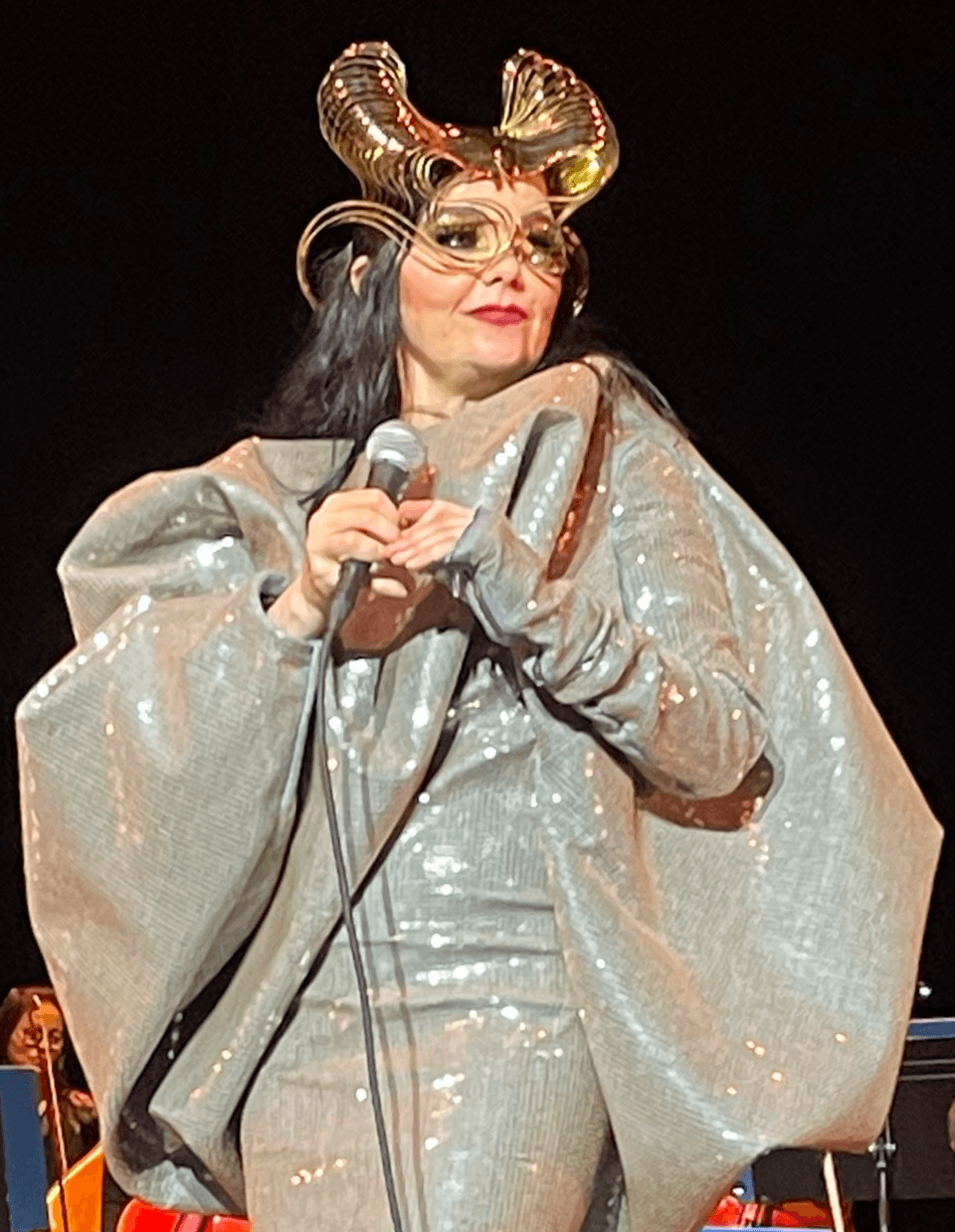
Icelandic · Arts
Bjork
November 21, 1965 – present
Early Life and Background
Björk Guðmundsdóttir was born on 21 November 1965 in Reykjavík, Iceland.[1][2][4] Her father, Guðmundur Gunnarsson, was an electrician and later a union official, while her mother, Hildur Rúna Hauksdóttir, was involved in visual arts and the alternative community.[7][1] Björk’s parents separated when she was young, and she spent part of her childhood in a hippie-style collective with her mother, surrounded by political discussions, experimental art, and communal living.[1][15] This unconventional environment shaped her openness to avant‑garde culture and non‑traditional ways of life.
Björk attended Reykjavík’s music school, where she studied classical piano and flute.[1][15] Her formal training in notation and instrumentation provided a foundation for the complex harmonic and textural work that would later define her compositions. At age eleven, she recorded her first album, Björk (1977), singing mostly covers and demonstrating an early capacity for interpreting diverse material.[1][15] The record was released in Iceland and showed a precocious musicality, though she later distanced herself from it conceptually, regarding her adult solo career as beginning with Debut in 1993.
Growing up in Reykjavík in the 1970s and early 1980s, Björk was part of a small but vibrant music scene that included punk, new wave, and experimental projects.[1] The relative isolation of Iceland’s culture encouraged a certain independence; rather than conforming to dominant Anglo‑American trends, many Icelandic musicians developed their own hybrid styles. Björk’s early experiences in bands immersed her in DIY production and collaborative creativity, skills that later fed into her highly auteurist solo work.
Career Beginnings: Punk, Post‑Punk, and the Sugarcubes
In her teens, Björk joined several bands, including the all‑girl punk group Spit and Snot, the jazz fusion ensemble Exodus, and later the post‑punk collectives that would coalesce into KUKL.[1][2] These groups operated within the emerging Icelandic punk scene and often engaged with experimental sound structures, political lyrics, and performance art. Through KUKL, she recorded two albums on the British label Crass Records, connecting Iceland’s underground scene to broader European networks.[1]
In 1986, Björk co‑founded the band The Sugarcubes with members of KUKL and other Icelandic musicians.[1][4][11] The Sugarcubes’ debut single "Birthday" attracted attention in the UK music press and on alternative radio, leading to the release of their album Life’s Too Good (1988). The band became widely regarded as Iceland’s first rock group to achieve significant international success.[11][19] Björk’s distinctive voice and charismatic presence as the lead singer were central to the group’s appeal, and the Sugarcubes toured extensively, exposing her to major stages and international audiences.
Despite their success, internal tensions and differing artistic goals led to the Sugarcubes’ dissolution by the early 1990s.[1] Björk had become increasingly interested in dance music, electronic production, and more personal songwriting, directions that were difficult to pursue within the band’s structure. The end of the Sugarcubes opened the path for her transformation from alternative‑rock frontwoman into a solo artist with a strongly defined creative vision.
Transition to Solo Career and Debut
Following the Sugarcubes, Björk relocated to London, immersing herself in its vibrant club and electronic music cultures.[1][2] She began collaborating with producers such as Nellee Hooper and the members of Underworld, exploring a palette that included house, techno, ambient, and global influences. These collaborations led to the material that would constitute her first adult solo album.
On 5 July 1993, she released Debut in the United Kingdom.[1] The record combined electronic beats, jazz‑inflected arrangements, and world‑music textures, with songs like "Human Behaviour," "Venus as a Boy," "Big Time Sensuality," and "Play Dead." Critics praised the album’s originality and Björk’s expressive vocal performances, noting the way she fused club culture with introspective lyricism.[1][4] Just over a week later, on 13 July 1993, Debut was released in the United States, expanding her reach into the American market and securing a position in the burgeoning "alternative" music landscape.[1]
Debut performed strongly on charts and in year‑end lists, firmly establishing Björk as a solo artist and indicating the possibilities for an Icelandic woman to shape global pop trends.[2][19] The album’s success, accompanied by visually inventive music videos, laid the groundwork for her continuing collaboration with directors and designers, which would become a hallmark of her career.
Post and Consolidation of an Auteur Voice
Björk’s second solo studio album, Post, was released on 13 June 1995.[1][4] Recorded partly in London and the Bahamas, and featuring production by Nellee Hooper, Tricky, and others, Post expanded her sonic range with brass sections, breakbeat rhythms, and experimental textures. Singles such as "Army of Me," "Hyperballad," "It’s Oh So Quiet," and "Possibly Maybe" demonstrated her ability to craft songs that were both accessible and structurally adventurous.
The accompanying music videos—many directed by Michel Gondry and other leading visual artists—reinforced Björk’s reputation as a multimedia innovator. In 1995, she won multiple Icelandic Music Awards and the MTV Europe Music Award for Best Female, strengthening her status as a leading international female solo artist.[7][11] These honours reflected industry recognition of her artistic autonomy and global impact.
On 19 February 1996, Björk received the Brit Award for International Female Solo Artist, further cementing her position in international popular music.[7] The prize acknowledged the influence of Debut and Post and highlighted the role of a woman artist who wrote, co‑produced, and conceptualised her projects. For Iceland, these achievements marked an unprecedented level of cultural export and visibility.
Homogenic and Late‑1990s Innovation
Björk’s third solo studio album, Homogenic, was released on 22 September 1997.[1][2] Co‑produced with Mark Bell and others, the album aimed to capture the emotional and physical landscape of Iceland by combining harsh electronic beats with lush string arrangements. Songs such as "Hunter," "Jóga," "Bachelorette," and "All Is Full of Love" illustrate a cohesive aesthetic in which orchestral and digital elements are tightly integrated.
The album received widespread critical acclaim and is often listed among the most important releases of the late 1990s.[2] Its music videos, including "Bachelorette" and "All Is Full of Love," were honoured with several awards for art direction, breakthrough video, and visual effects.[7] These works further established Björk as a central figure in the evolution of music‑video art and in the blending of sound, image, and narrative.
Homogenic consolidated Björk’s status as an auteur who treated albums as holistic, conceptual projects. It also showed her willingness to push technology and classical instrumentation into new combinations, influencing subsequent generations of artists in electronic, pop, and art‑music spheres.
Dancer in the Dark, Film Work, and Major Screen Recognition
Beyond music, Björk has pursued acting roles that intersect strongly with her musical identity. In 1990, she appeared in the film The Juniper Tree, a dark fairy‑tale adaptation that represented one of her earliest ventures into cinema.[2][9] Her most significant film role came a decade later.
In Dancer in the Dark (2000), directed by Lars von Trier, Björk portrayed Selma, a Czech immigrant and single mother gradually losing her eyesight. The film, which incorporates musical numbers into a stark narrative, relied heavily on her performance and songwriting. On 21 May 2000, she won the Best Actress Award at the Cannes Film Festival for this role.[1][2][4] The honour was highly unusual for a pop musician and underscored the depth of her acting ability.
The song "I’ve Seen It All," co‑written with von Trier, became the film’s best‑known musical piece. It was later nominated for an Academy Award for Best Original Song, and Björk’s work on the soundtrack highlighted the integration of her musical and cinematic identities.[1][5] In 2000, the role and soundtrack brought her widespread recognition in film circles, including a Golden Globe nomination for Best Actress in a Motion Picture Drama.[1][5]
Global Spectacle: Olympic Performances
Björk’s music has twice been associated with the Olympic Games, signifying her presence in global mega‑events. On 21 September 2000, "I’ve Seen It All" was featured during the closing ceremony of the Sydney 2000 Summer Olympics, exposing her voice and compositional style to a vast international television audience.[1]
More prominently, on 13 August 2004, she performed "Oceania", written specifically for the event, at the opening ceremony of the Athens 2004 Summer Olympics.[11] "Oceania" imagines the ocean narrating the evolution of humanity, reflecting Björk’s long‑standing interest in ecological themes. The performance featured elaborate staging, including a dress that unfurled to cover much of the stadium floor, symbolising the sea surrounding the continents.[11][19] These Olympic appearances underscored her status as an international cultural figure whose experimental work could be integrated into mainstream ceremonial contexts.
Oscar Nomination and Iconic Swan Dress
On 25 March 2001, Björk attended the 73rd Academy Awards, where "I’ve Seen It All" was nominated for Best Original Song.[1][4] Her appearance became a pivotal pop‑culture moment due to the surreal "swan dress" she wore on the red carpet. The dress, designed by Marjan Pejoski, playfully mimicked a swan draped around her body and included details such as an egg‑laying gesture.
Although the song did not win the Oscar, the nomination recognised her songwriting for cinema, and the swan dress sparked intense media discussion. Initially mocked by some commentators, the outfit has since been reinterpreted as a statement of autonomy and humour, challenging narrow standards of glamour and female presentation at high‑profile events.[1][17] The incident illustrates how Björk’s visual choices often carry conceptual weight and contribute to broader debates about gender, fashion, and artistic self‑definition.
Vespertine, Medúlla, Volta, and Mid‑Career Explorations
In the early 2000s, Björk continued releasing albums that explored distinct sonic worlds. Vespertine (2001) focused on intimate, micro‑level sound design, using music boxes, micro‑beats, and hushed vocals to create a sense of interiority and domesticity.[1][4] The album received strong critical acclaim and continued her collaboration with visual artists, including a celebrated video for "Pagan Poetry."
Medúlla (2004) took a radical turn by centring on the human voice. Björk constructed much of the album from layered vocal recordings—including her own singing, choirs, beatboxing, and guest vocalists—using minimal instrumental accompaniment.[1][2] The work can be read as an exploration of corporeality, language, and the primacy of voice in her artistry.
In 2007, she released Volta, a more outward‑looking album that incorporated brass ensembles and collaborations with artists such as Timbaland.[7] The single "Wanderlust" was accompanied by one of the world’s first stereoscopic 3D music videos, which later received several UK Music Video Awards.[7] This visual experimentation continued her interest in emerging technologies and immersive imagery.
Biophilia and Technological Innovation
Björk’s interest in the intersection of music, science, and technology culminated in the Biophilia project. Released on 10 October 2011, Biophilia is widely cited as the world’s first "app album".[1][10][11] Each song was paired with an interactive app that allowed users to explore musical structures and scientific concepts, ranging from planetary motion to cellular behaviour. Custom‑built instruments, such as gravity harps and digitally controlled pipe organs, were developed for performances.
The project encompassed not only an album and apps, but also educational workshops, museum installations, and collaborations with scientists and teachers. It reflected Björk’s commitment to fostering scientific curiosity and musical creativity among young people, particularly in Iceland, where Biophilia‑related education programmes were implemented in schools.[10][11]
At the 55th Annual Grammy Awards on 10 February 2013, the Biophilia package won the Grammy Award for Best Recording Package, recognising its innovative design and visual presentation.[5][7] While Björk has received multiple nominations for Best Alternative Music Album, Biophilia’s Grammy win underscores the importance of her multimedia vision and the value placed on integrative art‑science projects.
Later Albums: Vulnicura, Utopia, Fossora
In the mid‑2010s and 2020s, Björk released a series of albums that continued to evolve her sound and thematic focus. Vulnicura (2015), co‑produced with Arca and others, addressed the dissolution of a long‑term relationship, combining strings and electronic beats in a deeply confessional narrative.[1][2] The album was nominated for the Grammy Award for Best Alternative Music Album in 2016, adding to her record of nominations without a win in that category.[7][8]
Utopia (2017) turned towards more hopeful, eco‑feminist themes, again working closely with Arca and incorporating flutes, birdsong, and intricate electronic textures.[1][2] In 2019, Utopia was nominated for the Grammy Award for Best Alternative Music Album, reflecting continued critical esteem for her work.[8] The album formed the core of the Cornucopia live production.
Fossora (2022) explored grief, family, and earthbound imagery, using clarinet ensembles and heavy electronic bass to evoke subterranean landscapes.[1][2] In 2023, Fossora was nominated for the Grammy Award for Best Alternative Music Album, showing sustained recognition for her later‑career innovations.[8]
Cornucopia and Multimedia Performance
On 18 October 2019, Björk premiered Cornucopia at The Shed in New York City.[1][2] Described as her most elaborate stage concert to date, the production combined music from Utopia and new material with advanced acoustic technologies, a choir of Icelandic singers, instrumental ensembles, and extensive visual projections. The show emphasised environmental themes, featuring messages from climate activists and imagery highlighting ecological fragility.
Cornucopia illustrates Björk’s ongoing commitment to treating live performance as an integrated art form, involving architecture, sound design, political messaging, and fashion. It also positions her among a generation of women artists using large‑scale multimedia productions to engage audiences with urgent planetary concerns.
Awards, Honours, and Recognition
Over her career, Björk has received numerous honours across music, film, and design. In addition to the Brit Awards for International Breakthrough Act (1994) and International Female Solo Artist (1996), she has earned multiple Icelandic and European awards.[1][7] Her work with Homogenic and its videos has been recognised by MTV and other institutions for breakthrough visual artistry.[7]
In 2005, she received the BBC Radio 3 Award for World Music in the Audience Award category, reflecting her global fan base.[16] She has also accumulated many Grammy nominations, particularly in the Best Alternative Music Album category, making her one of the most nominated female artists without a win in those performance‑focused categories.[7][8]
On 30 August 2010, she was awarded the Polar Music Prize, one of the world’s most prestigious music honours.[7][2] On 16 April 2015, Time magazine included her in its Time 100 list of the most influential people, citing her wide‑ranging cultural and artistic impact.[15] These recognitions underscore her role not only as a musician but also as a conceptual and technological innovator.
Personal Life
Björk’s personal life has intersected with her public image but remains relatively private compared to many mainstream celebrities. She has one son, Sindri Eldon Þórsson, born in 1986, with artist Þór Eldon, a fellow member of the Sugarcubes.[1][2] Later, she was in a long‑term relationship with American artist Matthew Barney; they have a daughter, Ísadora, born in 2002.[1][2] The breakup of that relationship informed the emotional narrative of Vulnicura.
Björk has often spoken about her strong attachment to Iceland, where she continues to reside for significant portions of her life.[19] She has supported environmental causes and political initiatives related to conservation and democratic processes in Iceland, although she typically frames such involvement as part of a broader civic responsibility rather than formal activism. Her work frequently reflects ecological consciousness, focusing on oceans, landscapes, and non‑human perspectives.
Legacy and Historical Impact
Björk’s legacy in women’s history and global culture is profound. As an Icelandic woman artist who writes, co‑produces, and conceptualises her own work, she has challenged the gendered structures of the music industry, which often separate female performance from male technical and compositional authority.[15] Her career demonstrates that a woman can function as a full auteur across sound, image, technology, and performance.
Musically, she has expanded the possibilities of pop and electronic genres by integrating classical strings, custom‑built instruments, vocal experimentation, and environmental themes.[1][2] Her albums are frequently cited as major influences on later artists in alternative, electronic, and art pop fields, including many women who see in her a model for combining emotional candour with formal innovation.
Visually and technologically, Björk has been at the forefront of using music videos, fashion, apps, and stage architecture as integral components of her artistic practice. Projects like Biophilia and Cornucopia illustrate how she treats digital media and performance spaces as laboratories for exploring relationships between humans, nature, and machines.[10][11] Her willingness to experiment has helped shift industry expectations around how albums can be released and experienced in the digital era.
In broader cultural terms, Björk has become a symbol of Icelandic creativity and environmental consciousness. She is often cited as Iceland’s first true international celebrity in popular music, and her success has influenced how the country presents its arts and ecological identity to the world.[19] Her ongoing work continues to shape debates about feminism, ecology, and technological art, making her a pivotal figure in late twentieth‑ and early twenty‑first‑century cultural history.
Later Life and Continuing Work
As of the mid‑2020s, Björk remains an active artist, releasing albums, staging complex performances, and engaging in collaborations across disciplines.[1][2] She continues to live primarily in Iceland while maintaining an international presence through touring, exhibitions, and digital platforms.
Her later work, including Utopia, Fossora, and Cornucopia, reflects an ongoing evolution of themes such as ecological interdependence, grief, and community. The sustained critical attention to these projects, along with repeated Grammy nominations, indicates that her influence has not diminished with time.[8]
Björk’s life and career exemplify the possibilities for a woman artist to craft a long‑term, self‑directed path that traverses music, film, fashion, technology, and activism, while remaining deeply rooted in a distinctive cultural and geographic context. Her work continues to be studied in women’s studies, musicology, media studies, and environmental humanities as a paradigmatic example of interdisciplinary, feminist‑inflected art in the contemporary era.[15]
Dated achievements
16 indexed.
- Nov211965Arts
Birth of Björk Guðmundsdóttir
Björk Guðmundsdóttir was born in Reykjavík, Iceland, later becoming one of the country's most internationally celebrated musicians and artists.
View details Björk - Wikipedia - Jul051993Arts
Release of solo album Debut (UK)
Björk released her solo debut album Debut in the UK, transitioning from Sugarcubes frontwoman to acclaimed solo artist.