← All women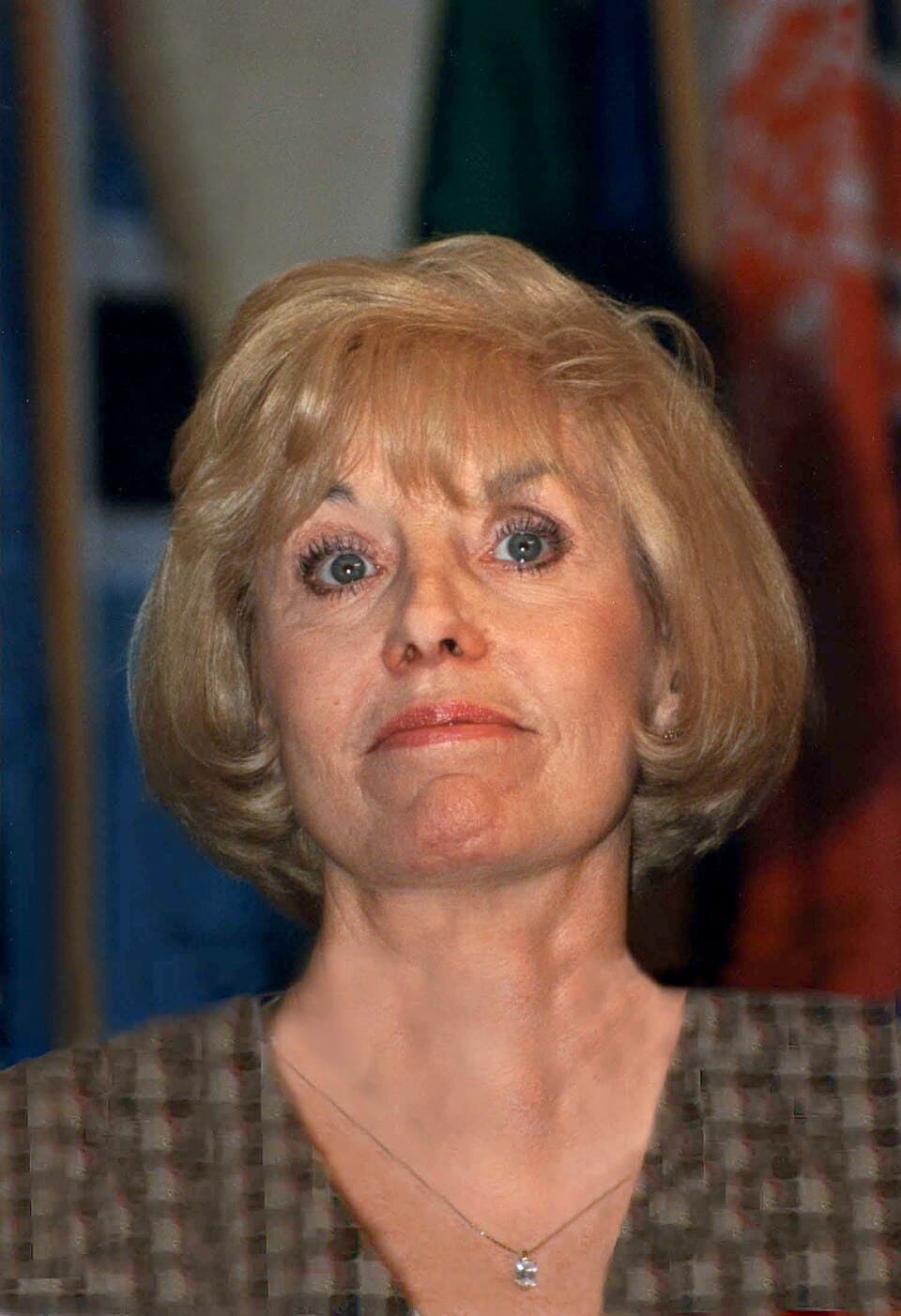
Northern Irish, British · Activism · Politics
Betty Williams
May 22, 1943 – March 17, 2020
Early Life and Background
Betty Williams, born Elizabeth Smyth on 22 May 1943 in Belfast, Northern Ireland, grew up in a city marked by religious and social divisions that would later erupt into the conflict known as the Troubles.[1][10] Her family background itself embodied these divisions: her father was a Protestant butcher and her mother a Catholic homemaker.[10] Williams was baptized Catholic and attended St Dominic’s Grammar School, a Catholic institution, where she received her secondary education.[10]
This mixed-faith household gave Williams insight into both Protestant and Catholic communities at a time when daily life was increasingly segregated by religion. Belfast in the 1940s and 1950s was shaped by economic hardship, lingering wartime effects, and underlying tensions over civil rights for the Catholic minority and the constitutional status of Northern Ireland. Growing up in such an environment, Williams experienced sectarian stereotypes and distrust, but she also saw cross-community relationships in her own family.
After leaving school, Williams worked as an office secretary.[10][13] She married and had children, living in a largely ordinary way and not initially engaged in public political life.[13] This early phase is important to understanding her later activism: she emerged not from party politics or academia but from everyday life in a working-class Belfast neighborhood, which lent authenticity and relatability to her subsequent leadership.
Career Beginnings and the Path to Activism
Before 1976, Williams’s life revolved primarily around her family and clerical work. According to retrospective accounts, she was in her early thirties, raising children and employed in office jobs when a single event abruptly transformed her trajectory.[13][20] Northern Ireland by the mid-1970s had descended into serious violence, with bombings, shootings, and clashes among paramilitary organizations, security forces, and civilians.
On 10 August 1976, an incident near her home became the catalyst for Williams’s public activism. An Irish Republican Army (IRA) member was shot while driving, and his car mounted the pavement, striking and killing three children: Anne, Joanna, and Andrew Maguire.[3][10] Williams, who lived nearby, witnessed the aftermath of the crash.[3][10] Deeply affected by the deaths and the broader pattern of violence, she concluded that ordinary citizens could no longer remain silent.
Within days, Williams drafted a petition calling for an end to violence and reportedly collected thousands of signatures by canvassing neighborhoods.[10][13] She contacted Máiread Corrigan, the children’s aunt, who shared her shock and moral outrage.[3][5] Together, they began organizing marches and rallies, calling not only for a ceasefire but for a fundamental rejection of sectarian killing. Their early efforts led to demonstration gatherings that crossed religious lines, drawing women, men, and children from both Protestant and Catholic communities.
Founding of the Community of Peace People
The activism sparked by the Maguire children’s deaths quickly evolved into a formal organization. On 14 August 1976, Williams, Corrigan, and journalist Ciaran McKeown founded the Community of Peace People in Belfast.[3][10] Known initially as the Northern Ireland Peace Movement and often referred to as the Peace People, the group articulated a set of principles centered on respect for human life, nonviolence, and cross-community solidarity.[3][5]
The Peace People’s founding statement urged citizens to denounce violence from all sides, whether carried out by paramilitaries or state forces. It called for building a society in which children could grow up free from fear. Williams and Corrigan, as prominent female leaders, were notable in a context where political and paramilitary leadership was overwhelmingly male. Their role reflected wider trends in peace movements worldwide, where women often assumed frontline organizing responsibilities.
Throughout late 1976, the Peace People organized mass rallies that drew tens of thousands of participants, including large gatherings in Belfast and Derry.[10][13] These marches provided visible evidence that sizable portions of the population opposed continued violence, despite intimidation from extremist groups. Williams’s skills as an organizer and speaker helped sustain momentum and media attention. She spoke candidly about the risks of challenging armed actors and about the moral obligation to protect children and civilians.
Nobel Peace Prize and International Recognition
Williams’s leadership, alongside Corrigan’s, quickly attracted international notice. In 1976, the Norwegian Nobel Committee selected Betty Williams and Máiread Corrigan for the Nobel Peace Prize for their work in founding and leading the Community of Peace People.[5][11] The Committee’s citation praised their “courageous efforts in founding a movement to put an end to the violent conflict in Northern Ireland.”[5]
On 10 December 1976, the customary announcement date for Nobel awards, the Committee officially named Williams and Corrigan as co‑laureates of the 1976 Nobel Peace Prize.[5][11] This recognition marked one of the earliest instances of women from Northern Ireland, and among a relatively small number of women worldwide at the time, receiving the Peace Prize. It signaled a shift in the Nobel tradition toward valuing grassroots, citizen-led peace initiatives rather than solely diplomatic or governmental achievements.
Williams received the physical Nobel medal and diploma one year later, at the formal award ceremony in Oslo on 10 December 1977.[5][3] At the ceremony and in associated events, she used her platform to emphasize that ordinary people must assume responsibility for ending violence. She underscored the centrality of children’s safety and argued that community mobilization was essential to disarming hatred. The Nobel Prize further elevated her visibility, leading to invitations to speak around the world.
In addition to the Nobel, Williams and the Peace People received other honors, including the Norwegian People’s Peace Prize in 1976.[3] Such awards reflected broad international support for their efforts, though they also intensified scrutiny and expectations.
Development and Challenges of the Peace People
Following the Nobel recognition, the Peace People continued activities in Northern Ireland, though the movement faced internal and external challenges. Supporters credited Williams and her colleagues with demonstrating that large numbers of citizens wished to reject violence; critics questioned the movement’s ability to sustain momentum or effect structural political change.[10][17]
Within the organization, debates emerged over strategy, leadership style, and engagement with political institutions.[10] Some activists argued for deeper involvement in structural reforms, while others preferred to maintain a strictly nonpartisan, grassroots identity. Williams’s forthright personality and outspoken criticisms of armed groups occasionally generated controversy, but she remained committed to a vision of nonviolent civic action.
By the 1980s, the Peace People had diminished visibility compared to its high-profile early years, in part due to the complexity of the conflict and the rise of other political initiatives. Nonetheless, Williams’s work during the 1970s laid important groundwork for later peace processes by normalizing cross-community cooperation and challenging the inevitability of violence.
Later Career: Global Peace and Children’s Rights
In the decades after the Nobel Prize, Williams extended her activism beyond Northern Ireland, focusing increasingly on children’s rights and global peace education. Biographical accounts note that she became involved in international initiatives and networks that sought to influence governments on issues affecting children.[3][8]
In 1997, Williams founded the World Centers of Compassion for Children International (WCCCI), an organization dedicated to advocating for children’s rights and creating an international network aimed at encouraging governments to prioritize children’s welfare and protection.[8] WCCCI reflected Williams’s conviction that children should be at the center of peace and human rights agendas and that compassion could serve as a guiding principle for policy.
Williams also participated in PeaceJam, a global program that connects Nobel Peace laureates with youth to inspire and mentor emerging activists.[8] Through lectures, workshops, and dialogues, she encouraged young people to view peace as an everyday responsibility and to challenge injustice in their own communities. Her messages often drew from her experience in Belfast, emphasizing that change can start with a simple refusal to accept violence as normal.
On 26 September 1993, Williams delivered a keynote lecture titled “Peace in the World is Everybody’s Business”, associated with Soka University of America and reported in the University of Notre Dame’s Observer newspaper.[16] In this address, she articulated her philosophy that peace cannot be left to leaders alone and must involve citizens globally. The lecture prefigured her later work with WCCCI and similar initiatives.
Personal Life
Williams’s personal life, though less documented than her public activism, involved multiple significant relationships. She was born as Elizabeth Smyth, later becoming known as Betty Williams through marriage.[1][20] Sources indicate that she married more than once, including marriage to a man with the surname Williams, whose name she used professionally, and later to James Perkins
Her personal experience of parenting during conflict shaped her emphasis on protecting children and making peace a domestic as well as public concern. She often described her activism as arising from an ordinary mother’s refusal to accept that children could be casualties of political struggles. Betty Williams occupies a significant place in the history of women’s peace activism and in the story of Northern Ireland’s conflict. As co‑founder of the Community of Peace People, she helped pioneer a large-scale, citizen-led movement that called for an end to violence in a deeply divided society.[3][10] Her activism demonstrated that ordinary individuals, particularly women, could exert moral and political influence without formal institutional power. Historically, Williams’s Nobel Peace Prize in 1976 contributed to broader recognition of grassroots movements within international peace discourse.[5][11] The award validated nonviolent civil action as a critical factor in conflict transformation, alongside diplomatic negotiations. It also highlighted the role of women as central actors in peace efforts, inspiring subsequent generations of female activists in other regions. While the Peace People did not directly resolve the Troubles, scholars have noted that the movement helped to shift public sentiment and provided a reference point for later peace initiatives.[10][17] Its marches and petitions signaled to political leaders and paramilitaries that large portions of society rejected violence and desired alternative paths. Williams’s insistence on the primacy of children’s safety anticipated later human rights frameworks that place children at the center of protection policies. Her work with WCCCI and PeaceJam extended this legacy internationally. By focusing on youth and compassion, she moved beyond the specifics of Northern Ireland to address structural violence, poverty, and conflict affecting children worldwide. In doing so, she connected local experiences of trauma to global conversations about human security. In her later years, Williams continued to speak and travel in support of peace and human rights. She remained outspoken about ongoing conflicts and about the responsibilities of governments and citizens to protect vulnerable populations. Her criticism was not limited to Northern Ireland; she addressed global issues, often highlighting children’s suffering in war zones and under oppressive regimes.[3][8] On 17 March 2020, Betty Williams died in Belfast at age 76.[1][3][17] Obituaries in major newspapers and statements from peace organizations commemorated her as a pioneering figure in grassroots peace activism and as a Nobel laureate whose work had inspired many. The Guardian obituary characterized her as a central figure in the Peace People and noted the lasting impact of her efforts to mobilize ordinary citizens against sectarian violence.[17] Her death closed a life that had moved from quiet domesticity to global recognition, anchored by a consistent moral stance: that the lives of children and civilians must never be sacrificed to political causes. Williams’s story remains a powerful example of how one person’s response to a local tragedy can catalyze wider movements for peace and justice. Within the broader field of women’s history, Bettty Williams is noteworthy for several reasons. She emerged as a leader from outside formal politics, embodying a pattern where women mobilize as community members and caregivers rather than as established elites. Her cross‑community family background allowed her to speak authentically to both Protestant and Catholic audiences, bridging divides in a context where such bridging was rare.[10] Her recognition with the Nobel Peace Prize at a relatively young age highlighted the contributions of women to peace processes and helped challenge assumptions about who qualifies as a "peace leader."[5][20] Williams’s subsequent focus on children positioned her at the intersection of peace activism and evolving international norms on children’s rights, prefiguring later global campaigns that center children in policy discussions. For historians of Northern Ireland and of global peace movements, Williams’s life illustrates both the possibilities and limits of grassroots action in complex conflicts. Her legacy continues in educational and youth programs that draw on her example to encourage civic responsibility and nonviolence, ensuring that her impact extends beyond her lifetime.Legacy and Historical Impact
Later Life and Death
Assessment within Women’s History
Dated achievements
7 indexed.
- May221943Science
Birth of Betty Williams in Belfast
Elizabeth 'Betty' Smyth was born in Belfast, Northern Ireland, the future Nobel Peace Prize laureate and co-founder of the Peace People.
View details Betty Williams - Wikipedia - Aug101976Science
Witnesses tragedy that sparks the peace movement
Betty Williams witnessed the deaths of three Maguire children after a car driven by a fleeing IRA member struck them, galvanizing her into activism.