← All women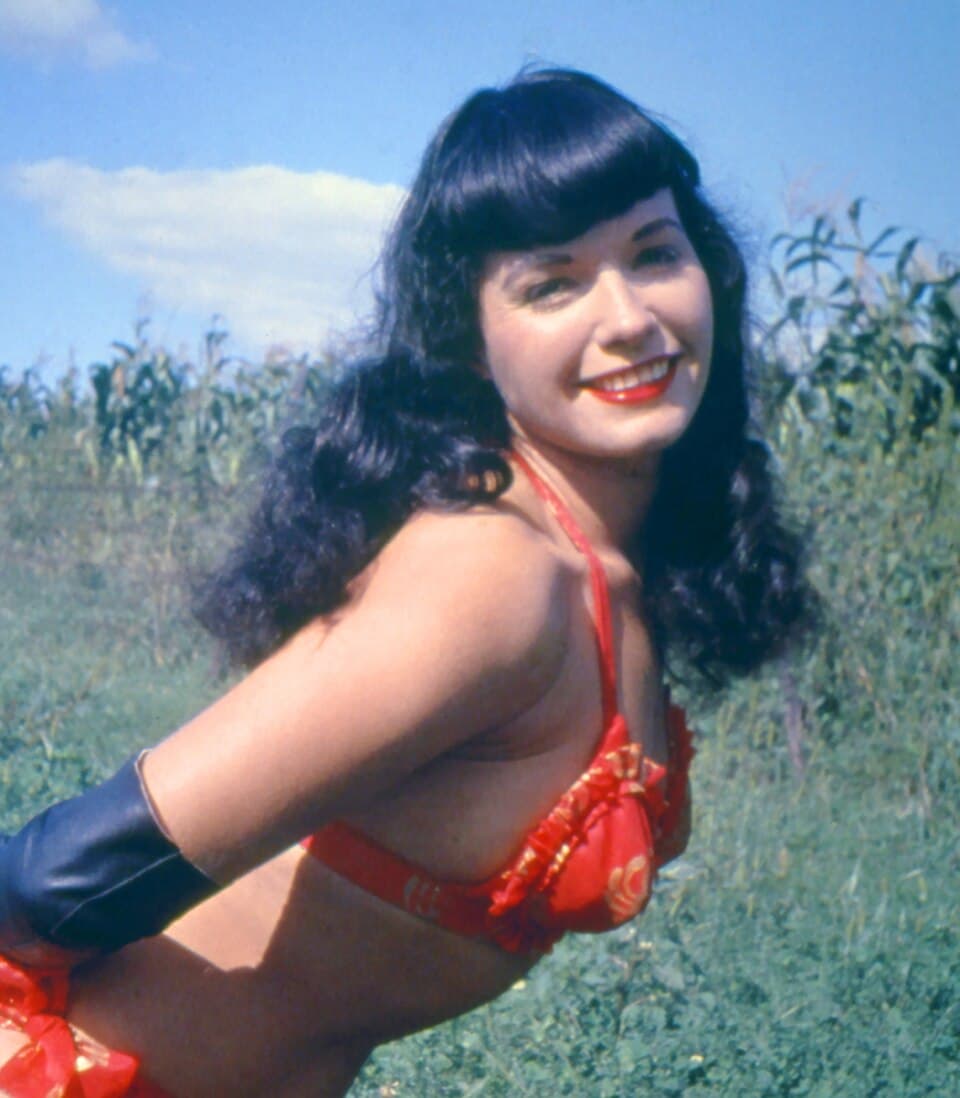
American · Arts
Bettie Page
April 22, 1923 – December 11, 2008
Early Life and Background
Bettie Mae Page was born on 22 April 1923 in Nashville, Tennessee, United States.[1][2][6][7] She was the second of six children of Walter Roy (Roy) Page and Edna Mae Pirtle, a working‑class family living in the American South during the interwar period.[1][10][15] Accounts of her childhood describe economic hardship and familial instability. According to biographical summaries and obituaries, she experienced neglect from her mother and sexual abuse by her father, who worked intermittently as a mechanic.[10] These early experiences formed a stark backdrop to the cheerful, confident persona she would later project as a model.
Despite these difficulties, Page excelled academically. She attended Hume-Fogg High School in Nashville, where she was an honor student and participated in extracurricular activities, including the drama club, often noted as an early outlet for her poise and performance skills.[2][10] She developed an interest in fashion and sewing, making clothes for herself and her sisters, a skill that later contributed to her distinctive pin‑up wardrobe and ability to style herself for photo sessions.[10]
After finishing high school, Page earned a Bachelor of Arts degree from Peabody College
Early Adulthood and Career Beginnings
During the Second World War era, Page’s life followed a pattern common to many young Americans. In 1943, she married Billy Neal, a sailor, in what would be her first of several marriages.[10][15] Neal’s naval service and the strains of wartime separation contributed to the eventual dissolution of the marriage; they divorced in 1947.[10][15] After the divorce, Page supported herself through a series of clerical and service jobs, including secretarial work, while continuing to nurture aspirations in acting and modeling.[2]
In the late 1940s, Page left Tennessee, spending some time in California and then moving to New York City to seek work in the entertainment industry.[2][8] New York offered more opportunities for aspiring models and actresses, but it also meant navigating a competitive and often exploitative environment. Page took acting classes and auditioned for small roles, while also posing for "camera clubs"—groups of amateur photographers who organized sessions with models.[2][6] These encounters would prove pivotal: her natural ease before the camera, expressive face, and athletic figure quickly made her a favorite subject.
By 1950, Page had begun working more systematically as a pin‑up and glamour model in New York.[3][7][9] She posed for numerous photographers, including well‑known names in the burgeoning field of commercial pin‑up imagery. Many of these early photographs were non‑nude or included only partial nudity, emphasizing playful poses, bikinis, and costumes that drew on beach, jungle, or burlesque themes. Her trademark hairstyle—jet‑black hair with short, straight bangs—and her bright smile quickly became part of her public persona.[2][6]
Collaboration with Irving Klaw and Fetish Photography
A major turning point in Page’s career came in 1951, when she began posing for photographer and film producer Irving Klaw.[3][6][9] Klaw ran a mail‑order business that specialized in pin‑up and fetish photography, as well as short film loops featuring models in costumes, role‑play scenarios, and staged bondage scenes. Page’s work with Klaw expanded her repertoire beyond conventional pin‑ups to include images that flirted with taboo themes of domination, submission, and sadomasochism.
Page’s Klaw sessions often depicted her in high heels, corsets, garter belts, and leather outfits, sometimes wielding whips or being tied up by other models.[3][6] These images were still constrained by the obscenity laws of the time—they generally avoided explicit nudity—but they were strikingly daring compared with mainstream depictions of women in the early 1950s. By 1952, she had become closely associated with Klaw’s bondage‑themed photographs, and her image circulated widely among enthusiasts of fetish material.[3][5][6]
Klaw’s business and Page’s participation in it intersected with national debates about morality, pornography, and censorship. In the mid‑1950s, the U.S. Senate, led by Senator Estes Kefauver, held hearings on "juvenile delinquency" that scrutinized comics, crime fiction, and erotic materials, including Klaw’s productions.[17] Page’s bondage photos were mentioned as examples of potentially corrupting influences, though she herself was not charged with any crime. This public scrutiny underscored how her work, initially marginal, had become a focal point in struggles over the limits of sexual representation.
Pin‑Up Fame and Playboy Centerfold
Beyond Klaw’s studio, Page also posed for other photographers, including Bunny Yeager, a former model who had transitioned to photography.[2] Yeager’s images of Page, taken largely in Florida, featured the model in bikinis, swimsuits, and playful outdoor settings, creating a contrast with the darker fetish imagery. One set of beach photos, showing Page in a leopard‑print bikini and Santa hat, became particularly famous and helped propel her into mainstream magazines.[2]
The culmination of this phase of her career was her appearance in Playboy magazine’s January 1955 issue as one of the earliest "Playmates of the Month" and, significantly, as the magazine’s first fold‑out centerfold.[2][3][7][13] In the centerfold, photographed by Yeager, Page lies on a beach, smiling and topless, her pose simultaneously relaxed and suggestive. The fold‑out design allowed the image to be printed larger than previous centerfolds, and the format quickly became a signature feature of Playboy and other men’s magazines.[3]
This appearance expanded Page’s audience beyond the niche mail‑order market to a mass readership. While pin‑up photography had existed for decades, including the work of artists like Alberto Vargas and photographers who documented wartime "cheesecake" imagery, Page’s combination of wholesome expression and uninhibited nudity felt new to many viewers. She was frequently described as the "Queen of Pinups," and she became one of the most photographed women of the 1950s.[2][6][7]
Major Works, Recognition, and Cultural Impact
Page’s "major works" consist primarily of photographic series and short film loops rather than traditional artistic or literary outputs. Among the most notable are:
- Hundreds of pin‑up photographs taken for camera clubs and commercial studios, emphasizing playful, athletic, and flirtatious poses.[2][6]
- A substantial body of fetish and bondage imagery with Irving Klaw, including staged whipping, tying, and domination scenarios that are now cited as foundational in the visual culture of BDSM.[3][6][9]
- The January 1955 Playboy centerfold, which cemented her place in mainstream erotic photography.[2][3][7][13]
Although Page did not receive formal awards during her modeling years—reflecting both the stigma attached to erotic work and the absence of institutional recognition for such material—later decades saw extensive retrospective recognition. Beginning in the 1980s and 1990s, her image was revived in comics, rockabilly culture, tattoo art, and alternative fashion scenes.[6][9] She became a cult icon, inspiring musicians, fashion designers, and artists who drew on her distinctive look.
Biographical works such as Bettie Page: The Life of a Pin-Up Legend by Karen Essex and others, as well as the film The Notorious Bettie Page released in the mid‑2000s, further solidified her cultural status, portraying her as both a victim of and participant in changing sexual norms.[17][2] While some sources describe her as "the first famous bondage model" or "first known bondage and fetish model," historians caution that such claims are difficult to verify against earlier, less documented forms of fetish photography and illustration.[6][9] Still, she is widely acknowledged as one of the earliest and most influential models to bring fetish imagery into broader circulation.
Personal Life and Religious Turn
Page’s personal life was marked by multiple marriages and significant changes in belief. After divorcing Billy Neal in 1947, she remained single for more than a decade while pursuing her modeling career.[10][15] In 1958, she married Armond Walterson, a relationship that lasted until around 1963, when they divorced.[10][15] That same year, she briefly remarried her first husband, Billy Neal, though this reconciliation also ended in divorce.[10] A later marriage to Harry Lear began in 1967 and lasted until about 1972.[10][15] None of these unions produced children.[15]
In the late 1950s, Page underwent a significant religious transformation. Sources report that she converted to evangelical Christianity around 1959, influenced by church communities and Bible study groups.[13] She studied the Bible intensively and, for a period, considered or undertook work with religious organizations, including possible aspirations to become a missionary. This spiritual turn coincided with her retreat from modeling and public life.
Page’s relationship to her past work was complex. While she sometimes expressed regret about the explicitness of certain images, she also defended her modeling as a form of art and insisted that she had never felt exploited by photographers like Yeager.[2] Interviews later in life, though limited, suggest that she saw herself as having been naive about the long‑term circulation of her images, yet proud of the joy they brought to fans.
Retirement, Disappearance, and Mental Health
By 1957, Bettie Page had effectively retired from pin‑up and fetish modeling and withdrawn from public life.[3][7][9] The combination of legal scrutiny, changing personal priorities, and her religious conversion contributed to this decision. She left New York and spent time in Florida and other locations, working in clerical jobs and attempting to build a new life separate from her modeling career.[2][11]
In the 1960s and 1970s, Page lived largely outside the spotlight. Rumors circulated that she had "disappeared" or died, contributing to her mystique among fans and collectors. In reality, she struggled with serious mental health issues. Sources indicate that she was diagnosed with schizophrenia and spent periods in psychiatric institutions in California after moving there in 1979.[13] There were incidents of erratic behavior and legal troubles, including reported assaults, which led to hospitalizations.[11][13]
During these years, Page lived on limited means, supported partly by Social Security benefits, even as her photographs began to be rediscovered and monetized by others.[11] Legal battles over the rights to her image unfolded, and eventually, licensing arrangements were made that provided her with some income from the use of her likeness. Nonetheless, the gap between her public image as a carefree pin‑up and her private struggles with poverty and illness remained wide.
Revival, Biographical Works, and Legacy
Beginning in the 1980s, Bettie Page’s image experienced a significant revival. Subcultures such as punk, rockabilly, and burlesque rediscovered her photographs, and she became a reference point for retro fashion and alternative beauty standards.[6][9] Artists and musicians incorporated her likeness into albums, posters, and performances. Her bangs, blue‑gray eyes, and athletic figure came to symbolize a particular mid‑century aesthetic that felt both nostalgic and rebellious.
Commercial licensing of her image expanded through agencies such as CMG Worldwide and later businesses managing "Bettie Page" brands.[3][1] She became, posthumously, one of the highest‑earning dead celebrities, with merchandise ranging from clothing to home decor bearing her name or image.[13] This commercialization sparked debates about consent, exploitation, and the ethics of profiting from the likeness of someone who had once been marginalized by mainstream culture.
The release of the biographical film The Notorious Bettie Page, directed by Mary Harron and released in the mid‑2000s, introduced her story to new audiences.[2] The film portrayed her life from Tennessee childhood through modeling fame, religious conversion, and retreat from public view, emphasizing the contradictions between her wholesome demeanor and the taboo nature of some of her work. Biographies such as Karen Essex’s Bettie Page: The Life of a Pin‑Up Legend further contextualized her within broader histories of sexuality, censorship, and women’s labor in the entertainment industry.[17]
Historians and cultural critics now often frame Page as a proto‑feminist or feminist‑adjacent figure, though she did not identify with organized feminist movements. Her work challenged the notion that erotic imagery had to be either purely male‑directed or morally corrupting, and her apparent comfort with nontraditional sexual themes broadened the range of representable desire in mid‑century photography.[2][6] At the same time, her vulnerability to exploitation and lack of control over her image’s circulation highlight the structural limitations faced by women in commercial media.
Later Life and Death
In her later years, Bettie Page lived quietly in Southern California. By the early 2000s, she had achieved some financial stability through royalties and licensing agreements, but she continued to guard her privacy fiercely. She rarely allowed herself to be photographed, preferring that the public remember her as she appeared in the 1950s.[11] Occasional interviews and public statements were often mediated through friends, lawyers, or biographers.
In 2008, Page was hospitalized in Los Angeles with pneumonia. After a three‑week illness, she suffered a heart attack11 December 2008 at the age of 85.[2][4][5][11] Reports from outlets such as the New York Times and The Independent emphasized her status as an iconic figure whose work had once been deemed scandalous but was now widely celebrated.[10][16] She left no children but a vast visual archive and an enduring influence on photography, fashion, and subcultural aesthetics.
Historical Significance and Legacy
Bettie Page occupies a distinctive place in women’s history and cultural history. As a 1950s pin‑up and fetish model, she operated within a male‑dominated industry that often objectified women, yet she projected an unusual sense of agency, playfulness, and self‑possession in her images. Her work straddled the boundary between mainstream glamour and underground fetish culture, making her a central figure in debates about obscenity, censorship, and the representation of women’s sexuality.[2][3][6]
Her January 1955 Playboy fold‑out centerfold helped shape the visual grammar of postwar men’s magazines, while her bondage photographs with Irving Klaw became touchstones in the history of BDSM representation.[3][6][7][9] The Senate investigations that referenced her work illustrate how anxieties about youth, delinquency, and sexual freedom crystallized around the figure of the pin‑up model.[17]
In the decades after her retirement, Page’s image was reclaimed by subcultures seeking alternative icons of beauty and sexuality. She became a symbol of retro style, inspiring countless imitators who adopted her bangs, lingerie, and poses. Scholars have noted that her appeal lies partly in the tension between her wholesome demeanor and the explicit or taboo nature of the scenarios she inhabited—a tension that invites viewers to reconsider simplistic distinctions between "good" and "bad" women, or between respectable and deviant sexuality.[2][6]
For women’s history, Bettie Page’s life highlights several themes: the limited economic options available to mid‑century women, the ways in which female bodies became battlegrounds for cultural politics, and the long‑term consequences of having one’s image circulate beyond one’s control. Her struggles with mental illness and poverty, contrasted with her posthumous fame and commercial success, underscore the human cost behind iconic imagery.
Today, Bettie Page is remembered not only as a "Queen of Pinups" but also as a figure whose career helped open space—however imperfectly—for more diverse, playful, and self‑aware representations of women’s erotic lives. Her biography remains a key case study in the intersections of gender, media, and power in the 20th century.
Dated achievements
3 indexed.
- Apr221923Science
Birth of Bettie Page
Bettie Mae Page was born in Nashville, Tennessee, later becoming one of the most photographed pin-up and fetish models of the 1950s.
View details Bettie Page: Queen of the fifties pin-ups who became a cult figure - The Independent - Jan011955