← All women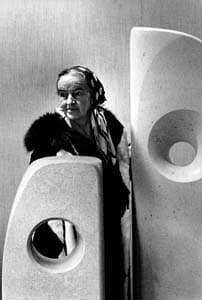
British · Arts
Barbara Hepworth
January 10, 1903 – May 20, 1975
Early Life and Background
Dame Barbara Hepworth was born on January 10, 1903, in Wakefield, West Yorkshire, England. She was the eldest of four children in a middle-class family. Her father, Herbert Hepworth, was a civil engineer, which perhaps influenced her precise approach to artistic form. Hepworth's early education took place at Wakefield Girls' High School. Inspired by the natural landscapes surrounding her in Yorkshire, Hepworth developed a passion for design and form at a young age. In 1920, she enrolled at the Leeds School of Art, where she met fellow sculptor Henry Moore, commencing a lifelong professional relationship. Hepworth continued her studies at the Royal College of Art in London, graduating in 1924.
Career Beginnings and Development
Hepworth's early career was shaped by her travels abroad. After a period in Italy, where she studied marble carving in Florence, she returned to London and began to forge her own artistic identity, moving away from traditional practices towards abstraction. By the 1930s, Hepworth had immersed herself in the modernist movement, particularly gaining recognition for her innovation in sculpture with pierced forms, a technique she pioneered in 1931. This bold step marked a significant shift towards abstraction in her work.
Major Works, Discoveries, or Accomplishments
Moving to St Ives in Cornwall during World War II significantly influenced Hepworth's work; the Cornish landscape became a source of inspiration, embedding natural and organic forms in her art. Among her most celebrated works are forms like "Oval Form" (1943), "Pelagos" (1946), and "Curved Form (Trevalgan)" (1956). In 1950, she participated in the Venice Biennale, emphasizing her influence in international circles. Her large-scale bronzes, notably exhibited in the 1960 retrospective at the Tate Gallery, established her as a leading figure in modern sculpture.
Awards, Honors, and Recognition Received
Throughout her career, Hepworth received numerous accolades, underscoring her impact on the art world. She was made a Dame Commander of the Order of the British Empire in 1965. Her works were not only exhibited globally but also integrated into prestigious collections in Europe and America, further confirming her international stature. Hepworth was one of the few female artists to achieve such recognition during her time, bypassing considerable gender barriers in the male-dominated art scene.
Personal Life
Hepworth's personal life was marked by tumultuous relationships and personal tragedy. Her first marriage was to sculptor John Skeaping in 1925, with whom she had one son. Post-divorce, Hepworth married painter Ben Nicholson in 1938, a relationship that was as artistically influential as it was personally challenging. The couple had triplets in 1934—two daughters, Sarah and Rachel, and a son, Simon.
Legacy and Historical Impact
Barbara Hepworth's legacy is enduring, with her approach to form and space continuing to inspire modern sculptors. The Barbara Hepworth Museum in St Ives, established posthumously, houses many of her iconic works and preserves the environment that nurtured her creativity. Critical retrospectives of her work continue to showcase her as a pivotal force in 20th-century art, breaking new ground for female artists worldwide.
Later Life and Death
Hepworth continued to work prolifically into her later years, despite suffering from numerous health issues. Her final years were dedicated to exploring religious themes through her art, culminating in works like "The Family of Man" sculpture series. Dame Barbara Hepworth passed away in a fire at her St Ives home on May 20, 1975, leaving behind an indelible influence on the world of art.
Dated achievements
2 indexed.
- Jan101903Arts
Birth of Barbara Hepworth
Barbara Hepworth was born in Wakefield, West Yorkshire, England.
View details Barbara Hepworth - Wikipedia - May201975Arts
Death of Barbara Hepworth
Barbara Hepworth died in a fire at her home in St Ives, Cornwall.
View details