← All women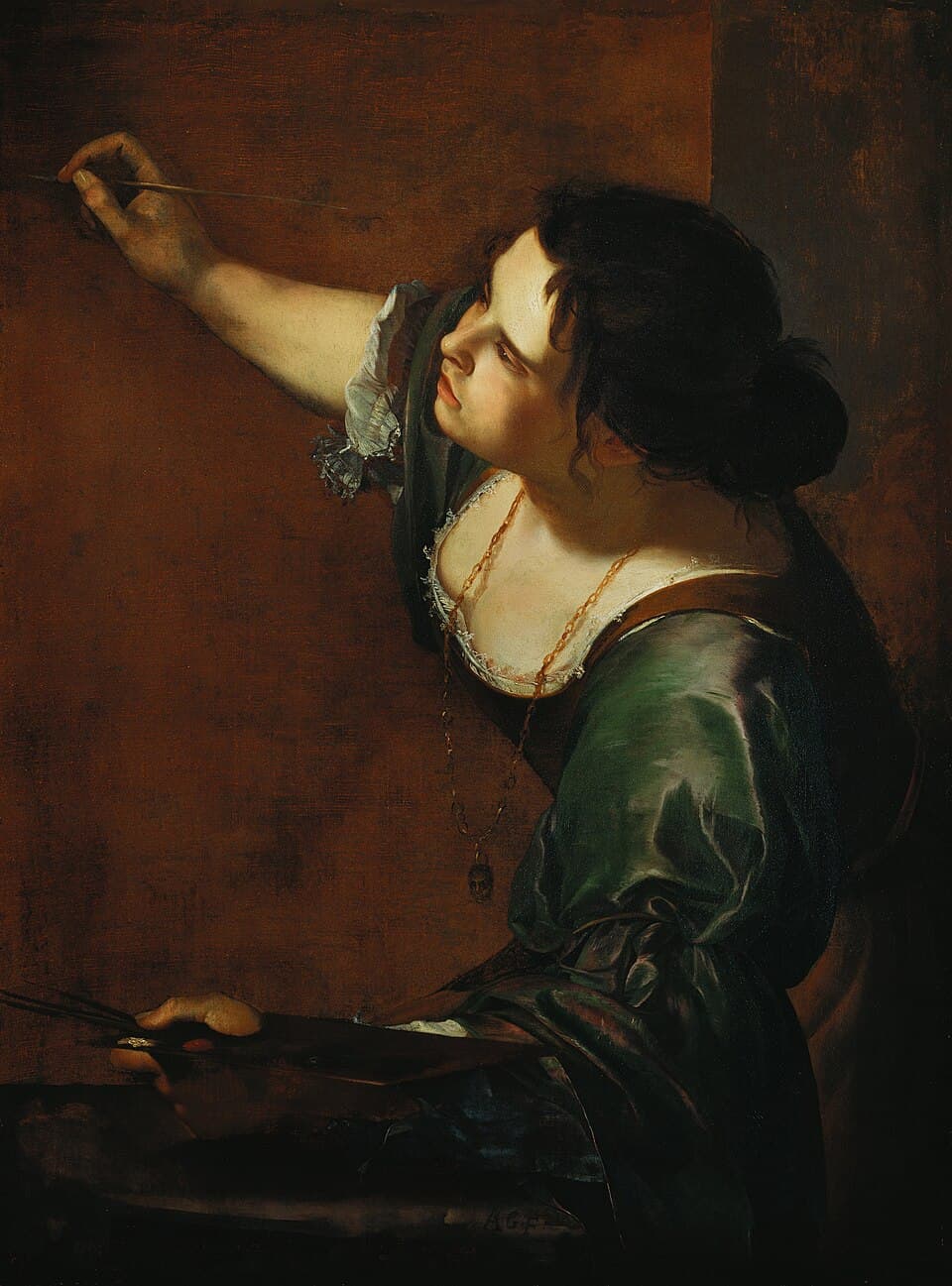
Italian · Arts
Artemisia Gentileschi
July 8, 1593 – 1656
Early Life and Background
Artemisia Lomi Gentileschi was born on 8 July 1593 in Rome, then part of the Papal States, into an artisan family closely tied to the city’s artistic milieu.[1][2][9][12][16] Her father, Orazio Gentileschi, was a Tuscan painter and a follower of Caravaggio, while her mother, Prudentia Montone, died when Artemisia was about twelve years old.[1][12] Artemisia was the eldest of five children and the couple’s only daughter, a position that shaped both her opportunities and responsibilities within the household.[4][9]
Rome around 1600 was a dynamic center of Baroque innovation, where new approaches to light, realism, and religious drama were transforming painting. Orazio’s workshop functioned as Artemisia’s primary school. She learned to grind pigments, stretch canvases, and copy drawings, absorbing technical skills typically denied to girls.[1][9] Her father’s close study of Caravaggio’s radical naturalism and chiaroscuro deeply influenced her early visual language, and Artemisia appears to have trained almost exclusively under Orazio rather than in formal academies.[1][2]
Unlike most early modern women, Artemisia had sustained access to professional artistic training, but she remained constrained by gender norms. She could not easily join guilds, study the nude in public life-drawing classes, or move freely in male-dominated spaces. These limitations would later inform her intense focus on female protagonists in biblical and classical narratives, and on scenes that foreground power, vulnerability, and resistance.
Career Beginnings and Development
By the age of fifteen, Artemisia was producing professional work in her father’s workshop.[1] Her earliest surviving signed and dated painting, "Susanna and the Elders", bears the date 1610 on the canvas and was completed when she was about seventeen.[1][4][6][11][14] The painting, now in the Schloss Weißenstein collection at Pommersfelden, Germany, shows a young woman twisting away from two lecherous elders; its psychological depth, complex composition, and use of light demonstrate that Artemisia had already mastered advanced techniques and was operating as an independent history painter.
In these early Roman years, Artemisia worked on religious themes aligned with Counter-Reformation requirements for clarity and emotional impact. She shared Caravaggio’s dramatic lighting and realism but developed a distinct sensitivity to women’s experiences. Around 1612–1613, she produced an early version of "Judith Beheading Holofernes", one of her most renowned works, in which the biblical heroine and her maid are shown actively and forcefully decapitating the Assyrian general.[2][4][13] Although the exact completion date is uncertain, scholars agree that this canvas belongs to her Roman period and reflects her growing command of violent, action-filled narratives.
Artemisia’s early career was profoundly marked by a traumatic event: in 1611 she was raped by the painter Agostino Tassi, a collaborator of her father.[1][2] The ensuing 1612 trial, documented in detailed court records, exposed Artemisia to invasive questioning and physical torture (the sibille, or thumbscrews) used to test the veracity of her testimony.[1] While the user prompt does not focus on the trial dates, the episode is central to her biography. Many later interpreters have connected the intensity and agency of her female figures—Judith, Susanna, Lucretia—to this lived experience of violence and injustice.
Florence: Courtly Patronage and Academic Recognition
In 1613 Artemisia married Pietro Antonio di Vincenzo Stiattesi, a Florentine artist, and moved to Florence.[1][2] There she entered a different artistic environment, oriented toward Medici court taste and humanist circles. That same year, in September 1613, she gave birth to her first child, Giovanni Battista, who was baptized and buried within about a week in Santa Maria Novella, indicating his brief life.[16] The couple would have other children, though documentation is fragmentary; one daughter, Prudenzia, likely survived to adulthood.[1][2]
Florence offered Artemisia new forms of patronage. She received commissions from members of the Medici family and from other elites, producing altarpieces and private devotional works. Around 1615–1617 she painted another powerful version of "Judith Beheading Holofernes", now in the Uffizi Gallery, in which Judith and her maid Abra strain physically as they carry out the beheading.[2][4] The painting’s visceral realism and focus on female strength have made it one of the most discussed images in feminist art history.
Her professional standing was formally recognized in 1616, when Artemisia became the first woman admitted to the Accademia delle Arti del Disegno in Florence.[1][2][6][9][16] Membership in this prestigious academy confirmed her status as a leading history painter and allowed her access to intellectual networks and institutional recognition normally closed to women. Scholars emphasize this episode as a milestone in the history of women artists and as evidence that Artemisia’s talent was acknowledged by her contemporaries.
During her Florentine years, Artemisia expanded her repertoire beyond biblical scenes. She painted subjects such as Lucretia (dated to 1621), a Roman matron who committed suicide after rape, and Cleopatra (painted around 1621–1622), exploring themes of honor, autonomy, and mortality.[8] These works, produced for sophisticated patrons, testify to her engagement with classical literature and moral exempla, and to her skill in translating complex narratives into emotionally charged images.
Work in Rome, Venice, Genoa, and Naples
By the early 1620s Artemisia had separated from her husband and eventually returned to RomeVenice, building an international clientele that included aristocratic and royal patrons.[4][9] In these cities she continued to paint large-scale history subjects and female heroines, such as Esther, Jael, and Bathsheba, as well as allegorical figures like Allegory of Painting (La Pittura), in which she portrayed herself as the personification of painting itself.[1][2]
By about 1630, Artemisia moved to Naples, then under Spanish rule, where a vibrant art scene attracted painters from across Italy.[6] She established a successful workshop and remained based there for more than two decades, occasionally traveling for commissions.[1][9] Naples offered ample opportunities for altarpieces and public works, and she collaborated with other artists, including likely her father Orazio for some projects.
In 1639 Artemisia traveled to London to join Orazio at the court of Charles I of England.[1][2][6] Charles I was an important patron of European Baroque painting, and Artemisia’s presence at his court further indicates her international stature. While in England, she contributed to the decorative cycles at the Queen’s House in Greenwich and may have worked on other royal commissions.[4][5] Her stay in London exposed her to northern European artists and collectors before she eventually returned to Naples.
Major Works and Artistic Contributions
Artemisia Gentileschi’s oeuvre centers on history painting, the most prestigious artistic genre of her time. She specialized in large-scale depictions of biblical and classical narratives, often emphasizing women as active protagonists rather than passive victims.[1][2][12] Among her major works are:
- "Susanna and the Elders" (1610) – her earliest signed and dated work, notable for its psychological realism and a composition that foregrounds Susanna’s distress rather than idealized beauty.[1][4][6][11]
- "Judith Beheading Holofernes" – multiple versions, including early Roman and later Florentine/Uffizi compositions, which portray Judith and Abra with intense physical effort and determination.[2][4][6]
- "Judith and her Maidservant" – companion pieces to the beheading scenes, showing the women in moments of suspense and escape.[2][12]
- "Lucretia" (1621) – exploring the Roman heroine’s tragic decision and highlighting themes of honor, trauma, and agency.[8]
- "Cleopatra" (1621–1622) – presenting the queen in the moment of suicide, a reflection on political power and vulnerability.[8]
- "Allegory of Painting (La Pittura)" – a self-referential image in which Artemisia embodies Painting, asserting her claim to the highest intellectual status of her art.[1][2]
Technically, Artemisia is renowned for her mastery of chiaroscuro, vigorous compositions, and sensitive handling of flesh tones and textiles. Conceptually, her paintings are distinguished by their attention to women’s emotions and actions, a feature that has led many scholars to describe her as offering a "female perspective" within Baroque visual culture.[12][15] While earlier art historians sometimes interpreted her entire oeuvre through the lens of her rape and trial, contemporary scholarship emphasizes her agency, professional savvy, and deliberate engagement with subjects that resonated with her patrons and with broader debates about virtue and power.
Awards, Honors, and Recognition
Formal honors for artists in Artemisia’s time typically took the form of commissions and memberships rather than modern prizes. Her most documented institutional recognition was her admission in 1616 as the first woman member of the Accademia delle Arti del Disegno in Florence.[1][2][6][9] This membership acknowledged her skill in history painting and placed her among the city’s leading practitioners.
Artemisia also received prestigious patronage from powerful figures: she worked for the Grand Duke of Tuscany, members of the Medici household, and later for Philip IV of Spain and Charles I of England.[4][5][9] Such commissions functioned as key markers of status, signaling that she was trusted to produce works suitable for princely collections and royal residences.
Though not "awards" in a modern sense, these institutional and courtly recognitions demonstrate that Artemisia’s contemporaries viewed her as one of the leading artists of her generation. She earned praise from fellow painters and writers, with some seventeenth-century commentators explicitly noting the exceptional nature of her success as a woman.
Personal Life
Artemisia’s personal life intersected closely with her career. Her marriage to Pietro Antonio Stiattesi brought her to Florence and into new patronage networks, but surviving documents suggest financial tensions and eventual separation.[1][2] She had several children, though records are incomplete; the first, Giovanni Battista, died soon after birth in September 1613.[16] At least one daughter, Prudenzia, seems to have remained with her and later assisted in the workshop.[1]
Letters from Artemisia reveal her concern with securing payments, managing workshop expenses, and negotiating with patrons across cities.[1][2] They show a woman deeply conscious of her reputation and of the need to protect her professional interests. She sometimes invoked her gender strategically, reminding patrons that supporting a woman artist brought particular honor.
Her relationship with her father, Orazio, oscillated between collaboration and distance. They worked together on commissions in England, but their correspondence indicates occasional disagreement. Nevertheless, their shared commitment to Caravaggesque realism and inventive compositions forged a familial artistic legacy.
Later Life and Death
After her time in London in the late 1630s, Artemisia returned to Naples, where she continued to run a workshop and to receive commissions well into the 1640s.[1][2][4][9] She adapted to changing tastes, incorporating influences from Neapolitan painters and responding to the city’s demand for religious imagery.
The precise date of her death remains uncertain. Scholarly references variously place it around 1652, 1652/53, c.1653, or c.1656, all in Naples.[2][3][4][5][7][8][10][16][17] Documentary evidence confirms that she was still alive after January 1654
These gaps reflect broader challenges in reconstructing early modern women’s lives, where archival documentation is often fragmentary and uneven. Nevertheless, it is clear that Artemisia remained professionally active into her later years and that her workshop in Naples maintained a measure of success. Artemisia Gentileschi is now widely recognized as one of the most accomplished painters of the Italian Baroque and as a central figure in the history of women artists.[1][2][4][6][9][12][15] Her admission to the Florentine Accademia, her international clientele, and her sustained production of large-scale history paintings distinguish her from most of her female contemporaries, who were often confined to minor genres or amateur status. In the twentieth and twenty-first centuries, feminist art historians played a crucial role in recovering and reassessing her work. Scholars such as Mary Garrard and Griselda Pollock emphasized her agency, technical skill, and the gendered dimensions of her choice of subjects. Museums and galleries have increasingly foregrounded Artemisia in exhibitions and publications; the National Gallery in London, the Royal Collection Trust, and many other institutions highlight her as the "most celebrated female painter of the 17th century".[4][5] Her paintings—particularly "Judith Beheading Holofernes" and "Susanna and the Elders"—have become iconic in discussions of female representation, violence, and resistance. They are frequently reproduced in textbooks, scholarly essays, and popular media as examples of how a woman artist reimagined canonical narratives from a perspective attentive to women’s experiences. Artemisia’s legacy extends beyond art history into broader cultural and political discourse. She is invoked in debates about sexual violence, testimony, and justice, and her life has inspired novels, plays, films, and digital projects that explore the intersection of gender, creativity, and power. At the same time, recent scholarship cautions against reducing her story solely to trauma, urging recognition of her strategic intelligence, entrepreneurial skill, and long-term professional success. Today, Artemisia Gentileschi stands as a symbol of women’s persistence in the face of structural exclusion, and as a reminder that artistic genius has never been limited by gender, even when institutions tried to enforce such limits. Her birth in Rome on 8 July 1593, her 1610 "Susanna," and her 1616 admission to the Accademia form key chronological anchors in a life that continues to reshape our understanding of the Baroque and of women’s history.Legacy and Historical Impact
Dated achievements
4 indexed.
- Jul081593Arts
Birth in Rome
Birth of Artemisia Gentileschi in Rome, later a celebrated Italian Baroque painter.
View details Artemisia Gentileschi - Wikipedia - Jan011610Arts
Completing 'Susanna and the Elders'
Artemisia completed 'Susanna and the Elders,' her first signed painting, marking her emergence as an artist.