← All women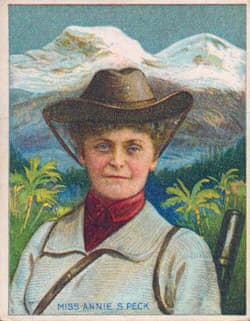
American · Exploration · Activism
Annie Smith Peck
October 19, 1850 – July 18, 1935
Early Life and Background
Annie Smith Peck was born on October 19, 1850, in Providence, Rhode Island, to Ann Power Smith and George Bacheler Peck, a lawyer and abolitionist. She was encouraged from a young age to pursue education and broaden her horizons, an unusual stride for women in her time. Peck attended the prestigious Rhode Island Women's Council before attending the University of Michigan, one of the few universities that admitted women during that period. Graduating in 1878 with a degree in classical studies, she furthered her education in Germany, using her scholarship to study Latin and Greek, which later facilitated her teaching career.
Career Beginnings and Development
After concluding her formal education, Annie Smith Peck began teaching archaeology at Purdue University and later Smith College. However, her true passion lay in exploration and mountaineering. With this in mind, she began climbing, a pursuit that was mostly dominated by men during the late 19th and early 20th centuries.
Major Works, Discoveries, or Accomplishments
Peck’s climbing career took off with her ascent of the Matterhorn in 1895. At 45 years old, her success redefined gender roles in mountaineering. Her most significant achievement came in 1908 when she reached the summit of Mount Huascarán in Peru, considered the highest peak in the Western Hemisphere at the time. During this climb, which she accomplished at the age of 58, Peck overcame severe difficulties, including inclement weather and challenging terrain, becoming the first person to reach its summit.
Awards, Honors, and Recognition Received
Annie Smith Peck’s climbing efforts were widely recognized and celebrated during her lifetime. Aside from her climbing achievements, she was an active contributor to academic and popular media, sharing her experiences and promoting women's rights. Her advocacy work led to her presidency of the American Alpine Club's first meeting and the Huascarán peak being named in her honor by the Peruvian government.
Personal Life
Although she never married, Peck led a fascinating life full of travel and adventure. She maintained financial independence through lecturing and writing about her travels and mountaineering experiences, further supporting her mountaineering ambitions.
Legacy and Historical Impact
Annie Smith Peck left an indelible mark on the world of exploration and women's rights. Her achievements challenged societal norms, encouraging women to seek their place in fields previously dominated by men. She paved the way for future generations of women mountaineers and explorers, reinforcing the belief that one's gender should not limit ambitions or achievements.
Later Life and Death
In her later years, Peck continued to travel, lecture, and inspire others. She remained an active member of the women’s suffrage movement until her death. Annie Smith Peck passed away on July 18, 1935, in New York City, leaving behind a powerful legacy as a trailblazer who dared to climb not only mountains but also societal expectations.
Dated achievements
4 indexed.
- Oct191850Exploration
Born in Providence, Rhode Island
Annie Smith Peck was born on October 19, 1850, in Providence, Rhode Island, the only daughter among five children of a prominent local family.
View details Wikipedia: Annie Smith Peck - Sep021908Exploration
First Ascent of the North Peak of Huascarán, Peru
On September 2, 1908, Peck reached the summit of the North Peak of Huascarán in Peru, achieving what was then claimed as the highest altitude reached in the Western Hemisphere by anyone.