← All women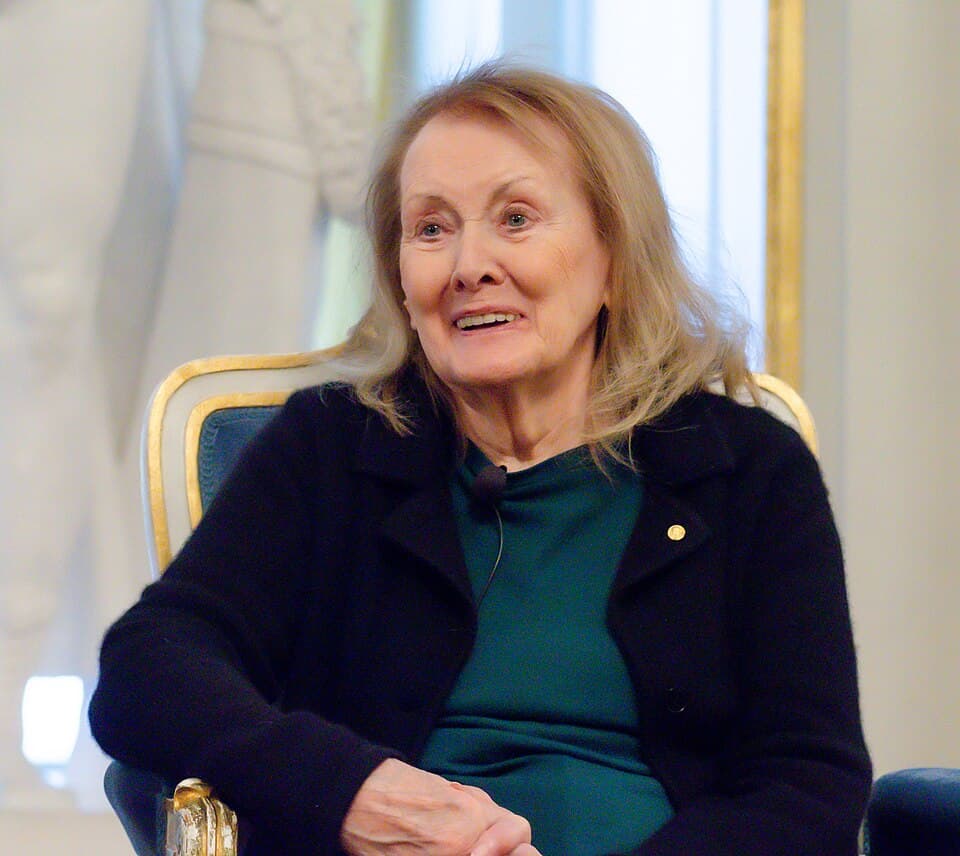
French · Literature · Arts
Annie Ernaux
September 1, 1940 – present
Early Life and Background
Annie Thérèse Blanche Ernaux (née Duchesne) was born on 1 September 1940 in Lillebonne, in the Seine-Maritime department of Normandy, France.[2][3][7][8][18] She grew up in the nearby town of Yvetot, where her parents, initially factory workers, became owners of a combined café and grocery store.[6][8][19] This working-class, small-town environment profoundly shaped her sensibility and later writing, which repeatedly returns to questions of social class, aspiration, and shame.
Ernaux’s parents were ambitious for their daughter and encouraged her education as a means of social mobility.[11][15] She attended local schools and eventually studied French literature at the University of Rouen and later at the University of Bordeaux.[8][11] Her experiences as a girl from a modest background entering the world of higher education exposed her to the cultural codes of the French middle class and to the feelings of inferiority and estrangement that would become central themes in her work.
During her youth, Ernaux also spent time working as an au pair in London, an experience that broadened her horizons and gave her first-hand insight into other cultures and languages.[14][15] These formative years, spanning wartime and postwar France, were marked by rapid social change—urbanization, consumerism, the expansion of education—and by the emergence of new feminist and political movements, all of which would later frame her autobiographical narratives.
Career Beginnings and Development
After completing her studies in modern French literature, Ernaux became a teacher. From 1966 to 1977, she taught French literature at secondary schools, initially in eastern France and later near Paris.[11][15] In 1977, she joined the Centre national d’enseignement par correspondance (National Centre for Distance Education), where she worked as a professor until her retirement in 2000.[2][11] Throughout these decades, she combined full-time teaching with a growing commitment to writing.
Ernaux began her literary career in the early 1970s. Her first published book, the autobiographical novel "Les armoires vides" (Cleaned Out), appeared in 1974.[2][3][11][15] The book introduces many of the themes that would define her work: an unwanted pregnancy and clandestine abortion, the constraints of a working-class upbringing, and the desire for social ascent through education. Its stark, unsentimental tone marked a break from traditional psychological novels and aligned her with emerging currents of autofiction and documentary prose.
She followed this debut with "Ce qu’ils disent ou rien" in 1977, a novel that continued her exploration of female interiority and social pressures.[11] That same year she received the Prix d’Honneur du roman for the book, an early sign of critical recognition.[5] In 1981, she published "La femme gelée" (A Frozen Woman), which examines the contradictions of marriage, motherhood, and career for a generation of women who came of age in the wake of the 1968 movements.[11][15]
Over time, Ernaux increasingly turned away from conventional fiction toward a hybrid form blending autobiography, sociology, and history. She has often described her approach as writing at the intersection of literature, history, and ethnology. Her books are typically short, written in a pared-down, "flat" language that seeks to capture the texture of everyday life while avoiding lyrical or metaphorical excess.[1][4][13][19]
Major Works and Literary Project
A central turning point in Ernaux’s career came with the publication of "La Place" (A Man’s Place) in 1983.[2][13] This slim volume focuses on her father, tracing his life from factory work to running a café-grocery, and investigating the class distance that her education created between them. Ernaux adopts a restrained, quasi-clinical style, carefully avoiding sentimentalism as she explores feelings of shame, pride, and betrayal. The book was widely acclaimed and, in 1984, received the Prix Renaudot, one of France’s major literary prizes, as well as the Prix Maillé-Latour-Landry of the Académie française.[3][5][16][18]
"La Place" is often cited as an exemplary text of Ernaux’s self-described "auto-socio-biography"—writing that uses personal experience to illuminate broader social structures. It established her reputation as a leading chronicler of working-class life and social mobility in late 20th-century France.
Another key work is "Une femme" (A Woman’s Story), published in 1987, which centers on her mother’s life and death. Through this narrative, Ernaux examines generational change, the transformation of women’s roles, and the complex mix of love and resentment in mother–daughter relationships.[2][3] The book has been particularly influential in feminist literary studies for its depiction of a woman’s trajectory from factory work to shopkeeping and its insight into the emotional costs of social ascent.
In 1991, she published "Passion simple" (Simple Passion), a brief but intensely focused account of an obsessive love affair with a married foreign man.[3][9] The book sparked controversy for its frank treatment of erotic desire and female dependency, yet it also attracted significant critical attention and became one of her best-known works internationally.
Ernaux continued to expand her project with books such as "Journal du dehors" (1993), which turns her gaze toward the urban environment and anonymous encounters, and "La Honte" (1997), which analyzes a childhood episode of violence that crystallized her sense of class and familial shame.[3] In 2000, she published "L’Événement" (Happening), a powerful account of her illegal abortion in the early 1960s, written decades after the fact.[3] The book situates her personal ordeal within the broader context of restrictive abortion laws and social stigmas, making it a landmark text on reproductive rights.
Ernaux retired from teaching in 2000 and thereafter devoted herself fully to writing.[2] She continued to produce works that engage with memory and time, such as "Je ne suis pas sortie de ma nuit" (1997), describing her mother’s decline from Alzheimer’s disease, and "L’Usage de la photo" (2005), a collaborative work combining images and text.[3]
Her most celebrated book, "Les Années" (The Years), was published in 2008.[2][4][7] Widely regarded as her magnum opus, it offers a sweeping "collective autobiography" of the period from the 1940s to the early 2000s. Ernaux employs an impersonal narrative voice and a montage of images, slogans, and media references to trace changes in consumer culture, politics, and everyday life. The book won multiple awards, including the Prix Marguerite-Duras, the Prix François-Mauriac (Aquitaine), and the Prix de la langue française for her body of work.[5][16]
"Les Années" has been praised for reinventing autobiography by merging individual experience with generational memory. In 2017, the English translation "The Years", translated by Alison L. Strayer, was published in the United Kingdom, significantly expanding Ernaux’s anglophone readership and drawing international attention to her project.[20]
In 2011, Ernaux published "L’Autre Fille" and "L’Atelier noir", further exploring family memory and her writing process.[4] That same year, the French publisher Gallimard issued a nearly complete collection of her works in its prestigious Quarto series. Ernaux became the first woman writer to be published in this series during her lifetime, underscoring her canonical status.[1]
Awards, Honors, and Recognition
Throughout her career, Annie Ernaux has received numerous literary awards. Early recognition came with the Prix d’Honneur du roman in 1977 for Ce qu’ils disent ou rien.[5] The landmark Prix Renaudot and Prix Maillé-Latour-Landry in 1984 for La Place firmly established her as a major French writer.[3][5][16][18]
Her later work brought further honors. In 2008, Les Années received the Prix Marguerite-Duras and the Prix François-Mauriac, while her entire body of work was distinguished with the Prix de la langue française.[5][16] These awards recognized both the innovation of her collective autobiography and her distinctive contribution to contemporary French prose.
Internationally, Ernaux’s reputation grew steadily. In 2016, she received the Prix Strega europeo (European Strega Prize), highlighting her impact on European literature and her presence in Italian translation.[5][16] In 2017, she was awarded the Prix Marguerite Yourcenar for her body of work, connecting her to a lineage of women who transformed French literature and its institutions.[5][16]
On 11 September 2021, the film "L’Événement" (Happening), directed by Audrey Diwan and adapted from Ernaux’s 2000 book about her illegal abortion, won the Golden Lion at the 78th Venice Film Festival.[14] This cinematic recognition significantly broadened awareness of Ernaux’s work on reproductive rights and women’s bodily autonomy.
The pinnacle of her recognition came on 6 October 2022, when the Swedish Academy announced that Ernaux had been awarded the Nobel Prize in Literature "for the courage and clinical acuity with which she uncovers the roots, estrangements and collective restraints of personal memory."[3][4][13] She became the first French woman to receive the Nobel Prize in Literature.[8][13] The Nobel Foundation simultaneously published official biographical and facts pages detailing her life and works.[4][13]
On 10 December 2022, Ernaux formally received the Nobel medal and diploma at the award ceremony in Stockholm.[4][13] Her Nobel lecture and accompanying publications further solidified her standing as a central figure in contemporary world literature.
Personal Life
Ernaux’s personal experiences are inseparable from her writing. She married Philippe Ernaux in 1964, and the couple had two sons before divorcing in 1985.[12] Her married life and motherhood, as well as the tensions between domestic responsibilities and professional ambitions, are recurring themes in books like La femme gelée and Une femme.
Her parents’ lives and deaths are central to her work. "La Place" focuses on her father and his trajectory from factory worker to small shopkeeper, while "Une femme" and "Je ne suis pas sortie de ma nuit" deal with her mother’s character, illness, and death from Alzheimer’s disease.[2][3] These narratives are both intimate and sociological, portraying family members as figures shaped by class, gender, and historical circumstances.
Ernaux has often written about deeply private experiences—such as her illegal abortion, an obsessive love affair, and her own aging body—not as confessional literature but as a means to understand collective structures of power and normativity. This approach has made her a key figure in feminist writing, though she has sometimes distanced herself from specific labels in favor of a broader focus on social inequality.
Legacy and Historical Impact
Annie Ernaux is widely regarded as one of the most important French writers of the late 20th and early 21st centuries. Her work has had a profound impact on the genre of autobiography and the concept of "autofiction." By insisting on a documentary, unsentimental style and by foregrounding social class, gender, and historical context, she redefined what autobiographical writing could accomplish.
Her concept of "auto-socio-biography" has influenced scholars and writers who seek to link personal experience with collective structures. Books such as "La Place," "Une femme," "La Honte," "L’Événement," and "Les Années" have become touchstones in feminist studies, sociology of literature, and memory studies.[1][4][13][19]
Ernaux’s Nobel Prize in 2022 marked a major moment in women’s literary history. As the first French woman to receive the Nobel in Literature, she challenged the longstanding gender imbalance in one of the world’s most prestigious cultural institutions.[8][13] The prize also brought unprecedented global attention to narratives of working-class life, abortion, and female desire, themes that had often been marginalized in canonical literature.
Her influence extends beyond literature into film and public debate. The Golden Lion for "L’Événement" in 2021 helped bring her story of clandestine abortion to international audiences in a period of renewed global controversy over reproductive rights.[14] Her books have been translated into numerous languages, taught in universities worldwide, and discussed in interdisciplinary contexts ranging from sociology and history to gender studies.
In publishing, Ernaux’s inclusion in Gallimard’s Quarto series in 2011 as the first woman writer to be so honored during her lifetime signaled a shift in the French literary canon, acknowledging the centrality of women’s and working-class voices.[1] Her recognition with prizes such as the Prix de la langue française and the Marguerite Yourcenar further confirms her role in reshaping conceptions of literary language and value.
Later Life and Ongoing Work
Since retiring from teaching in 2000, Ernaux has continued to write and publish, often reflecting on aging, memory, and the passage of time. Her later works maintain the same commitment to documenting everyday life and examining the structural forces that shape individual existence.
Following the Nobel Prize, her books have been reissued and newly translated, and she has become the subject of numerous retrospectives, interviews, and critical studies.[4][6][11][19] The award has prompted renewed interest in her entire oeuvre, including earlier works that had been less widely available in translation.
As of the mid-2020s, Annie Ernaux remains alive and active, residing in France and continuing to engage with public debates on literature, memory, and social justice.[3][13] Her legacy is still unfolding, but her impact on autobiographical writing, feminist literature, and the representation of working-class life is already firmly established.
Dated achievements
15 indexed.
- Sep011940Literature
Birth of Annie Ernaux
Annie Thérèse Blanche Duchesne (later Annie Ernaux) is born in Lillebonne, Normandy, France, into a working-class café-grocery family.
View details Nobel Prize – Annie Ernaux Facts - Jan011977Literature
Prix d'Honneur du roman for "Ce qu'ils disent ou rien"
Annie Ernaux receives the Prix d’Honneur du roman for "Ce qu’ils disent ou rien"; the award is documented for 1977 without a specific day.