← All women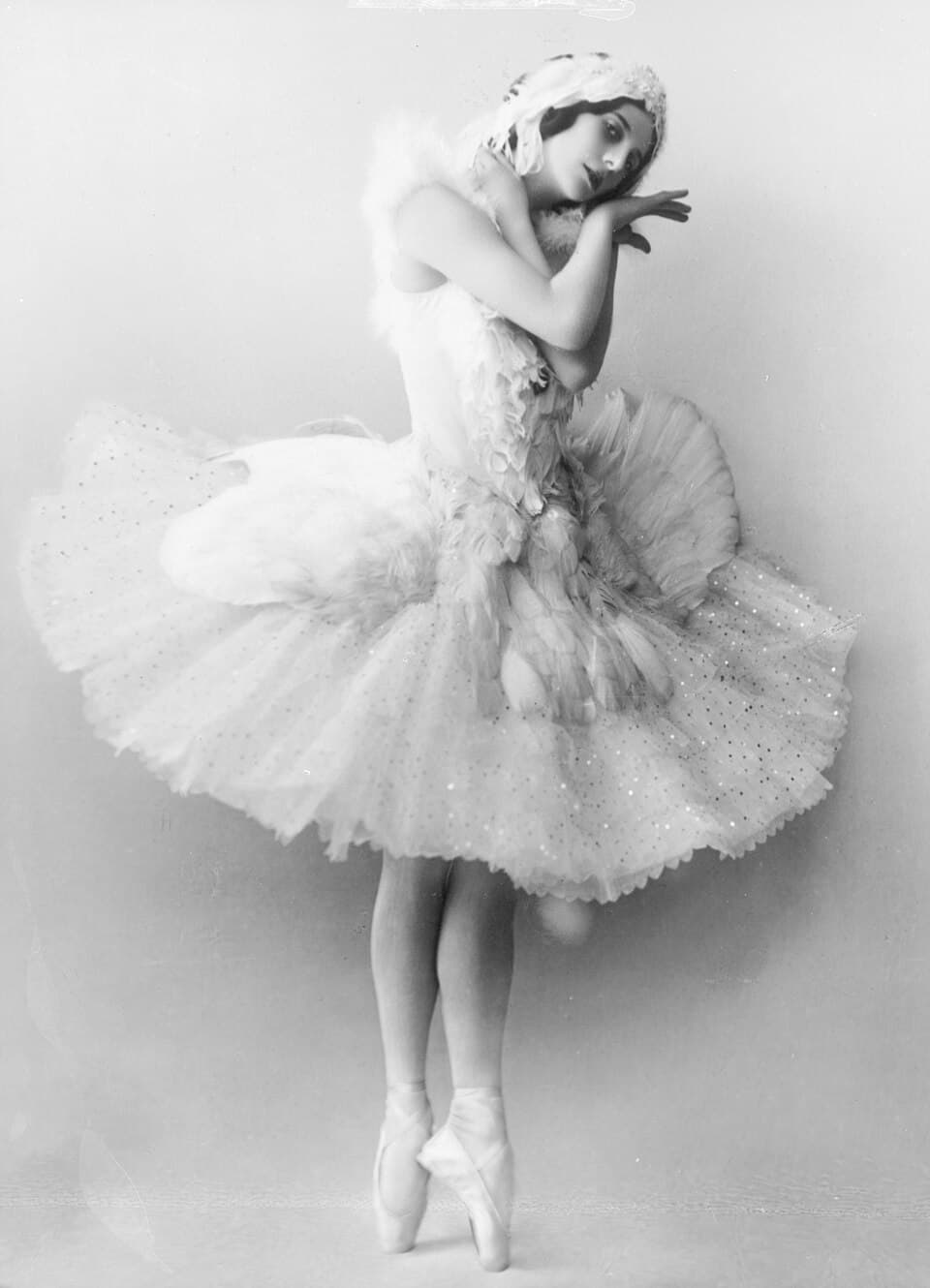
Russian · Arts
Anna Pavlova
February 12, 1881 – January 23, 1931
Early Life and Background
Anna Pavlovna Pavlova (born Anna Matveyevna Pavlova) was born on 12 February 1881 (31 January 1881 Old Style) in St. Petersburg, in the Russian Empire.[1][2][15] Some sources specify the suburb of Ligovo near the city.[18] She was the illegitimate daughter of Lyubov Feodorovna, a laundress, and grew up in modest circumstances, far from the aristocratic milieu that dominated the Imperial theatres.[12][15] The identity of her father is uncertain; one commonly cited figure is Matvey Pavlov, a soldier, whose patronymic she bore.[1][12]
Pavlova’s childhood was marked by frail health and economic hardship. Nevertheless, her mother encouraged her cultural exposure, and a pivotal moment came when she was taken to see The Sleeping Beauty at the Mariinsky Theatre in 1890.[15] The performance, choreographed by Marius Petipa to Tchaikovsky’s music, left a deep impression on the young girl, who reportedly determined then that she would become a ballerina.[1][15]
In 1891, at around age ten, Pavlova entered the Imperial Ballet School (Imperial School of Ballet) associated with the Mariinsky Theatre in St. Petersburg.[4][12][14] Her physical type—slight, delicate, and somewhat unconventional by contemporary standards—initially led some instructors to doubt her suitability for classical ballet.[1][4] She faced criticism for her thinness and hyperextended limbs, in an era that favored more robust physiques.
Despite these obstacles, Pavlova studied with leading teachers of the Russian school, including Ekaterina Vazem and later Paolo Gerdt
Upon graduating in 1899, Pavlova was accepted immediately into the Imperial Ballet company at the Mariinsky Theatre.[2][14] She made her company debut that year, dancing in the corps de ballet and quickly receiving solo opportunities.[3][14] Within a short period she began to attract public attention for her expressive arms, fluid upper body, and musical sensitivity. In 1900, Pavlova’s advancement became evident through significant new roles. In February 1900, she created the role of Frost in Petipa’s ballet The Seasons, a demanding character part that showcased the refinement of her technique and her capacity for stylized characterization.[15] In April 1900, she debuted as Eos in The Awakening of Flora, a ballet that, according to the Petipa Society, gave her first principal role that year.[15] These assignments marked her transition from promising soloist to featured artist in the Imperial repertory. By 1902, Pavlova was cast as Nikiya in La Bayadère, a role often identified as her breakthrough.[15] The part demanded both technical control and tragic emotional expressiveness, qualities she brought together in performances that impressed critics and audiences. Her interpretation helped to redefine the role in the early 20th century and solidified her status as one of the company’s leading ballerinas. In 1903, she first danced the title role in Giselle at the Mariinsky Theatre.[4][15] This Romantic ballet became closely associated with Pavlova; sources note that she "graduated" to the title role and then, by 1906, achieved formal ballerina status in the company.[4][14] Her Giselle, emphasizing fragility and spiritual delicacy in the second act, was widely admired and influenced later interpretations of the role. During these years, Pavlova also began to work with choreographer Mikhail (Michel) Fokine, whose interest in more expressive, music-driven choreography matched her strengths.[1][2][15] Their collaboration would produce her most famous solo and play a crucial role in her global fame. One of the defining events in Pavlova’s career occurred in 1905, when Fokine created a short solo for her to Saint-Saëns’s Le Cygne (The Swan).[1][2][15] The piece, later known as The Dying Swan, distilled the essence of her style: fluid arms evoking wings, a pliant spine, and an intense emotional arc compressed into a few minutes. The solo was tailored specifically to her strengths and quickly became her signature work.[2][3][14] She first performed The Dying Swan in 1907, according to the Kennedy Center and other sources.[4][12] Audiences were deeply moved by the fusion of music and movement, and the solo helped to shift emphasis in ballet toward expressive, character-driven performance. It has remained one of the most iconic pieces of solo choreography in the classical repertoire. The year 1907 also saw the beginning of Pavlova’s career as a touring artist. Biographical accounts describe this year as her first tour, initially to Moscow and then further afield.[12] Touring represented a departure from the traditional pattern of Imperial dancers, who largely remained in St. Petersburg or occasionally visited other European capitals. Pavlova’s willingness to take her art on the road foreshadowed her later role as a global ambassador for ballet. In 1908, Pavlova took the role of Aurora in The Sleeping Beauty, the very ballet that had inspired her childhood ambition.[4][15] This casting symbolized her full integration into the highest ranks of the classical canon. Her Aurora combined technical clarity with the lightness and warmth audiences associated with her style. Pavlova also worked briefly with Sergei Diaghilev and the Ballets Russes. She appeared with the company in its early Paris seasons, dancing in works such as Le Pavillon d’Armide and Les Sylphides, though precise dates vary across accounts.[1][12] However, she ultimately chose not to remain with Diaghilev, preferring artistic independence and the flexibility to tour widely rather than commit to his experimental repertory and ensemble. In February 1910, Pavlova made her first appearance in America at the Metropolitan Opera House in New York.[12] Although the exact day is not consistently recorded, sources agree on the month. Her performances introduced many in the United States to high-level classical ballet for the first time, and she was received with enthusiasm. This tour strengthened the transatlantic appreciation for ballet and laid groundwork for later American companies. In 1911, Pavlova founded her own touring company, often referred to simply as the Pavlova Company.[3][12] Biographical sources describe her, with this ensemble, as the first ballerina to tour ballet around the world, visiting South America, India, Mexico, Australia, and other regions.[1][13][14] The company’s repertory combined condensed versions of classical ballets—such as Giselle and Swan Lake—with short pieces like The Dying Swan and character dances tailored to diverse audiences. By 1913, Pavlova left Russia to tour with her own company on a more permanent basis.[2][14] This step marked a major shift: she effectively traded a secure position at the Mariinsky for the risks of independent touring at a time of increasing political instability in the Russian Empire. Her departure preceded the First World War and the Russian Revolution, events that would dramatically reshape the country she left behind. Within the Imperial Ballet structure, Pavlova achieved the status of prima ballerina and was widely hailed by critics as the foremost dancer of her generation.[2][14] The title reflected both institutional recognition and her popularity with audiences at home and abroad. Although formal state awards typical of later Soviet practice were not part of her career, contemporary testimony and later assessments consistently describe Pavlova as “the most celebrated dancer of her time.”[2][14] Her inclusion in major encyclopedias, museum collections, and retrospective exhibitions—such as portraits held by the National Portrait Gallery in London—attest to her sustained cultural standing.[4][9] Her image and name became synonymous with classical ballet. The dessert Pavlova, a meringue-based dish popular in Australia and New Zealand, is widely believed to have been named in her honour following her tours there in the 1920s, further illustrating her impact on popular culture, though specific naming dates are debated among culinary historians.[1] Pavlova was known for intense dedication to her art, often subordinating personal comfort and conventional domestic life to the demands of touring and rehearsal.[1][3] Nevertheless, she maintained close relationships with colleagues and, particularly, with her manager Victor Dandré. Sources indicate that Pavlova and Dandré were married, though the date and circumstances of their marriage were kept private and are not consistently documented.[12] Dandré managed her finances and touring arrangements, helping to sustain the extensive travel that defined her mature career. The couple is not known to have had children.[12] Pavlova eventually made London her principal home, establishing a residence at Ivy House in Golders Green.[9][12] There she kept swans and other animals, reinforcing the image of her affinity with the creature central to her most famous role. Ivy House became a symbol of her adopted life in England and, later, a site of memorial interest. Her personal habits were closely tied to her professional discipline. Accounts describe her as maintaining strict routines, including daily practice, and making financial sacrifices to support her company during challenging tours.[1][12] These choices reflected both her sense of responsibility to fellow dancers and her belief in ballet’s educational mission. In the 1920s, Pavlova continued to tour widely with her company, visiting countries across Europe, the Americas, Asia, and the Pacific.[1][14] She remained active at an age when many dancers retired, adapting her repertory to allow for sustained performance while spotlighting younger colleagues. Despite the rising prominence of new choreographers and styles—especially modernism and neo-classicism—Pavlova maintained a focus on accessible, emotionally direct works. Her programmes often featured abridged versions of classical ballets and short, evocative solos. She saw touring not only as artistic work but also as cultural diplomacy, introducing ballet to audiences who had never before encountered the art form.[1][14] During a tour in the early 1930s, Pavlova became ill with pneumonia and pleurisy while in the Netherlands.[1][2][12] According to biographies, she was advised to undergo an operation that would have ended her dancing career, and she refused.[1][2][12] On 23 January 1931, she died in The Hague at age 49.[1][2][6][15] Many accounts relate that her final request was for her Swan costume, reinforcing the impression that she remained emotionally joined to her art until the end.[1][3][12] Her body was later interred in London, where she had made her home, and memorials to her were established in various cities. Obituaries and tributes emphasized her transformative influence on ballet and her devotion to touring as a means of sharing dance globally.[1][2][14] Pavlova’s legacy rests on several intertwined contributions: her performance style, her role in the globalization of ballet, and her influence on subsequent generations of dancers and companies. Stylistically, Pavlova was celebrated for an ethereal quality rooted in exceptional use of the upper body and arms. Her dancing was less about virtuosic display than about expressive line and musical interpretation.[1][2][3] In roles such as Giselle, Nikiya, and Aurora, she emphasized spiritual intensity and emotional clarity, helping to shape expectations for Romantic and classical heroines in the 20th century. The Dying Swan stands as the clearest encapsulation of her aesthetic. The solo’s lasting presence in ballet repertories—performed and reinterpreted by countless ballerinas—testifies to both Fokine’s choreographic insight and Pavlova’s original embodiment.[1][2][15] The image of the fragile swan struggling against mortality became inseparable from Pavlova herself, coloring public memory of her life and death. Equally important was her role in spreading ballet beyond its traditional centers. With her own company, Pavlova toured South America, India, Australia, Mexico, and other regions where audiences had rarely, if ever, seen classical ballet on stage.[1][13][14] Britannica and other sources highlight that her tours brought ballet to many countries for the first time and "did much to popularize ballet worldwide."[14] She effectively demonstrated that ballet could thrive as a touring art form, inspiring later companies such as the Ballets Russes de Monte Carlo and touring ensembles associated with major national companies. Pavlova also shaped the image of the ballerina in popular culture. Photographs, posters, and anecdotes about her devotion to dance created a template of the ballerina as both artist and near-mythic figure. Her name became attached to products and stories well beyond the realm of theatre, including the aforementioned dessert and numerous biographical films and books.[1] Institutions such as the National Portrait Gallery in London preserve images of Pavlova that continue to be exhibited as part of narratives about early 20th‑century performance and women’s cultural history.[4] Museums and archives hold costumes, letters, and memorabilia associated with her career, which remain subjects of scholarly study regarding performance practice, touring logistics, and artistic networks of her era. From a women’s history perspective, Pavlova’s life illustrates how a woman from a non‑elite background navigated and reshaped a prestigious artistic institution. She overcame class and physical stereotypes to become a prima ballerina, then used her prominence to construct an independent career that circumvented conventional managerial structures.[1][2][12] Her work as a company leader—organizing tours, crafting repertory, and mentoring dancers—offers early examples of female artistic entrepreneurship in the performing arts. Her enduring reputation as one of the "finest classical ballet dancers in history"[5] is reflected in continued references in dance education, scholarship, and performance traditions. Students learn about her as a central figure in the evolution of classical ballet; choreographers and performers cite her as inspiration for prioritizing expressiveness and audience connection. Nearly a century after her death, Pavlova’s name remains shorthand for an ideal of lyrical, emotionally charged classical ballet. Her achievements, especially as the first ballerina to tour extensively around the world, secured her place not only in Russian dance history but also in global cultural heritage.[1][13][14]Career Beginnings and Development
Major Works and Pivotal Accomplishments
Awards, Honours, and Professional Recognition
Personal Life
Later Life and Death
Legacy and Historical Impact
Dated achievements
7 indexed.
- Feb121881Arts
Birth of Anna Pavlova
Anna Pavlova was born on February 12, 1881, in St. Petersburg, Russia.
View details Anna Pavlova - Britannica - Sep011899Arts
Company Debut at Mariinsky Theatre
Pavlova debuted at the Mariinsky Theatre, marking her entry into the professional ballet world.
View details