← All women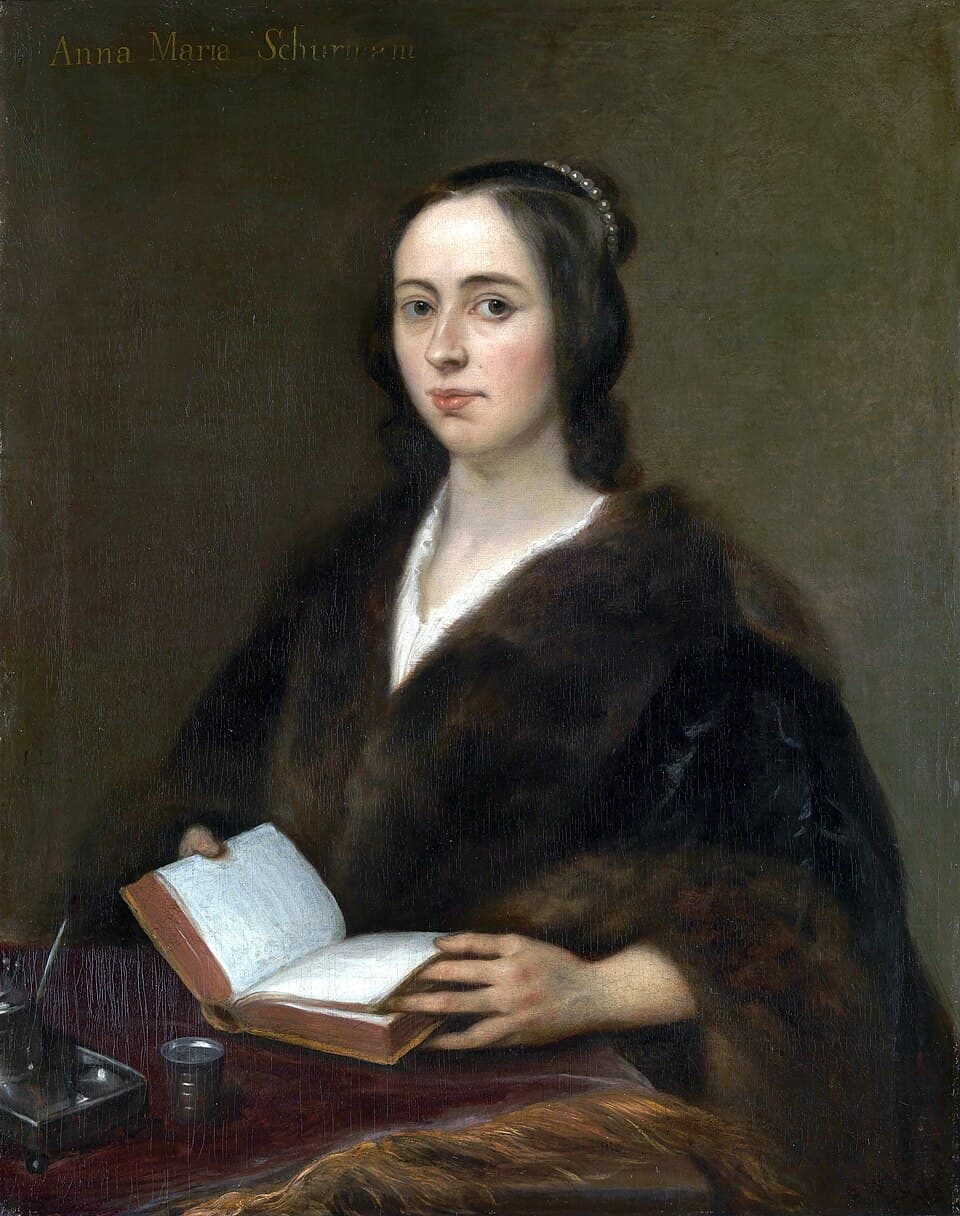
Dutch, German · Science · Literature · Arts
Anna Maria van Schurman
November 5, 1607 – May 4, 1678
"
Early Life and Background
Anna Maria van Schurman was born on 5 November 1607 in Cologne, in the Holy Roman Empire, to a family of devout Reformed Protestants of Dutch and Flemish descent who had fled religious persecution in the Southern Netherlands. Her father, Frederik van Schurman, came from a family of minor nobility and held strong convictions about the value of rigorous education — convictions he extended, remarkably for the period, to his daughters as well as his sons.
From her earliest years, Anna Maria displayed prodigious talents. Family accounts and her own later writings describe her reading fluently at age three, and by the age of six she was cutting intricate paper designs with scissors and drawing with great skill. Her father personally directed her early education, teaching her Latin, arithmetic, logic, and theology alongside more conventional feminine accomplishments such as needlework, drawing, and music, in which she also excelled and would achieve renown as an engraver, painter, and musician throughout her life.
Around 1615, the family relocated first to Utrecht and eventually settled permanently in that city, which became the center of Anna Maria's adult life and career. After her father's death in 1623, she continued her studies with the support of her mother and brothers, as well as correspondence with leading scholars of the day, quickly gaining a reputation as an intellectual prodigy.
Development as a Scholar
By her twenties, van Schurman had mastered an extraordinary range of languages, eventually including Latin, Greek, Hebrew, Aramaic, Syriac, Arabic, French, English, German, Dutch, and Ethiopic — a linguistic range almost unmatched among her contemporaries of either sex. She corresponded in Latin with prominent theologians, philosophers, and scholars across Europe, including André Rivet, Marin Mersenne, and later Descartes, whose philosophy she engaged with critically.
Her growing fame attracted the attention of Gisbertus Voetius, the influential theologian and first rector of the newly established University of Utrecht. When the university was inaugurated on 5 June 1636, Voetius arranged for van Schurman to attend lectures — an unprecedented step that made her the first woman known to formally study at a Dutch university. Due to prevailing norms about female modesty and the potential for her presence to distract male students, she was seated in a specially curtained booth or alcove, from which she could hear lectures without being seen. Despite these restrictions, she participated actively in scholarly exchange, submitting written questions and disputations that were read aloud and debated.
Major Works and Accomplishments
Van Schurman's most influential intellectual contribution was her sustained, erudite defense of women's right to education. Her landmark treatise, often known by its Latin title Dissertatio de ingenii muliebris ad doctrinam et meliores litteras aptitudine (Dissertation on the Aptitude of the Female Mind for Learning and the Liberal Arts), was composed in the 1630s and published in expanded form in 1641 (in an English translation titled The Learned Maid, or, Whether a Maid may be a Scholar, 1659). In it, she argued methodically, using scholastic logical form, that women possessed the same intellectual capacities as men and should therefore be permitted access to the same education, particularly in service of piety and the study of Scripture. The work circulated widely across Protestant Europe and was translated into multiple languages, cementing her reputation as a foundational figure in early modern debates on women's education — a precursor to later Enlightenment arguments for gender equality in intellectual life.
Beyond her scholarly treatises, van Schurman was also a gifted visual artist, working in engraving, painting, sculpture, and paper-cutting; several self-portraits and portrait engravings by her survive and are held in museum collections, including the Centraal Museum in Utrecht. She composed poetry in multiple languages, wrote hymns, and was skilled in music. Her polymathic accomplishments led contemporaries to dub her Stella Ultrajectina (the Star of Utrecht) and 'the Miracle of Utrecht' or 'the tenth Muse.'
She maintained a vast correspondence network across the Republic of Letters, corresponding with royalty, including Queen Christina of Sweden, and with leading intellectuals throughout Europe. Her collected Latin letters and poems were published as Opuscula Hebraea, Graeca, Latina, Gallica, prosaica et metrica (1648), which went through multiple editions and widely disseminated her reputation as Europe's most learned woman.
Personal Life
Anna Maria van Schurman never married, a choice she defended as consistent with her devotion to scholarship, piety, and, in her view, a life free from the distractions and subordination that marriage in that era typically entailed for women. She lived for much of her adult life in Utrecht with family members, and later devoted herself increasingly to religious contemplation.
In the 1660s, van Schurman's life took a dramatic turn when she became a follower of the French Pietist preacher Jean de Labadie, whose radical separatist religious movement emphasized communal living, spiritual purity, and withdrawal from the established church and from worldly learning. This was a stunning reversal for a woman whose entire earlier reputation rested on secular and religious scholarship celebrated across Europe. She joined the Labadist community, following it through several relocations in Germany and the Netherlands, eventually settling in the small Frisian village of Wieuwerd.
Later Life, Legacy, and Death
Van Schurman's embrace of Labadism scandalized many of her former admirers and correspondents, who saw it as a rejection of the intellectual life she had championed. In response to this criticism, she wrote her spiritual autobiography, Eukleria seu Melioris Partis Electio (Eukleria, or the Choosing of the Better Part), published in 1673, in which she defended her turn to radical piety as the culmination and fulfillment, rather than a betrayal, of her lifelong pursuit of truth and wisdom. The work remains a key primary source for understanding both her personal theology and the broader currents of Pietist and separatist religious thought in the seventeenth century.
She died on 4 May 1678 in Wieuwerd, where she had spent her final years within the tightly knit Labadist community. She was buried there, her death marking the close of one of the most remarkable intellectual lives of early modern Europe.
Anna Maria van Schurman's legacy endures on multiple fronts. She is remembered as a pioneering figure in the history of women's education, having been the first woman to study, however restrictedly, at a European university, and having authored one of the earliest sustained philosophical defenses of women's intellectual equality. Utrecht University continues to honor her memory through named lectures, fellowships, and institutional commemorations, and she remains a touchstone figure for historians of gender, education, and the Republic of Letters. Her surviving artworks, letters, and books are preserved in museums and libraries across Europe, testifying to the breadth of a life that spanned art, scholarship, theology, and radical religious devotion.
"Dated achievements
3 indexed.
- Nov051607Science
Born in Cologne
Anna Maria van Schurman was born in Cologne, Germany, to a devout Reformed family that would later settle in the Dutch Republic.
View details Wikipedia: Anna Maria van Schurman - Jun051636Science
First woman to attend a Dutch university (Utrecht)
Van Schurman became the first woman permitted to attend lectures at Utrecht University, seated behind a curtain to avoid distracting male students.