← All women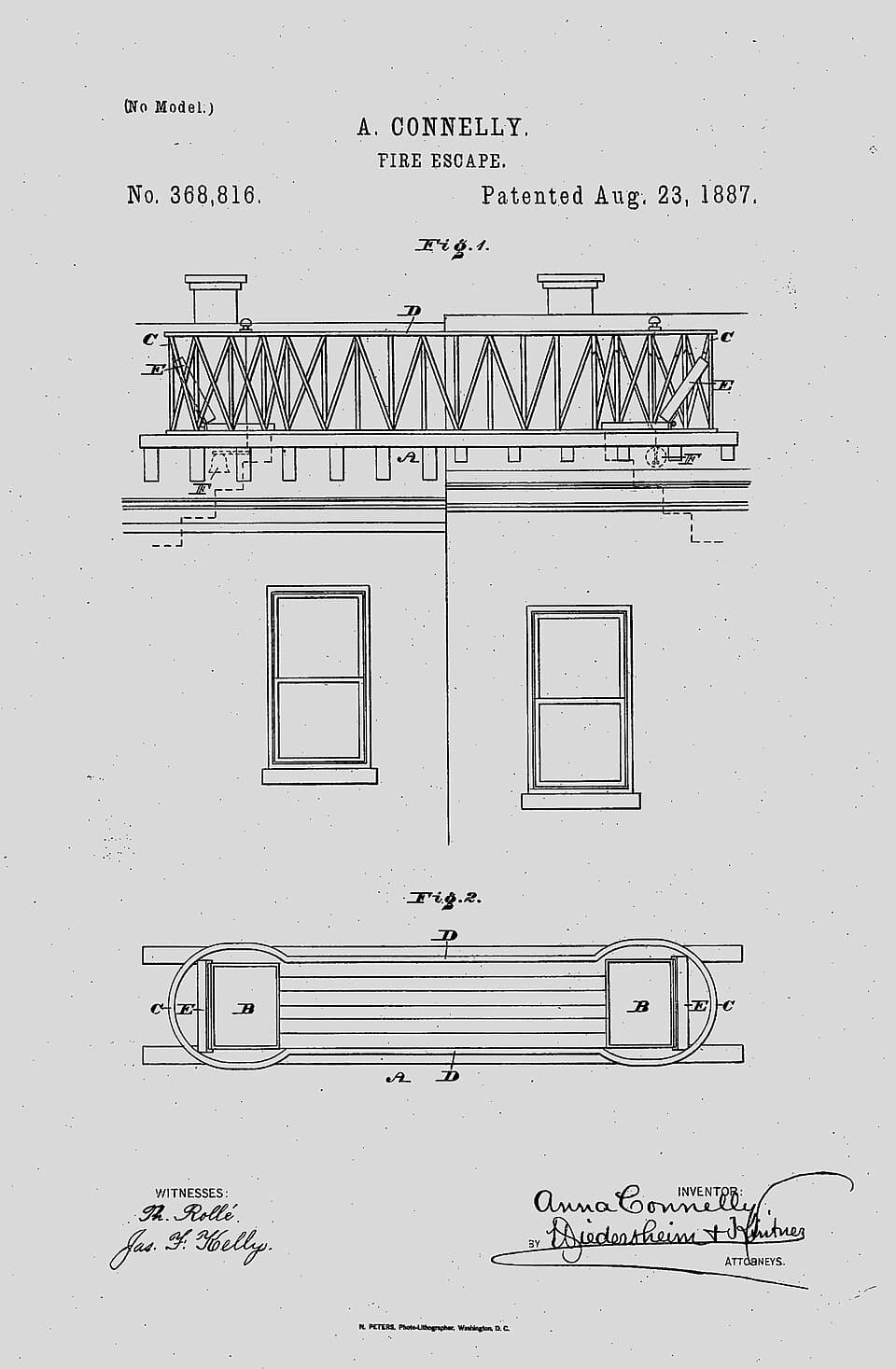
American · Science
Anna Connelly
1868 – April 1, 1969
Overview
Anna Connelly was a nineteenth‑century American inventor from Philadelphia, Pennsylvania, best known for her pioneering patent for a rooftop fire‑escape structure that became a direct predecessor of the modern outdoor fire escape.[1] Working in an era of rapid urbanization and frequent catastrophic fires, she devised a railed, fire‑proof bridge to connect the roofs of adjacent buildings, providing a safer way for residents to escape burning structures.[1] Her work contributed to the emerging field of building safety and helped shape later practices in urban egress design.
Connelly is also noted as one of the first women to submit a patent to the patent office in Philadelphia, a barrier‑breaking step at a time when women had limited legal and economic rights and rarely filed patents in their own names.[5] Although documentation of her personal life is sparse, surviving census and patent records situate her life in Philadelphia from the mid‑nineteenth century into the mid‑twentieth century.[1] Her fire‑escape invention has since been recognized by historians, educators, and legal commentators as a significant contribution to public safety and to women’s history in science and technology.[1]
Early Life and Background
Sources agree that Anna Connelly was born in Philadelphia, Pennsylvania, to parents of English origin, but they differ on the exact date.[1][3] The English‑language Wikipedia article states that she was born on September 23, 1868, while the Catalan‑language Viquipèdia notes that she was born on September 3, 1868 and attributes her parentage to English immigrants.[1][3] Both accounts identify Philadelphia as her birthplace and describe her as the daughter of English parents, reflecting the city’s sizeable immigrant population in the late nineteenth century.[1][3] Because no primary birth record has been presented in these sources, the exact day remains uncertain.
Little is known from primary documentation about Connelly’s childhood, family life, or formal education. The surviving narrative sources infer that she likely grew up in a working‑ or middle‑class environment in an increasingly industrial city, exposed to the challenges of crowded housing and fire risk that would later motivate her invention.[4][5] The 1920 U.S. census is cited as the main documentary reference for her life, recording her in Philadelphia at age 51, which aligns with an 1868 birth year.[1] However, detailed information about her schooling, early employment, or technical training has not been preserved in the historical record currently available.
Given the broader context of the era, Connelly would have come of age when women’s access to higher education, engineering training, and professional societies was sharply constrained. Many women interested in practical mechanics or household technologies pursued informal study, apprenticeships, or self‑directed experimentation rather than formal degrees. Later educational discussions of her contribution, such as those by the Library of Congress, position her within this under‑documented group of women who nonetheless engaged with science, technology, engineering and mathematics (STEM) in meaningful ways.[5]
Historical Context: Urban Fires and Building Safety
Connelly’s inventive work must be understood against the backdrop of repeated, large‑scale urban fires in the United States during the nineteenth century. The She Builds Podcast, which profiles her life and work, emphasizes that by the time she filed her patent in the 1880s, major American cities had already experienced devastating conflagrations: the Great New York City fire, the Great Chicago Fire, and other significant blazes in Pittsburgh, San Francisco, and Boston.[7] These events underscored the vulnerability of dense urban neighborhoods built largely of wood, with limited firefighting capacity and inadequate escape routes for residents.
As cities grew vertically, multi‑story tenements and commercial buildings became common, increasing the difficulty of evacuation once internal staircases filled with smoke or became impassable. Early fire‑escape solutions were often improvised, involving ropes, ladders, or simple platforms that lacked standardization or rigorous design. In this context, Connelly’s idea of a durable, fire‑proof bridge on rooftops represented a significant conceptual shift: instead of relying solely on interior passages, her design exploited the relative safety of rooftops and the proximity of neighboring buildings to create alternate paths of escape.[1][7]
Career Beginnings and Patent Activity
By 1877, Connelly was documented as filing patents from Philadelphia, indicating that she was already engaging with the formal mechanisms of invention and intellectual property.[4][5] Educational material from the Library of Congress notes that in that year she proposed a railed, fire‑proof platform acting as a bridge between adjacent buildings—an early innovation that foreshadowed the modern outdoor fire escape.[5] This suggests that she had begun to study urban fire problems and to formulate a structural solution well before her later, more fully developed patent.
The same Library of Congress discussion states that Connelly became one of the first women to submit a patent to the Philadelphia patent office in 1877, marking a notable departure from the male‑dominated pattern of patent filings.[5] While women had obtained U.S. patents before this date, her action appears to have been among the earliest instances in the local Philadelphia context, particularly in the field of building‑related technology. This early participation indicates that Connelly was not an isolated, late‑career inventor but someone who had been exploring patentable ideas for at least a decade.
Details of her early patents are not fully reconstructed in secondary sources, and some accounts focus primarily on the later, more famous fire‑escape patent of 1887.[1][4][5] Nonetheless, the 1877 references show that Connelly was experimenting with rooftop bridging concepts and taking the administrative steps necessary to protect her inventions. This formative period likely involved interactions with patent clerks and perhaps informal networks of tradespeople or builders, though such connections are not documented in the surviving record.
The Fire-Escape Invention
Connelly’s major and best‑documented accomplishment is her patented “Fire-Escape” design. On March 17, 1887, she filed a U.S. patent application describing a fire‑proof bridge with railings and openings at each end, adapted to be installed on the roofs of adjoining or adjacent buildings to facilitate escape from fires.[10] The patent specification details the structural features of this system, including the use of durable, non‑combustible materials and the arrangement of railings to prevent falls during emergency evacuations.[10]
The application framed the invention as a means to protect residents of tall buildings by offering a safe route to neighboring structures when the usual exits were blocked. By focusing on rooftops, Connelly’s design leveraged the proximity of structures in densely built urban blocks and addressed the problem that stairways and corridors might be quickly rendered unusable during a fire. Her choice of materials—including iron or steel—aimed to ensure that the escape route would remain structurally sound under intense heat.[1][10]
On August 2, 1887, the United States Patent Office granted her Patent No. 386,816 for the invention titled “Fire-Escape.”[1][10] The patent images and text, preserved in the official record, show a rooftop bridge surrounded by railings, with access openings at each end, designed to be reached by stairs and connected to other rooftop platforms as needed.[10] Later analyses describe this design as the first documented external metal fire‑escape system in the U.S. patent record, employing steel or iron platforms and railings to create a reliable, permanent means of escape.[1][2][12]
The Living Fires blog and a feature in Best Lawyers characterize Connelly’s invention as a precursor of the modern outdoor fire escape—those external staircases and landings familiar on the exteriors of urban apartment buildings.[2][3] These sources emphasize how her concept moved fire‑escape infrastructure outside the building envelope, reducing the risk that escape routes themselves would be engulfed by flames. The combination of platforms, railings, and connections to adjacent structures represented a new way of safeguarding occupants and managing evacuation in multi‑story buildings.[2][3]
Recognition as an Early Woman Inventor
Connelly’s role as an inventor has been highlighted in educational and historical narratives focusing on women in STEM. The English‑language Wikipedia article notes that she was one of the first women in the U.S. to submit a patent application without assistance from a man, underscoring the autonomy with which she pursued legal protection for her invention.[1] The Library of Congress teaching blog similarly frames her as an early woman inventor using the patent system after the Civil War, particularly in Philadelphia.[5]
These assessments must be contextualized within the broader history of women’s patents. Women such as Mary Dixon Kies had received U.S. patents decades earlier, but many nineteenth‑century women inventors remained obscure, and their work was frequently registered under male names or overshadowed in historical accounts. Connelly’s patent stands out because it pertains to a major area of public safety, carries her own name, and is connected with subsequent changes in building practices.
Modern commentators, including legal writers and women’s‑history bloggers, have celebrated Connelly’s achievement as a milestone in diversity and innovation in technology. A Best Lawyers article on diversity in innovation highlights her as an example of a woman whose safety‑oriented invention shaped the built environment and saved lives, while also illustrating the under‑representation of women in the historical technology narrative.[3] A profile on the Strong Women in History blog similarly portrays her as a "lifesaver," emphasizing the human impact of her work.[4]
Influence on Building Codes and Urban Practice
Although Connelly’s patent did not itself legislate building codes, later accounts connect her design to subsequent developments in urban egress regulations. The She Builds Podcast notes that after her invention, code officials in major cities came to require that buildings have two paths of egress, one of which could be an exterior fire stair similar to Connelly’s concept.[7] This evolution in regulatory practice meant that external metal fire escapes became common features on multi‑story urban buildings.
Legal and architectural commentary, including the Best Lawyers article, describes how external fire‑escape systems with steel platforms and railings became embedded in cityscapes, providing visible evidence of the prioritization of safety in building design.[3] While such codes were shaped by multiple engineers, officials, and incidents, Connelly’s patent provided an early technical model of how external egress could be structured, and it contributed to the conceptual and practical toolkit from which regulators drew.
In the broader history of technology, this pathway—from a single patent to pervasive urban infrastructure—demonstrates how individual inventors can influence everyday life. Residents of tenements and workplaces gained an additional measure of security, and the familiar image of metal fire escapes lining city blocks owes something to Connelly’s pioneering rooftop bridge. Her work thus forms part of the invisible history of how safety became an integral criterion in architectural design.
Awards, Honors, and Later Recognition
No contemporary records indicate that Anna Connelly received formal awards or honors for her fire‑escape invention during her lifetime. As with many nineteenth‑century women inventors, her work appears to have circulated primarily through patent records and practical adoption rather than public accolades or membership in professional societies.
However, in the late twentieth and early twenty‑first centuries, Connelly has been rediscovered and celebrated in educational and popular media. The Library of Congress teaching blog features her in a series on "Inventions and Innovations," framing her story as a tool to engage students with themes of urbanization, safety, and women’s contributions to technology.[5] Blogs such as Strong Women in History and Living Fires have published articles narrating her life and explaining the significance of her patent.[2][4]
Podcast episodes, including the She Builds Podcast, have devoted time to exploring her biography and invention, situating her among influential women in architecture and engineering.[7] Social‑media posts and short videos produced by history‑focused accounts have further amplified her story, describing her as a "19th‑century American inventor" whose patent "saved lives" and helped make buildings safer.[20] Through these channels, Connelly has increasingly been recognized as an important figure in women’s history and in the history of building safety, even if formal institutional honors remain limited.
Personal Life
The historical record provides only fragmentary information about Connelly’s personal life. The 1920 census, cited in the English‑language Wikipedia article, records her as living in Philadelphia at age 51, implying that she remained in the city long after her patent activity in the 1870s and 1880s.[1] Beyond this, there is no widely cited primary documentation regarding her marital status, children, occupation outside of inventing, or social networks.
Secondary narratives sometimes speculate that she lived a relatively quiet life in Philadelphia, continuing to observe the city’s changing skyline as metal fire escapes became more common. However, such speculation is not corroborated by archival sources currently referenced in mainstream accounts. As a result, responsible historical writing must acknowledge the limits of our knowledge about her family and personal relationships.
This paucity of personal detail is typical of many women inventors of the period whose lives were not thoroughly recorded by contemporary institutions. Their technical contributions were documented through patents and municipal records, but their daily experiences, challenges, and support networks often went unrecorded. Connelly’s biography thus reflects both the presence of women in the history of technology and the archival silences that surround them.
Legacy and Historical Impact
Anna Connelly’s legacy lies primarily in her contribution to building safety and in her role as an early woman inventor recorded in U.S. patent history. Her fire‑escape patent provided a technical foundation for the development of external metal fire‑escape systems, which became standard features of many urban buildings and have saved countless lives during fires.[1][2][3] By conceptualizing a rooftop bridge with railings and openings at each end, she offered a practical solution to the problem of evacuation from tall, densely packed structures.
In women’s‑history scholarship, Connelly serves as a case study of how women engaged with engineering problems despite systemic barriers. Her ability to file a patent under her own name and to be recognized as an inventor challenges narratives that women were absent from nineteenth‑century technological innovation. Educational programs use her story to illustrate themes of gender, law, urbanization, and public safety, encouraging students to see connections between historical inventions and the built environment around them.[5]
More broadly, her work contributes to the ongoing effort to identify and highlight women whose contributions to science and technology were overlooked. As historians and educators continue to examine patent records and local archives, figures like Connelly come into clearer view, expanding our understanding of who shaped modern infrastructure and safety standards. Her rooftop fire‑escape bridge, though a specific technical solution, symbolizes a wider pattern of women inventors whose ideas quietly transformed everyday life.
Later Life and Death
Accounts of Connelly’s later life and death rely on limited evidence and sometimes conflicting secondary interpretations. The English‑language Wikipedia article, drawing on census records, states that she "lived from the mid‑19th century to the mid‑20th century in Pennsylvania" and infers that she "stayed in Philadelphia for most of her life" based on her being recorded there at age 51 in 1920.[1] The She Builds Podcast and the Catalan Viquipèdia both assert that she died in April 1969, at approximately 100 years of age, in Philadelphia, but they do not provide a specific day or a primary death record.[3][7]
Because no verifiable, day‑specific documentation of her death has been widely cited, responsible historical practice treats the year 1969 as the most secure element of this claim.[3] If the April 1969 date and the age of 100 are accurate, they would imply a birth year around 1868 or 1869, consistent with the census and the birth years suggested by later narratives.[1][3][7] However, without more detailed archival evidence, the precise chronology of her final years remains uncertain.
Despite the gaps in documentation, the broad outline of Connelly’s life—from a young woman inventor in the 1870s and 1880s to a centenarian in the late 1960s—suggests that she witnessed immense changes in urban technology, architecture, and fire safety during her lifetime. The buildings around her would have increasingly incorporated the kind of external fire‑escape systems that her patent helped to conceptualize, reinforcing the lasting relevance of her work even as her personal story receded from public view.
Historiographical Notes and Name Confusion
Modern research into Anna Connelly’s life must distinguish her from several contemporary public figures who share her name. Search results today include a content creator and political commentator named Anna Connelly, active on social media and podcast platforms;[2][4][6][9][10][12] an actor listed on entertainment industry databases;[5][8][13][17] and an athlete, among others.[14] These individuals are distinct from the nineteenth‑century inventor and should not be conflated with her.
The presence of multiple modern Anna Connellys underscores the importance of careful source evaluation in women’s‑history research. For the inventor, the most relevant sources remain the U.S. patent record for Patent No. 386,816,[10] educational materials from institutions such as the Library of Congress,[5] and historical summaries provided by reputable secondary outlets like Wikipedia and curated history blogs.[1][2][4] These sources collectively provide a factual basis for understanding her contribution while highlighting the need for further archival investigation into her life.
As more digitized records become available, historians may be able to refine details about Connelly’s biography, including her exact birth and death dates, family background, and additional patent activity. For now, her legacy rests securely on the documented fact of her fire‑escape patent and its recognized impact on building safety and women’s history.
Dated achievements
6 indexed.
- Jan011877Science
Early fire-escape bridge concept introduced
Anna Connelly innovated an early fire-escape concept, influencing modern safety designs.
View details Anna Connelly: Lifesaver by Linda Harris Sittig - Jan011877Science
First female patent submission in Philadelphia
Among first women to submit a patent in Philadelphia, 1877.