← All women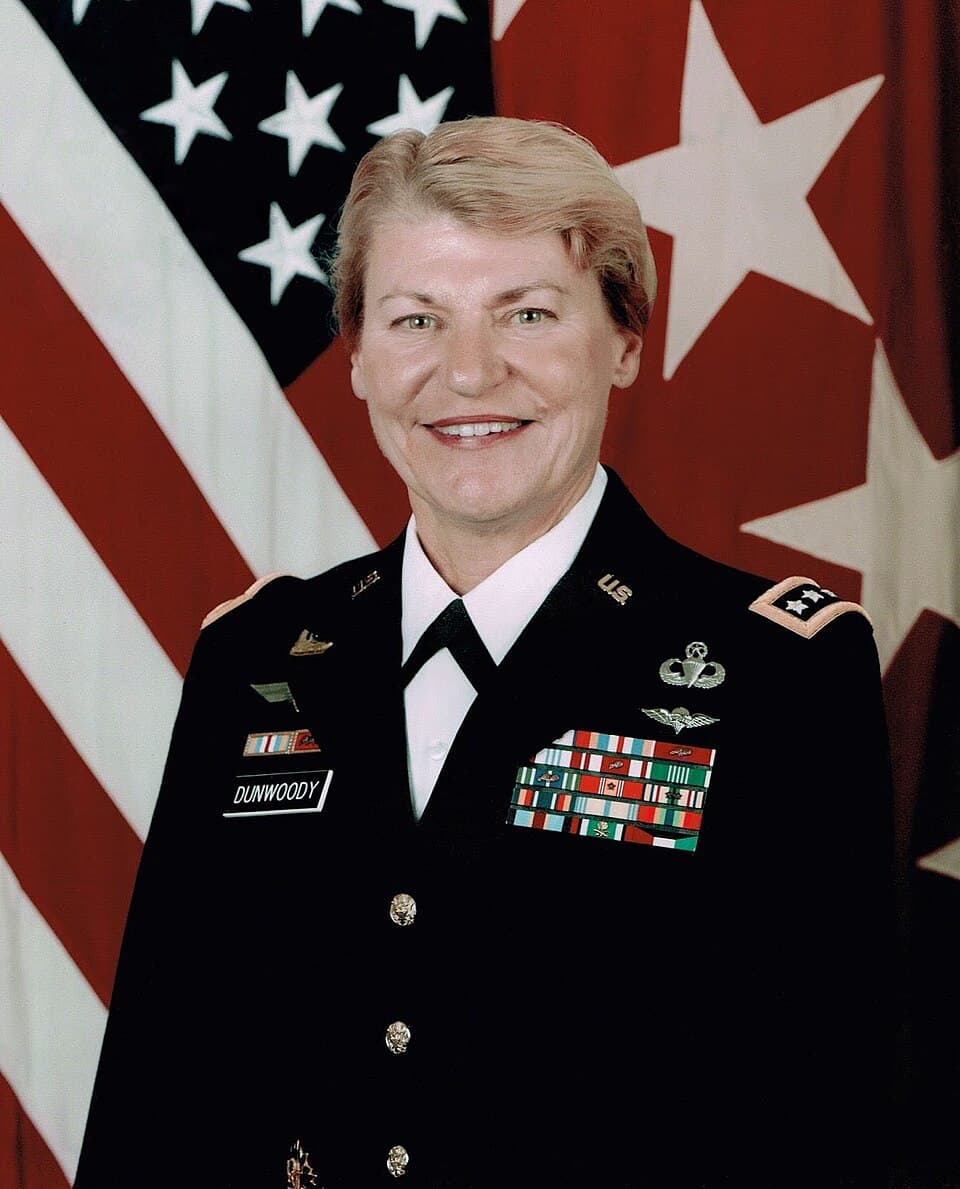
American · Politics
Ann E. Dunwoody
January 14, 1953 – present
Early Life and Background
Ann Elizabeth Dunwoody was born on 14 January 1953 at Fort Belvoir, Virginia, a U.S. Army installation near Washington, D.C.[1][5] She was the daughter of Col. Harold Dunwoody, a career Army officer, and Elizabeth Dunwoody
Because of her father’s postings, Dunwoody spent much of her childhood overseas. She lived in Germany and Belgium and attended American schools in Europe.[9] These experiences exposed her to NATO environments and the day-to-day realities of U.S. forces stationed abroad, giving her early insight into alliance structures and the logistical challenges of supporting troops in multiple countries.[3][9] Dunwoody completed high school at Supreme Headquarters Allied Powers Europe (SHAPE) American High School in Belgium, graduating in 1971.[9] Her initial ambition was not a military career but physical education. She enrolled at the State University of New York College at Cortland, where she studied physical education and played sports.[4][9] She graduated in 1975 with a bachelor’s degree.[4][9] Her trajectory shifted when she joined the Reserve Officers’ Training Corps (ROTC) at SUNY Cortland. While she had not originally intended to become a career officer, ROTC introduced her to leadership training and the possibility of commissioning in the Army.[4] The program, combined with her familiarity with military life, made a service career increasingly attractive, ultimately steering her toward what would become a historic path. Dunwoody entered the Army in the mid-1970s, a period when the service was still adjusting to the full integration of women following the Vietnam War and the transition to an all-volunteer force.[7][8] She was commissioned as a second lieutenant in the Women’s Army Corps—the separate administrative unit for women that would soon be disbanded as the Army moved toward full gender integration.[7] She later transitioned into the Quartermaster Corps, specializing in logistics, the field that would define her career.[8] Her early assignments reflected both traditional support roles and increasingly operational responsibilities. According to the Veterans of Foreign Wars, Dunwoody’s initial post was as a supply platoon leader with the 226th Maintenance Company, 100th Supply and Services Battalion, at Fort Sill, Oklahoma.[7] Here she supervised soldiers, equipment maintenance, and supply operations, learning the practical realities of keeping units mission-ready. Throughout the late 1970s and 1980s, Dunwoody advanced through a series of command and staff positions in the Quartermaster community. A career overview lists her as having commanded the 226th Maintenance Company at Fort Sill; the 5th Quartermaster Detachment (Airborne) in Kaiserslautern, Germany; the 407th Supply and Service Battalion/782nd Main Support Battalion at Fort Bragg, North Carolina; the 10th Mountain Division Support Command (DISCOM) at Fort Drum, New York; and the 1st Corps Support Command (COSCOM) at Fort Bragg.[9] Alongside command duties, she pursued extensive professional military education. She completed the Quartermaster Officers’ Basic and Advanced Courses, Basic Airborne School, and the United States Army Jumpmaster Course, underscoring her integration into airborne and high-readiness units.[9][10] Academically, she earned a Master of Science in Logistics Management from the Florida Institute of Technology in 1988 and a second master’s degree in National Resource Strategy from the Industrial College of the Armed Forces in 1995.[9][3] These qualifications reinforced her expertise in both the technical and strategic aspects of logistics. By the early 1990s, her combination of field experience and advanced education positioned her as one of the Army’s leading logistics officers. Her units supported operations including the Gulf War, providing sustainment and materiel flows that were critical to rapid combat success.[4] Her work in these roles strengthened her reputation as an innovative and dependable logistics commander capable of managing complex and high-stakes missions. Over the course of her career, Dunwoody became associated with a series of historic "firsts" for women in the U.S. Army. In 1992, she became the first woman to command a battalion in the 82nd Airborne Division, one of the Army’s premier rapid-deployment and combat units.[7][9] This assignment signaled a major shift in attitudes toward women’s roles; airborne and combat-related commands had long been viewed as the preserve of male officers, and her leadership there challenged entrenched gender norms. In 2000, Dunwoody broke another barrier when she became Fort Bragg’s first female general officer.[7][9] Fort Bragg is home to elite units such as the 82nd Airborne Division and U.S. Army Special Operations Command. Being the first woman general at such a high-profile installation highlighted both her professional stature and the gradual but tangible erosion of barriers restricting women’s advancement in combat-heavy organizations. By 2004, she had advanced further, assuming command of the Combined Arms Support Command (CASCOM) at Fort Lee, Virginia.[1][9] In doing so, she became the first woman to command CASCOM, the institution responsible for training and developing doctrine for logistics, sustainment, and related support functions across the Army.[1][9] This role meant that her influence extended beyond individual units to the entire support structure of the force, shaping how future logisticians would be educated and how support operations would be conceptualized. Her rise continued in 2005, when she was promoted to lieutenant general and appointed Deputy Chief of Staff, G-4 (Logistics) for the Army.[1][7] In that role, she became the Army’s highest-ranking woman and directed worldwide logistics policy and operations, including supply chains, maintenance, transportation, and materiel management.[3] As G-4, she had to ensure that soldiers in Iraq, Afghanistan, and other deployments received timely equipment, ammunition, and sustainment—an enormous responsibility in the midst of complex, multi-theater operations. On 23 June 2008, President George W. Bush nominated Dunwoody for promotion to full general.[7] The Senate confirmed her nomination the following month, paving the way for one of the most significant milestones in women’s military history.[7] On 14 November 2008, a ceremony at the Pentagon officially promoted her to general, making Dunwoody the first woman in U.S. military and uniformed service history to attain four-star rank.[1][8][10] The promotion was widely reported and hailed as a historic breakthrough. Army Chief of Staff Gen. George W. Casey Jr. and other senior leaders emphasized that the decision was based on merit and leadership, even as they acknowledged its symbolic importance for women and the institution.[1] Later that same day, she assumed command of the U.S. Army Materiel Command (AMC), one of the largest Army commands.[1][6] Headquartered at Redstone Arsenal in Alabama, AMC is responsible for equipping and sustaining soldiers worldwide. Under her command, AMC employed more than 69,000 personnel across all 50 states and 145 countries.[7][5] This dual event—promotion to four-star rank and assumption of AMC command—cemented her position as a central architect of Army readiness and logistics. As a logistics officer and commander, Dunwoody did not produce "works" in the traditional literary or artistic sense, but she led major organizational initiatives that transformed Army sustainment. At CASCOM and AMC, she was involved in modernizing supply chains, streamlining maintenance and repair operations, and improving accountability for equipment and materiel.[4][8] Her tenure as G-4 and AMC commander coincided with intense operational demands, including ongoing combat operations in Iraq and Afghanistan. She focused on ensuring that soldiers received the equipment they needed, from body armor and vehicles to advanced communications systems. She championed efforts to improve forecasting, reduce logistical bottlenecks, and integrate new technologies into supply and distribution processes.[4][13] In addition to her operational contributions, Dunwoody became a prominent voice on leadership and organizational excellence. After retiring from the Army, she authored a leadership book (often referenced in biographical sources) and became a sought-after keynote speaker. Her talks, as described by speaking agencies, emphasize accountability, ethics, and the importance of building resilient organizations that can adapt to change.[13] Her post-retirement advocacy includes speaking out against sexual assault in the military and supporting efforts to improve the treatment of servicemembers and veterans.[4] She leveraged her high-profile status to draw attention to systemic problems and to encourage institutional reforms, highlighting the responsibility of leaders to protect their personnel and uphold standards of dignity and respect. Throughout her career, Dunwoody received numerous military awards and honors reflecting both her operational achievements and her status as a trailblazer. Sources note that she earned multiple high-level decorations, although specific award lists vary by publication.[4][1] Her four-star promotion itself is often cited as a form of recognition, symbolizing the Army’s trust in her leadership. In addition to formal decorations, she has been recognized by veteran and civic organizations. The Veterans of Foreign Wars (VFW) highlighted her achievements in a 2020 feature, noting her groundbreaking roles in the 82nd Airborne Division, Fort Bragg, CASCOM, and AMC, and her impact on the Army’s global logistics enterprise.[7] The Army Field Heritage Museum and similar institutions have profiled her as an exemplar of logistical leadership and a pioneer for women in uniform.[8] Her career has also been celebrated by foundations and organizations dedicated to women’s service, such as the Foundation for Women Warriors, which presents her story as an illustration of barrier-breaking success in a traditionally male-dominated field.[14] Media profiles, including documentary-style segments like "Profiles in Valor," produced in partnership with veterans organizations, have further amplified her public recognition.[10] Biographical sources on Dunwoody focus primarily on her professional achievements and relatively little on her private life. She has generally kept details of her family life out of the spotlight, emphasizing instead her identity as a soldier and leader. Available profiles mention her parents and military family background but do not consistently document marriage or children.[4][9] This emphasis on professional identity is itself notable in women’s history. At a time when women leaders were often discussed in relation to their domestic roles, Dunwoody’s public narrative centers on her expertise, command responsibilities, and institutional impact. The lack of detailed reporting on her personal life in major reference works suggests either a deliberate choice to maintain privacy or a media focus on her historic career milestones rather than personal biography. Dunwoody’s legacy can be understood across several dimensions: gender integration, logistical innovation, and leadership culture. Most prominently, she is recognized as the first woman in U.S. military history to attain four-star rank.[1][5] This achievement has become a touchstone in discussions about women’s roles in the armed forces, demonstrating that there is no formal rank barrier to women’s advancement and that competence and sustained performance can overcome longstanding institutional biases. Her earlier "firsts"—battalion command in the 82nd Airborne Division, Fort Bragg’s first female general officer, and the first woman commander of CASCOM—helped normalize women’s presence in high-visibility and combat-oriented organizations.[7][9][1] Each of these roles expanded the range of assignments considered appropriate for female officers and provided tangible examples for younger women contemplating military careers. In the field of logistics, Dunwoody is often described as one of the Army’s most accomplished logisticians. Speaking agencies and military commentators have quoted leaders such as Army Chief of Staff Gen. Ray Odierno, who reportedly called her "quite simply the best logistician the Army has ever had," underscoring her professional reputation beyond gender considerations.[13] Her work at G-4 and AMC, particularly during the complex operations of the 2000s, contributed to more efficient and responsive support structures that continue to influence Army sustainment. Her leadership philosophy—centered on accountability, team-building, and adaptability—has also left a mark. Through speeches, writing, and mentorship, she has encouraged leaders to embrace change, invest in their people, and maintain ethical standards even under pressure. Her post-retirement advocacy on issues like sexual assault and veteran welfare demonstrates a continued commitment to improving the institutional cultures she once led.[4] For scholars of women’s history, Dunwoody’s career complicates simple narratives about gender and combat. Although she was a logistics officer rather than a front-line combat commander, her responsibilities had direct operational consequences, and her success shows that women can occupy the highest levels of military leadership in roles that are central to warfighting capability. After retiring from the Army on 15 August 2012, concluding a 38-year career,[7] Dunwoody transitioned to a civilian life that has remained closely connected to military service and leadership education. She has worked as a consultant and a keynote speaker, addressing corporate, governmental, and nonprofit audiences on topics such as logistics, leadership, and organizational transformation.[13] She has also continued to engage with military-related organizations and initiatives, supporting veterans and advocating for reforms to protect servicemembers from abuse and misconduct.[4] Foundations and educational programs focused on women in the armed forces frequently highlight her story as a case study and inspiration, using her example to encourage young women to pursue leadership roles in uniform.[14][12] As of the mid-2020s, Dunwoody remains an influential figure in discussions about military logistics and women’s advancement in defense institutions. Her profile appears in multiple languages on platforms such as Wikipedia, reflecting global interest in her achievements.[1][2][3][5] She continues to be referenced in educational materials, leadership training content, and public commemorations, including social media campaigns recognizing her service and trailblazing status.[11] Although she no longer wears the uniform, the structures she helped shape and the barriers she helped dismantle continue to affect the daily lives and career possibilities of soldiers across the U.S. Army. Her story stands as a reminder that institutional change often occurs through the cumulative impact of individual careers marked by persistence, excellence, and the willingness to step into roles where no woman has served before.Career Beginnings and Development
Barrier-Breaking Commands and Senior Leadership
Major Works, Initiatives, and Contributions
Awards, Honors, and Recognition
Personal Life
Legacy and Historical Impact
Later Life
Dated achievements
9 indexed.
- Jan011953Politics
Birth of Ann E. Dunwoody
Ann E. Dunwoody was born in January 1953, later becoming the first female four-star general in U.S. military history.
View details Ann E. Dunwoody - Britannica - Jan011992Politics
First woman to command a battalion in the 82nd Airborne Division
In 1992, Dunwoody became the first woman to command a battalion in the 82nd Airborne Division.