← All women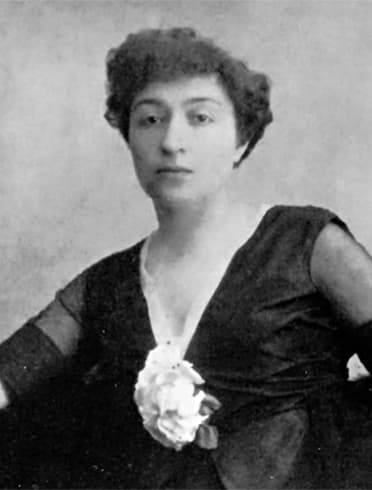
Ukrainian, Russian · Arts
Aleksandra Ekster
January 18, 1882 – March 17, 1949
Early Life and Background
Aleksandra Aleksandrovna Ekster was born on January 18, 1882, in Białystok, which was then part of the Russian Empire (now Poland). Her family moved to Kyiv, where she was immersed in a culturally rich environment. Ekster’s parents were of Belarusian descent, and they encouraged her education and artistic talents.
Ekster studied at the Kyiv Art School, excelling in painting, and was heavily influenced by the European avant-garde movements. Her education was supplemented by visits to Paris, where she interacted with renowned artists such as Pablo Picasso, Georges Braque, and cubist-futurist Fernand Léger, which significantly shaped her artistic vision.
Career Beginnings and Development
In 1908, Ekster began exhibiting her work in major Russian cities such as Moscow and St. Petersburg. Her style was initially influenced by Impressionism but quickly evolved into Cubo-Futurism—a blend of Cubism and Futurism. Ekster was a vital figure in the Russian avant-garde, maintaining close connections with Kazimir Malevich and Wassily Kandinsky.
Her work expanded beyond painting, encompassing innovative theatrical designs. She was a pioneer in using abstract elements and vibrant colors for stage sets, notably in Alexander Tairov’s Chamber Theatre in Moscow. Her designs were revolutionary, incorporating dynamic geometric forms that transformed theatrical visual aesthetics.
Major Works and Accomplishments
Ekster's exhibitions were notable across Europe, including Paris, Venice, and Vienna. Her contributions to the La Biennale di Venezia in 1924 and the Exposition Internationale des Arts Décoratifs et Industriels Modernes in Paris were particularly well-received. She was part of the key exhibition 'Bubnovy Valet' (Jack of Diamonds), which propelled Russian avant-garde art into the wider European context.
Awards, Honors, and Recognition
Although specific awards are not prominent in Ekster’s biography, her artistic work was widely recognized in avant-garde circles and remains influential in art history studies today.
Personal Life
Ekster married lawyer Nicolai Evgenovitch Ekster in 1908. The couple had no children, and throughout her career, Aleksandra maintained robust connections with artists across Europe, often participating in collaborative exhibitions that highlighted her cosmopolitan network.
Legacy and Historical Impact
Aleksandra Ekster significantly impacted the development of modern art. Her work in theatrical design influenced the course of stagecraft and scenography. Ekster was instrumental in bringing a new perspective to color and form in both painting and applied arts. Her teaching career at the Sorbonne in Paris further disseminated her innovative approaches to young artists, cementing her legacy in art education.
Later Life and Death
In her later years, Ekster continued to work and teach, dividing her time between Kyiv and Paris. Her final years were spent in France, where she passed away on March 17, 1949, in Fontenay-aux-Roses. Ekster’s contributions are celebrated in retrospectives and remain a focus for scholars of Russian and Ukrainian avant-garde art.
Dated achievements
2 indexed.
- Jan181882Science
Birth of Aleksandra Ekster in Białystok
Born Aleksandra Grigorovich in Białystok, Russian Empire (now Poland), on January 18, 1882 (per Gregorian calendar; some sources cite January 6, Julian).
View details Wikipedia: Aleksandra Ekster - Mar171949Science
Death of Aleksandra Ekster in Fontenay-aux-Roses, France
Aleksandra Ekster died on March 17, 1949, in Fontenay-aux-Roses near Paris, France, where she had lived in emigration since the 1920s.