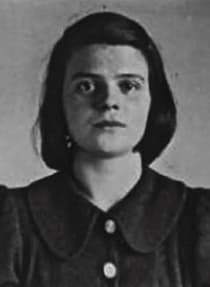
Sophie Scholl was born on May 9, 1921, in a town called Forchtenberg, in Germany. Her father was the town's mayor. He believed in fairness and treating people well. Sophie grew up in a family that cared about honesty and doing the right thing. Germany was going through hard times, and things would soon get much worse.
When Sophie was young, she joined a Nazi youth group for girls. Many German girls joined this group back then. But as she got older, Sophie began to see that the Nazi government was doing terrible, cruel things. Her brother Hans got in trouble with the secret police, called the Gestapo, in 1937. This scared the family and made Sophie think hard about what was right and wrong. She decided she did not agree with the Nazis at all.
Sophie finished school in 1940. She trained to become a kindergarten teacher. Later, she went to a factory to do required war work. Then, in May 1942, she started studying biology and philosophy at the University of Munich, a big city in Germany.
At the university, Sophie met other students and a teacher who also hated what the Nazis were doing. Together, they formed a secret group called the White Rose. The group included Sophie, her brother Hans, and their friends Alexander, Willi, Christoph, and their professor, Kurt Huber. They did not use weapons or violence. Instead, they wrote letters called leaflets. These leaflets told the truth about the Nazis' evil actions, like hurting Jewish people and other innocent people. The group secretly copied and handed out these leaflets to warn others.
Sophie worked hard on this dangerous project. She helped write, type, copy, and give out the leaflets. This was risky because girls were expected to stay quiet and follow rules. But Sophie bravely spoke up anyway.
In January 1943, Sophie helped make and give out the group's fifth leaflet. Then came the sixth leaflet, which was even bolder. It asked people to stop obeying the Nazis and to fight back with words, not weapons.
On February 18, 1943, Sophie and Hans were caught giving out the sixth leaflet at their university. A worker saw them and told the police. They were arrested right away.
Just four days later, on February 22, 1943, Sophie, Hans, and their friend Christoph went to trial. But it was not a fair trial. The judge had already decided to punish them harshly. They were found guilty of speaking against the government. That same day, they were executed. Sophie was only 21 years old.
Sophie never got married or had children. Her short life was full of family, friends, school, and her brave fight against unfairness.
After the war ended, people began to see Sophie as a hero. In 2003, people in Germany voted her the greatest woman of the 1900s. In 2014, the company Google made a special picture, called a doodle, to honor her birthday. In 2021, people celebrated 100 years since she was born.
Today, Sophie Scholl is remembered in schools, museums, and books. She teaches us that even young people can stand up against unfairness. She shows that words and courage can matter just as much as weapons. Sophie chose to do what was right, even though it was extremely dangerous. Her bravery still inspires people all over the world today.