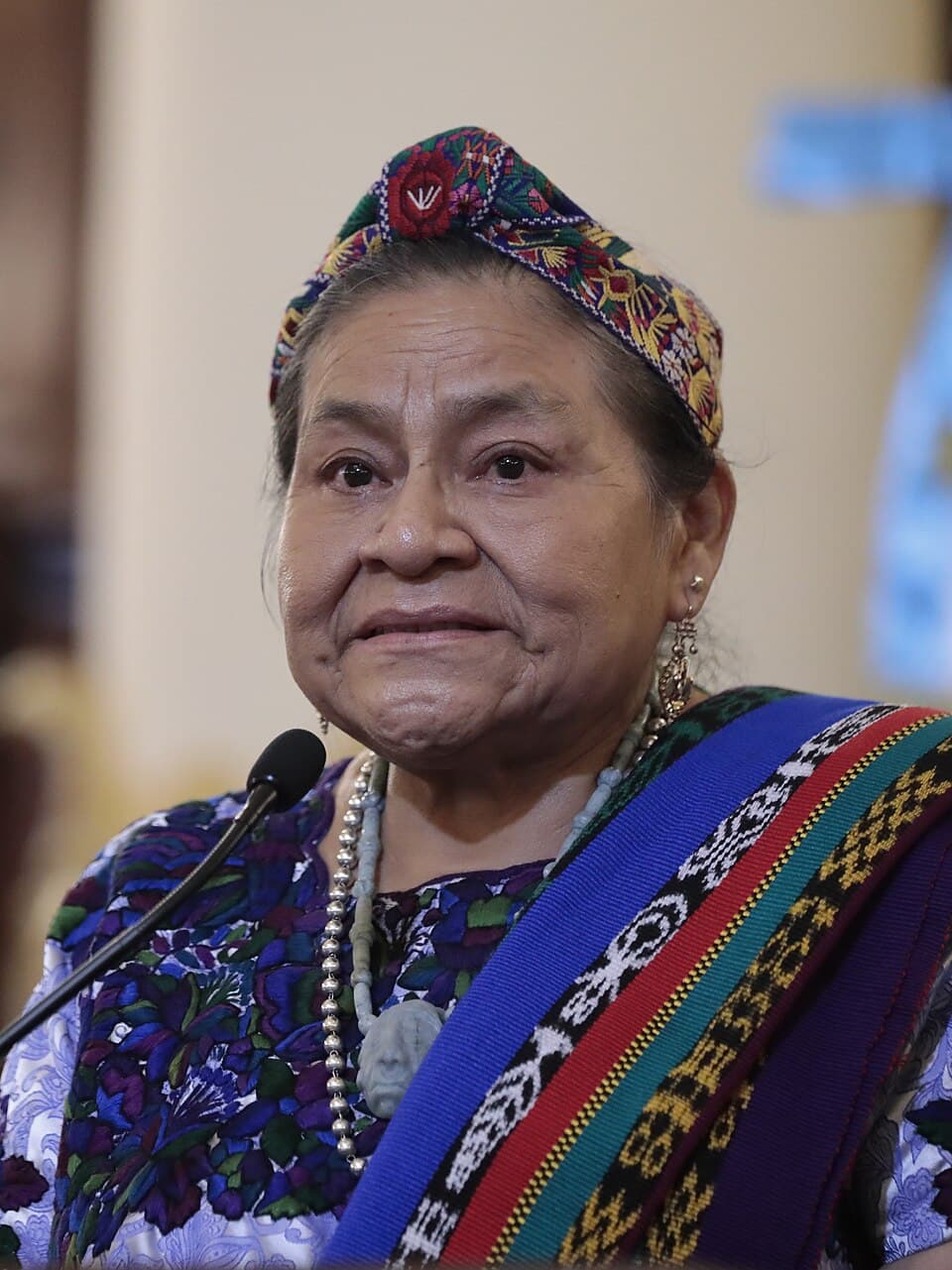
Rigoberta Menchú Tum was born on January 9, 1959, in a small village in Guatemala. She is part of the K'iche' Maya people, an Indigenous group with a long history in Guatemala. Her parents were poor farmers. Her family worked hard picking crops on big farms just to survive.
When Rigoberta was young, she learned the K'iche' language first. She learned Spanish later. She did not get to go to school very much. Instead, she worked with her family in the fields. Life was very hard. Indigenous people like her family were treated unfairly.
Rigoberta grew up during a terrible war in Guatemala. This war lasted from 1960 to 1996. Many Indigenous people were hurt or killed during this time. Rigoberta became a teacher and helped teach people about their rights. She also joined a group that helped farm workers get fair pay and land.
This work was dangerous. Soldiers did not like people who spoke up. In 1980, Rigoberta's father died during a terrible event at an embassy building. Later, her mother and brother were also killed. Rigoberta was very sad, but she became even more determined to help her people.
Because her life was in danger, Rigoberta left Guatemala in 1981. She went to live in Mexico. There, she met people who cared about human rights. She began traveling and telling people around the world about what was happening to Indigenous people in Guatemala.
In 1982, Rigoberta told her life story to a writer. This became a famous book called I, Rigoberta Menchú. The book helped many people learn about the suffering of Indigenous Guatemalans. It became very famous and was read in schools around the world.
In 1992, Rigoberta won a very special award called the Nobel Peace Prize. She won it for fighting for peace and for the rights of Indigenous people. She was only 33 years old. She was one of the first Indigenous people to ever win this prize. She used some of the prize money to start a foundation to help Indigenous people and teach about peace.
In 1996, Rigoberta became a special ambassador for peace with a group called UNESCO. That same year, the war in Guatemala finally ended. Rigoberta kept working for peace and fairness. She won more awards, including the Right Livelihood Award in 1994 and the Prince of Asturias Award in 1998.
Rigoberta also worked to bring people who committed crimes during the war to justice. In 2003, she helped judge a special court that looked into human rights abuses.
In 2006, Rigoberta helped start a new political party called Winaq. It was Guatemala's first political party led by Indigenous people. In 2007, she ran for president of Guatemala. She did not win, but many people were proud that an Indigenous woman ran for such an important job. She ran for president again in 2011.
Rigoberta is married to Ángel Canil, and they have a son. She often talks about how mothers and grandmothers help keep culture and traditions alive.
Rigoberta has written other books too, including one called Crossing Borders. Today, Rigoberta Menchú is still alive. She continues to work for human rights, peace, and fairness for Indigenous people all around the world. Many people see her as a symbol of courage and hope.