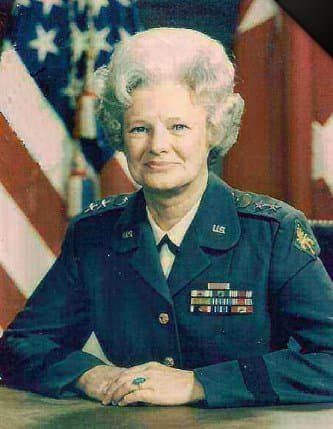
Mary E. Clarke was born on December 3, 1924, in Rochester, New York. She grew up at a time when women did not have many chances to be leaders. But Mary would grow up to be a very important leader in the United States Army.
Mary went to Rochester West High School. After she finished school, she got a job as a secretary. Then she worked as a defense worker, helping make things for the war. Many young women had jobs like this during World War II.
In August 1945, Mary joined the Women's Army Corps, called the WAC for short. This was a special part of the Army just for women. She joined right when World War II was ending.
Mary worked hard and did well. In 1948, the Army sent her to Berlin, a city in Germany. She was there during a tense and difficult time called the Berlin Airlift. In 1949, she finished special officer training and became a second lieutenant. This meant she went from being a regular soldier to being a leader of soldiers.
After that, Mary kept moving up. She led a group of WAC soldiers in Tokyo, Japan. She also worked in several states and in Washington, D.C. She helped with fairness programs and worked at the Pentagon, which is where Army leaders make big decisions.
In 1972, Mary became a colonel. She was put in charge of the WAC training center at Fort McClellan, Alabama. This meant she helped train new women soldiers. In 1975, she became the very last Director of the Women's Army Corps. Soon after, the WAC would end, and women soldiers would become part of the regular Army.
Mary's biggest moment came in November 1978. She was promoted to major general. This made her the first woman in Army history to reach that high rank! It was a huge deal because only men had ever been generals before.
That same year, Mary made history again. She became the first woman to command a major Army base. She was in charge of the U.S. Army Military Police School and the Chemical School at Fort McClellan. This meant she led thousands of soldiers and ran a huge training program. Norwich University also gave her a special honorary degree that year.
Mary retired from the Army in October 1981. She had served for 36 years! At the time, no other woman had served in the Army that long. Even after she retired, Mary kept helping the military. She joined groups that gave advice about women in the armed forces.
Not much is known about Mary's personal life, like if she was married or had children. Old records mostly talk about her Army work, not her home life.
Mary Clarke is remembered as a hero for women in the Army. She was the first woman major general. She was the first woman to command a big Army base. And she was the last leader of the Women's Army Corps. She proved that women could do every kind of Army job, from basic training to leading whole bases.
Mary died on June 10, 2011, in San Antonio, Texas. She was buried at a special military cemetery called Fort Sam Houston. Her life showed that one person can change how people think about what women can do.