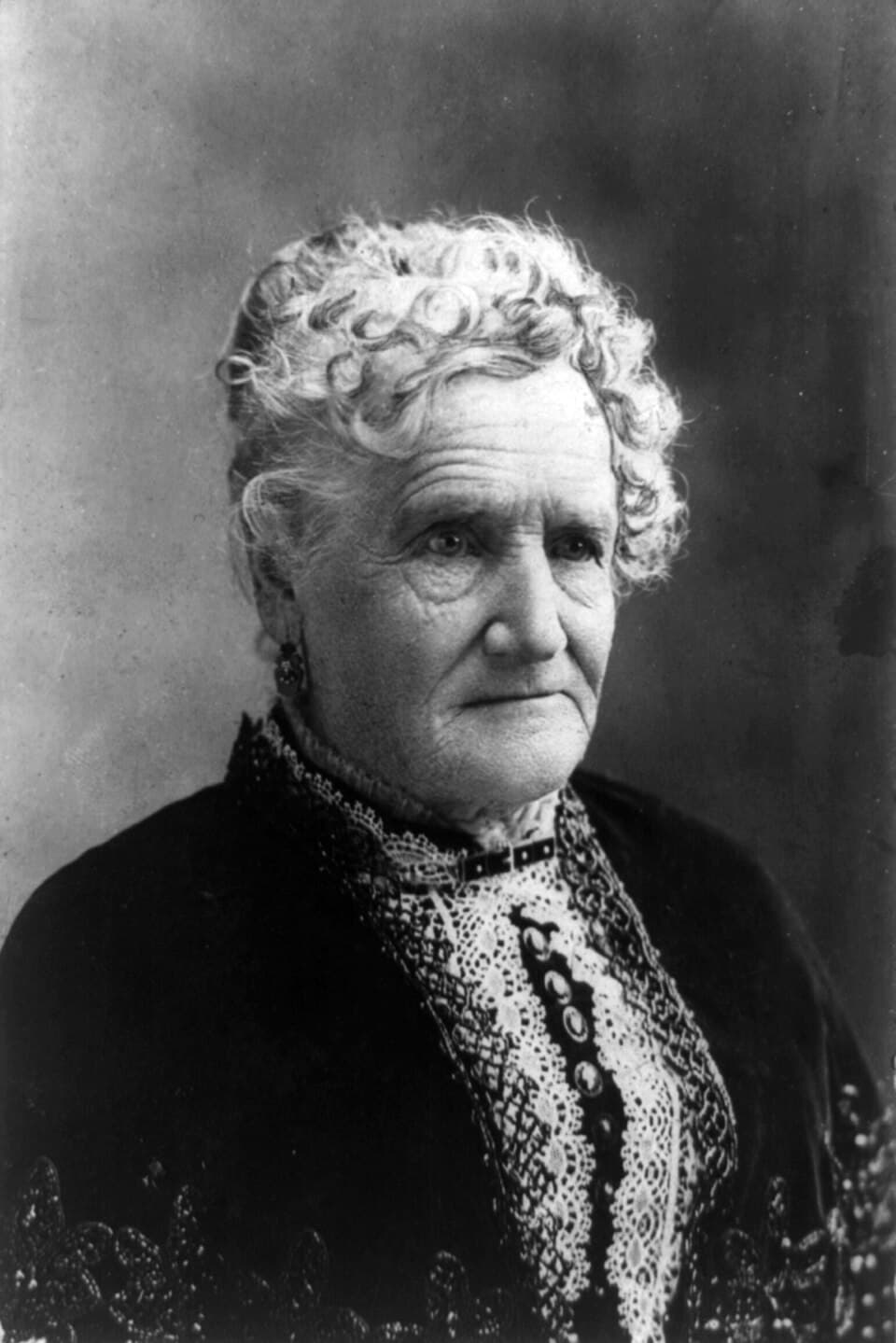
Esther Hobart Morris was born on August 8, 1814, in a small town in New York. When she was young, both of her parents died. She had to learn to take care of herself. She learned to sew and later worked as a seamstress and a milliner, which means she made and sold hats. She also cared about ending slavery, even before she became famous for other things.
Esther married a man named Artemus Slack, and they had a son. Sadly, her husband died in 1845. Esther had to move to Illinois to handle his money and property. Back then, laws were unfair to women, especially widows. This hard experience taught Esther how unfair the rules could be. It made her want to help change them.
Later, Esther married again. Her new husband was named John Morris. The family kept moving west. By 1869, they were living in Wyoming Territory. At that time, Wyoming was a new, rough place with mining towns. But it was also a place open to new ideas.
In 1869, Wyoming's lawmakers passed a bill allowing women to vote. The governor signed it into law. This made Wyoming the very first place in the United States where women could vote! Esther helped support this idea. She even hosted a tea party to talk with lawmakers about women's rights. Because of her efforts, many people began to connect her name with this big change.
On February 14, 1870, something amazing happened. Esther was appointed as a justice of the peace in South Pass City, Wyoming. This meant she became a judge! She was the very first woman in the whole United States to hold this kind of job. She listened to arguments between people and made fair decisions. She did this job for about eight months. People said she was smart, fair, and firm. None of her decisions were ever overturned.
This was a huge deal. At that time, most people did not think women could be judges. Esther proved them wrong. Her work showed that women could lead, make good choices, and be trusted with important jobs.
After her time as a judge, Esther stayed active in public life. She moved to Laramie, Wyoming, in 1871. In 1873, she even tried to run for a government position. She kept being a symbol of strength for women's rights as Wyoming grew.
In 1890, Wyoming became a state. It was the first state to let women vote as part of its rules. That same year, people celebrated Esther for her work supporting women's rights. In 1895, when she was about 80 years old, she traveled to Cleveland to attend a big meeting about women's voting rights. This showed how important she still was, even as an older woman.
Esther Hobart Morris died on April 2, 1902, in Cheyenne, Wyoming. Today, people still remember her. A statue of her stands in front of the Wyoming State Capitol building. Another statue of her stands in the United States Capitol building in Washington, D.C., representing the state of Wyoming.
Esther's life shows an important change in history. She helped show the world that women could vote, lead, and even judge others fairly under the law. Even though her time as a judge was short, her impact lasted a very long time.