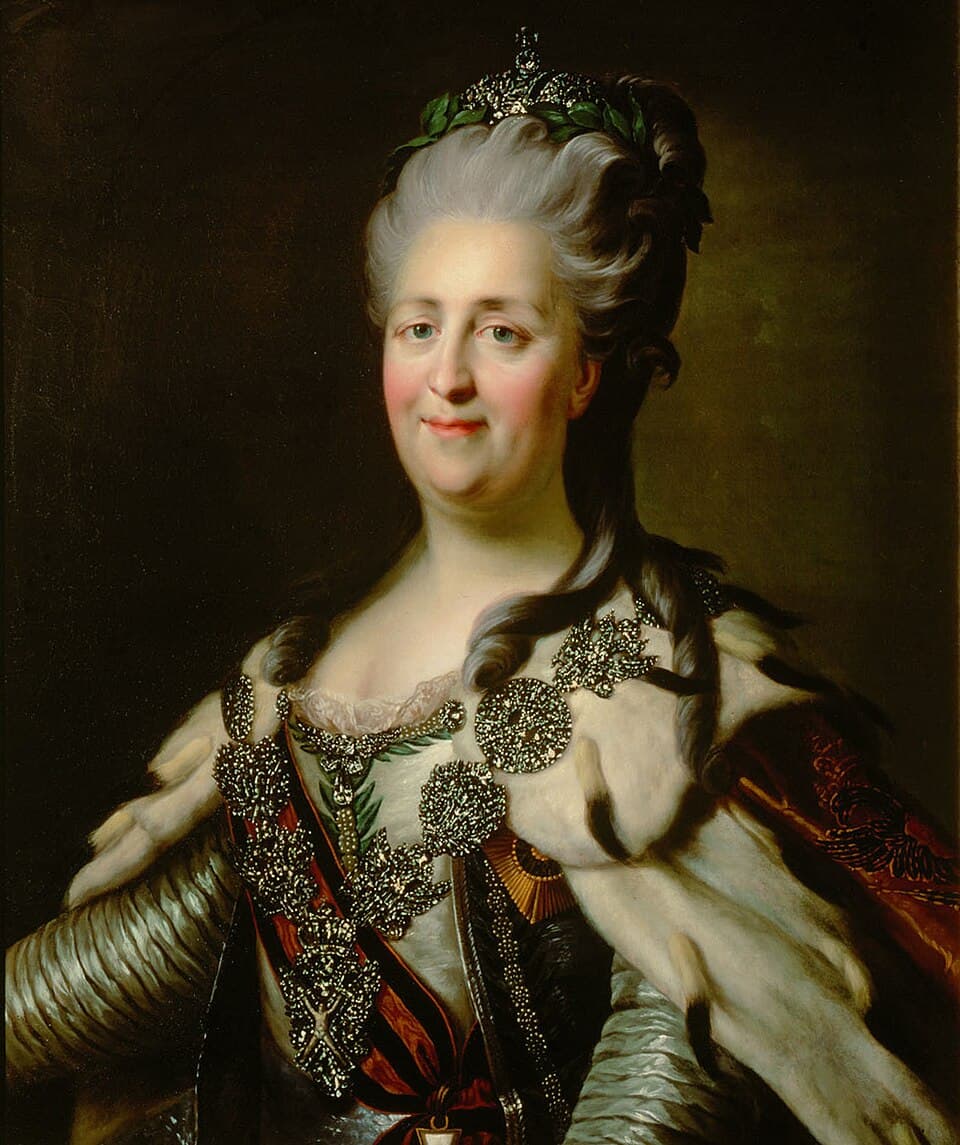
Catherine II was born on May 2, 1729. Her real name was Sophie. She was born in a place called Stettin, in a kingdom called Prussia. Her family was not super rich or famous. Her father was an army officer. Her mother came from a small noble family too.
When Sophie was young, she learned about religion, languages, and manners. She loved to read books. She got interested in French ideas and new ways of thinking that were popular in Europe at the time.
In 1744, Sophie traveled to Russia. She joined the Russian Orthodox Church and got a new name: Yekaterina, or Catherine. In 1745, she married Peter, who would one day become the ruler of Russia. Their marriage was not happy. But Catherine learned how to survive in the tricky Russian royal court.
In 1762, Peter became the ruler, but many people did not like him. Catherine had support from powerful friends and soldiers. She took action against her husband. On July 9, 1762, Catherine became the new Empress of Russia. This was a huge moment in Russian history.
As empress, Catherine wanted to be seen as a smart and caring ruler. She talked with famous thinkers and tried new ideas to help her country. In 1763, she started a special school for girls called the Smolny Institute. It was the first school in Europe paid for by the government just for women.
Catherine made many changes. She took land away from the church. She created a bank and printed Russia's first paper money. She supported groups that helped share new ideas and science.
But Catherine also let a system called serfdom continue. Serfdom meant many poor farmers had almost no freedom and had to work for nobles. This makes people today think about both the good and bad parts of her rule.
Catherine made Russia bigger and stronger. She fought wars with the Ottoman Empire and won land near the Black Sea. In 1783, she took control of Crimea. She also helped divide up Poland three times with other countries, which made Poland disappear from the map for a while. In 1780, she made a rule to protect ships from countries not fighting in a war, which helped Russia become respected around the world.
Catherine ruled over many different kinds of people, including Muslims, Christians, and others. In 1787, she had the first full copy of the Muslim holy book, the Qur'an, printed in Russia and given out for free.
In 1768, Catherine did something brave. She got a shot to protect herself from a sickness called smallpox. She was the first person in Russia to do this. She wanted to show people it was safe.
Catherine loved art. She collected paintings and other beautiful things. Her collection helped start a famous museum called the Hermitage. She also helped make the city of Saint Petersburg a center for art and learning.
Catherine had one son named Paul, who became ruler after her. People often talked about her personal life, but she was mostly known for being a strong and smart leader.
In her last years, Catherine kept ruling and making decisions. In 1795, Poland was divided one final time. On November 16, 1796, Catherine had a stroke. She died the next day, on November 17, 1796. She had ruled for 34 years.
Today, people remember Catherine as one of history's most powerful women. She made Russia bigger, supported schools and art, and tried new ideas. But she also let unfair systems like serfdom continue. She is remembered as a leader full of both great achievements and hard questions.