← All women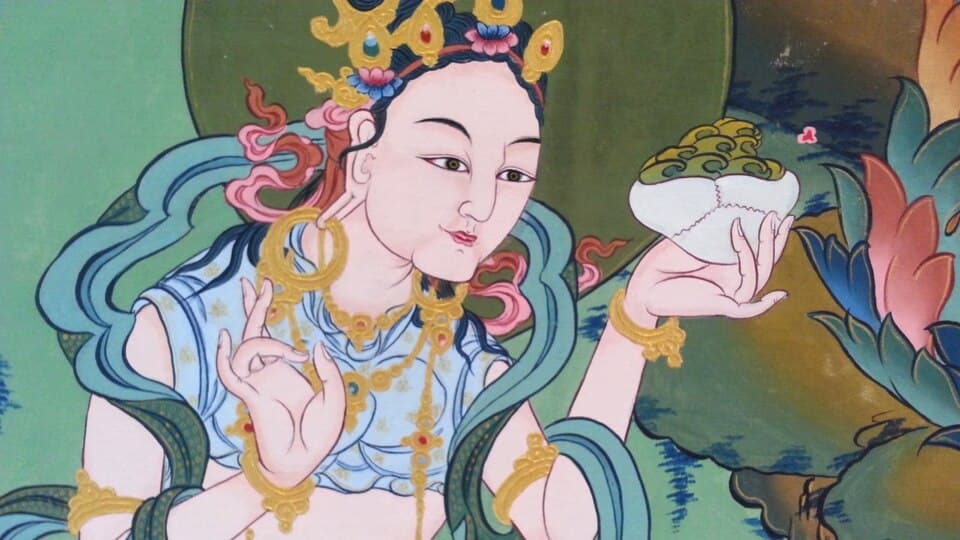
Tibetan · Arts · Activism · Literature · Exploration
Yeshe Tsogyal
757 – 817
Early Life and Background
Yeshe Tsogyal (Wylie: ye shes mtsho rgyal), often translated as “Victorious Ocean of Wisdom” or “Knowledge Lake Empress,” is revered across Tibetan Buddhism as the foremost female adept of the Nyingma school and the “Mother of Tibetan Buddhism.”[1][9][14][15][18][19] Most traditional sources place her life in the late eighth and early ninth centuries, around c. 757 or 777–817 CE, though exact dates are uncertain and heavily mythologized.[1][2][9][14][15][19]
Accounts of her birth and early life come largely from hagiographic biographies, especially treasure (terma) texts such as Lady of the Lotus-Born, revealed centuries after the period they describe.[12][18][19] These texts present Yeshe Tsogyal as a princess of the kingdom of Kharchen (also spelled Karchen), in central or eastern Tibet, born into an aristocratic family whose status placed her within the orbit of the imperial court of Emperor Trisong Detsen.[1][6][12][14][15] As with many Tibetan religious biographies, miraculous elements accompany her birth story, including omens and prophecies identifying her as an emanation of enlightened female deities such as Tara or Sarasvati and as the embodiment of all dakinis, the wisdom goddesses of tantric Buddhism.[4][5][9][12][17][18]
While modern historians debate how much of these narratives correspond to verifiable historical fact, there is broad scholarly agreement that Yeshe Tsogyal was a historical woman active in eighth‑century Tibet and closely associated with the Indian tantric master Padmasambhava and Emperor Trisong Detsen.[6][10][18][19] The hagiographies emphasize her early intelligence, spiritual inclination, and resilience in the face of social constraints placed on women, depicting her as chafing against expectations of marriage and domesticity and yearning for a life devoted to practice.[6][12][18]
Entry into the Imperial Court and Religious Career Beginnings
Most traditional accounts agree that Yeshe Tsogyal entered the Tibetan imperial court through marriage to Emperor Trisong Detsen, the monarch who invited Padmasambhava and the Indian scholar Śāntarakṣita to Tibet and sponsored the establishment of Buddhism as a state religion.[1][2][6][9][10][12][14][15] Sources describe her initially as one of Trisong Detsen’s queens or consorts. Later, at her own request and with the king’s consent, she became the spiritual consort and disciple of Padmasambhava (Guru Rinpoche), the itinerant tantric master credited with a decisive role in establishing Vajrayana Buddhism in Tibet.[2][6][10][12][15][17][18]
Her transition from imperial spouse to tantric disciple marks the beginning of her religious career. The narratives recount that Yeshe Tsogyal received extensive tantric initiations, instructions, and personal guidance from Padmasambhava, including teachings on Mahayoga, Anuyoga, and Atiyoga (Dzogchen).[12][18] She is portrayed as Padmasambhava’s closest and most advanced student, surpassing even male disciples in realization and becoming a peerless adept in meditation, ritual, and visionary practices.[5][12][15][18][19]
As part of Padmasambhava’s mission to establish Buddhism, Yeshe Tsogyal accompanied him on journeys throughout Tibet and surrounding regions, helping to pacify hostile forces, secure the patronage of local rulers, and plant the seeds of monastic and lay communities.[12][15][18] Hagiographic accounts depict her traversing remote mountains and valleys, enduring severe austerities and meditative retreats in caves, and engaging in practices designed to transform adverse circumstances into spiritual realization.[12][15][18]
Major Works, Accomplishments, and Role in the Terma Tradition
Yeshe Tsogyal’s most celebrated accomplishments center on her role in recording, organizing, and concealing Padmasambhava’s teachings as terma, or “treasure” teachings, meant to be discovered by future generations during times of spiritual decline.[3][10][12][15][17][18] According to these sources, Padmasambhava transmitted a vast corpus of oral instructions to select disciples. Yeshe Tsogyal, endowed with prodigious memory and literary skill, transcribed these teachings into coded scripts, compiled them, and helped hide them in physical locations (such as rocks, caves, lakes, and statues) and in the mindstreams of destined “treasure revealers” (tertöns).[3][12][15][17][18]
This work laid the foundation for the later Nyingma tradition’s distinctive reliance on revealed treasures as a source of scriptural authority and spiritual innovation. The terma tradition became a central feature of Tibetan religious culture, with prominent tertöns like Nyangrel Nyima Özer, Guru Chöwang, and Jigme Lingpa claiming visionary encounters with Yeshe Tsogyal or Padmasambhava and revealing concealed texts that shaped doctrinal and devotional life for centuries.[12][14][15][18][19] In the Nyingma view, Yeshe Tsogyal stands not only as a transmitter but as inaugurator and guardian of the terma system itself.[12][15][18]
Beyond her role in the terma tradition, Yeshe Tsogyal is credited with attaining complete enlightenment within a single lifetime, an achievement widely highlighted in traditional sources and modern Buddhist scholarship.[1][6][15][18][19] Some texts describe her as the first Tibetan—male or female—to achieve full Buddhahood, underscoring her status as an exemplary practitioner whose realization matched or exceeded that of her male counterparts.[5][18] Through prolonged retreats, visionary experiences, and mastery of tantric practices, she is portrayed as overcoming trauma, social oppression, and the limitations of her era to embody the culmination of the Vajrayana path.[6][12][18]
Her life story, especially as presented in Lady of the Lotus-Born, explores themes of sexual violence, gender inequality, and spiritual transformation, depicting how she transmuted painful experiences and patriarchal constraints into wisdom and compassion.[12][18][19] This narrative dimension has made her biography particularly resonant for contemporary readers seeking models of female spiritual agency in historically male-dominated religious traditions.
Teaching Activity, Disciples, and Wider Influence
After Padmasambhava’s departure from Tibet, traditional accounts portray Yeshe Tsogyal as continuing his work by teaching, guiding disciples, and preserving the integrity of the Vajrayana lineages he had established.[6][12][15][18] She is described as traveling widely, bestowing initiations and instructions, and helping practitioners confront obstacles on the path.
In these narratives, she becomes not merely a disciple but a lineage holder and spiritual heir, entrusted with the essence of Padmasambhava’s teachings and responsible for ensuring their transmission to future generations.[6][12][14][18] Some sources emphasize that she consciously underscored the possibility of enlightenment for women, using her own example to challenge prevailing assumptions about gender and spiritual capacity.[6][18][19]
Her relationships with other practitioners and tertöns are also significant. Later treasure revealers often report visionary encounters in which Yeshe Tsogyal appears as a guide, granting empowerment or authorization to reveal hidden teachings.[14][15][18] In the Nyingma imagination, she thus functions as a transhistorical presence, linking the eighth century to subsequent epochs through dreams, visions, and meditative experiences.
Awards, Honors, and Religious Recognition
As a figure from the early medieval period, Yeshe Tsogyal did not receive awards in the modern sense, but her religious recognition is extensive. Within Tibetan and Himalayan Buddhist communities, she holds a unique status as:
- Mother of Tibetan Buddhism and mother of the Dzogchen tradition, honored as a fully enlightened female Buddha.[1][5][9][15][18][19]
- The highest woman in the Nyingma Vajrayana lineage, often regarded as the preeminent female exemplar for practitioners.[1][6][18][19]
- A manifestation of enlightened feminine principles, and in some accounts an emanation of Tara or Sarasvati.[4][9][17][18]
- Central figure of numerous liturgical cycles, including sadhanas, feast offerings, and devotional practices focused on dakinis and feminine wisdom.[14][15][18]
Her story has inspired a substantial body of religious literature—biographies, commentaries, practice texts, and modern interpretations—produced within Tibet and in the global Buddhist diaspora.[10][12][15][18][19] Contemporary Buddhist authors and teachers often highlight her life as a paradigmatic example of female realization and as a resource for rethinking gender roles in Buddhist practice.
Personal Life and Relationships
Traditional accounts of Yeshe Tsogyal’s personal life intertwine inseparably with her religious career. As a young woman of noble birth, she was married or given in marriage to Emperor Trisong Detsen, becoming one of his queens and participating in the life of the imperial court.[1][2][6][9][12][14] Some sources describe her as dissatisfied with courtly existence and seeking a path that would allow for deeper spiritual practice.[6][12][18]
Her most significant relationship, both personally and spiritually, was with Padmasambhava. She became his tantric consort, disciple, assistant, and eventually, spiritual heir.[2][6][10][12][15][18] Within tantric Buddhism, the consort relationship involves complex symbolism, representing the union of wisdom and method, or of feminine and masculine principles, rather than merely conventional marriage. In this context, Yeshe Tsogyal is portrayed as embodying the wisdom (prajñā) aspect of the path, complementing Padmasambhava’s compassionate activity.[6][12][18]
The hagiographies also recount episodes of personal suffering, including abduction, assault, and harsh trials, which she is said to transform through dharma practice.[12][18] These experiences are narrated not as defining her in terms of victimhood, but as demonstrating her capacity to convert adversity into realization and compassion—key themes in her enduring appeal for many practitioners, especially women.
Legacy and Historical Impact
Yeshe Tsogyal’s legacy is multifaceted, encompassing doctrinal, institutional, literary, and cultural dimensions. Historically, she stands at the intersection of the formative period of Tibetan Buddhism, the rise of the Nyingma school, and the development of the terma tradition.
- Institutional and doctrinal legacy: By assisting Padmasambhava, Emperor Trisong Detsen, and other early figures, she contributed to the consolidation of Buddhism in Tibet and to the establishment of tantric lineages that shaped the country’s religious landscape.[6][12][15][18][19]
- Terma tradition: Her role in concealing and safeguarding teachings ensured that key tantric systems, including Dzogchen, remained available to future generations. Later treasures, such as the Longchen Nyingtik cycle revealed by Jigme Lingpa, trace their authority partly to visionary encounters with her.[14][15][18]
- Female religious exemplar: Over time, Yeshe Tsogyal became a central role model for Tibetan Buddhist women, alongside figures like Machik Labdrön. Modern scholarship identifies her as “probably Tibet’s most influential and famous female religious teacher and one of the world’s most significant female religious exemplars.”[19]
- Global influence: With the spread of Tibetan Buddhism worldwide in the twentieth and twenty‑first centuries, her story has reached a global audience. Translations of her biographies, contemporary commentaries, and practice texts have turned her into a symbol of enlightened feminine wisdom for practitioners beyond Tibet.[10][12][15][18]
Her birthplace, Tsogyal Latso, has been the focus of modern revitalization efforts, underscoring her enduring importance in Tibetan cultural memory. Articles describing the “reawakening” of Tsogyal Latso highlight how local communities and religious leaders preserve her heritage as part of a broader renewal of Tibetan spiritual traditions.[15]
In contemporary spiritual discourse, Yeshe Tsogyal’s life is often invoked in discussions about gender equity in Buddhism, the recognition of female teachers, and the reinterpretation of tantric consort relationships. Scholars and practitioners alike examine her biography to uncover historical possibilities for women’s participation in advanced practice and leadership roles.[6][10][18][19]
Later Life and Death
Accounts of Yeshe Tsogyal’s later life and death differ across sources and remain largely within the realm of hagiography rather than verifiable historical record. Many traditional narratives claim that she lived an extraordinarily long life, with some stating she reached the age of 211 years, continuing to practice, teach, and benefit beings across generations.[15] Other sources simply note that she attained complete enlightenment and eventually passed beyond ordinary existence, emphasizing the spiritual rather than chronological significance of her departure.[1][6][12][18]
Modern reference works generally list her lifespan as extending roughly from c. 757 or 777 to around 817 CE, reflecting attempts to place her within the known chronology of the Tibetan imperial period and the activity of Padmasambhava and Trisong Detsen.[1][2][9][14][19] These dates, however, remain approximate and contested, as the historical documentation from the era is sparse and interwoven with legendary embellishment.
Regardless of the exact circumstances of her death, the traditions that venerate Yeshe Tsogyal emphasize that she did not simply vanish from historical memory. Instead, she is regarded as present in visionary and meditative experiences, continuing to inspire practitioners as a living embodiment of enlightened feminine wisdom. Rituals and practices dedicated to her remain central in Nyingma communities, where she is invoked as protector, guide, and spiritual mother.[14][15][18][19]
Thus, the story of Yeshe Tsogyal bridges the gap between the mythic and the historical, the eighth century and the present, providing one of the most compelling examples of a woman whose life and legend have shaped an entire religious tradition.
Dated achievements
0 indexed.