← All women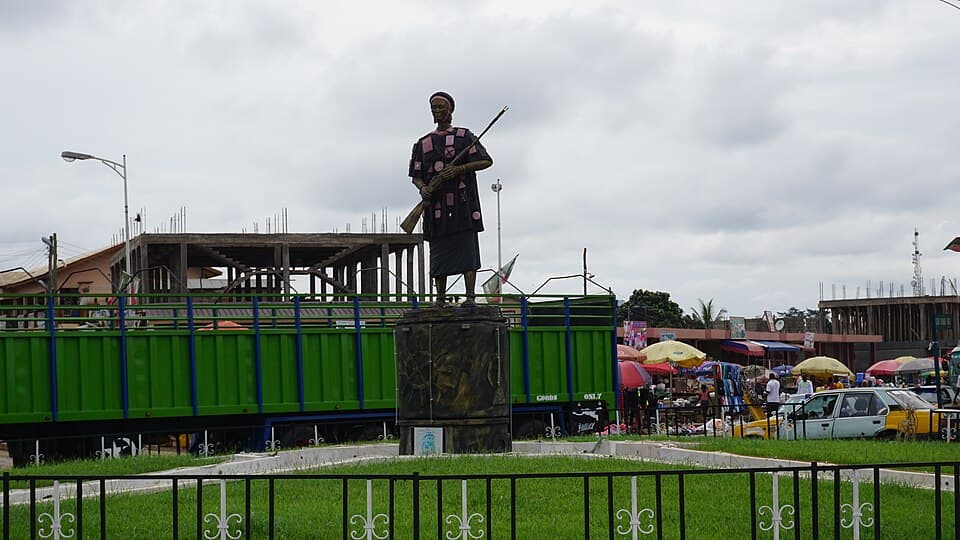
Ghanaian · Politics · Activism
Yaa Asantewaa
1840 – October 17, 1921
Early life and background
Yaa Asantewaa was born in the Asante Empire, probably in the 1840s, with many reference works giving an approximate birth year of around 1840. The exact date is not securely documented, and the surviving historical record is fragmentary, which is common for women leaders from precolonial and early colonial West Africa. She is associated with the Besease or Ejisu area, within the political and cultural world of Asante in what is now Ghana.
According to later historical accounts, she came from a family with political standing and was connected to the Ejisu ruling line. Her brother, Nana Akwasi Afrane Okese, is said to have appointed her as queen mother of Ejisu. In Asante political culture, the queen mother had real influence, especially in matters of succession, counsel, and community authority. Yaa Asantewaa also came to be remembered as a farmer before her rise to prominence, a detail that has helped make her story especially resonant in Ghanaian memory because it places her among ordinary working people before her emergence as a major historical figure.
Her early life unfolded in a society shaped by strong institutions, complex diplomacy, and a long series of conflicts with expanding British power on the Gold Coast. That context matters: Yaa Asantewaa’s later leadership did not emerge in isolation, but from an Asante world in which women could hold recognized civic roles and where loyalty to the Golden Stool represented loyalty to the nation itself.
Rise to political authority
By the late nineteenth century, Yaa Asantewaa had become queen mother of Ejisu, a position that placed her within the governing structures of Asante. Queen mothers were not merely ceremonial figures. They could advise rulers, influence succession, and embody continuity between lineage, land, and state. Yaa Asantewaa’s significance increased after the British exile of Asantehene Prempeh I and other leaders in 1896, an event that destabilized the political order and created new openings for local leadership.
In that period, Yaa Asantewaa is described in historical accounts as becoming regent of the Ejisu-Juaben district. Even where the surviving record is incomplete, the broader pattern is clear: she moved from a regional leadership role into a central political position at a moment of imperial crisis. British policies had already weakened Asante autonomy, and the removal of key leaders intensified debates over how to respond to colonial authority. Yaa Asantewaa’s authority, therefore, was both inherited and earned; she stood at the intersection of lineage politics, spiritual legitimacy, and anti-colonial urgency.
The War of the Golden Stool
Yaa Asantewaa’s name is inseparable from the War of the Golden Stool, also known as the Yaa Asantewaa War, which began in March 1900. British colonial officials sought control over the sacred Golden Stool, the central symbol of Asante nationhood and sovereignty. For Asante people, the stool was not a mere royal object but a vessel of collective identity, authority, and continuity. British interference in this symbol, combined with the continuing exile of Prempeh I, provoked a crisis that Yaa Asantewaa helped transform into organized armed resistance.
On 28 March 1900, she was chosen to lead the Asante fighting force. Multiple modern sources describe her as the first and only woman to command Ashanti forces in war. That designation is historically significant because it reflects both the exceptional nature of her leadership and the degree of trust placed in her during a moment of existential threat. Her rallying of chiefs and fighters turned anger into military action and made her one of the most recognizable African anti-colonial leaders of the era.
The war lasted for months and ended in Asante defeat, but it did not end in total symbolic surrender. The Golden Stool was not captured by the British, and that fact has remained central to the memory of the conflict. The war also demonstrated the scale of colonial violence and the resilience of local resistance. Yaa Asantewaa’s leadership became the most enduring historical outcome of the conflict, because she embodied both military opposition and cultural defense.
Capture and exile
Following the suppression of the war in 1901, Yaa Asantewaa was captured and exiled to the Seychelles Islands, where she remained until her death. Exile was a common colonial punishment for leaders who resisted imperial rule; it separated them from their communities and aimed to break political momentum. In Yaa Asantewaa’s case, however, exile did not erase her influence. Instead, it helped convert her into a figure of memory and legend.
Her removal from Asante political life reflected the wider colonial strategy of decapitating local leadership structures after armed resistance. Yet the effort to silence her had the opposite effect in the long run. As later generations revisited the history of the war, Yaa Asantewaa became a central reference point for courage, women’s leadership, and African resistance to imperial domination. Her exile thus became part of the story of her endurance rather than the end of her significance.
Death and posthumous reputation
Yaa Asantewaa died on 17 October 1921 in the Seychelles. Some traditions later claimed that her remains were returned secretly to Asante for burial, but that detail is not securely dated and remains difficult to verify. What is certain is that her death did not diminish her stature; if anything, it helped consolidate her legacy as a national heroine.
In the decades after her death, Asante and Ghanaian nationalist narratives increasingly framed her resistance as part of a broader struggle against colonial rule. By the time Ghana achieved independence in 1957, she was already being remembered as a source of inspiration for anti-colonial activism and women’s leadership. Her story has continued to appear in scholarship, museums, popular histories, and commemorations, often emphasizing the extraordinary nature of a woman leading a war in a male-dominated political order.
Her historical significance lies in several overlapping achievements: she defended Asante sovereignty, she challenged colonial assumptions about gender and authority, and she became a durable symbol of resistance. In modern Ghana, Yaa Asantewaa is remembered not simply as a warrior queen but as a political strategist, a guardian of cultural heritage, and a woman whose leadership altered the way history would remember the Asante struggle.
Personal life
Because the surviving historical record is limited, many details of Yaa Asantewaa’s private life remain uncertain. She is not known from reliable sources for a documented marital biography or for clearly recorded children in the manner of modern public figures. This absence should not be mistaken for insignificance; rather, it reflects the uneven preservation of women’s histories in colonial and precolonial Africa.
What can be stated more securely is that she occupied a highly respected social role within Asante society and that her life combined domestic, agricultural, and political experience. Later retellings often emphasize her origins as a farmer, underscoring the fact that her authority was rooted not in elite military training but in social standing, moral conviction, and the political structures of her community.
Legacy and historical impact
Yaa Asantewaa’s legacy extends far beyond the brief war with which she is most closely associated. She has become a symbol of African women’s political agency, anti-colonial resistance, and the defense of cultural sovereignty. Her story is frequently invoked in Ghana in relation to leadership, courage, and the right of women to occupy public authority.
Scholars and popular historians alike have noted that she remains a powerful figure in the politics of memory. The naming of schools, public references, museums, and commemorative projects after her reflects the way her image has been woven into national identity. She is often cited as an inspiration for girls and women entering fields previously dominated by men, not because she represented a modern form of feminism, but because she demonstrated that women could mobilize, command, and resist at the highest levels of political crisis.
Yaa Asantewaa’s importance also lies in what her life reveals about colonial history. The British Empire often described African societies as lacking organized political sophistication, yet her leadership shows the presence of established institutions, strategic resistance, and legitimate female authority within Asante governance. Her story therefore challenges simplistic narratives about both African politics and imperial power.
Today she stands as one of the most celebrated women in Ghanaian history and one of the most widely recognized anti-colonial figures in Africa. Her life, from approximate birth in the 1840s to death in exile in 1921, traces the arc of a leader who moved from local authority to historical legend. The precise details of her early years may remain incomplete, but her impact is unmistakable: she transformed resistance into memory and memory into a durable national symbol.
Dated achievements
3 indexed.
- Mar281900Politics
Leads War of the Golden Stool as first woman Ashanti war-leader
Yaa Asantewaa first and only woman war leader in Ashanti history.
View details DW: Yaa Asantewaa, the Asante Warrior Queen - Mar281900Politics
War of the Golden Stool begins
Marked official start of the War of the Golden Stool, led by Yaa Asantewaa.