← All women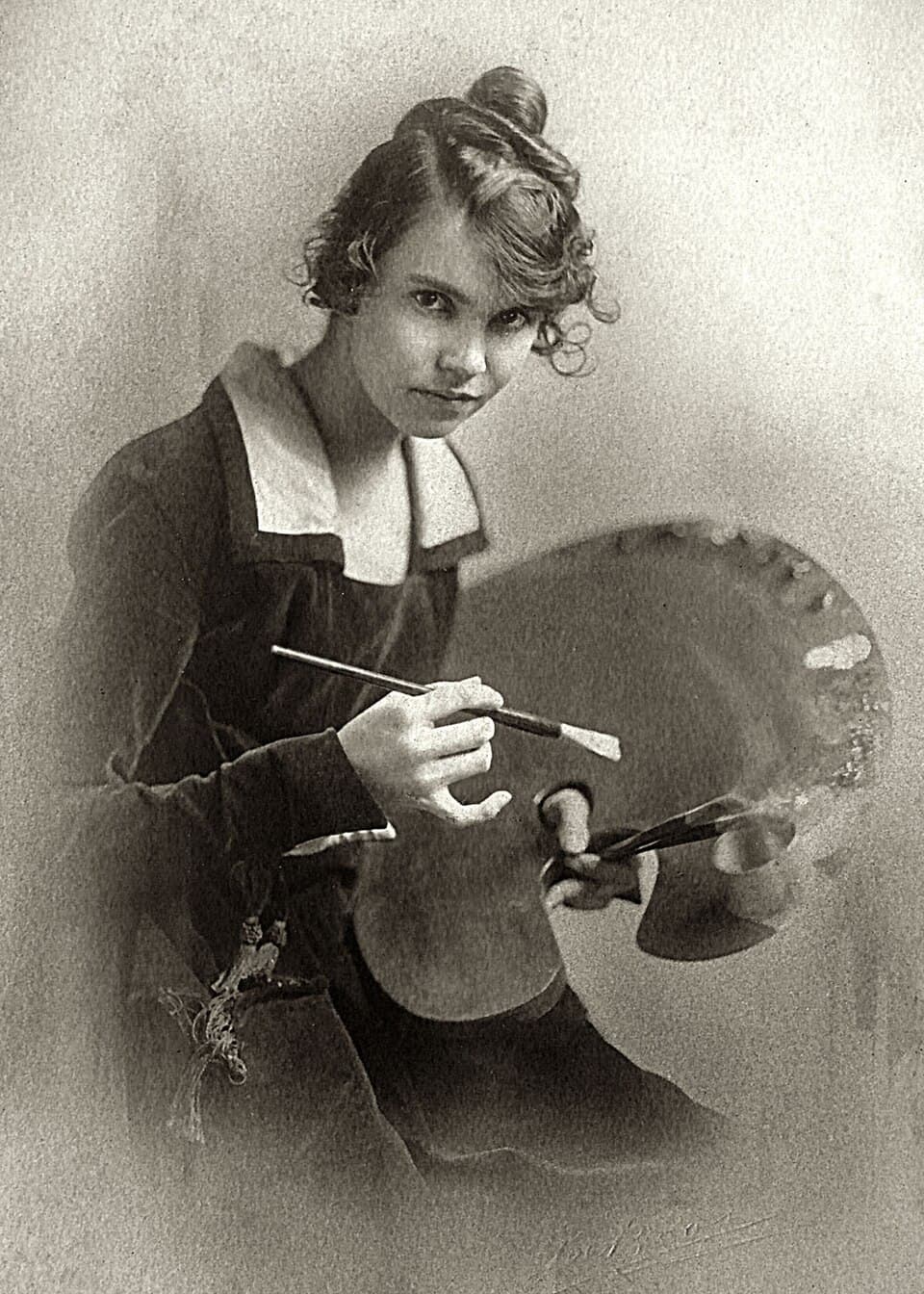
American · Arts · Literature
Wanda Gág
March 11, 1893 – June 27, 1946
Early Life and Background
Wanda Hazel Gág was born on March 11, 1893, in New Ulm, Minnesota, a town founded and heavily populated by German and Bohemian immigrants. She was the eldest of seven children born to Anton Gág and Elisabeth "Lissi" Biebl Gág, both of whom had emigrated from Bohemia (in present-day Czech Republic). Anton Gág worked as a house and sign painter but also pursued fine art, decorating local churches and painting landscapes in his spare time. The Gág household was steeped in Old World folklore, music, and storytelling traditions that Bohemian immigrants carried with them to the American Midwest, and this cultural inheritance would deeply inform Wanda's later artistic sensibility.
From early childhood, Wanda showed a precocious talent for drawing, encouraged by her father, who allowed her to use his studio materials. When Anton Gág died of tuberculosis in 1908, fifteen-year-old Wanda was famously told by her dying father to "finish what he had started," a charge she took deeply to heart. With her mother in poor health and six younger siblings to help support, Wanda took on enormous responsibility, selling drawings and greeting card designs to help sustain the family while still attending school. She graduated from New Ulm High School and briefly attended a teacher training school, but her ambitions lay firmly in art.
Education and Early Career
Gág's talent attracted the attention of local patrons and teachers, who helped her secure scholarships. She studied at the St. Paul Art School (now the Saint Paul School of Art) beginning around 1913, and later won a scholarship to the Minneapolis School of Art. In 1917, she moved to New York City to study at the Art Students League, supporting herself through commercial illustration work, including advertisements and magazine art for publications such as Judge and the New York Evening Post. These early commercial jobs, while creatively unsatisfying to her, gave her the technical facility with pen, ink, and lithography that would later define her celebrated visual style.
Throughout the 1920s, Gág struggled to establish herself as a serious fine artist distinct from the commercial illustrator work that paid her bills. She became associated with New York's bohemian art circles in Greenwich Village, and her prints, drawings, and lithographs began attracting critical attention for their bold, rhythmic, and highly patterned depictions of rural and domestic scenes. Her fine art was noted for a distinctive undulating, almost hypnotic linear style, often applied to houses, trees, and household objects, imbuing ordinary subjects with an animated, almost anthropomorphic energy.
Breakthrough: Millions of Cats
Gág's defining achievement came in 1928 with the publication of Millions of Cats, which she both wrote and illustrated. Published by Coward-McCann on September 19, 1928, the book told the whimsical, cumulative tale of an old man sent by his lonely wife to fetch "a cat" and who returns instead with "millions and billions and trillions of cats." The story's rhythmic, repetitive refrain became instantly memorable and beloved among generations of children.
What made Millions of Cats revolutionary was not merely its charming narrative but its groundbreaking visual design. Gág rejected the conventional format of the era, in which text was set in blocks separate from small, static illustrations boxed on the page. Instead, she hand-lettered her text and wove it organically around and through dynamic double-page-spread illustrations rendered in a bold, black-and-white style reminiscent of her fine-art lithographs. The visual flow guided the reader's eye and paced the turning of pages, effectively inventing many of the visual storytelling techniques that would come to define the modern American picture book.
Millions of Cats received a Newbery Honor in 1929 (an unusual distinction for a picture book, as the Newbery Medal typically honors text-driven works) and became an instant classic. It is frequently cited by scholars and librarians as the oldest American picture book still continuously in print, a testament to its enduring appeal. Its influence on subsequent generations of picture-book creators—including luminaries such as Maurice Sendak, Robert McCloskey, and Margaret Wise Brown—is widely acknowledged in the history of children's literature.
Later Works and Continued Success
Following her breakout success, Gág continued to produce influential children's books throughout the 1930s and early 1940s. The Funny Thing (1929) and Snippy and Snappy (1931) further developed her narrative and illustrative style. In 1933, she published The ABC Bunny, an alphabet book featuring a rabbit's adventures, illustrated with her characteristic bold lithographic technique; the book received both a Newbery Honor and a Caldecott Honor, the latter award having just been established in 1938 for retrospective recognition in some early years' cases, cementing her reputation as one of the preeminent picture-book artists of her generation.
Gág also turned her attention to translating and illustrating European fairy tales, drawing on her Bohemian heritage and her father's storytelling influence. Her translations and illustrations of the Brothers Grimm tales, including Tales from Grimm (1936) and Snow White and the Seven Dwarfs (1938), were praised for restoring darker, more authentic tonal elements to stories that had often been softened for American audiences, alongside her signature dramatic black-and-white illustrations. Her later book Nothing at All (1941), the story of an invisible dog who wishes to become visible, received a Caldecott Honor recognition as well, demonstrating her sustained relevance in the field even as new illustrators entered the scene influenced by her innovations.
Fine Art Career
Parallel to her children's book career, Gág maintained a serious practice as a printmaker and visual artist. Her lithographs and drawings were exhibited at major American institutions, and she became closely associated with the American Scene and Regionalist movements of the 1920s and 1930s, alongside contemporaries such as Grant Wood and Thomas Hart Benton, though her style remained distinctly her own—more rhythmic, stylized, and emotionally charged than typical Regionalist realism. Works such as her lithograph "Grandma's Kitchen" and depictions of rural farmhouses and interiors captured everyday American and immigrant domestic life with an intensity that elevated the mundane to the visually extraordinary. Her fine art is held in the collections of institutions including the Smithsonian American Art Museum and the Whitney Museum of American Art.
Personal Life
Gág never married in a conventional legal sense for much of her adult life but shared a long-term domestic partnership with Earle Humphreys, an engineer, whom she eventually married in 1943. The couple lived together for many years at "Tumble Timbers," a rustic property near Milford, New Jersey, which Gág had purchased and which became her primary residence and creative retreat starting in the early 1930s. She never had biological children of her own but remained deeply devoted to her younger siblings, several of whom, including her sister Flavia Gág, also pursued careers in art and illustration. Gág's independent lifestyle, her refusal to be confined by traditional expectations for women of her era, and her insistence on supporting herself through her art reflected a broader spirit of feminist self-determination unusual for a woman artist of the early 20th century.
Illness and Death
In the mid-1940s, Gág's health began to decline. She was diagnosed with lung cancer, and despite the illness, she continued working on projects, including further translations of Grimm's fairy tales, until shortly before her death. She died on June 27, 1946, at her home at Tumble Timbers, at the age of 53. Her death was mourned within the literary and artistic communities as the loss of one of the most innovative voices in American children's literature and printmaking.
Legacy and Historical Impact
Wanda Gág's contributions to American children's literature are widely regarded as transformative. She is credited with helping to establish the modern American picture book as a unified art form in which text and image work together organically rather than as separate, disconnected elements. Her innovations in page design, pacing, and the integration of hand-lettered text with expressive illustration directly influenced the picture-book format that remains standard today.
Her hometown of New Ulm, Minnesota, preserves her childhood home as the Wanda Gág House, a museum and historic site dedicated to her life and work. Her papers and artworks are held by institutions such as the University of Minnesota's Kerlan Collection, the Smithsonian American Art Museum, and the Whitney Museum of American Art, ensuring continued scholarly and public engagement with her legacy. In 1993, the U.S. Postal Service honored her with a postage stamp featuring artwork from Millions of Cats, part of its Legends of Hollywood... no, part of a series commemorating notable children's book illustrators, further cementing her place in the American cultural canon.
Scholars of children's literature and art history continue to cite Gág as a foundational figure whose synthesis of European folk-art sensibility, modernist visual rhythm, and deep respect for children's imaginative capacities reshaped an entire genre. Nearly a century after its publication, Millions of Cats remains in print and beloved by new generations of readers, a rare and enduring testament to Gág's singular vision and skill.
Dated achievements
3 indexed.
- Mar111893Arts
Born in New Ulm, Minnesota
Wanda Gág was born on March 11, 1893, in New Ulm, Minnesota, to Bohemian immigrant artist parents.
View details Wanda Gág - Wikipedia - Sep191928Literature
Publication of 'Millions of Cats'
Gág's picture book Millions of Cats was published, becoming the oldest American picture book still in print today.