← All women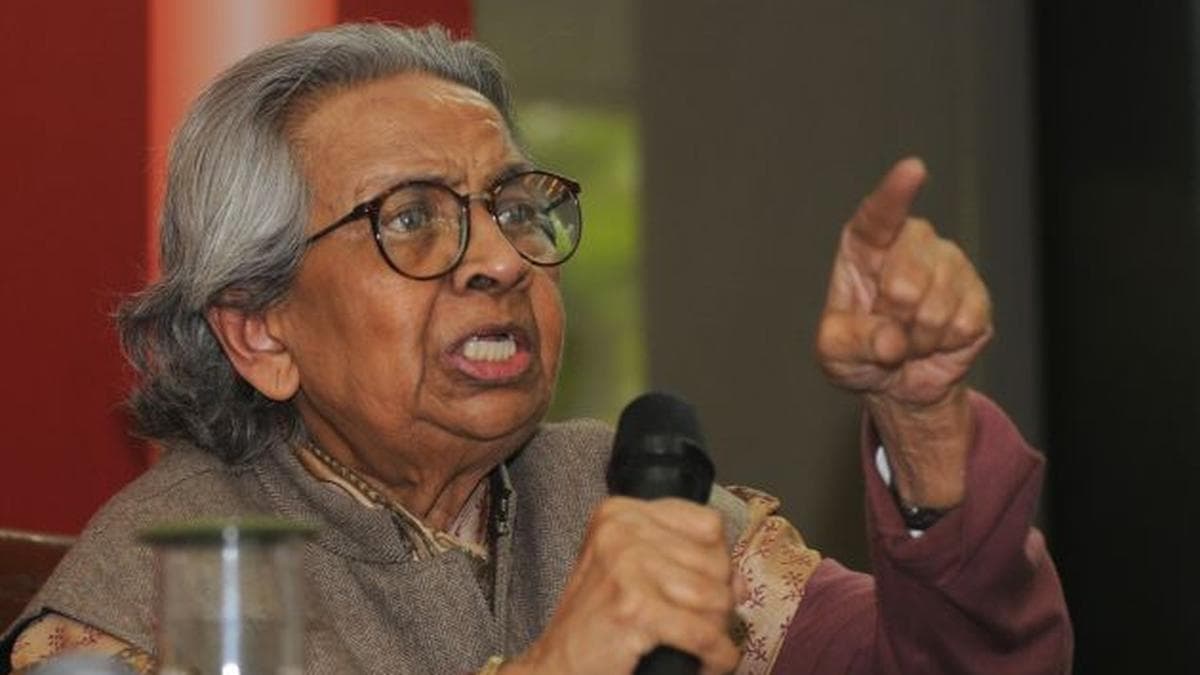
Indian · Activism · Politics · Science · Law
Vina Mazumdar
January 28, 1927 – May 30, 2013
Early Life and Education
Vina Mazumdar was born on 28 January 1927 in Jaipur, in the princely state of Rajasthan under British colonial India. She grew up in an unusually progressive household for the era: her father was a physician and her mother a schoolteacher, and both parents strongly encouraged Vina's education at a time when female literacy, let alone higher education, was far from the norm in India. This early exposure to intellectual rigor and gender-egalitarian values within her family shaped her worldview and set her on a path toward academic distinction.
Mazumdar pursued higher education against the backdrop of India's independence movement and the tumultuous partition of 1947. She completed her undergraduate and postgraduate studies in India, eventually earning a doctorate in history from Patna University. Her doctoral research and early academic training grounded her in rigorous historical and social-scientific methodology, which she would later apply to the nascent field of women's studies. She also spent time at Oxford University's Somerville College, where she was further exposed to comparative perspectives on gender, society, and politics — an experience that broadened her analytical framework beyond a purely Indian context.
Career Beginnings
Mazumdar began her academic career as a lecturer and later a professor of political science, teaching at various institutions including Patna Women's College and Berhampur University in Odisha. During these early teaching years, she was primarily engaged with mainstream political science and history, but she grew increasingly conscious of the near-total absence of women's issues and gendered analysis within Indian academic and policy discourse.
Her career took a decisive turn in the early 1970s when the Indian government, prompted by the United Nations' declaration of International Women's Year (1975) and growing global attention to women's rights, commissioned a national inquiry into the status of women in India. Mazumdar was invited to serve as member-secretary of the Committee on the Status of Women in India (CSWI), a role that would define the rest of her professional life.
Towards Equality: A Watershed Report
Between 1971 and 1974, Mazumdar led the research and drafting efforts for what became the CSWI's report, Towards Equality, submitted in December 1974. The report was groundbreaking in its scope and rigor: it systematically documented declining sex ratios, deteriorating female labor force participation, persistent educational disparities, and entrenched legal and social discrimination against women across India, spanning class, caste, and religious lines.
Crucially, the report's findings directly contradicted a widely held assumption among policymakers and elites that women's status had automatically improved following independence and the introduction of constitutional guarantees of equality. By marshaling empirical data, Towards Equality exposed the gap between constitutional promise and lived reality, sparking intense public debate and academic interest. The report is widely credited as the single most important catalyst for the resurgence of the Indian women's movement in the mid-to-late 1970s, and it directly influenced the trajectory of Indian social science by legitimizing women's studies as a serious field of inquiry.
Mazumdar later described the process of compiling the report as personally transformative, recalling how it forced her and her colleagues to confront uncomfortable truths about the failures of post-independence development to benefit women equitably. The report also fed into India's official positioning at the UN's first World Conference on Women in Mexico City in 1975.
Founding the Centre for Women's Development Studies
Building on the momentum and institutional credibility generated by Towards Equality, Mazumdar became the founding director of the Centre for Women's Development Studies (CWDS) in New Delhi in 1980, an autonomous research institution devoted to interdisciplinary study of women's issues, gender relations, and development policy. Under her leadership, CWDS became one of the most respected feminist research institutions in South Asia, producing scholarship that informed government policy, NGO practice, and international development discourse.
Mazumdar was instrumental in establishing women's studies as a recognized academic discipline within Indian universities. She played a key role in setting up the Indian Association for Women's Studies (IAWS) and worked closely with the University Grants Commission to promote the inclusion of women's studies centres across Indian higher education institutions. Her efforts helped institutionalize gender as a category of serious academic and policy analysis in a system that had previously largely ignored it.
Her scholarship extended into numerous published works and edited volumes examining women's employment, education, political participation, and legal status in India. She wrote and lectured extensively on the intersections of gender, caste, class, and religion in shaping Indian women's lived experiences, always insisting on empirically grounded, policy-relevant research rather than purely theoretical or Western-derived feminist frameworks.
Policy Influence and International Engagement
Beyond her institutional work in India, Mazumdar was an influential voice in international forums on women's development, participating in UN conferences and collaborating with global feminist scholars and organizations. She contributed to shaping India's approach to gender in national planning documents, including inputs into subsequent Five-Year Plans, and advised governmental bodies on women's welfare and development policy for decades.
She was also known for mentoring generations of younger scholars and activists, many of whom went on to lead their own research institutions, NGOs, and academic departments across India. Her insistence on rigorous, field-based research combined with unflinching activism became a model for the "scholar-activist" tradition within Indian feminism.
Personal Life
Vina Mazumdar was married to Dr. Sudhir Kumar Mazumdar; the couple had a son. She balanced her demanding professional life as a scholar, administrator, and public intellectual with her family responsibilities, at a time when few Indian women occupied such prominent public roles. Colleagues and biographers have noted her remarkable work ethic and the personal sacrifices she made to sustain her research and institution-building efforts over more than four decades.
Awards and Recognition
Over her career, Mazumdar received numerous honors in recognition of her contributions to social science and women's rights in India, including honorary doctorates and awards from Indian academic bodies and civil society organizations. She was widely referred to in Indian media and academia as the "doyenne" or "grande dame" of women's studies in India, a title reflecting her foundational and enduring influence on the field.
Later Life, Death, and Legacy
Mazumdar remained intellectually active well into her later years, continuing to write, mentor, and engage with policy debates on gender and development even after formally stepping back from full-time administrative duties at CWDS. She died on 30 May 2013 in New Delhi at the age of 86.
Her death was widely mourned across Indian academic, activist, and political circles, with extensive tributes published in national media such as The Hindu and specialized outlets like Governance Now and Feminism in India. She is remembered as one of the principal architects of modern Indian feminist scholarship and policy, whose work fundamentally altered how the Indian state and society understood and addressed gender inequality.
The institutions she built, particularly the Centre for Women's Development Studies, continue to operate as leading centers of feminist research in India, and her 1974 report Towards Equality remains a touchstone document cited in academic and policy discussions of gender in India to this day. Her legacy endures not only through her scholarly contributions but through the generations of researchers, activists, and policymakers she trained and inspired.
Dated achievements
3 indexed.
- Jan281927Science
Birth of Vina Mazumdar in Jaipur
Vina Mazumdar was born on 28 January 1927 in Jaipur, Rajasthan, British India, into a progressive, education-focused family.
View details Vina Mazumdar - Wikipedia - Dec311974Science
Chaired landmark report 'Towards Equality' on the status of women in India
Mazumdar chaired the Committee on the Status of Women in India, whose 1974 report 'Towards Equality' transformed India's women's movement and policy.