← All women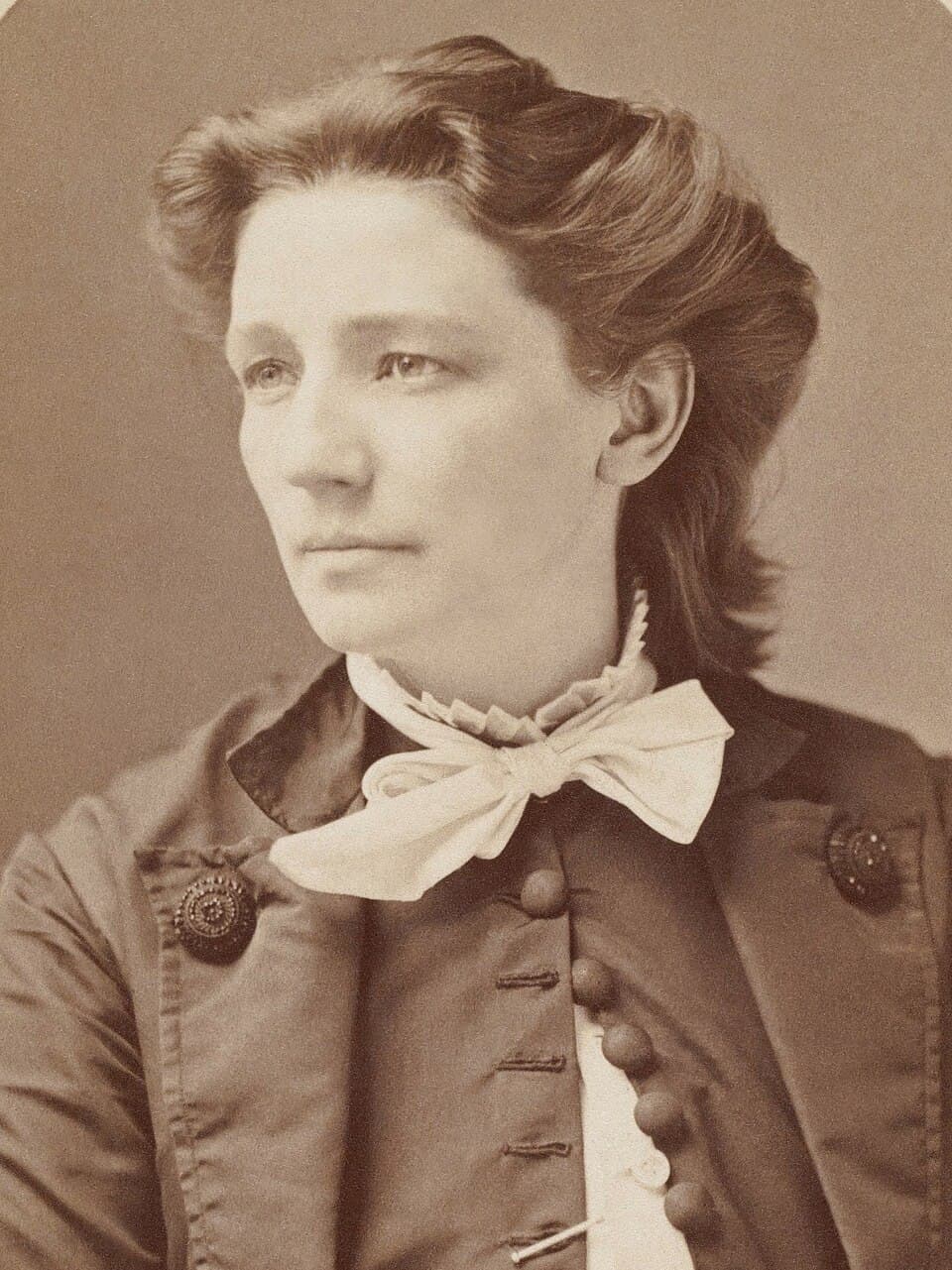
American · Politics · Activism
Victoria Woodhull
September 23, 1838 – June 9, 1927
Early Life and Background
Victoria California Claflin, later known as Victoria Woodhull, was born on 23 September 1838, in Homer, Ohio, the seventh of ten children of Reuben Buckman Claflin and Roxanna Hummel Claflin.[3][2][1] Her family lived in poverty, and numerous accounts describe her father as a petty criminal, con man, and abusive figure, while her mother was illiterate, deeply religious, and emotionally unstable.[1][10] The household environment was chaotic and violent, leaving Victoria with little formal education and considerable responsibility for her siblings.
Woodhull attended school irregularly and left around age eleven, later teaching herself through reading and experience.[1][9] As a child and teenager, she worked in her father’s traveling medicine and fortune‑telling show, billed as a clairvoyant and spiritual medium.[10] These experiences in itinerant performance and spiritualism shaped her skills as a public speaker and her later embrace of Spiritualism, a movement that believed in communication with the dead and emphasized women’s roles as mediums.
At age fifteen, she married Canning (Channing) Woodhull, a physician who struggled with alcoholism and instability.[2][1] The marriage, marked by infidelity and abuse, became central to her understanding of women’s legal vulnerability within nineteenth‑century marriage. She had two children: Byron and Zulu Maude (later known as Zula).[2] Her efforts to support her family through healing work and public speaking deepened her awareness of the economic and legal constraints on women.
Career Beginnings and Development
In the late 1850s and 1860s, Woodhull’s public career began to take shape through a combination of spiritualist practice, lecture tours, and faith healing.[9][1] She and her sister Tennessee (Tennie) Claflin gained reputations as clairvoyants, attracting clients among the emerging urban middle and upper classes. Through these networks, Woodhull encountered influential figures, including railroad magnate Cornelius Vanderbilt, who became a patron and adviser.[2]
By the end of the 1860s, Woodhull and Tennie had moved to New York City, positioning themselves at the center of American finance and reform politics. With Vanderbilt’s backing, they entered the world of stockbroking, a profession almost entirely closed to women.[2][6] Their work as spiritualists and healers provided an unconventional avenue into elite circles, while their ambition pushed them toward more formal economic roles.
The turning point came in February 1870, when they opened the Wall Street brokerage firm Woodhull, Claflin & Company, becoming the first women to operate a brokerage firm on Wall Street.[6][3] The firm attracted significant media attention, with newspapers alternately mocking and marveling at "lady brokers" handling stocks and bonds. Woodhull used her business success not only to accumulate capital but also to fund her growing political and publishing endeavors.
That same year, the sisters founded Woodhull and Claflin’s Weekly, a radical newspaper published in New York City.[6][2] The paper became a vehicle for their views on women’s rights, labor reforms, spiritualism, and sexuality. It also reported on national politics and international radical thought, helping to position Woodhull as one of the era’s most provocative public figures.
Major Works, Political Campaigns, and Accomplishments
Woodhull’s newspaper and public lectures quickly brought her into the heart of the women’s suffrage movement. By 1871, she had emerged as a prominent, if controversial, figure within the movement’s radical wing.[1][2] She supported the "New Departure" strategy, arguing that women already possessed the constitutional right to vote under existing amendments.
On 11 January 1871, Woodhull achieved a landmark in U.S. political history by becoming the first woman to address a congressional committee.[4][13] Appearing before the House Judiciary Committee, she argued that the Constitution’s Fourteenth and Fifteenth Amendments, which refer to "citizens" and their rights, implicitly enfranchised women.[2] Her testimony insisted that denying women the ballot violated equal protection and called on Congress to affirm women’s right to vote. Although the committee took no immediate action, the event marked a significant escalation in suffrage strategy and symbolized women’s determination to speak within formal political institutions.
Woodhull used Woodhull and Claflin’s Weekly to advance both suffrage and broader social reforms. The paper advocated divorce law reform, labor rights, and what she called "free love"—the freedom to marry, divorce, and bear children without government interference.[1][2] On 2 December 1871, she delivered a widely reported speech in New York City elaborating her free‑love philosophy; contemporary accounts describe an audience responding with both hisses and applause, highlighting how deeply her ideas challenged Victorian moral norms.[7] Her insistence on women’s sexual autonomy, including condemnation of marital rape, placed her at odds not only with mainstream society but also with more conservative suffragists.
In December 1871, Woodhull and Claflin’s Weekly published what is widely recognized as the first English‑language printing of Karl Marx and Friedrich Engels’s The Communist Manifesto in the United States.[6][2] By presenting the text to American readers, Woodhull connected U.S. reform debates to European socialist theory and highlighted the intersections of class and gender oppression. The publication underscored her role as an intermediary between international radical movements and American political culture.
Woodhull’s most famous achievement was her 1872 presidential campaign. On 6 June 1872, the newly organized Equal Rights Party formally ratified her nomination for President of the United States, making her the first woman ever officially nominated for the U.S. presidency by a political party.[2][1][3] The party’s platform combined demands for women’s suffrage with calls for civil rights, labor protections, and sweeping reform of marriage and divorce laws. It also named abolitionist and orator Frederick Douglass as her running mate, although Douglass did not recognize or campaign for the nomination.[6]
On 5 November 1872, U.S. Election Day, Woodhull stood as the Equal Rights Party candidate, widely regarded as the first woman to run for president.[6][3][1] Historians debate whether her candidacy strictly met constitutional requirements, as she would have been thirty‑four—not thirty‑five—on inauguration day.[2] Nevertheless, contemporary journalists and later scholars treat her campaign as the earliest female presidential bid in the nation’s history.
The campaign unfolded amid legal and social turmoil. Just days before the election, on 23 November 1872, Woodhull and Claflin’s Weekly published Woodhull’s explosive exposé alleging that celebrated minister Henry Ward Beecher had committed adultery with Elizabeth Tilton, wife of journalist Theodore Tilton.[7] By revealing a scandal that had circulated as rumor within reform circles, Woodhull accused Beecher of hypocrisy and challenged the double standard that condemned women and radicals while protecting powerful men.
The Beecher article led to federal charges under obscenity laws, and Woodhull, her husband, and her sister were arrested and jailed.[7][2] As a result, Woodhull spent Election Day incarcerated, unable to campaign and still unable to vote as a woman. She received no electoral votes, and many states ignored or mishandled her candidacy. Nonetheless, the 1872 campaign symbolized a radical claim to political authority by a woman decades before women gained nationwide suffrage.
Beyond the campaign, Woodhull authored pamphlets and essays outlining her political and social philosophy. In 1872, she published writings such as The Coming Woman, articulating her views on marriage, sexuality, and women’s political rights.[1][6] Throughout these works, she argued that genuine democracy required recognizing women’s full personhood and autonomy, including control over their bodies, labor, and political voice.
Awards, Honors, and Recognition
Woodhull did not receive conventional awards or official honors during her lifetime; indeed, much of her notoriety stemmed from criminal charges and moral condemnation. However, her contributions have been recognized posthumously by institutions devoted to women’s history.
She has been inducted into the National Women’s Hall of Fame, which highlights her roles as the first woman to address Congress and the first woman to run for the office of President of the United States.[13] Contemporary scholars and organizations, including the National Women’s History Museum and various historical societies, now feature her in educational materials and biographies that emphasize her trailblazing significance.[1][4]
Memorials in England, including a cenotaph at Tewkesbury Abbey, acknowledge her contributions to improving Anglo‑American relations and her distinctive life story as an American radical who settled in Britain.[8][14] These recognitions, though largely symbolic, reflect a growing consensus that Woodhull’s political audacity and feminist advocacy warrant prominent placement in the historical record.
Personal Life and Relationships
Woodhull’s personal life was complex and often scandal‑ridden, intersecting closely with her political and philosophical positions. Her first marriage to Canning Woodhull was unhappy; he struggled with alcoholism and repeatedly failed to support the family.[1][2] Woodhull’s experiences in this marriage, including infidelity and abuse, profoundly influenced her critiques of marriage law and her insistence that women needed the freedom to leave destructive relationships.
After separating from Canning, she formed a partnership with Colonel James Blood, a Civil War veteran and radical reformer involved in spiritualism and social movements.[2] Blood supported her activism and introduced her to networks of radicals and spiritualists in New York. Their unconventional relationship, which did not always follow legal marital norms, reinforced public perceptions of Woodhull as a "free love" advocate and fueled conservative attacks on her character.
In the mid‑1870s, Woodhull’s relationships within the American suffrage movement deteriorated. Many mainstream suffragists, including Susan B. Anthony and Elizabeth Cady Stanton, initially collaborated with her but later distanced themselves, particularly after the Beecher scandal and growing concerns that her sexual radicalism jeopardized the movement’s respectability.[1][17]
Woodhull eventually moved to England with members of her family, including her mother and children. In 1883 she married John Biddulph Martin, a wealthy banker, and adopted the name Victoria Woodhull Martin.[2] This marriage provided financial stability and social respectability, and she gradually withdrew from high‑profile political agitation, though she continued to write and engage in local reforms.
Later Life in England and Educational Reform
After settling in England, Woodhull shifted her focus from national campaigns to community‑level initiatives and writing projects. She maintained interest in suffrage and social reform but operated primarily through lectures, articles, and local activism.[2]
One documented episode occurred on 4 October 1908, when Woodhull and her daughter undertook efforts to reform a village school in Worcestershire, England, seeking to turn it into an exemplar of educational improvement.[7] Newspaper accounts portray her as an energetic, sometimes domineering figure who applied her long‑standing beliefs about children’s moral and intellectual development to the practical management of the school.
In England, she also engaged with debates about imperial politics and Anglo‑American relations, occasionally writing about transatlantic issues and supporting causes aligned with her earlier commitments to democracy and social progress.[8] While she never regained the sensational prominence she had known in the United States during the 1870s, she remained, in the words of one biographer, an "unrepentant radical" who continued to question authority and advocate reform.
Death
Woodhull lived into her late eighties, witnessing transformative changes in women’s legal and political status. She saw British and American suffrage movements grow and, in the United States, the eventual ratification of the Nineteenth Amendment in 1920, granting women the right to vote nationally—an outcome she had advocated for half a century earlier.[3][1]
On 9 June 1927, she died at her home in Bredon’s Norton, Worcestershire, England, at the age of 88.[3][2][4] By then she was known as Victoria Woodhull Martin. Her death passed with limited fanfare, reflecting the degree to which she had been sidelined from mainstream historical narratives and overshadowed by more conventional suffrage leaders.
Posthumous assessments have increasingly recognized the originality and breadth of her contributions. Historians and activists now view her death as the conclusion of a life that spanned multiple worlds—from antebellum poverty and spiritualism to Gilded Age finance, radical feminism, and transatlantic respectability.
Legacy and Historical Impact
Victoria Woodhull’s legacy in women’s history is multifaceted and sometimes contested, but several elements command broad agreement among scholars.
First, she is widely recognized as the first woman to run for President of the United States and the first woman formally nominated for the presidency by a political party.[3][2][6] Her 1872 campaign established a precedent for female candidacies at the highest level of American politics, expanding the imagination of what roles women could occupy long before they gained the right to vote.
Second, her appearance before the House Judiciary Committee in January 1871 marked the first time a woman addressed a congressional committee, symbolizing women’s emergence as direct participants in national policymaking.[4][13] Her constitutional argument—that women’s suffrage was already guaranteed by the Fourteenth and Fifteenth Amendments—anticipated later legal strategies and underscored the centrality of constitutional interpretation to civil rights movements.
Third, her pioneering role as a Wall Street broker and co‑founder of Woodhull, Claflin & Company challenged economic gender barriers.[6][3] By operating a brokerage firm and successfully engaging in stock trading, she demonstrated that women could exercise financial expertise and entrepreneurial leadership in spheres previously reserved for men. This experience informed her views on economic independence as a prerequisite for women’s freedom.
Fourth, as editor of Woodhull and Claflin’s Weekly, she developed a distinctive form of radical feminist journalism. The paper’s advocacy of suffrage, labor rights, free love, and socialist ideas, including publication of The Communist Manifesto, linked gender issues to broader critiques of capitalism and social hierarchy.[6][2] Her willingness to expose the Beecher–Tilton scandal demonstrated the use of the press to contest moral hypocrisy and male privilege, despite the legal and reputational risks.
Fifth, Woodhull’s ideas about marital reform, sexual autonomy, and reproductive rights prefigured later feminist movements. She spoke publicly about marital rape, the double standard of sexual morality, and the need for women to control their own bodies—issues that would become central to twentieth‑century feminism.[9][1] In this sense, she can be seen as an early advocate for what would later be termed "sexual politics."
Her legacy is complicated by tensions with other suffrage leaders, controversies over her spiritualism and sexual radicalism, and disputes about the constitutional viability of her presidential candidacy. Some contemporaries and later historians dismissed her as a sensationalist or opportunist.[2][9] However, recent scholarship and public history initiatives emphasize that her radicalism itself was historically significant, revealing the diverse strategies and perspectives within the broader movement for women’s rights.
Today, institutions such as the National Women’s History Museum, the National Park Service, and the National Women’s Hall of Fame highlight Woodhull in educational materials and exhibitions.[1][6][13] Biographies and research guides, including those produced by the Library of Congress, have deepened understanding of her life and work.[7][9] As a figure who crossed boundaries between spiritualism, finance, journalism, and politics, she offers a rich case study of how women navigated and contested nineteenth‑century structures of power.
Ultimately, Woodhull’s historical impact lies not only in her "firsts" but also in her insistence that democracy must encompass the intimate realms of marriage, sexuality, and bodily autonomy. Her life invites ongoing debate about the relationship between respectability and radical change, the role of scandal in social movements, and the ways in which some of the most transformative ideas in women’s history have emerged from figures long considered "notorious."
Dated achievements
10 indexed.
- Sep231838Politics
Birth of Victoria Woodhull
Victoria California Claflin was born in Homer, Ohio.
View details Victoria Woodhull - Britannica - Feb011870Politics
Opens first women-operated brokerage firm on Wall Street
Victoria Woodhull opens a women-operated brokerage firm on Wall Street.