← All women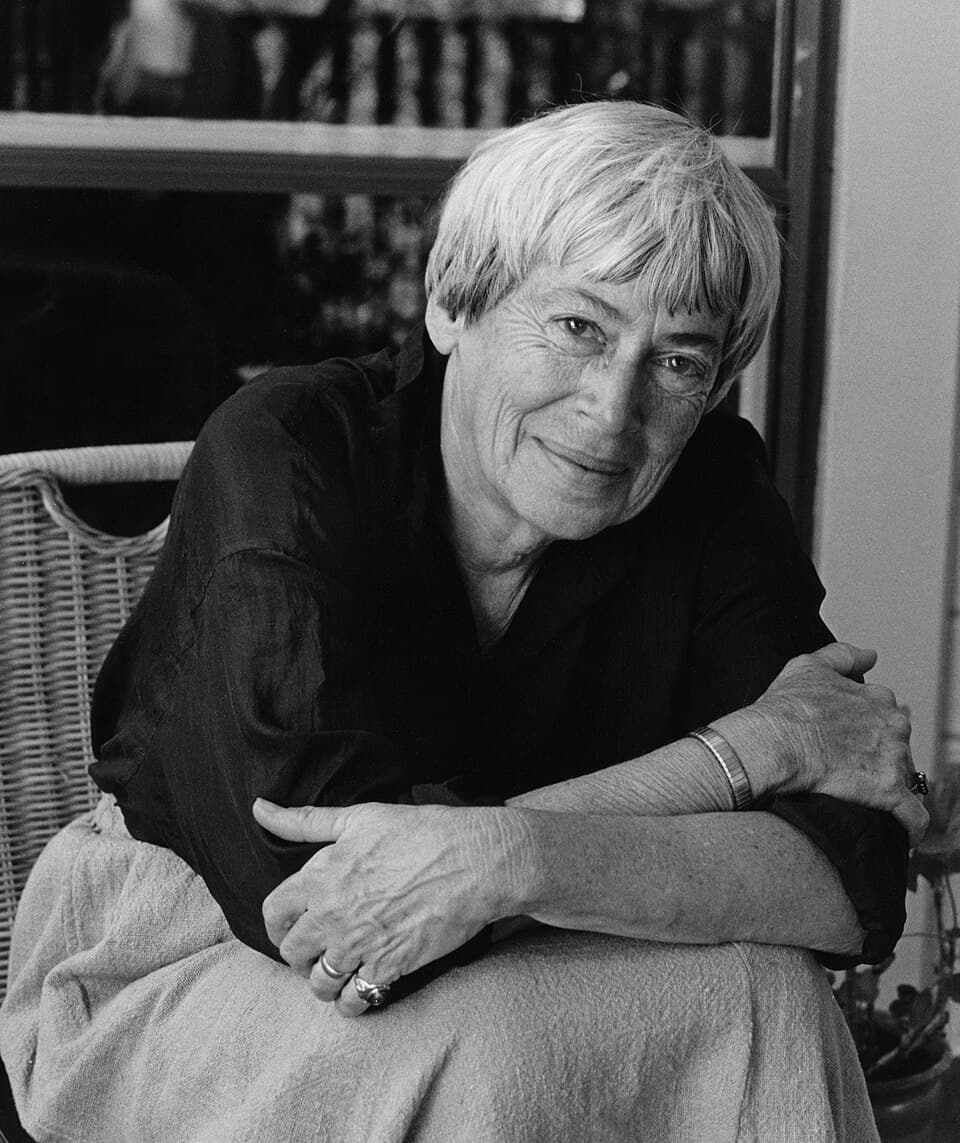
American · Literature
Ursula LeGuin
October 21, 1929 – January 22, 2018
Early Life and Family Background
Ursula Kroeber Le Guin was born on October 21, 1929, in Berkeley, California, the fourth child and only daughter of Alfred Louis Kroeber, a founding figure of American anthropology, and Theodora Kroeber, a writer who would later achieve fame for her book Ishi in Two Worlds (1961), an account of the last surviving member of the Yahi people, who had lived under her husband's care and study. Ursula grew up surrounded by scholars, writers, and artists who frequented the family's Berkeley home and their summer ranch, Kishamish, in the Napa Valley. This environment—rich with discussions of mythology, folklore, Native American cultures, Taoist philosophy, and Jungian psychology—left an indelible mark on her imagination.
Le Guin later recalled reading widely and voraciously as a child, particularly enjoying mythology, fairy tales, and the science fiction pulp magazines her older brothers brought home. She began writing stories and poems from a young age; she submitted her first short story to the magazine Astounding Science Fiction at age eleven (it was rejected). Her upbringing in a household devoted to the serious study of culture and myth gave her an intuitive grasp of anthropological world-building that would distinguish her fiction throughout her career.
Education
Le Guin attended Berkeley High School and went on to earn a Bachelor of Arts degree in Renaissance French and Italian literature from Radcliffe College in 1951, followed by a Master's degree from Columbia University in 1952. She began doctoral studies but abandoned them upon receiving a Fulbright grant to study in France. It was aboard the ship to Europe that she met historian Charles A. Le Guin; the two married in Paris on September 22, 1953. The marriage marked both a personal and professional turning point, as she adopted the surname under which she would publish for the rest of her career.
Early Career and Literary Development
After returning to the United States, Ursula Le Guin worked various jobs while writing extensively, though for years she struggled to publish her work, in part because much of it defied easy genre categorization—blending literary fiction, fantasy, and speculative elements in ways publishers of the 1950s found difficult to market. Meanwhile she and Charles settled in Portland, Oregon, and raised three children: Elisabeth (b. 1957), Caroline (b. 1959), and Theodore (b. 1964).
Her breakthrough came in the 1960s when she began publishing science fiction and fantasy short stories in genre magazines. Her first novel, Rocannon's World (1966), inaugurated what became known as the Hainish Cycle, a loosely connected series of novels and stories set in a shared universe of interstellar civilizations descended from a common ancestor, the planet Hain. This series would eventually include some of her most celebrated works.
Major Works and Literary Achievements
Le Guin's reputation as a major literary voice was cemented with two landmark works published in rapid succession. A Wizard of Earthsea (1968), the first book in what became the Earthsea series, told the story of a young wizard named Ged and was groundbreaking for its nuanced, non-Western-coded fantasy setting and its dark-skinned protagonist—a striking departure from the overwhelmingly white heroic fantasy of the era. The novel won the Boston Globe-Horn Book Award and is regarded as one of the foundational texts of modern fantasy literature, influencing generations of writers, including J.K. Rowling and Terry Pratchett.
In 1969, Le Guin published The Left Hand of Darkness, a novel set on the planet Gethen, whose inhabitants are ambisexual, without fixed gender. The novel became a foundational text of feminist science fiction, using speculative estrangement to interrogate assumptions about gender, sexuality, and social organization. It won both the Hugo Award and Nebula Award for Best Novel in 1970, making Le Guin one of the first women to win both of science fiction's most prestigious awards for a single work.
She followed this with The Dispossessed: An Ambiguous Utopia (1974), which explored anarchism, capitalism, and utopian political theory through the story of a physicist moving between two starkly different worlds. It too won both the Hugo and Nebula Awards, an unprecedented achievement that confirmed Le Guin's status as the leading intellectual voice in American science fiction. Her Earthsea series expanded over subsequent decades with The Tombs of Atuan (1971), The Farthest Shore (1972)—which won the National Book Award for Children's Literature—Tehanu (1990), Tales from Earthsea (2001), and The Other Wind (2001), the later volumes revisiting and complicating the gender and power dynamics of the earlier books with a more explicitly feminist lens.
Beyond these major series, Le Guin wrote numerous standalone novels and short stories of lasting significance, including The Lathe of Heaven (1971), a meditation on dreams, reality, and Taoist philosophy; Always Coming Home (1985), an experimental novel blending fiction and ethnography about a future Californian society; and the acclaimed short story "The Ones Who Walk Away from Omelas" (1973), a philosophical parable frequently taught in schools and universities. She also produced influential essays on writing and genre, collected in volumes such as The Language of the Night (1979) and Steering the Craft (1998), a widely used guide for writers.
Awards and Honors
Over her career, Le Guin received an extraordinary array of honors. She won multiple Hugo Awards, Nebula Awards, Locus Awards, and World Fantasy Awards. In 2003, the Science Fiction and Fantasy Writers of America named her a Grand Master, one of the field's highest honors. She won the National Book Award for young people's literature in 1973 for The Farthest Shore. In 2014, she received the National Book Foundation's Medal for Distinguished Contribution to American Letters, using her acceptance speech to deliver a widely circulated critique of corporate publishing and a call for writers to imagine alternatives to capitalism. She was inducted into the Science Fiction Hall of Fame in 2001 and received the PEN/Malamud Award for excellence in short fiction. In 2000, the Library of Congress named her a "Living Legend." She was also a finalist for the Pulitzer Prize and received lifetime achievement recognition from the World Fantasy Convention.
Personal Life and Philosophy
Le Guin's personal life centered on her long marriage to Charles Le Guin and their three children, based in Portland, Oregon, where she lived for over six decades. She was deeply influenced by Taoism, particularly the Tao Te Ching, which she translated in her own rendition published in 1997, and by Jungian psychology, both of which permeate the moral and metaphysical structures of her fiction. She identified as a feminist and was outspoken about gender inequities in publishing and literary criticism, famously critiquing the marginalization of "genre" fiction relative to literary fiction and advocating for the serious critical treatment of science fiction and fantasy.
She was also politically engaged, addressing themes of anarchism, colonialism, ecological responsibility, and anti-war sentiment throughout her body of work, most explicitly in The Dispossessed and The Word for World Is Forest (1972), the latter written partly as a response to the Vietnam War and later cited as an influence on works like James Cameron's Avatar.
Legacy and Impact
Ursula K. Le Guin is widely regarded as one of the most significant American writers of the 20th century, credited with elevating science fiction and fantasy to the level of serious literary art and expanding the genres' capacity for social, anthropological, and philosophical inquiry. Her works are taught extensively in universities across disciplines including literature, gender studies, anthropology, and political theory. She mentored and influenced countless writers, including Margaret Atwood, Neil Gaiman, David Mitchell, and Kelly Link, and her insistence on treating speculative fiction as a vehicle for serious ideas reshaped the literary respectability of the genre.
Her papers are held at the University of Oregon and University of California, Berkeley. The asteroid 4362 Kroeber was named in honor of her family, and in 2017, PEN America established an award in her name recognizing fiction that grapples with issues of social and environmental justice. A documentary, Worlds of Ursula K. Le Guin, was released in 2018 chronicling her life and influence.
Death
Ursula K. Le Guin died on January 22, 2018, at her home in Portland, Oregon, at the age of 88, after several months of declining health. Her death prompted an outpouring of tributes recognizing her as a towering figure of American letters whose work permanently altered the cultural standing and ambitions of speculative fiction.
Dated achievements
3 indexed.
- Oct211929Literature
Born in Berkeley, California
Ursula Kroeber Le Guin was born in Berkeley, California, to anthropologist Alfred L. Kroeber and writer Theodora Kroeber.
View details Ursula K. Le Guin - Wikipedia - Sep221953Literature
Married historian Charles Le Guin
Ursula Kroeber married historian Charles A. Le Guin in Paris on September 22, 1953, adopting the surname 'Le Guin' under which she would publish.