← All women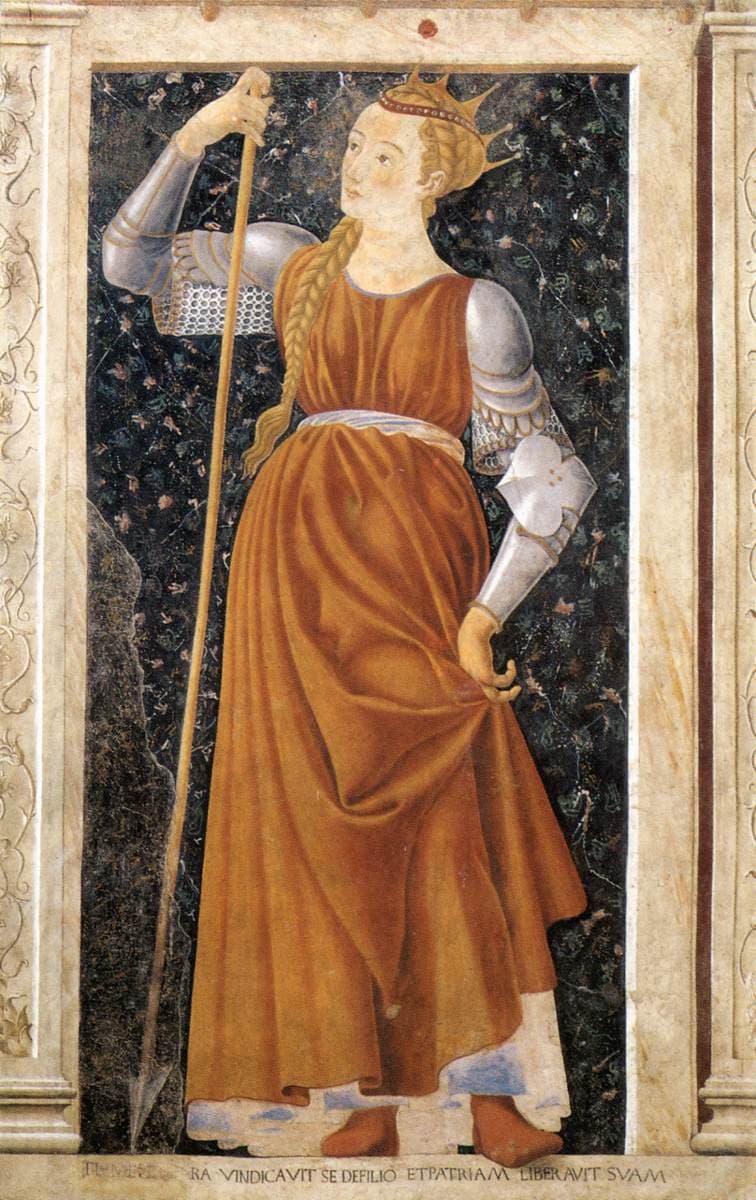
Massagetae · Politics · Exploration
Tomyris
Unknown – present
Overview
Tomyris (also spelled Thomyris, Tomris, Tomiris) was a queen of the Massagetae, a nomadic people of Central Asia traditionally associated with the wider Scythian world and Iranian steppe cultures. Herodotus, the 5th‑century BCE Greek historian, is the sole ancient source for her story, and our knowledge of Tomyris rests almost entirely on his narrative in the Histories.[1][9][19]
According to Herodotus’ account, Tomyris ruled the Massagetae in the 6th century BCE and became renowned for leading her forces against Cyrus the Great of the Achaemenid Empire. In a campaign dated by modern scholarship to around 530 BCE, she defeated the Persian army and caused Cyrus’s death in battle, an event that has echoed through classical literature, art, and modern nationalist memory.[1][9][19]
Modern historians emphasize that Tomyris is a semi‑legendary figure: her existence, the details of her life, and even the precise circumstances of Cyrus’s end cannot be independently verified beyond Herodotus. Nonetheless, her story has been repeatedly reinterpreted as an emblem of resistance to imperial expansion, a moral tale of hubris, and a powerful example of a woman exercising sovereign and military authority in the ancient world.[1][9][6]
Early Life and Background
No ancient source provides information about Tomyris’ birth, childhood, or early life, and there is no reliable evidence for her exact birth date, birthplace, or parentage.[1][9] Herodotus introduces her simply as "Tomyris, queen of the Massagetae," assuming his audience would understand the Massagetae as a formidable steppe people living beyond the Araxes River, on the eastern fringes of the known world.[1][9][19]
The Massagetae are described by classical authors as a pastoral‑nomadic confederation in Central Asia, east of the Caspian Sea, inhabiting territories that roughly correspond to parts of present‑day Turkmenistan, Afghanistan, western Uzbekistan, and southern Kazakhstan.[19] They are frequently grouped among the Scythian or Iranian nomads, known for their horsemanship, archery, and mobile way of life.[1][4][19] In later linguistic and ethnographic reconstructions, Tomyris’ name is linked to Eastern Iranian forms such as Tahmirih, glossed as "Brave" or "Brave glory," and to a Saka‑Scythian form Taumuriyah, reinforcing the association with Iranian steppe cultures.[1][19]
Because the Massagetae were a nomadic people whose history was preserved primarily through oral tradition and external observers, we lack institutional records that might disclose Tomyris’ upbringing or education. Her emergence as a ruling queen is therefore inferred from Herodotus’ depiction of her as already a sovereign, commanding warriors and making strategic decisions. Modern reconstructions often imagine her as a product of aristocratic steppe culture, trained in riding and war leadership, but such details remain speculative.
Accession and Political Role
Herodotus implies that Tomyris ascended to power following the death of her husband, an unnamed king of the Massagetae, though he gives no dates or additional information.[7] Later summaries of his narrative state that she "took command of the nomadic Massagetae people after her husband, an unnamed king, died," suggesting a transition in which a widowed queen assumed rulership over a tribal confederation.[7]
This depiction situates Tomyris within a broader pattern of steppe queens and female rulers known from Greek and Near Eastern sources, where women occasionally appear as regents or autonomous sovereigns, particularly in times of crisis or succession disputes.[9] Modern historians compare her to other "warrior queens" in Greek tradition—such as Artemisia of Halicarnassus and Semiramis—not to assert historical similarity, but to highlight how Greek authors used powerful women to explore themes of power, gender, and the limits of empire.[9]
Chronologically, Tomyris’ reign is generally placed sometime in the 6th century BCE, a period when the Achaemenid Empire under Cyrus was expanding dramatically across the Near East. The dating is inferred from the accepted chronology of Cyrus’s campaigns and death; it cannot be tied to specific regnal years or internal Massagetae timelines, which are unknown.[1][9][19]
Cyrus the Great’s Campaign and Tomyris’ Defiance
Tomyris’ historical significance stems almost entirely from the episode in which she opposes Cyrus the Great during his final campaign.[1][9] Herodotus presents the story as a dramatic confrontation between imperial ambition and frontier resistance.
In Herodotus’ narrative, Cyrus, having defeated numerous kingdoms including Lydia and Babylon, turned his attention to the Massagetae, whose lands lay beyond the river Araxes. He viewed their territory as the next step in his expansion and sought to bring them under Persian control.[1][9] Cyrus first sent envoys proposing a marriage to Tomyris, a tactic she interpreted as a veiled attempt at conquest. She rejected the proposal, refusing to surrender her sovereignty through diplomatic subterfuge.[17]
After this rebuff, Cyrus launched a military campaign against the Massagetae. Herodotus describes a complex tactical situation in which Cyrus, advised by the Lydian Croesus, arranged a stratagem: he left behind an apparently vulnerable camp rich with food and wine, then withdrew his main force. When a contingent of Massagetae, including Tomyris’ son, attacked the camp, they found and consumed the provisions; unaccustomed to wine, they became intoxicated and were overwhelmed by the returning Persians. Tomyris’ son was captured and later died, either in captivity or by suicide, depending on the version.[1][9][18]
This episode of deception and personal loss is crucial to later portrayals of Tomyris. Her reaction—sending a message warning Cyrus that she would "give him his fill of blood"—sets the stage for the climactic battle and underscores themes of maternal grief, justice, and vengeance that have fascinated artists and writers for centuries.[1][9][3]
The Battle and Death of Cyrus
Herodotus recounts that, enraged by the death of her son, Tomyris gathered the full force of the Massagetae and offered Cyrus a choice of battleground: either the Persians would cross the Araxes to fight in Massagetae territory, or the Massagetae would cross into Persian‑held lands.[1][9] Cyrus chose the former, and the armies met in a major battle that modern scholarship dates to around 530 BCE, traditionally in the summer.[1][9][19]
In Herodotus’ account, the battle was fierce and bloody, with heavy casualties on both sides, but ultimately a Massagetae victory. Cyrus was killed, and his army was effectively destroyed.[1][9] This episode stands out in Greek historiography because Tomyris is the only leader explicitly credited with killing an Achaemenid Great King in battle, whereas other royal deaths in the tradition often occur off‑field or by assassination.[9]
Later versions of the story emphasize a grisly act of vengeance: Tomyris, having recovered Cyrus’s corpse, allegedly ordered his head to be severed and placed into a vessel filled with blood, declaring that he could now drink his fill of what he had so thirsted for.[1][3][14][17] Herodotus includes a version of this motif, and it has been repeatedly elaborated in later literature and art. Modern scholars, however, treat the decapitation and blood‑filled vessel as a literary trope rather than a verifiable historical detail, part of Herodotus’ moralizing narrative about hubris punished.[1][9][18]
Despite uncertainties, the campaign itself and Cyrus’s death around 530 BCE are broadly accepted by historians as historical events, supported by the synchronism of Achaemenid royal lists and external references. Tomyris’ role in the campaign remains debated, but her appearance in Herodotus as a named queen leading troops is unparalleled, giving her a distinctive place in the record of women’s participation in ancient warfare.[9]
Tomyris in Greek and Roman Literary Tradition
Herodotus is the earliest and principal source for Tomyris, and later classical authors transmit and reshape his story. While details differ, they tend to preserve core elements: a Massagetae queen, an attempted Persian conquest, deception leading to familial loss, and a decisive battle in which Cyrus dies.[1][9]
In Greek cultural memory, Tomyris is connected to the Amazon tradition, a cluster of myths and stories about warrior women who inhabit the fringes of the known world and challenge male heroes.[9][11] Modern scholarship notes that Herodotus likely drew on this tradition to frame Tomyris as a moral foil to Cyrus, accentuating the novelty of a woman defeating a powerful king. Thomas Waters, for instance, describes the Tomyris episode as a "cautionary tale of hubris" that uses Amazon motifs to dramatize the limits of imperial power.[9]
Over time, Tomyris appears in various works of art and literature. Renaissance and early modern artists painted scenes of Tomyris with Cyrus’s severed head and the vessel of blood, highlighting themes of justice and revenge.[12] In some accounts she is styled the "last queen of the Amazons," anachronistically placing her within a mythic lineage of female warriors; this is a later interpretive label, not a contemporary title from her own era.[11]
These representations often blur the boundary between history and myth, using Tomyris less as a figure of factual record and more as a symbol through which male authors and artists explored gender, violence, and the morality of conquest.
Modern Scholarship and Debates
Modern historians approach Tomyris with caution, treating her as a single‑source figure whose existence and deeds cannot be fully corroborated.[1][9][18] Key debates revolve around the historical reliability of Herodotus, the nature of his sources, and the degree to which his narrative reflects Greek literary conventions rather than frontier realities.
The article on Tomyris in the Achaemenica project summarizes the consensus: the campaign against a nomadic people beyond the Araxes and Cyrus’s death on that campaign are accepted as historical, but Tomyris’ specific role and the dramatic details (such as the head‑in‑blood episode) are likely shaped by Greek storytelling traditions.[9] Scholars emphasize that Herodotus structures the episode as a moral story in which Cyrus’s overreaching ambition meets punishment from a woman ruler who embodies the wild, unconquered frontier.[9][6]
Because Tomyris’ story is isolated in the literary record, historians avoid using it to reconstruct detailed Massagetae political structures or gender norms. Instead, they treat it as a lens on how Greeks imagined steppe societies and the limits of imperial power. It offers rare evidence that Greeks could conceive of women exercising sovereign authority and commanding armies, even if the portrayal is heavily stylized.
Personal Life
Herodotus provides very little direct information about Tomyris’ personal life. The narrative indicates that she was a widow, having previously been married to a king of the Massagetae.[7] It also notes that she had at least one son, whose death at Persian hands—or in captivity—serves as a key turning point in the story.[1][9]
Beyond these minimal details, there is no reliable evidence about her family relationships, number of children, or domestic arrangements. The intense focus on her maternal grief in Herodotus and later retellings has encouraged modern authors to cast Tomyris as an archetypal "mother‑avenger" whose fury at the loss of her son drives her to challenge a powerful king.[3] While this motif is central to her reception, it should be recognized as part of the narrative framing rather than a documented psychological portrait.
Later Life and Death
No ancient account records what happened to Tomyris after the defeat of Cyrus. Herodotus does not describe her later life, length of reign, or circumstances of death.[1][9] Likewise, there are no inscriptions, royal lists, or archaeological records that mention her directly, leaving her ultimate fate unknown.
Modern reference works therefore refrain from assigning specific dates or locations to her death. Biographical entries typically state that Tomyris flourished around 530 BCE and that both her birth and death are undated and uncertain.[1][12][21] Any attempt to place her death in a particular year or region would be conjectural and is avoided in scholarly literature.
Awards, Honors, and Named Objects
As an ancient ruler of a nomadic confederation, Tomyris did not receive formal "awards" in the modern sense. Her "honors" consist of later commemorations and symbolic recognitions in art, literature, and astronomy.
A notable example is the minor planet 590 Tomyris, named in her honor. Modern sources mention that this asteroid commemorates the queen, though the discovery and naming relate to the astronomical object rather than the historical figure herself.[3] The naming reflects her enduring presence in cultural memory and the tendency to inscribe notable historical and legendary figures into celestial nomenclature.
In addition, Tomyris has been featured on modern coins, stamps, and monuments, particularly in states of Central Asia that emphasize Scythian and steppe heritage. Such uses are part of contemporary national and regional identity construction rather than direct continuations of ancient Massagetae tradition.[1][3][12]
Representation in Art, Film, and Popular Culture
Tomyris has inspired numerous works of visual and literary art, particularly focused on the dramatic moment of her confrontation with Cyrus. European paintings from the Renaissance onward often depict Tomyris holding or contemplating the severed head of Cyrus, sometimes with a bowl or vessel of blood, emphasizing themes of righteous vengeance and the reversal of power between conqueror and victim.[12][14]
In the modern era, Tomyris appears in historical novels, popular history articles, and educational media. She is the subject of online essays and videos that celebrate her as a "warrior queen" who defeated one of history’s greatest conquerors.[2][10][14] Some treatments cast her within a broader narrative of "rejected princesses"—women whose lives do not fit conventional fairy‑tale molds—highlighting her agency and ferocity.[16]
Tomyris has also been adapted into video games and film. For example, a leader character named Tomyris appears in the strategy game Sid Meier’s Civilization VI, where she represents the Scythian civilization and is characterized by aggressive, horse‑archer warfare, echoing her legendary martial prowess.[civilization.fandom.com] A modern Kazakhstani film titled Tomiris dramatizes her life and conflict with Cyrus, blending historical reconstruction with national mythmaking.[Tomiris_(film)] These works often enrich her story with imagined details and dialogue, making clear their status as artistic interpretations rather than historical sources.
Legacy and Historical Impact
Despite the fragmentary and semi‑legendary nature of the evidence, Tomyris occupies a prominent place in both women’s history and the cultural memory of resistance to empire.
First, Herodotus’ portrayal of Tomyris as a ruling queen who commands armies challenges assumptions that women in the ancient world were universally excluded from political and military leadership. While she may be exceptional, her story demonstrates that Greek observers could imagine—and record—women in positions of sovereign authority, even if they framed such figures as exotic or morally charged.[1][9]
Second, Tomyris’ alleged defeat of Cyrus the Great marks a rare narrative in which a woman decisively thwarts a major imperial conqueror. She becomes an emblem of the idea that even the most powerful empires are vulnerable at their frontiers, particularly when they underestimate local leaders, including women.[9][6]
Third, Tomyris has been adopted as a symbol in various modern contexts. Writers and activists highlight her as an early example of female leadership and military success, using her story to illustrate longstanding—but often overlooked—traditions of women’s participation in warfare and governance.[2][6] In Central Asia, she appears in discourse about national origins and heroism, with some accounts emphasizing her role as a Saka‑Massagetae queen who defended her people against foreign domination.[12]
At the same time, responsible scholarship stresses the importance of distinguishing between literary Tomyris and any historical queen who might lie behind the story. Researchers caution against assigning precise dates, genealogies, or institutional structures to her reign and call for clarity about the single‑source nature of the evidence.[1][9][18] Tomyris thus functions as both a potent symbol and a case study in the challenges of reconstructing women’s history from sparse and biased records.
Historiographical Cautions
Because Tomyris is known only from Herodotus and later derivative texts, historians and women’s‑history researchers follow several key guidelines when working with her story:
- Avoid fabricating dates: There are no reliable month‑and‑day dates for her birth, death, accession, or battles; only approximate chronology such as "c. 530 BCE" is available.[1][9][19]
- Distinguish Herodotus from later embellishments: Details such as Tomyris personally beheading Cyrus and using his skull as a goblet are literary motifs that gain color in later retellings; they should not be treated as independently verified facts.[1][3][14][18]
- Recognize nationalistic appropriations: Modern coins, monuments, and films that celebrate Tomyris often embed her in contemporary identity politics, which may shape how her story is told.[12]
- Emphasize uncertainty: Scholars agree that both her individual historicity and the exact dating of events are uncertain, and they present her narrative with appropriate qualifiers.[1][9][18]
By following these cautions, researchers can honor Tomyris’ significance in cultural memory while maintaining rigor about what the sources actually support.
Tomyris in Women’s History
Within the field of women’s history, Tomyris illustrates both the possibilities and limits of reconstructing female agency in antiquity. She stands as a vivid example of a woman depicted as a military leader and sovereign, yet the evidence is thin and mediated by external observers whose interests and assumptions differ from modern ones.
Her story invites reflection on how women’s power is remembered—or forgotten—when historical records are sparse. It also underscores the need to critically evaluate sources, identify literary conventions, and resist the temptation to fill gaps with speculation. Nevertheless, Tomyris’ enduring presence in art, literature, and scholarship shows that even semi‑legendary women can shape historical imagination and inspire new inquiries into gender, power, and empire.
Dated achievements
1 indexed.
- Jun30530Politics
Tomyris defeats Cyrus the Great
Tomyris, Queen of Massagetae, defeats Cyrus the Great around 530 BCE.
View details Tomyris - Wikipedia