← All women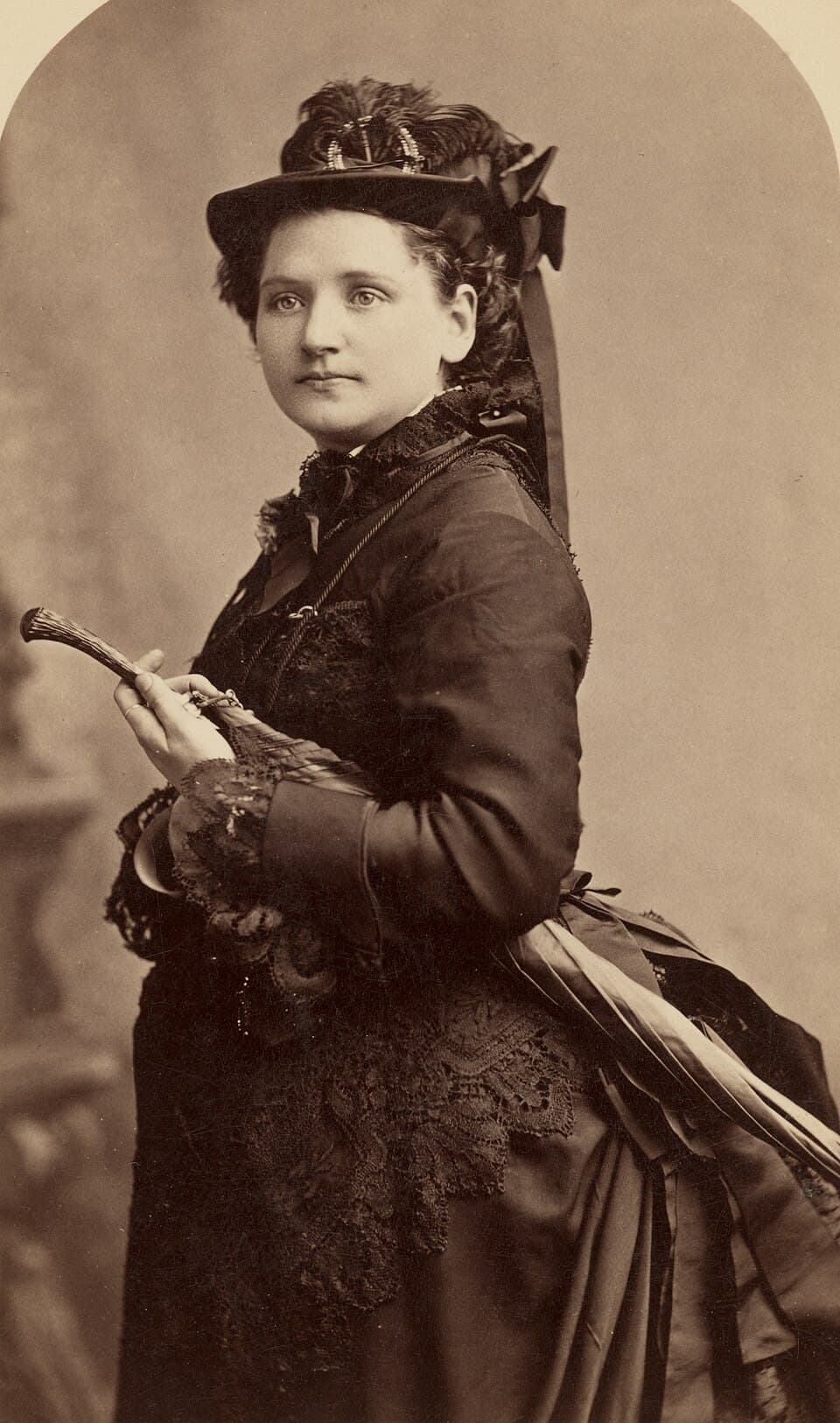
American, British · Activism · Politics · Science
Tennessee Claflin
October 26, 1844 – January 18, 1923
Early Life and Background
Tennessee Celeste Claflin, later known as Tennie C. and as Lady Cook, Viscountess of Monserrate, was born on 26 October 1844 in Homer, Ohio, United States.[1][3][8][9][17] She was one of the seven surviving children of Reuben Buckman ("Buck") Claflin, a speculative entrepreneur and sometime lawyer, and Roxanna (Anna) Hummel Claflin, who engaged in spiritualist practices and "magnetic healing."[11][12] The family lived in poverty and moved frequently, and the children were drawn early into their parents’ itinerant enterprises.
As a girl, Tennessee was put forward as a "magnetic healer" and spiritual medium, traveling with her elder sister Victoria Claflin (later Victoria Woodhull) across the Midwest.[2][12][16] They offered cures and spiritual consultations, often to working‑class clients, in a period when spiritualism and alternative healing enjoyed wide popularity. These experiences exposed Tennessee to public speaking and business dealings and gave her an unusual degree of mobility and visibility for a nineteenth‑century girl.
Her childhood was also marked by instability and exploitation. Sources describe an early marriage to a gambler, John Bartels, which was short‑lived and unhappy, and legal troubles that included a manslaughter indictment connected with her healing practice.[2][11] The combination of family chaos, early marriage, and public controversy shaped her developing sense of injustice and helped push her toward women’s rights activism.
Later biographical references disagree on her exact year of birth, citing 1845 or 1846, but multiple multilingual encyclopedia entries—including English, Spanish, Portuguese, and Basque Wikipedias—converge on 26 October 1844, and that date is widely used in contemporary scholarly summaries.[1][3][8][9][11][17] This profile adopts the 1844 date while noting that the discrepancy itself reflects the patchy documentation of women’s lives in the period.
Career Beginnings and Development
By the late 1860s, Tennessee and Victoria had relocated to New York City, where they became involved in spiritualist circles and radical reform movements.[1][2][4][18] Their skills as mediums and healers brought them into contact with wealthy and powerful men, most notably railroad magnate Cornelius Vanderbilt.[2][4][7] Tennessee served as a spiritual advisor to Vanderbilt, reportedly providing him with stock tips and personal counsel, and this relationship gave the sisters both capital and social leverage.
With Vanderbilt’s backing, Tennessee and Victoria moved into the heart of American finance. In 1870 they established Woodhull, Claflin & Co., a brokerage house near Wall Street, and on 5 February 1870 the firm opened its doors to the public at 10 a.m., drawing crowds to 44 Broad Street.[4][14] The office was furnished in an elegant style intended to attract female clients and to signal that women belonged in the world of investment and speculation.[4]
On 14 February 1870, their elegantly appointed office was opened in full operation, and Tennessee and Victoria became the first women to open and run a Wall Street brokerage firm.[1][8][9][17] Tennessee played a central role as a broker and manager, advising clients and managing day‑to‑day operations. At a time when women could not vote and were largely excluded from professional careers, her presence as a stockbroker sent a powerful message about women’s capacity for financial autonomy.
The brokerage’s success enabled the sisters to fund broader reform activities. In 1870, using profits from their financial ventures and relying on Tennessee’s business management, they launched the weekly newspaper Woodhull & Claflin’s Weekly, devoted to radical social and political reform.[2][4] The paper advocated women’s suffrage, sexual freedom, equal education, and labor reform, and it was one of the earliest American publications to print a translation of Karl Marx and Friedrich Engels’ Communist Manifesto.[2]
Major Works, Campaigns, and Accomplishments
Tennessee’s most visible accomplishments came from her partnership with Victoria Woodhull during the early 1870s. Through Woodhull & Claflin’s Weekly, the sisters challenged conventional morality and political structures, arguing for women’s right to control their own bodies, to divorce abusive husbands, and to participate fully in public life.[2][4][5] The paper’s willingness to discuss topics such as prostitution, free love, and marital rape made Tennessee a target of fierce criticism but also positioned her at the cutting edge of feminist thought.
On 10 January 1871, Tennessee accompanied Victoria to Washington, D.C., where Victoria became the first woman to address the House Judiciary Committee of the U.S. Congress on women’s suffrage.[4] Tennessee helped articulate and promote their argument that the existing Constitution, particularly the Fourteenth and Fifteenth Amendments, already enfranchised women. Although popular accounts sometimes claimed Tennessee herself was the first woman to speak before Congress, detailed narratives and later scholarship confirm that Victoria delivered the formal testimony while Tennessee stood beside her in support.[4][11]
In 1871, the sisters made a symbolic attempt to vote, decades before the adoption of the Nineteenth Amendment.[15] This act of civil disobedience highlighted their belief that women were already citizens entitled to the franchise. Tennessee’s work as a stockbroker and publisher made her a visible embodiment of this claim: she was a woman earning her own income, managing investments, and directing editorial campaigns, insisting that political rights should follow economic independence.
During 1872, Victoria Woodhull mounted a presidential campaign as a candidate of the Equal Rights Party, widely described as the first female presidential candidacy in U.S. history.[3][4] Tennessee was active in the radical reform circles surrounding this campaign—lecturing, organizing, and writing in support of the broader platform of women’s rights, labor reforms, and social reorganization.[3][4][18] Although she did not run for office herself, her work in publicity and fundraising helped ensure that the unprecedented candidacy received national attention.
The sisters’ activism also led them into legal conflicts. Their newspaper’s decision to expose the extramarital affair of prominent pastor Henry Ward Beecher resulted in obscenity charges and led to their arrest in 1872, though they were eventually acquitted.[2][4] Tennessee’s role in these confrontations reinforced her reputation as a fearless critic of sexual double standards, willing to challenge powerful men and institutions.
Awards, Honors, and Public Recognition
Like many nineteenth‑century women reformers, Tennessee Claflin did not receive formal awards or state honors during her lifetime, and there is no evidence of official decorations comparable to modern feminist accolades. Instead, her recognition came through media coverage, public controversy, and later historical reassessment.
In the early 1870s, newspapers and magazines across the United States and Britain reported extensively on the sisters’ brokerage, their radical newspaper, and their speeches, often in sensational and critical tones.[2][4] Tennessee was alternately portrayed as an audacious businesswoman and as a dangerous disruptor of social order. This notoriety kept her in the public eye and brought her reform ideas to audiences far beyond the readership of Woodhull & Claflin’s Weekly.
Her later marriage to Sir Francis Cook, a wealthy English industrialist and art collector, and her title as Viscountess of Monserrate constituted a form of social recognition, acknowledging her status within British and Portuguese high society.[11][13][16] While the title came through marriage rather than public office, it gave her a platform for philanthropic and educational projects.
In the twentieth and twenty‑first centuries, encyclopedias, feminist histories, and museum exhibits have increasingly highlighted Tennessee’s role in pioneering women’s financial participation and radical reform. Reference works such as Encyclopedia.com, feminist organizations, and dedicated historical websites now identify her as a key figure in women’s economic and political history.[2][11][18] This retrospective recognition has helped restore her place alongside Victoria Woodhull in the narrative of early feminism.
Personal Life
Tennessee’s personal life was complex and often controversial. Early in adulthood she married John Bartels, described in sources as a gambler, but the marriage was short‑lived and unhappy.[2][11] The relationship exposed her to financial insecurity and social stigma, reinforcing her conviction that women needed both economic independence and legal rights to escape abusive or exploitative marriages.
After the decline of Woodhull & Claflin’s Weekly and the sisters’ New York enterprises, Tennessee and Victoria relocated to Britain in the mid‑1870s.[1][2][5][16] In Britain, Tennessee moved within radical reform and intellectual circles and gradually built a new life. In October 1885, she married Sir Francis Cook, an elderly and wealthy widower who held the Portuguese title of Visconde de Monserrate.[11] Through this marriage she became Lady Tennessee Cook and Viscountess of Monserrate, based at Doughty House in Surrey and linked to the Monserrate estate at Sintra in Portugal.[5][11][13]
Sources indicate that Tennessee had no children with Sir Francis, though she was closely involved with her extended family and with educational projects for young people.[11][12][18] Her new social position allowed her to engage in philanthropy on a larger scale, supporting schools and charitable institutions both in Britain and Portugal.
Later Life: Suffrage, Philanthropy, and International Work
In her later years, Tennessee continued to advocate for women’s rights and social reform, extending her work beyond the United States to Britain and Portugal. She became an active suffragist in the British movement, lecturing and writing on women’s enfranchisement, education, and social welfare.[1][5][18]
As Viscountess of Monserrate, she contributed financially to schools and charitable initiatives in Sintra, Portugal, and elsewhere. Historical accounts note her support for educational institutions and her role in promoting opportunities for women and children in communities connected with the Monserrate estate.[13][18] Her philanthropy included backing the creation of spaces for women artists and students, reflecting her belief in the transformative power of education.
In Britain, Tennessee helped found or support Alexandra House, described as a home and school for women artists in London, and participated in broader efforts to improve training and living conditions for women engaged in the arts.[18] She also lectured on subjects ranging from constitutional interpretation to the treatment of illegitimate children, continuing the eclectic blend of political theory, social reform, and moral critique that had characterized her earlier journalism.[18]
At some point after Sir Francis Cook’s death, Tennessee reportedly founded a short‑lived bank, Lady Cook & Co., demonstrating her continued interest in financial enterprise and her belief that women could and should control capital.[5][12] Later, she and her sister and niece relocated to Worcestershire, where they were involved in founding a school.[12] Precise dates for these activities are not firmly documented in accessible sources, but they illustrate the continuity of her commitment to combining business, education, and reform.
Legacy and Historical Impact
Tennessee Celeste Claflin’s legacy rests on three intertwined contributions: pioneering women’s participation in high finance, advancing radical feminist ideas, and sustaining transatlantic philanthropy in support of women and children.
Her role as one of the first women stockbrokers on Wall Street fundamentally challenged nineteenth‑century assumptions about gender and economic capacity.[1][7][8][9] By co‑founding and running Woodhull, Claflin & Co., she demonstrated that women could manage investments, speculate in stocks, and advise clients with the same skill as male brokers. This example opened imaginative space for later generations of women in banking and finance, even though institutional barriers would persist for decades.
Through Woodhull & Claflin’s Weekly and associated campaigns, Tennessee helped articulate a radical feminist agenda that linked suffrage to sexual freedom, marriage reform, and economic independence.[2][4][5] Her willingness to address taboo topics—such as prostitution, marital rape, and the rights of illegitimate children—pushed public debate beyond the narrower focus of many mainstream suffrage organizations. While some of her positions, including support for eugenics, are now regarded critically, they were part of a broader attempt to rethink social structures from the ground up.
Her transatlantic later life illustrates how feminist and reform networks crossed national boundaries. As Viscountess of Monserrate, she used her resources to support schools, women artists, and charitable initiatives in Britain and Portugal, demonstrating that women’s philanthropy could shape cultural and educational landscapes as well as political ones.[5][13][18]
Historians and feminist writers now view Tennessee as a complex figure whose life embodies both the possibilities and contradictions of nineteenth‑century feminism. She broke significant barriers in finance and public discourse but also embraced ideas—such as aspects of spiritualism and eugenics—that invite critical scrutiny. Her story highlights the need to understand reformers in the context of their time, while recognizing their role in expanding the horizons of what women could do and be.
Later Life and Death
In the final decades of her life, Tennessee lived primarily in England, with periodic involvement in Portugal and continued interest in developments in the United States. She remained engaged in suffrage and educational work and maintained a public presence as Lady Cook.[1][5][18]
She died on 18 January 1923 in England, at approximately seventy‑eight years of age.[1][8][9][11][17] A contemporary obituary in The New York Times recorded her passing and recalled her earlier prominence in spiritualism, finance, and reform, describing her as "Lady Cook" and noting that she had been born in Homer, Ohio, on October 26.[10] While that obituary gave her birth year as 1845, other reference works, including multilingual Wikipedia entries and biographical summaries, state 1844 or 1846, underscoring the persistent uncertainty about the exact year.[1][8][9][11][17]
Tennessee’s death came three years after the adoption of the Nineteenth Amendment to the U.S. Constitution in 1920, which granted women the vote nationally—a reform for which she and her sister had campaigned half a century earlier.[2][4][18] By the time of her passing, the world had changed dramatically from the Reconstruction era in which she opened her Wall Street brokerage, yet many of the issues she had addressed—economic inequality, sexual double standards, and access to education—remained unresolved.
Today, Tennessee Celeste Claflin is remembered as an American suffragist, stockbroker, publisher, and philanthropist whose life traversed poverty and scandal, radical activism, and aristocratic status. Her story offers a window into the dynamic, contested terrain of nineteenth‑century women’s history and continues to inspire research and reflection on the diverse paths through which women have pursued freedom and power.
Dated achievements
5 indexed.
- Oct261844Activism
Birth of Tennessee Celeste Claflin in Ohio
Birth of Tennessee Celeste Claflin, later known as Tennie C., in Homer, Ohio.
View details Wikipedia - Tennessee Claflin - Feb051870Science
Opening of Woodhull, Claflin & Co. brokerage
Public opening of Woodhull, Claflin & Co. brokerage in New York City, established by Tennessee Claflin and her sister.