← All women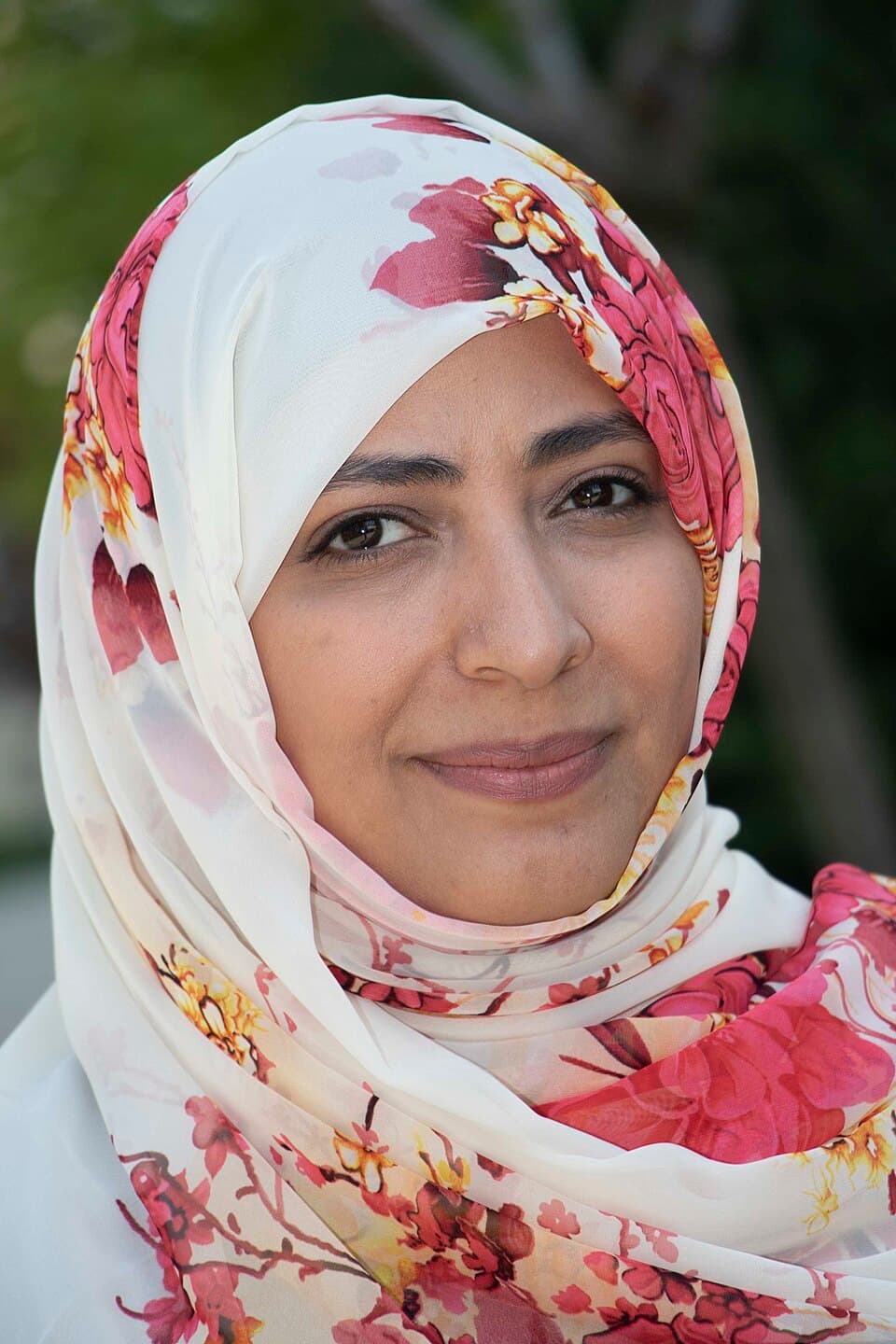
Yemeni · Politics · Activism
Tawakkol Karman
February 7, 1979 – present
Early life and education
Tawakkol Karman was born on 7 February 1979 in Taʿizz, Yemen. She grew up in a country marked by political repression, limited public space for women, and recurring conflict over the future of the Yemeni state. These conditions helped shape her later commitment to civic activism, journalism, and democratic reform. Sources consistently identify her as Yemeni and note that she would later become one of the most recognizable political activists in the Arab world.
Karman studied at the University of Science and Technology in Sana’a, where she earned an undergraduate degree in commerce, and later completed a master’s degree in political science at Sana’a University. Her education combined practical and political training and helped prepare her for work that moved between journalism, organizing, and public advocacy. Biographical sources also describe her as a journalist, a human-rights activist, and a politician, reflecting the overlap of these roles in her public career.
Her early life is often discussed in relation to the social barriers she confronted as a woman in Yemen. In a conservative environment where women’s political leadership was frequently discouraged or dismissed, Karman’s emergence as a public figure was itself significant. Her later activism would consistently challenge that order by insisting that women had a central role in freedom of expression, democratic reform, and peace-building.
Career beginnings and activism
By the early 2000s, Karman had become involved in grassroots activism as a university student and then went on to found Women Journalists Without Chains, a group dedicated to press freedom and human rights. The organization became one of the most visible vehicles for her work, defending writers and photographers while also supporting women entering journalism. It reflected a broader strategy that linked women’s empowerment with civil liberties rather than treating them as separate causes.
Karman’s public activism developed under intense pressure. Biographical sources note that she was imprisoned or otherwise persecuted on account of her activism, and that she repeatedly protested authoritarian practices in Yemen. Her work was not limited to women’s rights in a narrow sense; it included freedom of expression, democratic participation, and opposition to corruption and political violence. This broader agenda helped make her an important figure in Yemen’s civil society and later in the Arab Spring.
She also became associated with the political and moral language of peaceful protest. The titles later given to her by supporters — including “The Mother of the Revolution”, “the Iron Woman”, and “Lady of the Arab Spring” — captured the mix of perseverance and symbolic authority that defined her public image. These titles mattered because they marked a woman who had become a face of nonviolent opposition in a region where public dissent could be dangerous, especially for women.
Arab Spring leadership
In 2011, Karman came to international prominence during Yemen’s uprising against President Ali Abdullah Saleh. On 15 February 2011, she helped lead one of the early major demonstrations in Sana’a, contributing to the momentum of the Arab Spring in Yemen. Her role in these protests was significant because it linked street mobilization, media visibility, and the demand for democratic change.
Her leadership was especially notable because it foregrounded women’s participation in a political movement often narrated through male leaders alone. Karman helped present the uprising as a civic and moral struggle rather than simply a contest for power. She called for democracy, freedom of speech, and peaceful change, and her visibility made her one of the best-known women activists in the Arab Spring. For many observers, her prominence challenged assumptions about women’s political roles in Yemen and the wider Arab world.
Her activism during this period also demonstrated the costs of dissent. She faced state hostility, detention, and repeated attempts to silence her work. Those pressures only amplified her symbolic importance. In a region where women’s public leadership was often circumscribed by law, custom, or intimidation, Karman’s continued presence in the streets and in the media became an emblem of persistence and courage.
Nobel Peace Prize and international recognition
On 7 October 2011, the Norwegian Nobel Committee announced that Karman would share the Nobel Peace Prize with Ellen Johnson Sirleaf and Leymah Gbowee. The committee honored their nonviolent struggle for the safety of women and for women’s rights to full participation in peace-building work. The award placed Karman in a global lineage of peace activists while also redefining peace-building as a field in which women’s organizing mattered at the highest level.
The award carried several historic firsts. Karman became the first Yemeni and the first Arab woman to win the Nobel Peace Prize, and she was also the second Muslim woman to receive it. At age 32, she was the youngest Peace laureate at the time. These distinctions gave the award symbolic power far beyond individual recognition: they signaled that activism emerging from Yemen and led by a woman could reshape global understandings of peace, civil resistance, and leadership.
She formally received the prize on 10 December 2011 in Oslo City Hall and delivered her Nobel lecture. That ceremony confirmed her place among the most prominent human-rights figures of her generation. It also underscored the international resonance of Yemeni democratic protest during a year when the Arab Spring was transforming political discussion across the Middle East and North Africa.
Public role after the Nobel Prize
After the Nobel Prize, Karman remained a public voice for democracy, women’s rights, and civil liberties. Institutional biographies describe her as founder and president of Women Journalists Without Chains and as the founder of the Peaceful Youth Revolution Council. She also became associated with the Tawakkol Karman International Foundation, which continued to extend her public mission beyond Yemen.
Her recognition by international bodies, human-rights organizations, and academic institutions reflects the breadth of her influence. She has been profiled by the Nobel Prize, Britannica, the Nobel Women’s Initiative, the Council on Foreign Relations, and other institutions that emphasize her role in nonviolent struggle and women’s participation in political life. These profiles portray her as a representative figure for civic activism in the Arab world, not simply as a national activist.
Karman’s work also became part of broader discussions about how women’s leadership changes the history of protest movements. Her example showed that women could shape the strategic, symbolic, and organizational dimensions of mass mobilization. In that sense, her significance lies not only in the prizes she won, but in the way she expanded the public image of who can lead democratic movements.
Personal life
Biographical sources describe Karman as a mother of four. Public sources do not provide a detailed, consistently documented account of her private family life, and editorial biographies generally emphasize her public activism over personal relationships. That pattern is common in the historical record of women activists whose political lives are much more fully documented than their domestic lives.
Even so, the fact that she is a mother has often been mentioned in profiles because it adds another layer to her public identity in a conservative social context: she became internationally known while also navigating the expectations attached to womanhood, family, and public leadership. The record available in standard biographical sources does not support adding more detail beyond those basics.
Legacy and historical impact
Tawakkol Karman’s historical importance rests on several interconnected achievements. She became a leading face of the Yemeni and Arab Spring pro-democracy movements; she founded and led an organization devoted to press freedom; and she transformed women’s participation in protest into a globally recognized form of political leadership. Her Nobel Prize consolidated that significance, making her a symbol of nonviolent resistance and of the political power of women in the Arab world.
Her legacy is especially important in the history of women’s activism. Karman challenged the assumption that women’s public roles should be secondary, and she did so in a setting where the risks were heightened by authoritarian rule and social conservatism. Her success helped broaden international understanding of democratic struggle in Yemen, linking freedom of speech, women’s rights, and nonviolent protest into a single political vision. For that reason, she remains one of the most consequential women political activists of the twenty-first century.
Dated achievements
5 indexed.
- Feb071979Activism
Birth of Tawakkol Karman
Tawakkol Karman was born in Ta’izz, Yemen, later becoming a journalist, human rights activist, and Nobel laureate.
View details Nobel Prize Facts on Tawakkol Karman - Feb152011Activism
Leads early Arab Spring demonstration in Yemen
Tawakkol Karman led a major demonstration in Sana’a against Yemeni president Ali Abdullah Saleh during the Arab Spring.