← All women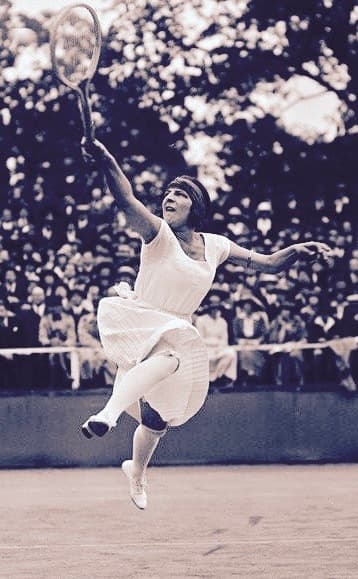
French · Sports
Suzanne Lenglen
May 24, 1899 – July 4, 1938
Early Life and Background
Suzanne Rachel Flore Lenglen was born on 24 May 1899 in Paris, France, into a middle‑class family that would play an active role in shaping her sporting career.[1][2][8] Some biographical sources, including certain encyclopedic entries, list Compiègne as her birthplace, but leading tennis and general references such as the main English and French Wikipedias and Britannica identify Paris as the location of her birth.[1][2][8][10][12] She grew up during the Belle Époque, a period of cultural vibrancy that was soon disrupted by World War I.
Lenglen’s father, Charles Lenglen, was central to her development as an athlete. Concerned about her fragile health in childhood, he encouraged her to take up tennis to build strength and stamina.[2][11][17] At a time when physical exertion for girls was often limited to genteel exercise, his decision to push her into rigorous competition was unconventional. He coached her intensively, emphasizing attacking play, footwork, and mental toughness, and he was known to be demanding and sometimes domineering, shaping both her style and temperament.[2][12][17]
She began playing tennis at a young age on courts near her home and quickly showed exceptional talent. Early successes in junior and local events confirmed her potential, and her father’s ambitions for her expanded accordingly.[2][12] Formal schooling details are sparsely documented, as contemporary accounts focus mainly on her sporting life, but it is clear that tennis became the organizing center of her adolescence. By her early teens, she was already recognized in French tennis circles as a prodigy with unusual flair and athleticism.[11][17]
Career Beginnings and Development
Lenglen’s competitive breakthrough came in her early teens. In 1913, she won her first adult tennis titles in regional French events, marking the start of her rise in serious competition, though the exact dates of these tournaments are not consistently recorded.[17] The following year, she reached the final of the French Championships for the first time, losing to Marguerite Broquedis, an important milestone in her domestic career.[3][15][17] These early achievements demonstrated her ability to compete with established adult players while still a schoolgirl.
Her true international emergence occurred in 1914. That year she both played in the French Championships final and, more importantly, won the World Hard Court Championships singles title in Paris, defeating Germaine Golding. On 13 June 1914, she secured the women’s singles crown 6–3, 6–2, becoming the youngest person ever to win a major tennis championship.[1][11][17] This clay‑court tournament was considered one of the era’s most significant events, and her victory at age 15 established her as a rising star in European tennis.[4][11]
The outbreak of World War I soon halted international competition. From 1914 to 1918, many tournaments were suspended, and players’ careers were interrupted. Lenglen continued to train and compete domestically when possible, but her full international debut was delayed until the postwar period.[11] The war years nonetheless allowed her to mature physically and technically under her father’s close supervision.
After the war, Lenglen’s ascent was rapid. In 1919, she began an extraordinary run of dominance, winning nine of ten singles events she entered and starting a streak that would see her collect an estimated 269 of 270 titles between 1919 and 1926, according to later compilations.[4][14][16] On 5 July 1919, she made her debut at Wimbledon, defeating Dorothea Lambert Chambers in a dramatic three‑set final—10–8, 4–6, 9–7—to claim her first ladies’ singles title.[1][2][11] The match, pitting a youthful French challenger against an established British champion, symbolized postwar generational and international change in the sport.
Postwar Dominance and Major Accomplishments
From 1919 to 1926, Suzanne Lenglen dominated women’s tennis to a degree rarely seen before or since. She became the sport’s inaugural women’s world No. 1, a status recognized in retrospective rankings from 1921 through 1926.[1][16] During this period she won six Wimbledon singles titles (1919–1923, 1925) and numerous doubles and mixed doubles crowns, as well as multiple French Championships titles on clay.[1][2][10][16]
Lenglen’s game was built around aggressive baseline and net play, superb footwork, and precise shot placement. Observers noted her ability to convert defense into attack instantly, using sharp angles and drop shots to control opponents.[2][12] Her athleticism contrasted with the more restrained style typical of many women’s matches of the time, and she helped redefine expectations about how women could move and compete on court.
On 23 August 1920, at the Antwerp Olympic Games, Lenglen captured the women’s singles gold medal, losing only four games in the entire tournament.[1][2][11] The next day, 24 August 1920, she added the mixed doubles gold medal with partner Max Décugis, completing a rare Olympic double.[1][11][12] These victories established her as the leading woman player in the world and elevated the profile of women’s tennis within the Olympic movement.
Lenglen also continued to excel in non‑Olympic championships. She won multiple World Hard Court Championships titles, confirming her clay‑court strength, and added further French Championships and Wimbledon victories through the early 1920s.[1][2][16] In 1921, she secured her second World Hard Court Championships singles title and additional doubles and mixed titles, consolidating her status as the premier clay‑court player, though individual match dates are not consistently recorded.[2][4]
At Wimbledon, she won her third singles title in 1921, defeating Elizabeth Ryan 6–2, 6–0, and continued her streak with additional titles in 1922 and 1923, though precise final dates are less clearly documented in accessible sources.[1][2][6] Her run of five consecutive Wimbledon singles crowns from 1919 to 1923 remains one of the most dominant stretches in women’s tennis.[1][16]
On 8 July 1922, Lenglen achieved what contemporaries termed the “triple crown” at Wimbledon, winning the ladies’ singles, women’s doubles, and mixed doubles titles in the same Championships.[1][6][16] This feat demonstrated her versatility and endurance across multiple disciplines and helped cement her image as the era’s supreme all‑round player.
Her success extended to the French Championships. She captured the women’s singles title multiple times, with wins recorded between 1920 and 1923 and again in the mid‑1920s.[1][2][10] On 6 June 1925, she defeated Kitty McKane 6–1, 6–2 to win the first international French Championships women’s singles title, in the inaugural year the event was open to international competitors.[1][2][16] This victory is widely regarded as a genuine first in modern tennis history, marking the transformation of the French Championships into a major global tournament.
Lenglen’s final major amateur triumph came on 5 June 1926, when she defeated Mary Browne 6–1, 6–0 to win another French Championships singles crown in Paris.[1][2][16] This emphatic victory, in which she conceded only a single game, would be her last major championship before turning professional.
Style, Fashion, and Cultural Impact
Beyond scores and titles, Suzanne Lenglen profoundly influenced the culture of tennis and women’s sport. She was known for abandoning traditional restrictive tennis attire, including corsets and long skirts, in favor of shorter, sleeveless dresses designed by Jean Patou and others.[2][4][11] This clothing allowed greater freedom of movement and became symbolic of the broader 1920s shift toward modern fashion and female autonomy.
Her on‑court persona combined intense competitiveness with theatrical flair. She was famous for expressive gestures, dramatic entrances, and a willingness to show emotion during matches.[4][11] Contemporary journalists in France dubbed her La Divine—“the divine one”—reflecting both admiration and fascination with her celebrity status.[3][6][8]
Lenglen’s dominance and charisma made her one of the first global sporting celebrities. She attracted coverage not only in sports pages but also in society columns, with public interest extending to her travel, fashion, and social life.[4][11][14] In an era when few women athletes achieved international recognition, her visibility challenged conventional gender roles and demonstrated that women’s sport could captivate mass audiences.
Her influence reached educational and instructional spheres as well. In the mid‑1920s, she published the book "How I Play Tennis", which offered guidance on technique and strategy and helped shape perceptions of modern tennis play, though the exact publication date is not uniformly documented.[20] She also appeared in an instructional film, Tennis and How to Play It, released in 1922, further disseminating her approach to the game.[17]
Professional Transition and Later Playing Career
By the mid‑1920s, tensions were mounting between Lenglen and tennis authorities over scheduling, expectations, and amateurism. She occasionally clashed with organizers, withdrew from events due to illness or disputes, and faced intense media scrutiny.[2][4] Meanwhile, the commercial potential of her fame attracted promoters interested in professional exhibitions.
On 16 February 1926, Lenglen met rising American player Helen Wills in Cannes in the highly publicized “Match of the Century”, winning 6–3, 8–6.[1][4] The exhibition was framed as an unofficial world championship contest and drew unprecedented attention to women’s tennis, highlighting both Lenglen’s continuing supremacy and Wills’s emergence as a future champion.
Later that year, she took a decisive step that would reshape tennis economics. On 9 August 1926, she signed a contract and embarked on a professional tour in North America organized by promoter Charles C. Pyle, becoming the first major female tennis star to turn professional and undertake a large‑scale paid exhibition circuit.[1][6][13] This tour, staged in major U.S. cities, offered guaranteed payments and shared gate receipts, breaking with the strict amateur ethos of the time.
Her professional status meant she could no longer compete in official amateur events such as Wimbledon or the French Championships. Instead, she played exhibition matches before large crowds, often against notable opponents, demonstrating that women’s tennis could succeed as a commercial entertainment product.[1][6][4] Although the tour was relatively brief and demanding, it set an important precedent for later professionalization in the sport.
Awards, Honors, and Recognition
During her career, Lenglen accumulated an extraordinary record of titles. Estimates from retrospective studies credit her with 241 tournament victories, including eight major singles titles at the Slam events of her time (six Wimbledons and two French Championships) and numerous doubles and mixed doubles trophies.[1][6][16][18] Between 1919 and 1926, she won 25 Grand Slam titles in singles, doubles, and mixed doubles, depending on the counting of events and formats.[9][10]
Her match record is similarly remarkable. Some compilations report a streak of 181 consecutive wins and an overall record of approximately 341–7, corresponding to a winning percentage near 98 percent.[6][8] These figures, while reconstructed from historical sources, emphasize how rarely she lost during her prime.
Lenglen’s contributions have been formally recognized in institutional honors. She was inducted into the International Tennis Hall of Fame, which lists her birth and death dates and summarizes her major titles and Olympic successes.[5] In Paris, the second show court at Roland Garros was named Court Suzanne‑Lenglen, ensuring that her legacy is visible at one of the sport’s most prominent venues.[8][16]
Personal Life
Details of Suzanne Lenglen’s personal life are less extensively documented than her on‑court achievements, reflecting both the norms of the era and the focus of contemporary reporting on her athletic celebrity. Sources indicate that she lived much of her adult life in and around Paris and the French Riviera, traveling frequently for tournaments and exhibitions.[2][4]
She was portrayed in the press as a fashionable figure, often photographed in elegant dresses and social settings, and associated with high society circles that overlapped with the cultural milieu of the 1920s.[4][11] Her relationship with her father Charles remained influential well into her career, with some accounts noting both his motivational role and the pressures he placed on her performance.[2][12][17]
Information about marriages, long‑term partnerships, and children is fragmentary in mainstream biographical sources, which tend to focus instead on her competitive life and public image. Encyclopedic entries and major tennis histories do not present clear evidence of a publicly recognized marriage or family life that played a central role in her career narrative.[1][2][12] As a result, the historical record emphasizes her identity as an athlete and celebrity more than as a domestic figure.
Legacy and Historical Impact
Suzanne Lenglen’s legacy extends far beyond her trophy count. She is widely regarded as tennis’s first global female superstar and one of the earliest women in any sport to achieve international celebrity status.[4][6][14] Her dominance on court, combined with her style, fashion, and media presence, transformed public perceptions of women’s athletic potential.
On the technical side, her aggressive all‑court game foreshadowed later developments in women’s tennis, where speed, power, and varied shot‑making became standard at the highest levels.[2][12] Many historians credit her with helping to shift the game away from purely defensive baseline exchanges toward more dynamic, attacking play.[11]
Culturally, Lenglen’s choices in dress and demeanor challenged restrictive ideas about femininity and sport. Her short, sleeveless dresses and absence of a corset allowed her to move freely and symbolized a broader liberation in women’s fashion during the 1920s.[2][4][11] She demonstrated that a woman could be simultaneously glamorous and athletically formidable, influencing how later stars—from mid‑century champions to modern Grand Slam winners—would navigate the intersection of style and performance.
Institutionally, her victory in the 1925 international French Championships helped consolidate the tournament’s status as a major global event and laid the groundwork for the modern Roland Garros as part of the Grand Slam.[1][2][16] Her professional tour in 1926 anticipated the later Open Era and the broader acceptance of professional tennis as a legitimate career path for both men and women.[1][6]
Her influence has been memorialized in various ways. Court Suzanne‑Lenglen at Roland Garros, her induction into the International Tennis Hall of Fame, and frequent references in tennis histories and cultural analyses attest to her enduring significance.[5][8][4] Contemporary articles continue to describe her as the world’s first global sporting celebrity, underscoring her role in the history of sports media and marketing.[4]
Later Life and Death
After her professional tour and the conclusion of her competitive career, Lenglen remained associated with tennis through coaching, exhibitions, and occasional public appearances, though she no longer competed in major amateur championships.[2][12] She continued to live in France, and her name retained prestige among fans and young players.
In June 1938, Lenglen was diagnosed with leukemia, and her health deteriorated rapidly.[17] On 4 July 1938, she died in Paris at the age of 39, reportedly from pernicious anemia and leukemia.[1][2][16][17] Her early death shocked the sporting world, as contemporary accounts recalled her once formidable physical vitality and relatively recent prominence.
Following her death, tributes highlighted her extraordinary record—multiple Wimbledon and French Championships titles, Olympic gold medals, and an astonishing winning percentage—as well as her broader influence on women’s tennis and fashion.[1][2][6][18] Over time, her career has come to be seen as a foundational chapter in the history of women’s sports, illustrating how a single athlete can reshape both a discipline and cultural attitudes toward female athleticism.
Today, Suzanne Lenglen is remembered not only for her numbers—titles, streaks, and records—but for the way she played and lived: with daring, charisma, and a determination to transcend the limitations placed on women of her era. Her story continues to inspire scholars, fans, and athletes interested in the evolution of women’s roles in competitive sport and public life.[4][11][16]
Dated achievements
11 indexed.
- May241899Sports
Birth of Suzanne Lenglen
Suzanne Lenglen was born on May 24, 1899, in Paris, France.
View details Suzanne Lenglen Biography - Britannica - Jun131914Sports
Wins World Hard Court Championships at 15
Won the World Hard Court Championships singles title, becoming the youngest ever major champion.