← All women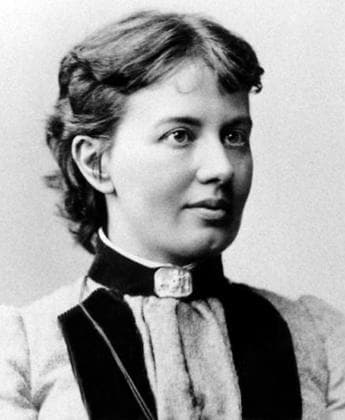
Russian · Science
Sofia Kovalevskaya
January 15, 1850 – February 10, 1891
Early Life and Background
Sofya (Sofia) Vasilyevna Kovalevskaya, born Korvin‑Krukovskaya, entered the world on 15 January 1850 in Moscow, in the Russian Empire.[3][4] She came from an aristocratic family: her father, Vasily Korvin‑Krukovsky, was a general in the artillery, and her mother, Yelizaveta Fedorovna Shubert, descended from a line of academics and intellectuals.[4][8] Growing up on the family estate, Sofya and her siblings were initially educated at home, in line with the norms for upper‑class girls, where emphasis was placed on languages, music, and social accomplishments rather than advanced science.
Despite this, she developed an early fascination with mathematics. A famous anecdote, reported in multiple biographies, recounts that part of the nursery was papered with pages from a calculus text, due to a shortage of wallpaper.[1][4] The formulas intrigued the young girl and served as an unconventional introduction to mathematical symbolism. Private tutors later encouraged her talent, though formal advanced instruction was difficult to obtain, as Russian universities did not admit women.
The social and political context of mid‑19th‑century Russia profoundly shaped her trajectory. Intellectual circles were debating serfdom, women’s rights, and the modernization of education, yet legal and cultural barriers remained severe for women seeking higher learning.[1][4] As Kovalevskaya matured, she became increasingly determined to pursue scientific study and align herself with radical circles advocating expanded opportunities for women.
Fictitious Marriage and Study Abroad
By the late 1860s, Sofya recognized that serious study in mathematics required access to European universities. However, unmarried Russian women were generally not permitted to travel abroad independently. In 1869, she entered into a so‑called “fictitious marriage” with the young paleontologist and socialist Vladimir Kovalevsky, a union intended to circumvent travel restrictions and enable her to study abroad.[4][1] The marriage later became a genuine but complex relationship, intertwining shared intellectual ambitions with personal and financial strains.
After leaving Russia, Kovalevskaya sought admission to universities in Western Europe. In 1870, she moved to Berlin, hoping to study under leading mathematicians.[4] The University of Berlin refused to enroll her because of her gender, reflecting widespread exclusion of women from formal higher education. Nevertheless, the eminent analyst Karl Weierstrass agreed to teach her privately and quickly recognized her exceptional ability.[4][2]
Under Weierstrass’s mentorship, Kovalevskaya undertook intensive study in analysis and differential equations. Because she could not matriculate, he arranged for her work to be evaluated by another institution—the University of Göttingen—where faculty were more open to exceptional cases. This arrangement would eventually lead to her landmark doctorate.
Doctorate and Early Research
By 1874, Kovalevskaya had completed three substantial research papers that Weierstrass deemed collectively sufficient for a doctoral degree.[4][2] The most famous of these treated the existence and uniqueness of solutions to certain classes of partial differential equations with given initial conditions, work that would become known as the Cauchy–Kovalevskaya theorem.[2][3] Another paper focused on the theory of elliptic integrals, and a third addressed the dynamics of Saturn’s rings.[4]
On 24 January 1874, the philosophical faculty of the University of Göttingen formally approved her dissertation and decided to confer the doctorate in mathematics in absentia.[4] She thus became the first woman in the modern era to obtain a doctorate in mathematics, and one of the first women anywhere to receive a doctoral degree in a scientific field.[3][2] The degree recognized her papers as meeting the highest contemporary standards and signaled that her work stood shoulder‑to‑shoulder with that of leading male mathematicians.
Despite this success, institutional positions remained elusive. Returning to Russia, she hoped to secure a university post, but her applications were rejected. Prevailing opinion held that a woman could not appropriately teach university students, regardless of her credentials.[1][3] She turned to writing and journalism, producing popular science essays and literary works to support herself and maintain an intellectual presence.
Career Development and Move to Sweden
In subsequent years, Kovalevskaya’s life in Russia and Western Europe was marked by financial difficulties and personal challenges, including the eventual suicide of her husband Vladimir in 1883.[4][1] During the 1880s, she began to build ties with Scandinavian mathematical circles, thanks in large part to Gösta Mittag‑Leffler, a Swedish mathematician and founder of the journal Acta Mathematica.
In 1880, she delivered a series of mathematics lectures at the University of Stockholm.[4] These lectures demonstrated both her teaching skill and her ability to communicate advanced topics to students, helping to persuade local authorities that she could succeed in a formal academic role. Her reputation as a researcher was also growing, supported by publications and correspondence with leading mathematicians.
Mittag‑Leffler became a crucial ally. He advocated for her appointment despite skepticism within the Swedish academic establishment. At his urging, in 1884 she moved to Stockholm to accept a five‑year position as an extraordinary professor of mathematics at Stockholm University.[14][4] This role, beginning in early June 1884, gave her a stable institutional base for teaching and research and represented one of the first long‑term university posts in mathematics held by a woman in Europe.[3][14]
Acta Mathematica and Editorial Work
In the same year, 1884, Kovalevskaya expanded her influence beyond the classroom by joining the editorial board of Acta Mathematica, the journal Mittag‑Leffler had founded to promote high‑level mathematical research.[4][2] She is widely regarded as the first woman to serve on the editorial board of a major scientific journal.[3][2]
As an editor, she evaluated submissions, corresponded with authors, and helped shape the journal’s scientific agenda. Acta Mathematica became a leading outlet for European mathematics, publishing work by figures such as Poincaré and Cantor. Kovalevskaya’s participation signaled that women could not only contribute research but also participate in the governance and quality control of science.
This editorial position carried symbolic weight in women’s history. Editorial boards were powerful gatekeeping bodies, and women’s absence from them reinforced structural inequality. Kovalevskaya’s role challenged assumptions about who was qualified to judge and disseminate cutting‑edge mathematical work, thereby expanding the concept of scientific authority.
Major Works and the Kovalevskaya Top
Kovalevskaya’s most celebrated later work emerged in the mid‑1880s, when she turned to problems in mechanics and the motion of rigid bodies. Building on classical work by Euler and Lagrange, she investigated conditions under which the rotation of a rigid body about a fixed point in a gravitational field could be integrated explicitly.
Her memoir on this topic, completed in 1886, identified a special case in which the equations of motion are integrable, now known as the Kovalevskaya top.[4] On 11 January 1886, the French Academy of Sciences awarded her the Prix Bordin for this work.[4][3] The Academy doubled the prize’s value in recognition of the exceptional quality of her solution. This achievement established her as a leading figure in the theory of rigid body dynamics and confirmed that her expertise extended beyond analysis into mathematical physics.
The Kovalevskaya top is historically significant because it constitutes one of only three known classical integrable cases of rigid body motion under gravity. Her methods influenced later developments in dynamical systems and the qualitative theory of differential equations. Combined with her earlier work on partial differential equations, these results secured her place in the canon of 19th‑century mathematical innovation.[2][4]
Awards, Honors, and Recognition
Recognition of Kovalevskaya’s work grew steadily during the 1880s. In addition to the Prix Bordin, she achieved notable institutional honors. On 3 December 1888, she was elected a corresponding member of the Russian Imperial Academy of Sciences, becoming the first woman to receive this status.[5][4] The Academy reportedly had to alter its statutes to permit her election, as its rules had not anticipated female members.
This honor represented a belated acknowledgment by Russian official science of a scholar who had long worked abroad. It also provided a key precedent for the inclusion of women in scientific academies, which were conservative institutions central to the validation and funding of research.
In 1889, after years as an extraordinary professor, Kovalevskaya was promoted to a full, lifetime professorship in mathematics at Stockholm University.[14][4] She thus became the first woman in modern Europe to hold a full professorship in mathematics, and the first woman in Northern Europe to occupy such a chair.[2][3][13] This promotion solidified her institutional status and was widely reported across Europe.
Later that year, she received the Oscar Prize of the Swedish Academy of Sciences for further work on rigid body rotation.[4] The prize, one of Sweden’s highest scientific distinctions, reinforced her standing as a leading mathematician within both national and international communities.
Literary Work and Advocacy
Alongside mathematics, Kovalevskaya cultivated a significant literary career. She wrote essays, memoirs, and fiction that explored social issues, personal relationships, and the challenges facing women intellectuals. Her novel “Nihilist Girl” and her autobiographical work “A Russian Childhood” reflect her engagement with radical politics and feminist questions.[1][2]
Her writing connected her to broader networks of European intellectuals, including novelists and social critics who debated the role of women in public life. She used her experiences—such as the fictitious marriage, exclusion from universities, and battles for recognition—to illustrate the structural obstacles confronting women. In this sense, she was not only a mathematician but also a public intellectual advocating for women’s rights and educational reform.[1]
Kovalevskaya’s dual identity as scientist and writer enhanced her impact. It enabled her to reach audiences beyond the mathematical community and to articulate the significance of women’s participation in intellectual life in accessible, narrative form.
Personal Life
Kovalevskaya’s personal life was intertwined with her intellectual pursuits but marked by considerable hardship. Her marriage to Vladimir Kovalevsky, initially arranged to secure travel abroad, evolved into a committed relationship. The couple had one daughter, Sofia (Fufa), born in the 1870s.[4] Financial instability, business ventures gone wrong, and Vladimir’s mental health struggles, however, strained the marriage.
Vladimir’s suicide in 1883 deeply affected Sofia, adding emotional burden to the challenges she already faced as a woman seeking academic recognition. She continued to support her daughter and maintain her career, drawing on networks of friends and colleagues, particularly in Sweden and Russia.
Her friendships with figures such as Gösta Mittag‑Leffler and various women writers provided intellectual companionship and practical support. Letters from this period reveal a complex personality—ambitious and intellectually rigorous, yet sensitive and sometimes vulnerable to self‑doubt. These relationships, along with her role as a mother, shaped her daily life amid the demands of research and teaching.
Legacy and Historical Impact
Sofia Kovalevskaya is remembered today as a pioneering mathematician and as a central figure in the history of women in science. Her contributions to analysis, particularly the Cauchy–Kovalevskaya theorem, helped clarify conditions under which solutions to partial differential equations exist and are unique.[2][3] Her work on the Kovalevskaya top enriched classical mechanics and remains a reference point in studies of integrable systems.[4]
Equally important is her institutional impact. She was the first woman in modern Europe to obtain a doctorate in mathematics, the first woman to join the editorial board of a major scientific journal, and the first woman in Northern Europe to hold a full professorship in mathematics.[2][3][13] Her election as a corresponding member of the Russian Imperial Academy of Sciences further expanded the boundaries of women’s participation in elite scientific institutions.[5][12]
For women’s history, Kovalevskaya’s life illustrates both the obstacles and possibilities confronting women who sought scientific careers in the 19th century. She navigated restrictive laws by entering a fictitious marriage, circumvented university rules by studying privately, and relied on supportive male mentors to access formal credentials. At the same time, her achievements demonstrate that these structures, while formidable, were not unbreakable.
Her legacy has been commemorated in numerous ways. Mathematical societies and universities host Sonia Kovalevsky Days, outreach events aimed at encouraging girls to pursue mathematics and science.[9] Biographies, scholarly articles, and educational resources continue to highlight her story as an example of perseverance, intellectual brilliance, and advocacy for women’s rights.[1][8]
Later Life and Death
In her final years, Kovalevskaya continued to teach at Stockholm and produce research, while also traveling in Europe for lectures and personal reasons. She experienced bouts of ill health but remained committed to her work. In early 1891, after a trip to Italy, she returned to Stockholm suffering from a serious illness diagnosed as pneumonia or influenza.[4][9]
On 10 February 1891, she died in Stockholm at the age of forty‑one.[3][4][2] Her early death shocked colleagues and students, many of whom believed that she stood on the threshold of further major contributions. Obituaries emphasized her scientific accomplishments, her role as a trailblazer for women, and her complex, passionate personality.
Although her life was relatively short, its impact has been long‑lasting. Subsequent generations of women mathematicians, including those who entered universities in the early 20th century, often cited her example as inspiration. Modern scholarship situates her among the most important mathematicians of her time and among the most influential women in the history of science.
Today, Sofia Kovalevskaya’s name is associated not only with theorems and mechanical systems, but also with the broader struggle for women’s inclusion in higher education and research. Her biography continues to serve as a powerful narrative in both mathematical and feminist historiography, underscoring how intellectual excellence can challenge and eventually transform entrenched social barriers.
Dated achievements
9 indexed.
- Jan151850Science
Birth of Sofia Kovalevskaya in Moscow
Sofya Vasilyevna Kovalevskaya was born in Moscow, later becoming a pioneering mathematician.
View details Sofia Kovalevskaya - Encyclopedia Britannica - Jan241874Science
Doctorate in mathematics awarded to Sofia Kovalevskaya
Sofia became the first woman to be awarded a doctorate in mathematics.