← All women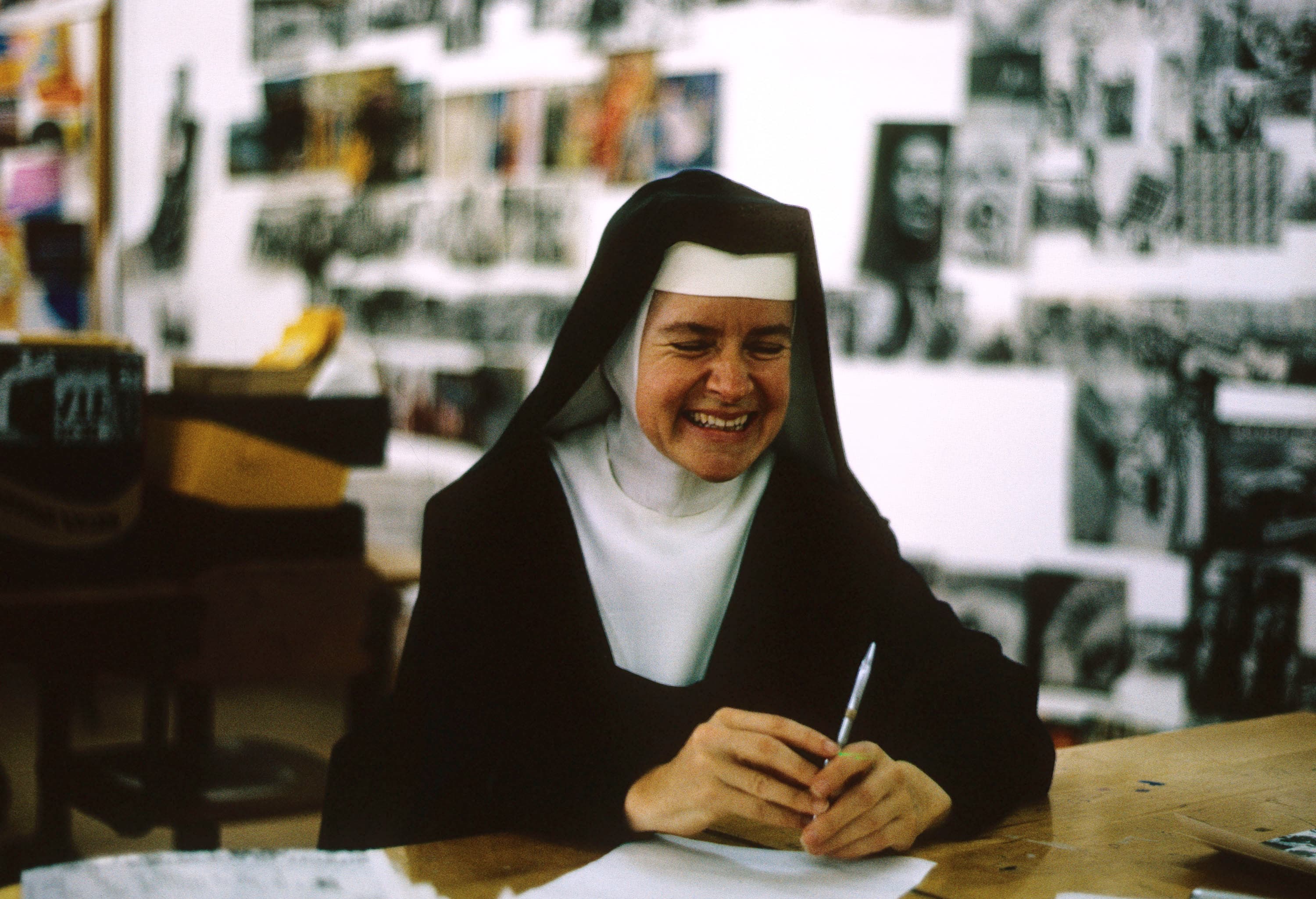
American · Arts · Activism
Sister Corita Kent
November 20, 1918 – September 18, 1986
Early Life and Background
Frances Elizabeth Kent, later known as Sister Corita Kent and simply Corita Kent, was born on 20 November 1918 in Fort Dodge, Iowa.[2][1] She was the fifth of six children in a devout Catholic family.[4][10] When she was still a young child, her family relocated to Los Angeles, California, where she grew up in the rapidly expanding urban landscape of Hollywood and greater Los Angeles.[4][10] This move exposed her to the emerging visual culture of billboards, film, and advertising that would later become central to her art.
Kent attended Catholic schools in Los Angeles, including Los Angeles Catholic Girls’ High School, where she was formed by both traditional religious education and the cultural dynamism of Southern California.[4][10] Her early experiences of Catholic devotional imagery, liturgy, and community life gave her a strong spiritual grounding, while the everyday sights of grocery stores, gas stations, and commercial signage fostered a fascination with the visual language of mass culture.
In 1936, at age 18, she made a decisive choice that would shape the next three decades of her life: she entered the Sisters of the Immaculate Heart of Mary, a teaching order based in Hollywood, and took the religious name Sister Mary Corita.[3][5][10] Joining the order allowed her to pursue higher education and art in a context that was unusual for women at the time, particularly for those of modest means.[10][12] The community’s emphasis on education and the arts provided a supportive environment for her emerging vocation as an artist and educator.
Education and Formation
As a young sister, Corita both studied and taught. She enrolled at Immaculate Heart College (IHC) in Los Angeles, where she studied art and began to develop her skills in printmaking and teaching.[10][12] The college was known for its progressive, intellectually engaged faculty and for encouraging women to pursue professional and creative careers.
While teaching at IHC, Corita continued her own education. She completed a master’s degree in art history at the University of Southern California (USC) in 1951, deepening her understanding of historical and contemporary art movements.[3][11][12] Her academic work at USC provided a foundation for her later pedagogical approach, which linked formal analysis, contemporary culture, and moral questions.
During the 1950s, she developed expertise in serigraphy (screenprinting), a medium that allowed her to produce bold, layered images with vivid color. She studied printmaking techniques and explored how text and image could be combined in ways that were both visually striking and conceptually rich.[1][2] Her early prints often used explicitly religious imagery—Madonnas, sacred hearts, and scriptural citations—reflecting her life within a Catholic community.
Career Beginnings at Immaculate Heart College
By the late 1940s, Corita had begun teaching art at Immaculate Heart College, where she would remain for roughly three decades.[1][10] IHC’s art department became a laboratory for her experiments in pedagogy and design. She encouraged students to mine everyday life for visual inspiration, telling them to look at supermarket shelves, street signs, and product packaging as "found" art and potential sources of theological reflection.[10][12]
In the classroom, Corita emphasized creativity, critical thinking, and social awareness. Her assignments often asked students to respond to contemporary events—such as civil rights struggles or debates over nuclear weapons—through visual media. The college environment, especially in the post–World War II years, supported this engagement, as many faculty were involved in peace and justice movements and open to new approaches in theology and art.
Immaculate Heart College’s art department gradually gained a reputation for innovation. Students and visitors were struck by the unconventional materials, vibrant colors, and socially conscious themes emerging from Corita’s studio and classes.[1][7] This campus milieu helped nurture a generation of artists and art educators who saw graphic design and printmaking as tools for spiritual and political communication.
Embrace of Pop Art and Social Justice Themes
A key turning point in Corita’s artistic development came in the early 1960s. In the summer of 1962, she visited the Ferus Gallery in Los Angeles and saw Andy Warhol’s "Campbell’s Soup Cans".[11][4] The encounter with Warhol’s use of banal commercial imagery as high art profoundly influenced her. She began to incorporate brand logos, advertisements, and consumer packaging into her own work, seeing them as modern icons whose meanings could be reimagined.
Throughout the 1960s, Corita’s serigraphs evolved from primarily religious imagery to compositions that fused corporate logos, biblical verses, popular song lyrics, poetry, and headlines.[1][2][11] Works referencing General Mills cereal, Wonder Bread, gasoline brands, and supermarket slogans juxtaposed texts from the Bible, E. E. Cummings, and other writers.[12] This blending created an intersection between religious euphoria and advertising hyperbole, inviting viewers to find grace and critique in everyday consumer culture.[11]
At the same time, her work grew increasingly political. She addressed issues such as racism, poverty, nuclear proliferation, and the Vietnam War.[1][6][10] Her prints often included quotations from civil rights leaders, peace activists, and contemporary theologians. For Corita, art was a vehicle for conscience: she believed that visual messages could encourage viewers to consider their complicity in injustice and to imagine alternative futures grounded in love and solidarity.
Director of the Immaculate Heart College Art Department
In 1964, Corita was appointed director (chair) of the Immaculate Heart College art department, a position she held until 1968.[11][7][12] As chair, she helped transform the department into a nationally recognized center for experimental art education. She advocated for collaborative projects, interdisciplinary courses, and curricula that linked aesthetics with ethics.
Under her leadership, the department fostered a politically engaged community of sisters and lay students. IHC became known for supporting the civil rights movement, opposing the Vietnam War, and exploring renewal in Catholic theology and practice. These commitments sometimes brought the college into conflict with the Archdiocese of Los Angeles, which viewed certain aspects of its teaching and governance as too radical.[12][13]
Corita’s pedagogy was distinctive for its emphasis on joy, play, and close looking. She famously encouraged students to "slowly and quietly" look at and listen to the world around them, using everyday objects, sounds, and texts as starting points for art. Her classroom methods later influenced broader trends in participatory and socially engaged art education.
Conflict with Church Authorities and Departure from the Order
As Corita’s art and teaching became more experimental and outspoken, tensions with ecclesiastical authorities increased. Her use of secular advertising, her public opposition to war, and Immaculate Heart College’s stance on issues such as obedience and curriculum reform were viewed suspiciously by the local hierarchy.[12][13]
During the late 1960s, the Archdiocese of Los Angeles criticized the Sisters of the Immaculate Heart of Mary for their progressive approaches, leading to negotiations and, ultimately, significant restructuring of the community. Corita’s work, in particular, was singled out as emblematic of the order’s perceived radicalism.[12]
In 1968, amidst these conflicts and broader personal reflection, Corita made the difficult decision to leave the religious order.[1][5][11] She also stepped down from her position at Immaculate Heart College and relocated to Boston, Massachusetts, where she would pursue life as a full‑time artist.[1][6][11] Leaving religious life after more than three decades was a profound change, but Corita retained her spiritual commitments and continued to draw extensively on religious texts in her work.
Boston Years and Major Works
After moving to Boston in 1968, Corita focused primarily on her art rather than formal teaching roles.[1][6][11] She continued to produce serigraphs, drawings, and watercolors, while also accepting commissions for public and corporate projects. Her work during this period often became more spare and introspective, reflecting both her new environment and her ongoing struggles with cancer.[1]
One of her most visible public works is the "Rainbow Swash", designed in 1971 for a large natural‑gas storage tank owned by the Boston Gas Company (now National Grid) along Interstate 93.[1][10] The massive design features sweeping bands of color that create an abstract rainbow form across the tank’s surface. It quickly became a local landmark and remains one of the most recognizable pieces of public art in the Boston area. The Rainbow Swash exemplifies Corita’s interest in bringing vibrant, hopeful imagery into ordinary public spaces.
In the 1970s, she also engaged with the technological and corporate world. In 1976, the Digital Equipment Corporation (DEC) commissioned her to design colorful serigraph panels intended for use with computers, cubicle walls, and office furniture.[16] Although DEC ultimately did not mass‑produce the panels, the project illustrates her willingness to experiment with emerging technologies and corporate design contexts.
Throughout the late 1970s and early 1980s, Corita’s work gained increasing recognition in major museum collections and exhibitions.[1][11][2] Institutions such as the Whitney Museum of American Art, the Smithsonian American Art Museum, and others began acquiring her prints. Her art was exhibited in group and solo shows that framed her as a significant figure in Pop and text‑based art, rather than solely as a "nun artist."
The "Love" Stamp and Graphic Design Legacy
In 1985, Corita designed a commemorative "Love" stamp for the U.S. Postal Service, which was officially issued on 27 April 1985.[10] The stamp featured the word "Love" in stylized lettering and bright colors, translating her screenprint aesthetic into a compact, widely distributed format. It became extraordinarily popular, with estimates of more than 700 million copies sold.[10]
The "Love" stamp is one of the most widely reproduced works by a twentieth‑century woman artist. It exemplifies how Corita’s approach to typography and color could operate effectively within the constraints of institutional design and reach a mass audience. The stamp has been cited in design histories as a landmark of American postal design and as an example of how public agencies can collaborate with artists whose work carries ethical and spiritual messages.
Beyond the stamp, Corita’s contributions to graphic design lie in her inventive use of text, color fields, and layered imagery. She handled words not just as carriers of meaning but as visual forms, often breaking apart and reassembling letters to create rhythmic compositions. Her prints influenced later practices in poster design, socially engaged graphics, and typographic experimentation.
Personal Life and Relationships
After leaving the Immaculate Heart order, Corita did not marry and there is no evidence that she had children.[2][1] She lived as an independent artist, maintaining close friendships and professional relationships within both religious and secular communities. Her correspondence and collaborations indicate a network of fellow sisters, former students, artists, and activists who supported her work.
One important personal and collaborative relationship was with Mickey Myers, a former student and later colleague who helped document and disseminate Corita’s legacy.[12] Projects such as "Corita & Mickey" reflect the importance of mentorship and intergenerational collaboration in her life. More broadly, her role as teacher and spiritual guide meant that many former students regarded her as a formative influence in both artistic and ethical terms.
Corita’s personal spirituality remained central throughout her life. Even after leaving religious life, she continued to draw on Catholic texts, saints, and liturgical language. Her later works often meditate on gratitude, mortality, and divine love, suggesting an interior life marked by contemplation as well as activism.
Later Life, Illness, and Death
In the 1970s and 1980s, Corita faced health challenges, including cancer, which increasingly shaped her life and work.[1] She nonetheless remained active in social causes and continued producing art. Her style during this period often became more minimal, with fewer textual layers and more emphasis on open color fields and simple forms, reflecting a contemplative turn.
Corita lived in the Boston area, where she balanced studio work with ongoing collaborations and commissions. She maintained connections with former Immaculate Heart colleagues and with the growing network of institutions collecting her work. Her prints and watercolors from these years often feature themes of peace, gratitude, and endurance in the face of suffering.
On 18 September 1986, Corita Kent died of cancer in the Boston area (frequently cited as Watertown), Massachusetts, at the age of 67.[2][1][4] Her death marked the close of a career that had produced almost 800 serigraph editions, thousands of watercolors, and innumerable commissions.[1] Shortly before and after her death, efforts began to preserve and catalog her work, leading to the establishment of what is now the Corita Art Center in Los Angeles.[1][13]
Posthumous Recognition and Awards
Following her death, Corita’s reputation continued to grow as museums, scholars, and activists revisited her contributions. In 1980, and increasingly through the 1980s, her work entered major institutional collections, consolidating her status within art history.[11][2] However, broad recognition remained uneven, and for many years she was primarily remembered within Catholic and regional circles.
From the 2000s onward, exhibitions and scholarly studies have reframed Corita as a central figure in the history of Pop art and conceptual text‑based art. Around 2014, significant retrospectives and essays drew attention to how her practice intersected with feminist art, liberation theology, and the visual culture of social movements.[2][7][13]
A major milestone in institutional recognition came on 5 April 2016, when the American Institute of Graphic Arts (AIGA) named her a 2016 AIGA Medalist.[18] The medal citation praised her innovative use of typography and color, her integration of social justice themes, and her influence on generations of designers. This honor formally embedded her within the canon of graphic design, decades after her most active teaching years.
Historic Preservation and Ongoing Scholarship
Corita’s legacy is also preserved through attention to the physical spaces where she worked and taught. On 1 June 2021, the Los Angeles City Council designated her former art studio at Immaculate Heart College as Los Angeles Historic‑Cultural Monument No. 1215, recognizing the site’s importance in the city’s artistic and religious history.[ReligionNews] The decision acknowledged the studio as a place of experimentation in sacred art, feminist pedagogy, and social activism.
On 4 June 2021, Religion News Service reported on the monument designation, bringing wider attention to the preservation effort and emphasizing Corita’s role as the "Pop art nun" who used visual language to promote peace and justice.[ReligionNews] The article highlighted the significance of conserving spaces associated with women’s and religious history, not just monumental buildings.
Academic institutions have also contributed to the ongoing reassessment of Corita’s work. On 24 February 2025, the University of Iowa Libraries published "Voices from the Stacks: Corita Kent", an article situating her within activist art and detailing the library’s holdings of her prints.[10] Such scholarship helps integrate her work into curricula on art history, religious studies, and social movements, ensuring that new generations encounter her as a major figure rather than a historical footnote.
Major Themes and Artistic Contributions
Across her career, several themes define Corita Kent’s contributions to art and culture:
- Integration of sacred and secular imagery: She juxtaposed advertising slogans and corporate logos with biblical verses, liturgical language, and poetry, challenging distinctions between holy and ordinary.[1][2][11]
- Social justice and activism: Her work addressed racism, poverty, war, and civil rights, using accessible visual forms to promote ethical reflection and activism.[1][6][10]
- Innovative typography and text: She treated words as both semantic and visual elements, pioneering approaches in text‑based art and graphic design.[11][18]
- Pedagogical influence: As a teacher and department head at Immaculate Heart College, she developed classroom practices that emphasized observation, play, and social responsibility, influencing art education broadly.[1][10][12]
- Women’s and religious history: Her career shows how a woman religious could become a leading figure in contemporary art, negotiating institutional constraints while reshaping Catholic visual culture.[5][12][13]
Legacy and Historical Impact
Corita Kent’s legacy extends across multiple fields: art history, graphic design, religious studies, and social movements. As a contemporary of Andy Warhol and Ed Ruscha, she brought a distinctive spiritual and ethical dimension to Pop art, showing that engagement with consumer imagery could serve purposes beyond irony or critique.[11] Her work demonstrates how visual culture can be harnessed for constructive, hopeful messages without ignoring structural injustice.
Within the history of women in art, Corita stands out as a figure who navigated the constraints of mid‑twentieth‑century religious life to secure education, leadership roles, and artistic visibility. Her tenure as head of the Immaculate Heart College art department, her public conflicts with church authorities, and her eventual decision to leave the order illustrate the complex interplay between institutional power, conscience, and creativity for women religious in the post‑Vatican II era.[12][13]
Her influence on graphic design has been acknowledged through awards such as the AIGA Medal and through the continued study of her prints in design programs. Designers cite her layered compositions, hand‑rendered typography, and use of found language as antecedents for contemporary approaches to socially engaged visual communication.[18]
In religious and theological contexts, Corita’s work has been associated with liberation theology, feminist spirituality, and experiments in liturgical art. She helped shift Catholic visual culture away from strictly representational devotional images toward more abstract, text‑rich, and socially conscious forms. Her prints remain popular in churches, retreat centers, and communities seeking art that reflects both faith and justice concerns.
The establishment of the Corita Art Center in Los Angeles, the preservation of her studio as a historic monument, and ongoing exhibitions internationally—such as those in institutions like the Whitney Museum, Hammer Museum, and Galerie Allen—ensure that her work continues to reach new audiences.[1][14][7][13] Scholars and curators increasingly situate her alongside better‑known Pop artists, arguing that her gender and religious status contributed to her earlier marginalization but now offer critical perspectives on the movement.
Conclusion
Born in a small Iowa town in 1918 and raised in the burgeoning metropolis of Los Angeles, Corita Kent transformed the intersections of art, religion, and social justice. As Sister Mary Corita of the Immaculate Heart of Mary, she became an influential teacher and printmaker, turning a modest college art department into a hub of Pop‑inflected sacred art and activist pedagogy. Her embrace of commercial imagery, her experimental typography, and her unwavering commitment to peace and civil rights made her a unique voice in the 1960s and 1970s.
After leaving religious life and moving to Boston, she continued to produce major works—from the Rainbow Swash to the "Love" stamp—while facing illness with resilience and imagination. Posthumously, her reputation has grown, with museums, design organizations, and scholars recognizing her as a key figure in twentieth‑century art and design. Her life story sheds light on the possibilities and challenges faced by women artists, particularly those within religious institutions, and her images of love, hope, and justice remain resonant today.
Through teaching, printmaking, public commissions, and activism, Corita Kent left an enduring imprint on visual culture. Her work invites viewers to see the divine in the everyday, to question structures of violence and exclusion, and to imagine a world shaped by compassion and creativity—an invitation that continues to inspire artists, educators, and communities around the world.
Dated achievements
8 indexed.
- Nov201918Arts
Birth of Frances Elizabeth Kent (Sister Corita Kent)
Frances Elizabeth Kent, later Sister Corita Kent, was born in Fort Dodge, Iowa.
View details Whitney Museum of American Art - Dec181967Arts
Newsweek cover story "The Nun: Going Modern" featuring Corita Kent
Newsweek featured a cover story on Sister Corita Kent titled "The Nun: Going Modern," spotlighting her as a leader in modern-religious Pop-art.