← All women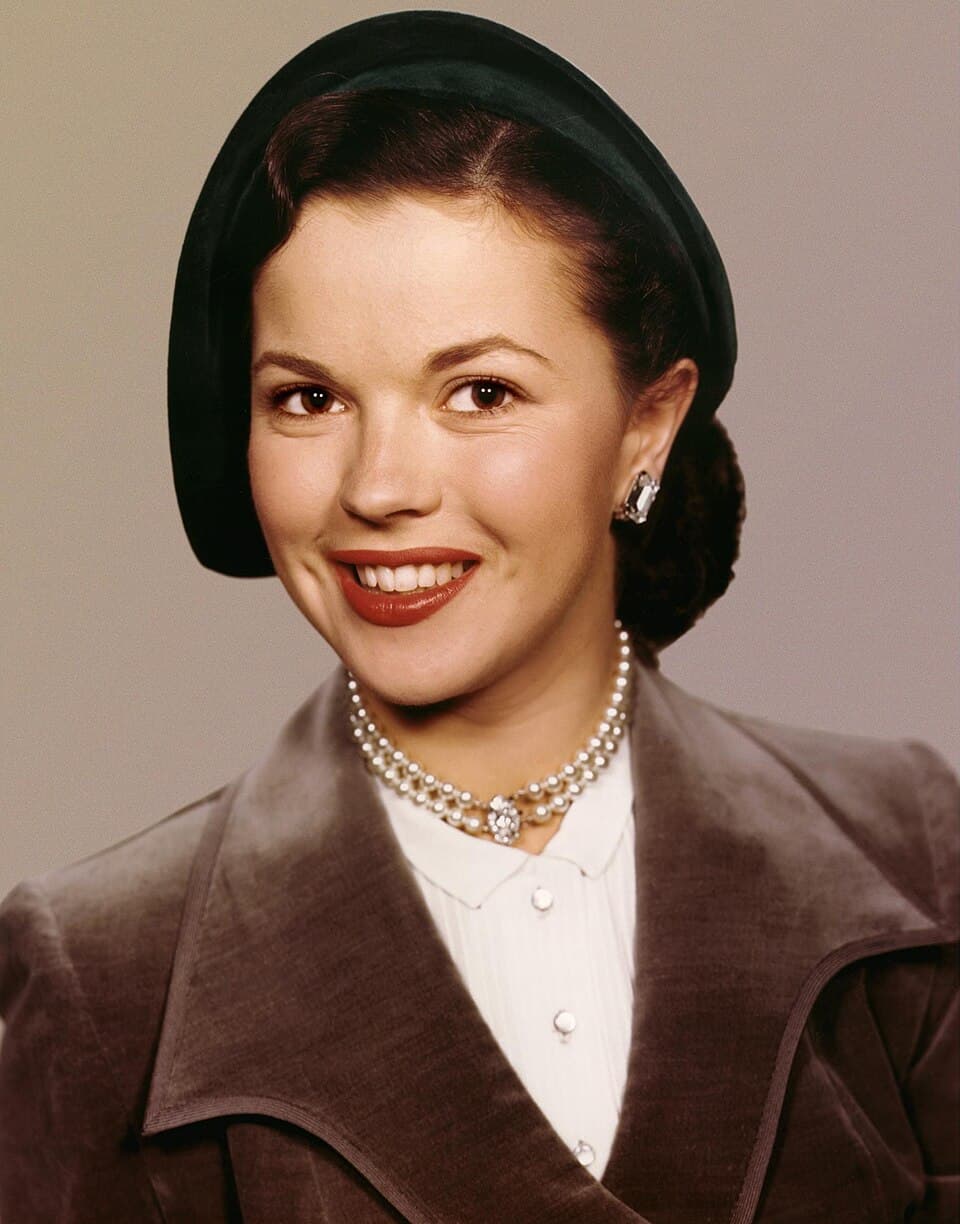
American · Arts · Politics
Shirley Temple
April 23, 1928 – February 10, 2014
Early Life and Background
Shirley Jane Temple was born on April 23, 1928, in Santa Monica, California, to George Francis Temple, a bank employee, and Gertrude Amelia Temple, a homemaker.[1][2][4][8] She grew up in a middle-class household with two older brothers, John and George Jr., who were 9 and 13 years her senior.[4][8] Her mother played a crucial role in shaping her future, encouraging performance from an early age and styling the signature ringlet curls—often 56 in number—that became a hallmark of her screen persona.[1][2]
In 1931, when Temple was three, Gertrude enrolled her in the Ethel Meglin dance school, a Los Angeles studio known for training children for film work.[4][10] There, she learned tap, ballet, and character dances, developing the poise and coordination that would make her stand out on camera. Her talent was soon noticed by producers from Educational Pictures, who were seeking child performers for short films.
Temple attended local schools and later the Westlake School for Girls, balancing education with demanding studio schedules.[10] Her early exposure to film sets and professional choreography, combined with her mother’s ambition and careful management, created a foundation for an unprecedented career in child stardom during the Great Depression.
Career Beginnings
Temple’s professional film career began in the early 1930s with a series of short subjects. In 1932, she received her first speaking role in the Baby Burlesks short War Babies, often cited as her first credited film role.[4][8] These satirical shorts cast preschool-aged children in parodies of adult scenarios; although later criticized for exploitation, they introduced Temple to the mechanics of filmmaking.
Also in 1932, she appeared in her first feature-length film, The Red-Haired Alibi, in a small role.[10] Through the early 1930s, Educational Pictures loaned her to major studios for minor parts in films such as To the Last Man (1933), building her screen résumé.[10] Despite the modest scale of these roles, Temple’s expressive face, confident dance style, and ability to memorize lines quickly distinguished her from other child performers.
The turning point came in 1934 when Temple appeared in Stand Up and Cheer!, performing a memorable song-and-dance number to "Baby, Take a Bow."[2][10] Her performance captivated audiences and studio executives, demonstrating her capacity to carry a film’s emotional core. That same year she starred in Little Miss Marker, based on a Damon Runyon story, which became her first feature film vehicle constructed around her persona.[1][4] Fox Film Corporation (soon to become 20th Century-Fox) signed her to a long-term contract, recognizing her box-office potential.[10]
Also in 1934, Temple headlined Bright Eyes, her first film created specifically for her, which included the song "On the Good Ship Lollipop".[1][4][8] The film crystallized her screen image as an irrepressibly cheerful orphan or quasi-orphan who wins over gruff adults. "On the Good Ship Lollipop" became a cultural phenomenon, selling hundreds of thousands of sheet-music copies and reinforcing her association with innocent optimism during economic hardship.[2][8]
Rise to Stardom and Major Works
By 1934–1938, Shirley Temple was widely reported as Hollywood’s number-one box-office draw, surpassing adult stars.[1][2][4][10] She appeared in more than 20 feature films during this period, many structured around her singing, dancing, and emotional resilience. Her popularity was so great that President Franklin D. Roosevelt reportedly remarked that "as long as our country has Shirley Temple, we will be all right," underscoring her symbolic importance to national morale.[2]
On February 23, 1935, Temple received a special Juvenile Academy Award at the 7th Academy Awards, honoring her "outstanding contribution to screen entertainment" in 1934.[1][2][10] She was the first recipient of the juvenile Oscar and remains among the youngest Academy honorees. Just days later, on February 27, 1935, she presented the Best Actress Oscar to Claudette Colbert, becoming the youngest person to present a competitive Academy Award.[4]
Temple’s filmography from the mid-1930s includes notable titles such as The Little Colonel (1935), Curly Top (1935), Captain January (1936), Dimples (1936), Heidi (1937), and Rebecca of Sunnybrook Farm (1938).[1][2][11] She worked with prominent directors, including John Ford, and often portrayed plucky heroines whose charm and integrity reformed flawed adults.
The Little Colonel, released in 1935, is especially significant for featuring Temple opposite tap legend Bill "Bojangles" Robinson.[1][4] Their staircase dance is widely cited as the first interracial dance pairing on film in a major Hollywood production, occurring amid rigid segregation and racial stereotyping.[4] The sequence expanded Robinson’s visibility to white audiences and subtly challenged prevailing norms of interracial performance, even as the film retained many period prejudices.
On March 14, 1935, Temple placed her handprints and footprints in the forecourt of Grauman’s Chinese Theatre in Hollywood, a privilege reserved for major stars.[4][15] This event cemented her status as a cultural institution despite her youth. Two years later, on June 26, 1937, she attended what contemporary sources describe as her first major Hollywood premiere for Wee Willie Winkie, a John Ford-directed film that further showcased her drawing power.[4]
Temple’s films often combined sentimental plots with elaborate musical numbers. Her performances in Heidi and The Little Princess (1939) are remembered for their emotional intensity, as she navigated roles that required both childlike innocence and mature pathos.[1][2] By the late 1930s, however, as she approached adolescence, studios found it more difficult to fit her into the established child-star mold, and her box-office dominance began to wane.
Transition and Later Screen Work
In the 1940s, Temple’s popularity declined as she aged and audiences’ tastes shifted.[10] She made films for various studios, including Fort Apache (1948), directed by John Ford, where she appeared alongside her first husband, actor John Agar.[1][2] Her final feature-film appearance came in 1949 with The Story of Seabiscuit, effectively closing her major screen career.[1][4]
Temple officially retired from acting around 1950, at age 22, having made approximately 40–50 films depending on counting criteria for shorts and features.[3][7][10] However, she continued to appear on television. In the late 1950s, she hosted and occasionally acted in the anthology series The Shirley Temple Storybook (1958–1960), adapting classic children’s tales.[10] In the 1960s, she also hosted Shirley Temple’s Storybook and other television specials, maintaining a nostalgic presence for audiences who had grown up with her films.
Entry into Politics and Diplomacy
Temple’s interest in public affairs deepened in the 1950s and 1960s, as she withdrew from acting and focused on family and civic engagement.[2][5] She became active in the Republican Party, working on campaigns and serving on various committees. In 1967, she ran unsuccessfully in the Republican primary for California’s 11th Congressional District, losing but signaling her seriousness about electoral politics.[4][10][15]
Her shift from entertainment to diplomacy began in earnest with her appointment to the U.S. delegation to the United Nations General Assembly. On September 23, 1969, President Richard Nixon named her as a member of the delegation to the 24th UN General Assembly.[4][10] In this role, she engaged with international issues, including environmental and refugee policies, and gained experience in multilateral diplomacy.
Temple Black’s diplomatic career advanced further when President Gerald Ford nominated her on December 9, 1974 as Ambassador Extraordinary and Plenipotentiary to Ghana.[4][10][15] Serving in Ghana from 1974–1976, she worked on strengthening bilateral relations, supporting development initiatives, and representing U.S. interests in West Africa.[10][15]
On July 1, 1976, President Ford appointed her Chief of Protocol of the United States, making her the first woman to hold this office.[1][4][10][15] As Chief of Protocol, she oversaw the Washington diplomatic corps, coordinated state visits, and managed ceremonial aspects of foreign policy until 1977.[10]
Temple Black continued to receive diplomatic trust into the late 1980s. On August 2, 1989, President George H. W. Bush nominated her as U.S. Ambassador to Czechoslovakia.[4][10] She served from 1989–1992, a period encompassing the Velvet Revolution and the peaceful end of communist rule in Czechoslovakia.[10][15] Her posting in Prague placed her at the center of one of the Cold War’s final chapters, as she witnessed and reported on the transition to democracy.
In recognition of her contributions, Secretary of State George P. Shultz designated her an Honorary United States Foreign Service Officer on January 25, 1988, a symbolic first for a non-career appointee whose service matched that of professional diplomats.[10][16] This honor underscored the seriousness and effectiveness of her diplomatic work.
Awards, Honors, and Recognition
Temple’s career garnered numerous awards spanning entertainment and public service. In addition to her special Academy Award in 1935, she received significant honors later in life. In 1998, she was among the recipients of the Kennedy Center Honors, recognizing her lifetime contributions to American culture through the performing arts.[4][10][11]
On January 28, 2006, she received the Screen Actors Guild Life Achievement Award at the 12th SAG Awards, honoring her distinguished career and humanitarian efforts.[4] The acting community’s recognition highlighted her influence on generations of performers and acknowledged the breadth of her contributions beyond film.
Temple Black was also inducted into the California Hall of Fame, and numerous retrospectives, museum exhibits, and television specials celebrated her work.[15] The California Museum and other institutions have preserved artifacts from her career, including costumes, posters, and memorabilia, further cementing her place in cultural history.
Personal Life
Shirley Temple married twice. In 1945, at age 17, she wed John Agar, a sergeant and aspiring actor.[2][4] The couple had one daughter, Linda Susan, born in 1948.[2][11] Their marriage coincided with Temple’s transition to more adult screen roles, including films in which Agar also appeared. The relationship was strained, and they divorced in 1950
Later in 1950, she married Charles Alden Black, a World War II Navy intelligence officer and businessman.[2][4][11] Charles Black’s background in shipping and aquaculture contrasted sharply with Hollywood, and the marriage provided the relative privacy and stability Temple sought after her film career. The couple had two children: Charles Jr. and Lori2005.[11] Temple Black was known for her candor about personal health issues. In the early 1970s, she publicly disclosed her diagnosis of breast cancer and her subsequent mastectomy, at a time when such topics were rarely discussed openly.[2][5] Her decision to speak frankly about the disease encouraged other women to seek screening and treatment and contributed to destigmatizing cancer conversations. Outside her official roles, Temple Black was active in charitable work and environmental causes, including involvement with organizations focusing on wildlife and pollution.[16] She authored an autobiography, Child Star, published in 1988, offering her own account of the pressures and rewards of early fame.[18] Shirley Temple’s legacy is multifaceted, spanning film history, gender studies, and diplomatic practice. As a child actor, she redefined the economic and cultural possibilities of girlhood on screen. During the Great Depression, her films became a source of comfort and optimism, with her characters often symbolizing resilience, moral clarity, and emotional warmth.[2][5] Her unprecedented box-office success demonstrated that a young girl could anchor major studio productions and drive international distribution. This success influenced studio strategies, leading to increased production of family-oriented musicals and a focus on merchandising. The "Shirley Temple" brand extended to dolls, clothing, and other products, illustrating early forms of cross-media marketing around a female child star.[2][10] From a gender perspective, Temple’s image both reflected and shaped expectations of femininity. Her roles often emphasized obedience, charm, and emotional labor—qualities prized in girls and women of the era. Yet her later life complicated this narrative. By entering politics, accepting demanding diplomatic roles, and becoming the first female U.S. Chief of Protocol in 1976, she demonstrated that women could move from symbolic to structural power.[1][10] As a diplomat, Temple Black contributed meaningfully to U.S. foreign policy. Her ambassadorships in Ghana and Czechoslovakia occurred during critical moments in both regions’ histories, and her presence as a high-profile woman helped normalize female leadership in international affairs.[10][15][16] The Honorary Foreign Service Officer designation in 1988 reflected institutional respect for her work and underscored that nontraditional entrants to diplomacy could achieve distinction. The staircase dance with Bill "Bojangles" Robinson in The Little Colonel remains a touchstone in film and race studies. Though produced within a segregated system, the sequence is widely cited as a first interracial dance pairing in a major Hollywood film, and it continues to be analyzed for its complex symbolism, blending joyful collaboration with the limitations of its era’s racial politics.[4][16] Temple’s public disclosure of her breast cancer diagnosis also marked an important moment in health advocacy, particularly for women. Her willingness to speak openly about surgery and recovery helped challenge taboos and encouraged more candid media treatment of women’s health issues.[2][5] In her later years, Shirley Temple Black remained a respected public figure, occasionally appearing at retrospectives, award ceremonies, and documentary projects. Following her Screen Actors Guild Life Achievement Award in 2006, she was widely celebrated in media retrospectives as a pioneering child star who successfully reinvented herself as a diplomat and civic leader.[4][5] She lived in Woodside, California, maintaining close ties with her family and engaging in selected public events. Her husband Charles Black died in 2005, after more than five decades of marriage.[11] Temple Black continued to receive honors and participated in interviews reflecting on Hollywood’s golden age and the challenges faced by child actors. On February 10, 2014, Shirley Temple Black died at her home in Woodside at the age of 85, reportedly from complications including pneumonia and chronic obstructive pulmonary disease.[1][3][4][8] News of her death prompted tributes from actors, politicians, and commentators who emphasized both her cinematic achievements and her diplomatic service. Her passing marked the end of a unique life trajectory—from preschool performer in satirical shorts to global symbol of hope during the Depression, and finally to ambassador and protocol chief in the late 20th century. For historians of women’s lives, Shirley Temple Black stands as a rare example of a woman who navigated early fame, public scrutiny, and career transformation while leaving a lasting mark on both popular culture and international diplomacy.Legacy and Historical Impact
Later Life and Death
Dated achievements
13 indexed.
- Apr231928Arts
Birth of Shirley Temple
Shirley Jane Temple was born in Santa Monica, California, to George and Gertrude Temple.
View details USA Today - Shirley Temple Timeline - Feb231935