← All women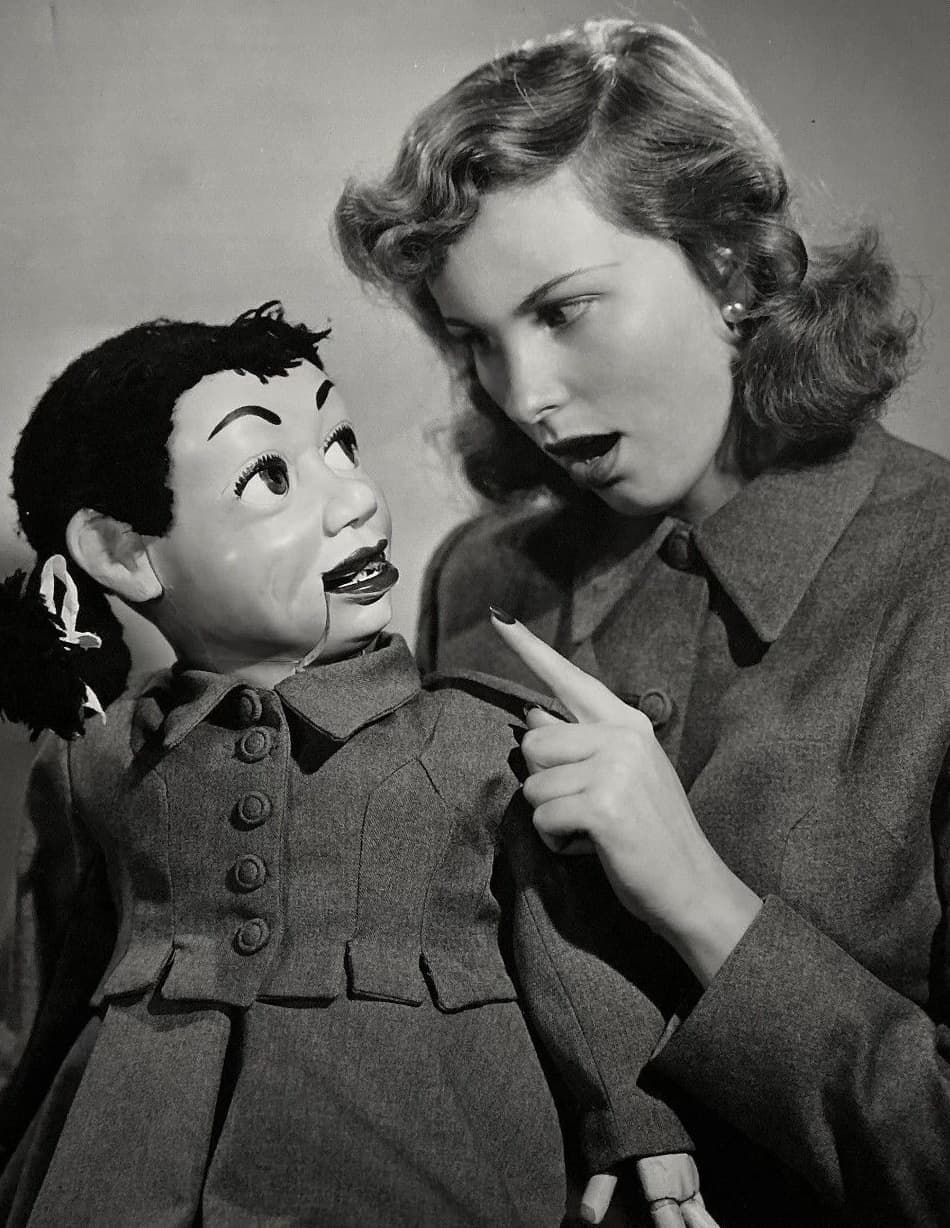
American · Arts
Shirley Dinsdale
October 31, 1926 – May 9, 1999
Early Life and Background
Shirley Dinsdale Layburn, known professionally as Shirley Dinsdale, was born on October 31, 1926, in San Francisco, California, United States.[1][3][16] She grew up in the San Francisco Bay Area, a region that was rapidly embracing radio and later television technology, providing fertile ground for a future broadcast performer.[2][4] Details of her parents and family background are sparse in published sources, but multiple accounts agree that her childhood was marked by both hardship and creativity.[2][4][5]
As a child, Dinsdale suffered a serious accident when a kettle tipped over, severely scalding her and requiring a long stay in hospital.[2][4][5] She reportedly spent about a year recovering from her burns, an episode that could have been purely traumatic but instead became a turning point in her life. To comfort her during this period, she was given a puppet, which would later evolve into or inspire the character Judy Splinters, a saucy, pigtailed girl dummy who became her professional ventriloquist partner.[2][4][5][13]
The experience of coping with injury, coupled with the companionship of the puppet, is frequently cited as the origin of Dinsdale’s interest in ventriloquism and performance.[2][4][5] After she returned home, her father is said to have bartered for professional ventriloquist lessons, helping her channel a convalescent pastime into a developing skill.[2] By her early teens, she had transformed this skill into a viable entry into radio entertainment.
Career Beginnings in Radio
Dinsdale’s performing career began in earnest on local radio in the San Francisco area. Sources generally agree that by her early teens—some mention age 13, others 14—she was appearing on Bay Area radio programs with Judy Splinters, refining an act built around humorous dialogue and the distinctive personality of her wooden partner.[2][4][5][10] The dummy’s bratty, wisecracking style contrasted with Dinsdale’s poised delivery, creating the kind of character dynamic that suited mid-century radio variety formats.
Her growing reputation soon led her from local shows to more prominent broadcasts. Dinsdale moved to Los Angeles, where she became a regular on the Eddie Cantor radio program and appeared with well-known figures such as Nelson Eddy, Bob Burns, and Rudy Vallée.[2][4][10] These appearances embedded her in the Hollywood-centered world of radio entertainment and exposed her to large audiences at a relatively young age.
During World War II, she performed at benefits and in hospitals as part of the broader wartime entertainment effort, using her ventriloquist act to raise morale among servicemen and civilians.[2][4] This phase of her career illustrates the way women entertainers contributed to public morale and civic life while simultaneously advancing their own professional trajectories.
Transition to Early Television
By the late 1940s, Dinsdale’s radio success intersected with the emergence of commercial television on the West Coast. In 1947, she began working for KTLA, an early Los Angeles television station, doing announcing and birthday greetings—short pieces suited to the limited programming schedules of the time.[3] Her ability to perform live to camera, together with the visual appeal of her dummy Judy Splinters, positioned her well for the new medium.
Soon, KTLA developed a children’s program around her act. Dinsdale became the star of The Judy Splinters Show, a 15-minute children’s television program built around her interactions with the dummy.[1][3][5][7] Although precise premiere dates are not consistently documented, contemporary accounts describe it as one of the earliest, and in some commentary the very first, children’s television shows in Los Angeles.[5][7] The show demonstrated how ventriloquism, long associated with stage and radio, could be adapted for television, using close-ups and simple sets to focus attention on the performers.
Her television work extended beyond KTLA. Later sources indicate that after her success in Los Angeles, Dinsdale hosted children’s programs on KNBC and appeared in further shows on ABC in New York and Chicago.[3] These engagements suggest that she was among the first generation of performers whose careers traversed local and network television, making her a recognizable figure to children and families in multiple regions.
Major Works and Accomplishments
Dinsdale’s signature work was her ventriloquist act with Judy Splinters, which defined both her radio and television careers. The dummy’s mischievous persona, often described as bratty and saucy, allowed Dinsdale to construct dialogues that blended gentle subversion with family-friendly humor.[2][4][5][13] Her ability to maintain vocal control and character distinction live on air exemplified the technical skill demanded of ventriloquists in audio and visual media.
By the late 1940s, she was not only performing for KTLA but also reaching national audiences. During the summer of 1949, her program appeared as a daily evening broadcast on NBC, and it continued as a regular afternoon show during the 1949–1950 season.[2] This schedule placed her at the center of network efforts to develop children’s programming, an area that would later become a major feature of American television.
Her influence extended into merchandising: after her rise to fame, the Ideal Toy Company produced Judy Splinters dolls, indicating that her character had achieved sufficient popularity to support licensed products.[4][5] Such merchandising was an early example of the commercial synergy between television characters and consumer goods that would become standard in later decades.
Awards, Honors, and Recognition
Shirley Dinsdale’s most historically significant honor is her Emmy Award for Most Outstanding Television Personality, received at the first-ever Emmy ceremony. On January 25, 1949, at the Hollywood Athletic Club in Los Angeles, the Academy of Television Arts & Sciences held the First Annual Emmy Awards. Only five awards were given, and Dinsdale, then a 20-year-old KTLA performer and a student at UCLA, was the first recipient to be called.[6][1]
She received the award for her work with Judy Splinters on children’s programming, becoming the first person and first woman ever to receive an Emmy statuette.[6][1][8] The Television Academy’s retrospective accounts confirm that she and Judy Splinters were recognized as Most Outstanding Television Personality, and that their award was the first presented.[6] Guinness World Records also lists her as the first Emmy Award winner, emphasizing that she inaugurated the long-running tradition of annual television honors.[1]
This achievement has been echoed in later historical writing. Lists of American women’s firsts identify Dinsdale as the first woman to receive an Emmy, situating her within a broader narrative of women breaking into institutional recognition systems in the arts.[1] Anecdotal accounts, including those repeated in popular articles, note that she nearly missed the ceremony because she had made other personal plans, underscoring how unexpected the award may have seemed even to her contemporaries.[2][4]
Beyond the Emmy, Dinsdale’s visibility was reinforced by guest appearances and archival preservation. She appeared on the panel show To Tell the Truth in 1958, where her status as first Emmy winner was highlighted for television audiences.[10] Clips of her performances with Judy Splinters survive in archival and online video, allowing later generations to view her work and situating her as a representative figure in documentaries and retrospectives on early television.[7][10]
Personal Life
In the early 1950s, after a decade of intense activity in radio and television, Dinsdale chose to step away from show business. In 1953, she retired from her entertainment career, married, and focused on raising a family.[2][4] Subsequent sources identify her married name as Shirley Dinsdale Layburn, and genealogical records list her as Shirley Faye (Dinsdale) Layburn.[1][16] Accounts from the period and later summaries note that she had two children.[2][10]
Her decision to leave television to marry and raise children reflects common patterns among women in mid-20th-century America, who frequently faced pressures to prioritize domestic roles over professional ambitions. Yet Dinsdale’s story diverges from the usual narrative in that she reentered the workforce in a completely different field and attained significant professional responsibility there.
Second Career in Cardiopulmonary Therapy
After her children grew older, Dinsdale embarked on a major career transition. At around age 40, she enrolled at SUNY Stony Brook, pursuing studies in respiratory and cardiopulmonary therapy.[2][4][5] This return to higher education in midlife underscores her commitment to developing new skills and contributing in a clinical setting.
Having completed her professional training, Dinsdale joined the John T. Mather Memorial Hospital in Port Jefferson, New York. From 1973 to 1985, she served as head of the hospital’s Respiratory Therapy Department, overseeing clinical work and likely playing a key role in managing respiratory care services during a period of significant development in pulmonary medicine.[3][5]
This second career is an important part of her historical profile. It demonstrates that a woman who had once been known as a ventriloquist and children’s television star could successfully reinvent herself as a health professional and departmental leader. In doing so, Dinsdale challenged stereotypes that entertainers, particularly women, were confined to narrow roles and that midlife career changes into scientific or medical fields were unusual.[3][5]
Later Life and Death
By the mid-1980s, Dinsdale retired from her hospital position, reportedly around age 50.[5] She continued to live in Stony Brook, New York, under her married name. While detailed public information about her later personal activities is limited, her earlier achievements remained part of television history; occasional articles, fan recollections, and institutional retrospectives referenced her status as the first Emmy winner and a pioneer of children’s television programming.[1][6][13]
On May 9, 1999, Shirley Dinsdale died at her home in Stony Brook, New York, at the age of 72.[1][3][2] Portuguese-language sources specify cancer as the cause of death.[3][5] Her passing closed a life that had moved through distinct phases: childhood illness and recovery, early radio fame, television pioneering and major award recognition, domestic life and parenting, and a second career in respiratory therapy.
Legacy and Historical Impact
Shirley Dinsdale’s legacy operates on several levels. In the history of television, she is best remembered as the performer behind Judy Splinters and as the first-ever Emmy Award winner for Most Outstanding Television Personality in 1949.[1][6] Her work on The Judy Splinters Show and related programs illustrated how children’s television could be built around intimate, conversational performances rather than large-scale sets or spectacles, a model that influenced later children’s hosts and puppetry-based shows.
Her recognition at the inaugural Emmy ceremony has enduring symbolic weight. By making a young woman ventriloquist the first recipient of its principal award, the Television Academy implicitly affirmed that women could be central creative forces in television, even in its earliest years. Subsequent documentation—by the Academy, Guinness World Records, and scholars of women’s history—has reinforced this point, placing Dinsdale among the notable "firsts" in American women’s cultural achievements.[1][6]
Beyond television, Dinsdale’s life story contributes to a broader understanding of women’s work and identity in the 20th century. Her transition from entertainer to hospital department head reflects the flexibility and ambition of women who navigated shifts in gender expectations, family responsibilities, and economic opportunities. She demonstrated that success in a glamorous field did not preclude later accomplishment in a technical, patient-centered profession.[3][5]
In popular memory, Dinsdale is sometimes overshadowed by more widely known television personalities. However, historians, bloggers, and enthusiasts of early broadcasting continue to highlight her contributions, particularly through articles that recount her childhood injury, the creation of Judy Splinters, and her groundbreaking Emmy win.[4][5][13] Clips posted online allow viewers to see her in action, preserving the performance style that once captivated children on early television.[7][10]
As interest in women’s media history and the origins of television grows, Shirley Dinsdale’s story is increasingly recognized as emblematic of the era’s possibilities and constraints. She stands as a reminder that the foundations of major cultural institutions—such as the Emmy Awards—were laid not only by executives and producers, but also by young women performers whose talents helped define what television could be.
Dated achievements
4 indexed.
- Oct311926Arts
Birth of Shirley Dinsdale
Shirley Dinsdale was born in San Francisco, California, United States.
View details Shirley Dinsdale - Wikipedia - Jan251949Arts
First-ever Emmy Award winner for Most Outstanding Television Personality
At the first Annual Emmy Awards, Shirley Dinsdale received the very first Emmy Award.