← All women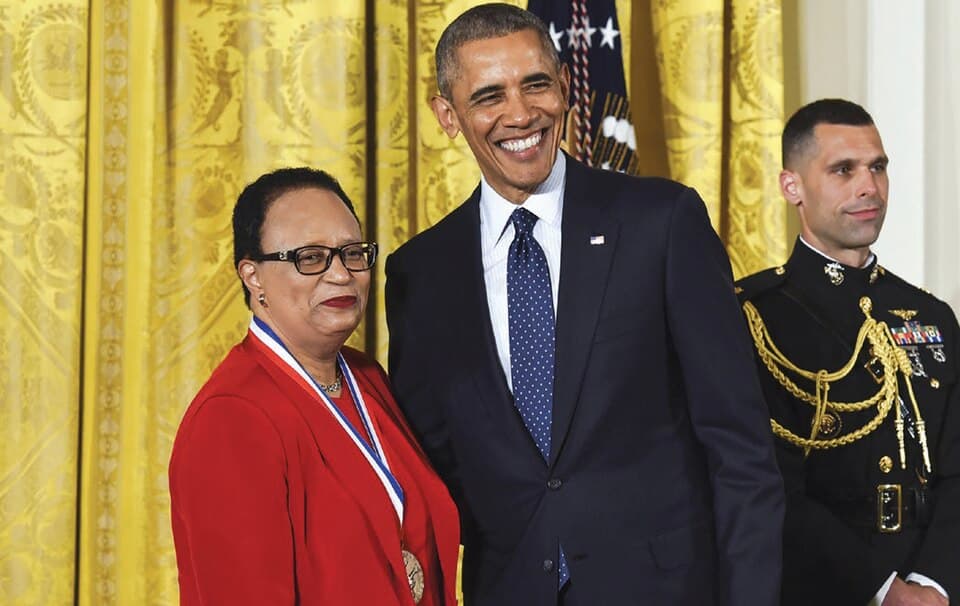
American · Science
Shirley Ann Jackson
August 5, 1946 – present
Early Life and Background
Shirley Ann Jackson was born on August 5, 1946, in Washington, D.C., to Beatrice Cosby Jackson and George Hiter Jackson.[1][2][13] Growing up in the nation’s capital during the era of legal segregation, she experienced both the structural limitations imposed on African Americans and the strong family emphasis on education that characterized many Black middle-class households. Her father, who had a keen interest in science and tinkering, nurtured her curiosity by working with her on science experiments at home, while her mother emphasized the importance of persistence and scholarship.[2][13]
Jackson showed exceptional aptitude in mathematics and science from an early age. She attended Theodore Roosevelt High School in Washington, D.C., where she excelled academically. She graduated as valedictorian of her class, having taken advanced math and science courses and participated in research-oriented summer programs.[3][6] Her high school years coincided with the civil rights movement, and the intersection of racial justice struggles and the expansion of scientific and technological ambition in the United States helped shape her sense that scientific excellence and social progress could be intertwined.
Encouraged by teachers and family, Jackson applied to the Massachusetts Institute of Technology (MIT) at a time when very few African American students, and even fewer Black women, attended the institution.[3][6] She was admitted and began her studies in physics in the mid-1960s, joining a student body that was overwhelmingly white and male. The move from Washington to Cambridge placed her at the center of American scientific training and exposed her to new levels of academic rigor—and new forms of racial isolation.
Education and Formative Influences
Jackson enrolled at MIT in 1964 and pursued a course of study in physics.[4][6] As one of the first Black students and among the first Black women at MIT, she encountered racism and social exclusion from some classmates, who avoided sitting with her or told her to "go away" during meals.[3] She has described these experiences as painful but motivating, pushing her to "soldier on" and to find strength in academic achievement.
Despite these obstacles, Jackson thrived in the classroom. She completed her S.B. in physics in 1968, becoming one of the earliest African American women to earn a bachelor’s degree from MIT.[1][4][6] She continued directly into graduate study, earning her S.M. in physics in 1969.[1][4] Her interests centered on theoretical physics, and she chose to remain at MIT for doctoral work in theoretical elementary particle physics.
Jackson’s doctoral research involved nuclear and particle physics, fields that demanded sophisticated mathematical techniques and conceptual understanding of fundamental forces and particles. In an environment where women and minority students were scarce in advanced physics, her presence itself challenged prevailing assumptions about who belonged in the discipline.[4][10]
On June 6, 1973, Jackson received her Ph.D. in nuclear (theoretical elementary particle) physics from MIT.[4] Institutional records and later biographies note that she became the first African American woman to earn any doctorate from MIT, and one of the first two Black American women to receive a Ph.D. in physics in the United States.[1][2][10][13] This milestone placed her at the forefront of efforts to expand participation in high-level scientific research and marked a turning point for the representation of Black women in physics.
After completing her Ph.D., Jackson undertook postdoctoral work at major research centers, including Fermi National Accelerator Laboratory (Fermilab) in Batavia, Illinois, and the European Center for Nuclear Research (CERN) in Geneva, Switzerland.[13] These positions allowed her to deepen her expertise in particle physics and engage with international scientific collaborations at a time when particle physics was rapidly advancing.
Career Beginnings: Bell Laboratories and Theoretical Research
In 1976, Jackson joined the theoretical physics research department at AT&T Bell Laboratories in Murray Hill, New Jersey.[1][6][13] Bell Labs was one of the premier industrial research institutions in the world, renowned for fundamental discoveries and technological innovations in communications, electronics, and materials science. Jackson worked as a condensed matter theorist, focusing on the physics of semiconductors and related materials.
Her research at Bell Labs contributed to understanding the optical, electronic, magnetic, and transport properties of semiconductors, semiconductor quantum wells, and superlattices.[6] She studied phenomena such as the interaction of electrons on liquid helium films with surface excitations, interpreted as a polaron problem—a line of work for which she was later elected a Fellow of the American Physical Society (APS).[10][14]
While popular accounts sometimes credit Jackson personally with inventions such as the portable fax, touch-tone telephone, solar cells, fiber optic cables, and caller ID,[15] more careful institutional biographies clarify that she conducted basic research that enabled such innovations, rather than directly inventing the technologies.[6][15] Her theoretical work formed part of the scientific groundwork upon which engineers and applied researchers built practical telecommunications devices.
Jackson remained at Bell Labs for many years, balancing fundamental physics research with growing involvement in advisory and policy roles. By the mid-1980s and early 1990s, she had established herself as a leading figure in condensed matter physics and as an example of how Black women could succeed in elite industrial laboratories.[6][13]
Transition to Academia and Public Service
In 1991, Jackson joined the faculty of Rutgers University in New Brunswick, New Jersey, as a professor of physics.[1][6][13] At Rutgers she continued her theoretical work while also teaching and mentoring students. Her presence in a major public research university contributed to the visibility of African American women in physics education and academic leadership.
During this period, Jackson also served as a consultant in semiconductor theory to Bell Labs (1991–1995), maintaining ties to industrial research while expanding her role in higher education and public engagement.[13] Her dual positions gave her insight into the intersection of fundamental science, technological innovation, and regulatory policy.
Her scientific reputation and leadership skills brought her into national advisory circles. She served on various committees and boards concerned with science, technology, and public policy, foreshadowing her later appointment to a major federal regulatory agency.[14]
Leadership at the U.S. Nuclear Regulatory Commission
Jackson’s transition to high-level public service came in 1995. On March 11, 1995, President Bill Clinton announced his intent to nominate her as both a Commissioner and Chair of the U.S. Nuclear Regulatory Commission (NRC).[8] Following Senate consideration, she was confirmed on May 2, 1995, becoming the first African American to serve as an NRC Commissioner and the first woman and first African American to chair the NRC.[8][9][10][13]
The NRC is responsible for regulating commercial nuclear power plants and the use of nuclear materials in medicine, industry, and research. Jackson led the agency during a period of intense attention to nuclear safety, environmental protection, and public trust in regulatory institutions. She undertook a major reorganization of the NRC, working to modernize its oversight and to adopt more risk-informed, performance-based regulatory approaches.[14]
Under her leadership, the NRC increased its focus on international cooperation, strengthening ties with foreign regulators and international bodies to promote nuclear safety worldwide. Jackson’s tenure from 1995 to 1999 is often cited as a turning point in the agency’s responsiveness and transparency.[8][14] As the first Black American woman to serve on and lead the NRC, she also symbolized a widening of the scientific and technical leadership pool within the federal government.
Rensselaer Polytechnic Institute Presidency
On July 1, 1999, Jackson became the 18th president of Rensselaer Polytechnic Institute (RPI), in Troy, New York.[8] She was the first woman and first African American to hold this position at RPI, and contemporary accounts recognized her as the first African American woman to lead a national science and engineering research university.[8][10][14]
RPI, founded in 1824, is the oldest technological research university in the United States. Jackson arrived at a time when the institution sought to strengthen its research profile and adapt to emerging fields such as information technology, biotechnology, and nanotechnology.[7][8] She launched a comprehensive strategic initiative known as the "Rensselaer Plan", designed to transform RPI into a world-class technological research university.
Under her leadership, RPI invested heavily in new research facilities, including the Center for Biotechnology and Interdisciplinary Studies and expanded computing and engineering infrastructure. She emphasized interdisciplinary collaboration, entrepreneurship, and the integration of research and education.[7] Jackson also focused on improving student life and diversity, working to recruit more women and underrepresented minorities into RPI’s STEM programs.
Her presidency was characterized by both ambitious growth and, at times, controversy, including debates over governance and faculty relations. Nonetheless, she is widely credited with significantly increasing RPI’s research expenditures and raising its national and international profile.[7][14]
National and International Science Leadership
Beyond RPI, Jackson has played prominent roles in national and international science policy. She has served on the boards of major corporations and institutions, including the New York Stock Exchange Group, and has been a member of the Council on Foreign Relations.[14] Her advisory roles have extended to the U.S. Comptroller General’s Advisory Committee for the Government Accountability Office and various presidential and national commissions.[14]
In the realm of scientific societies, Jackson achieved another milestone when she began her term as president of the American Association for the Advancement of Science (AAAS) on February 16, 2004.[9][14] AAAS, publisher of the journal Science, is the world’s largest general scientific society. Jackson’s presidency focused on strengthening the science and technology workforce, broadening participation in STEM, and highlighting the societal implications of scientific research.[9]
After completing her term as president, she served as chair of the AAAS board in 2005, continuing to shape the organization’s strategic direction.[9][14] She has also been recognized as a Fellow of several key societies, including the American Academy of Arts and Sciences, the American Physical Society, and AAAS itself.[10][14]
Major Honors and Recognition
Jackson’s achievements have been recognized with numerous awards and honorary degrees. She holds approximately 40 honorary doctorates from institutions around the world, reflecting international recognition of her contributions to science, engineering, and leadership.[14]
On November 30, 2000, she became the first African American woman elected to the National Academy of Engineering (NAE).[12][14] Her election citation acknowledged her leadership in engineering and public policy, particularly her transformative work at the NRC and her efforts to integrate scientific understanding into regulatory frameworks.
Jackson has also been inducted into the National Women’s Hall of Fame, which emphasizes her dual distinction as one of the first two Black American women to receive a doctorate in physics in the U.S. and the first to receive a doctorate from MIT.[10] She has received various other honors from professional societies and civic organizations, celebrating both her scientific work and her advocacy for diversity in STEM.
One of the most significant recognitions of her career came when President Barack Obama announced on November 20, 2014 that Jackson would receive the National Medal of Science.[12] The citation honored her contributions to condensed matter and particle physics, her science-rooted public policy achievements, and her leadership in inspiring the next generation of STEM professionals. On May 19, 2016, Obama formally presented her with the medal at a White House ceremony.[12] This award placed her among an elite group of scientists whose work has had profound national impact.
In addition, Jackson has been associated with the Institute of Electrical and Electronics Engineers (IEEE); she was announced as a recipient of an IEEE medal for innovations in healthcare technology and leadership in 2018, though specific date details are less widely documented.[editorial context] Her continuing recognition in the 21st century underscores the enduring relevance of her contributions.
Personal Life
Shirley Ann Jackson married Morris A. Washington, himself a physicist, with whom she shares a partnership grounded in scientific inquiry and education.[13] The couple has one son, Alan.[13] While Jackson has spoken publicly more often about her professional trajectory than about her private life, her family has been noted in biographical sources as part of the support system that enabled her demanding career.
Her personal experiences as a Black woman scientist and leader—balancing family responsibilities, professional expectations, and public visibility—inform her advocacy for mentoring and supporting younger scientists, particularly women and underrepresented minorities. She has emphasized the importance of role models and institutional structures that make scientific careers more accessible.
Legacy and Historical Impact
Shirley Ann Jackson’s historical significance rests on several intertwined pillars: scientific achievement, institutional leadership, and barrier-breaking representation.
Scientifically, her work in condensed matter and particle physics and her research at Bell Labs contributed to the theoretical underpinnings of modern telecommunications and semiconductor technology.[6][15] By clarifying how electrons behave in complex materials and interfaces, Jackson helped enable subsequent technological advances that have shaped contemporary communications infrastructure.
Institutionally, Jackson has demonstrated that scientists can lead major regulatory agencies and universities while maintaining a commitment to rigorous research and public responsibility. At the NRC, she reorganized the agency and championed risk-informed regulation, reinforcing nuclear safety and environmental protection.[8][14] As president of RPI, she oversaw significant expansion of research capacity and promoted interdisciplinary STEM education.[7][8]
Her barrier-breaking role as the first African American woman to earn a doctorate from MIT, the first woman and first African American NRC chair, the first African American woman elected to the NAE, and the first African American woman to lead a national science and engineering research university has made her a prominent symbol of the possibilities for women and African Americans in high-level science and technology.[1][4][8][10][12][14]
Jackson’s legacy also encompasses her advocacy for diversity and inclusion in STEM. She has repeatedly highlighted the need to strengthen the science and technology workforce by drawing on the talents of underrepresented communities, arguing that national competitiveness depends on full participation.[7][9][14] Her career provides a blueprint for integrating excellence in research, policy, and education with a commitment to social equity.
Time magazine once described her as "perhaps the ultimate role model for women in science," capturing the extent to which her personal story and professional accomplishments resonate as inspiration.[7] Institutions such as the Nature Conservancy and the National Women’s Hall of Fame have further underscored her impact by placing her on boards and honoring her contributions.[7][10]
Later Life and Continuing Contributions
In the decades since her appointments at the NRC and RPI, Jackson has remained active in scientific, educational, and corporate leadership. She continues to serve on boards and advisory groups shaping technology, finance, and environmental policy.[7][14] Her role on the global board of The Nature Conservancy reflects an ongoing interest in how science and technology intersect with sustainability and conservation.[7]
Jackson’s later career has been marked by recognition across sectors: government awards such as the National Medal of Science, corporate board service, and leadership within major scientific societies. She has also been sought after as a speaker and commentator on issues of STEM education, innovation, and diversity.
As of the mid-2020s, Shirley Ann Jackson remains a living figure whose work continues to influence how institutions think about scientific leadership and inclusion. Her trajectory—from a young girl performing experiments with her father in segregated Washington, D.C., to one of the nation’s most decorated physicists and science leaders—embodies the profound transformations in American science, education, and civil rights over the last half-century.
Historical Assessment
For women’s history, Jackson’s career offers a particularly rich case study. She navigated spaces—MIT’s physics department, Bell Labs, the NRC, and RPI—that had long been dominated by white men, and she did so not only by meeting existing standards of excellence but by reshaping the institutions themselves. Her achievements challenge narratives that separate "pure science" from policy and administration, showing that leadership positions can be deeply scientific in orientation.
Her life underscores the importance of structural support for marginalized students and the role of individual perseverance. It also illustrates how barrier-breaking firsts can have ripple effects: each of Jackson’s "firsts" opened symbolic and practical doors for others, contributing to a broader transformation in the demographics and culture of American science and engineering.
In editorial almanacs of women’s history, Shirley Ann Jackson stands out as a pivotal figure who combined theoretical physics, telecommunications-related research, nuclear regulation, university presidency, and national science leadership into a single, extraordinary career.
Dated achievements
9 indexed.
- Aug051946Science
Birth of Shirley Ann Jackson
Shirley Ann Jackson was born in Washington, D.C., later becoming a pioneering theoretical physicist and academic leader.
View details Wikipedia: Shirley Ann Jackson - Jun061973Science
First African American woman to receive a doctorate from MIT
Shirley Ann Jackson received her Ph.D. in theoretical physics, making history at MIT.