← All women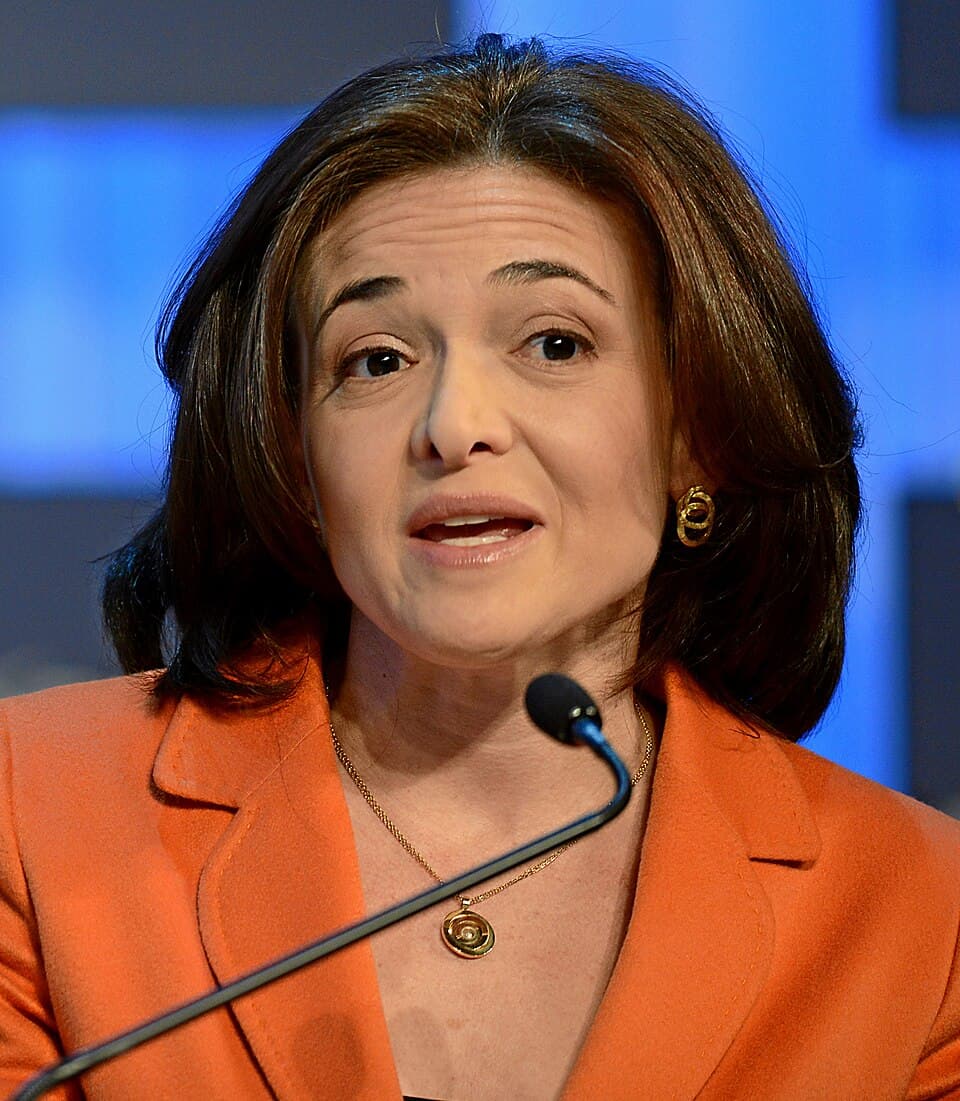
American · Activism · Politics
Sheryl Sandberg
August 28, 1969 – present
Early Life and Background
Sheryl Kara Sandberg was born on August 28, 1969, in Washington, D.C., U.S., the eldest of three children in a Jewish family.[1][6][11][13] Her father, Joel Sandberg, worked as an ophthalmologist, and her mother, Adele Sandberg, taught French at a local college, creating a household that both valued education and modeled professional careers.[11][13] When Sheryl was two, the family moved to North Miami Beach, Florida, where she spent most of her childhood.[8]
Sandberg excelled academically from an early age. In high school she was known as a top student and class leader, setting the stage for admission to Harvard College in the mid‑1980s.[1][8] At Harvard, she majored in economics and studied under future Nobel laureate Lawrence Summers, an influence that deepened her interest in development economics and public policy.[1][6] She completed her bachelor’s degree summa cum laude and was elected to Phi Beta Kappa, graduating in 1991.[1][2][6]
Sandberg’s senior thesis focused on economic disparities, and her work with Summers helped orient her toward both quantitative analysis and policy applications. After several years in the workforce, she returned to Harvard and earned an MBA from Harvard Business School, graduating with highest distinction in 1995.[1][2][6] This combination of rigorous economic training and elite business education would later underpin her roles in government, tech, and corporate leadership.
Career Beginnings and Development
Sandberg’s early career reflected a blend of international development, management consulting, and public service. After Harvard College, she worked as an economist at the World Bank, where she focused on projects related to health and poverty alleviation in developing countries.[2][5][8] This experience exposed her to global inequality and large‑scale policy implementation.
Seeking broader strategic experience, she then joined McKinsey & Company as a management consultant, analyzing corporate operations and strategy.[2][5] Her policy interests remained strong, however, and in the mid‑1990s she moved to Washington, D.C., to serve in the U.S. government.
Sandberg became chief of staff to Lawrence Summers, who served as U.S. Secretary of the Treasury under President Bill Clinton.[1][2][6] In this role, she worked on domestic and international economic issues, gaining high‑level experience in financial policy and organizational management at a relatively young age. Her tenure at Treasury coincided with debates over globalization, financial regulation, and international development, giving her insight into both political processes and economic systems.
Transition to Technology and Google
Following the Clinton administration, Sandberg left government service and entered the emerging world of large‑scale Internet companies. In 2001, she joined Google as vice president of global online sales and operations, marking a pivotal shift from public policy to the technology sector.[1][5][6][8] At the time, Google was rapidly expanding but still defining its business model.
At Google, Sandberg oversaw online ad sales, including the growing AdWords and AdSense businesses, and helped build out the company’s sales operations and self‑service advertising infrastructure.[1][5][9] She also contributed to Google.org, the company’s philanthropic arm, aligning her longstanding interest in social impact with corporate resources.[3][8] Her work was instrumental in scaling Google’s advertising revenues and establishing the operational systems that supported the firm’s global growth.
Sandberg’s success at Google brought her to the attention of Silicon Valley leaders, including Facebook founder Mark Zuckerberg. By the mid‑2000s, she was widely seen as an executive adept at building large organizations around rapidly growing technology products.[5][13]
Facebook/Meta COO and Corporate Leadership
In 2008, Sandberg joined the social networking company then known as Facebook as chief operating officer (COO).[1][6][10] Zuckerberg recruited her to turn the fast‑growing platform into a consistently profitable business. As COO, she was effectively the second‑highest‑ranking executive at the company.[14]
Sandberg took charge of Facebook’s advertising and business operations, developing strategies to monetize the platform’s vast user base. She led efforts to expand the self‑service advertising model, grow international operations, and professionalize the company’s management and HR practices.[1][5][9] Under her operational leadership, Facebook’s revenue grew from roughly $150 million to over $110 billion annually across her fourteen years at the company, according to later institutional profiles.[2]
In June 2012, Sandberg was elected to Facebook’s board of directors, becoming the first woman to serve on the company’s board.[3][13] This was a notable milestone in Silicon Valley corporate governance, highlighting both the underrepresentation of women at board level and the gradual shift toward more inclusive leadership.
During her tenure, Facebook matured from a start‑up into one of the world’s most influential technology firms, later rebranded as Meta Platforms. Sandberg remained COO from 2008 until 2022, stepping down after fourteen years while initially retaining a seat on Meta’s board.[1][2][6][7] Her role included not only operations and monetization but also public policy engagement, especially as the company faced intense scrutiny over privacy, content moderation, political advertising, and the social impacts of social media.
Major Works and Advocacy: Lean In and Option B
Beyond corporate leadership, Sandberg became widely known as an author and advocate for women’s advancement in the workplace. In 2013, she published Lean In: Women, Work, and the Will to Lead, a book that quickly became a bestseller and cultural touchstone.[1][6][10] Drawing on personal experience and research, Sandberg argued that structural barriers and social norms limit women’s leadership, but also urged women to "lean in" to opportunities, negotiate assertively, and pursue ambitious careers.
Lean In reignited debates over feminism, corporate culture, and the balance between individual agency and systemic change. Some praised the book for legitimizing women’s professional ambition and encouraging open discussion of gender bias in workplaces; others critiqued it for focusing primarily on highly educated professional women and underemphasizing structural inequalities.[1][5][9] Regardless of stance, the book significantly shaped early‑2010s discourse around women in leadership.
Sandberg extended the book’s impact by founding LeanIn.Org, a nonprofit initiative designed to support women through peer "circles" and educational resources.[1][2][14] The organization promotes leadership development, mentorship, and workplace equality and has partnered with companies and community groups globally. In Time’s "Firsts" project, Sandberg is recognized for being the first woman on Facebook’s board and for leveraging her corporate platform to launch such activism.[3]
After the sudden death of her second husband, Dave Goldberg, in 2015, Sandberg turned more directly to themes of grief and resilience. She co‑authored Option B: Facing Adversity, Building Resilience, and Finding Joy with psychologist Adam Grant, exploring how individuals and families cope with loss.[2][8] Around this work, she helped launch OptionB.Org, a project under what is now the Sandberg Goldberg Bernthal Family Foundation, focused on resilience and community support for people facing hardship.[2]
Sandberg has also published Lean In for Graduates, a revised edition of her flagship book tailored to young adults entering the workforce.[2] Collectively, these works establish her as a prominent voice in contemporary management thinking about gender, leadership, and adversity.
Philanthropy, Foundations, and Venture Initiatives
Sandberg’s philanthropic and organizational work is anchored in the Sandberg Goldberg Bernthal Family Foundation, where she serves as founder and chair.[2][8] The foundation pursues a mission of building "a more equal and resilient world" through three core initiatives: LeanIn.org, OptionB.org, and the Dave Goldberg Scholarship Program
LeanIn.org works globally to support women’s leadership, offering resources, campaigns, and networks that encourage women to pursue ambitions and challenge bias.[1][2][14] OptionB.org provides tools and community for people dealing with grief and adversity, reflecting Sandberg’s own experience of loss.[2][8] The Dave Goldberg Scholarship Program honors her late husband by supporting students who embody his values, blending educational access with personal legacy.[2] Sandberg is also a co‑founder of Sandberg Bernthal Venture Partners (SBVP), an early‑stage venture fund that invests in innovation across consumer, enterprise, climate, and healthcare technology.[2] While less public than her advocacy work, SBVP reflects her ongoing role in shaping the broader tech ecosystem beyond Meta. Her philanthropic portfolio is complemented by involvement in corporate and nonprofit boards and advisory roles over the years, including work with organizations focused on women’s advancement and social impact.[1][2][5] Sandberg has received extensive recognition as both a technology executive and a public advocate. She has consistently appeared on lists such as Fortune’s "50 Most Powerful Women in Business" and similar rankings of influential business leaders.[9] Forbes has regularly listed her among its most powerful or influential people, reflecting both her corporate role and public visibility.[9][16] Media outlets and institutions have profiled Sandberg’s career trajectory and leadership philosophy. Time magazine’s "Firsts" collection highlights her as the first woman on Facebook’s board of directors, emphasizing the barrier‑breaking nature of that appointment and her broader impact on women’s leadership discourse.[3][13] Her book Lean In has been described as "best‑selling" and widely influential across corporate and academic discussions of gender and work.[1][5][10] In addition to rankings and media features, Sandberg has received honorary degrees and speaking invitations from universities and policy fora, although these are less systematically documented across open sources. Her recognition often centers on the combination of operational excellence—scaling Meta’s business—and advocacy for inclusion and resilience. Sandberg’s personal life has intersected with her public work, particularly around themes of partnership and grief. She has been married three times.[8][15] Her first marriage was to Brian David Kraff, which ended in divorce; details are generally noted in biographical sketches but discussed less in her public writing.[15] Her second marriage was to Dave Goldberg, a technology executive best known as CEO of SurveyMonkey.[8][15] The couple had two children together.[8] In 2015, Goldberg died unexpectedly while on vacation, a loss that profoundly affected Sandberg and her family.[8] She later wrote about the experience and its aftermath in Option B, turning private grief into a broader exploration of resilience and community. In 2022, Sandberg married Tom Bernthal, founder of Kelton Global, a strategic consulting firm.[8][15] The marriage symbolically linked her personal life to her later philanthropic and venture work, which now carries the combined Sandberg Goldberg Bernthal name. She continues to emphasize the importance of family and close relationships in public remarks, often framing them alongside career ambitions. Sheryl Sandberg’s historical significance derives from her role as one of the most visible women leaders in Silicon Valley and from the public conversations she helped catalyze around gender, work, and leadership. As COO of Facebook/Meta from 2008 to 2022, she demonstrated that a woman could occupy one of the highest executive roles at a global technology giant and play a central role in its business transformation.[1][2][6][14] Her appointment as the first woman to serve on Facebook’s board in 2012 marked a milestone in the corporate governance of major tech firms, reflecting both pressure for diversity and the gradual breaking of long‑standing barriers.[3][13] This achievement is frequently cited in discussions of board diversity and the slow pace at which women have entered the uppermost levels of corporate decision‑making. Through Lean In and the creation of LeanIn.org, Sandberg helped mainstream conversations about women’s ambition, office dynamics, and leadership, especially among professional and managerial workers.[1][2][10][14] The "lean in" metaphor became part of the cultural lexicon, debated and reinterpreted across media, academia, and everyday workplace discussions. Her later work on Option B expanded this influence into the domain of personal resilience and mental health. At the same time, Sandberg’s legacy is intertwined with critiques of the companies she helped lead. Meta has faced sustained scrutiny regarding privacy, misinformation, political advertising, and the psychological impact of social media, raising complex questions about the responsibilities of tech executives and the societal consequences of their business models.[1][6][13] As COO, Sandberg was deeply involved in the operations and policies that shaped these outcomes, making her legacy multifaceted and contested. For women’s history, Sandberg stands as a figure who both embodied and shaped late‑20th‑ and early‑21st‑century shifts: the rise of women in elite business education, their increasing presence in executive leadership, and the ongoing negotiation between individual empowerment and structural change. After stepping down as COO of Meta in 2022, Sandberg shifted her primary focus to philanthropy, writing, and investing.[1][2][7] She has continued to chair the Sandberg Goldberg Bernthal Family Foundation and to support the initiatives LeanIn.org and OptionB.org.[2][8] Her venture work through Sandberg Bernthal Venture Partners keeps her engaged with early‑stage technology companies, particularly in areas such as climate and healthcare tech.[2] Sandberg remains active as a speaker and writer on topics including women’s leadership, workplace inclusion, grief, and resilience. Institutional biographies, such as those published by the Institute of Global Politics at Columbia University and business‑focused outlets, describe her as an influential voice at the intersection of technology, business, and social impact.[2][5][9] As of the mid‑2020s, Sandberg is alive and continues to participate in public debates on the future of work, corporate responsibility, and gender equality. Her career illustrates the possibilities and tensions of high‑level leadership in an era when technology companies play central roles in economic, social, and political life.Awards, Honors, and Recognition
Personal Life
Legacy and Historical Impact
Later Life and Ongoing Work
Dated achievements
2 indexed.
- Aug281969Activism
Birth of Sheryl Sandberg
Sheryl Kara Sandberg was born in Washington, D.C. on August 28, 1969.
View details Wikipedia: Sheryl Sandberg - Mar112013Activism
Publication of Lean In
Sheryl Sandberg's book 'Lean In' was published on March 11, 2013, becoming a bestseller.
View details