← All women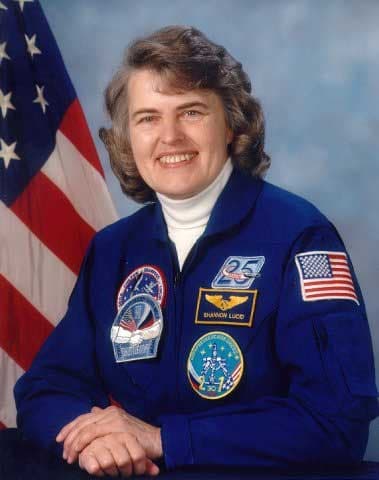
American · Science · Aviation
Shannon Lucid
January 14, 1943 – present
Early Life and Background
Shannon Matilda Wells Lucid (née Wells) was born on January 14, 1943, in Shanghai, China, to American Baptist missionary parents Oscar and Myrtle Wells.[1][2][9] Her birth occurred during World War II, when Shanghai was under Japanese occupation. According to biographical accounts, the Wells family’s missionary work and their wartime experiences, including internment by Japanese forces, shaped Lucid’s early understanding of hardship and resilience.[11] After the war, the family returned to the United States, eventually settling in Bethany, Oklahoma, a small community near Oklahoma City.[2][6][12]
Lucid grew up in Bethany and attended local schools, graduating from Bethany High School in 1960.[6][13] Her interest in science developed early, encouraged by a curiosity about the natural world. She later recalled growing up in the 1940s and 1950s when women were rarely encouraged to pursue careers in science or aviation.[7] Despite these social norms, she nurtured ambitions in both fields, inspired by stories of exploration and by the emerging space age.
After high school, Lucid enrolled at the University of Oklahoma in Norman, where she studied chemistry and biochemistry.[1][2][12] She earned a Bachelor of Science in chemistry, followed by a Master’s degree and a Ph.D. in biochemistry, completing her doctorate in 1973.[1][7][13] During her graduate studies, she conducted research in the Department of Biochemistry, gaining experience in laboratory techniques and scientific problem‑solving that would later underpin her work as a mission specialist and space scientist.
Lucid’s decision to pursue a Ph.D. in the early 1970s was itself a significant departure from expectations for women of her generation. The National Women’s Hall of Fame notes that she confronted discriminatory attitudes and "ignored conventional restrictions" to pursue her dream of becoming a scientist.[7] Her academic success provided essential credentials that made her eligible for NASA’s astronaut program when it finally opened to women later in the decade.
Career Beginnings and Development
Before joining NASA’s astronaut corps, Lucid worked professionally as a research biochemist. She conducted research at the University of Oklahoma and later for the Oklahoma Medical Research Foundation, specializing in areas such as enzyme kinetics and biological chemistry, though detailed accounts of her specific projects are less widely documented.[1][11] This period established her credentials as a scientist and prepared her for the experimental work she would later conduct in orbit.
In January 1978, Lucid’s career took a decisive turn when she was selected by NASA as an astronaut candidate as part of Astronaut Group 8, the first U.S. astronaut class to include women.[1][5][8] NASA’s decision to admit women to the astronaut corps came after years of advocacy and changing public expectations during and after the women’s movement of the 1960s and 1970s. Among 35 candidates selected in 1978, six were women: Sally Ride, Judith Resnik, Anna Fisher, Rhea Seddon, Kathryn Sullivan, and Shannon Lucid.[1][5][11]
Lucid was distinctive among this cohort in that she was already a mother when selected—an aspect noted in retrospective accounts as emblematic of her determination to balance family commitments with demanding professional aspirations.[13] During astronaut training, she completed coursework and exercises in shuttle systems, orbital mechanics, survival training, and flight operations, alongside physical conditioning and simulator work.
In 1979, after completing training, Lucid and her five female colleagues from the 1978 group became the first women to achieve full rank of astronaut at NASA.[5][7][11] The Astronaut Scholarship Foundation notes that she "became an astronaut in August 1979" as part of this groundbreaking class.[5] This transition from candidate to astronaut was a major institutional milestone, marking the first time women were formally integrated into NASA’s operational astronaut corps.
Over the next several years, Lucid worked on shuttle‑related assignments in Mission Control and technical branches within the Astronaut Office. She served as a "capcom" (capsule communicator) for numerous space shuttle missions, acting as the primary voice between Mission Control and crews in orbit.[13] These roles built her expertise in shuttle operations and mission timelines, setting the stage for her own flights.
Space Shuttle Missions and Scientific Contributions
STS‑51‑G: First Spaceflight (1985)
Lucid’s first trip into space came with Space Shuttle Discovery on mission STS‑51‑G. The shuttle launched on June 17, 1985, from Kennedy Space Center and landed on June 24, 1985, at Edwards Air Force Base.[1][9][13] The seven‑day mission focused on deploying three communications satellites—Morelos‑1 for Mexico, Arabsat‑1B for the Arab League, and Telstar‑3D for the United States.[1][13]
As a mission specialist, Lucid helped manage payload operations and supported the deployment sequences, which involved precise timing and coordination with ground control.[1] The successful deployment of these satellites expanded telecommunications and broadcasting capabilities across multiple regions and illustrated the shuttle program’s role in building global communications infrastructure.
STS‑51‑G also featured a Getaway Special canister and other experiments, reflecting the multifaceted mission profiles typical of the shuttle era.[1] Lucid’s participation placed her among the early women to fly on the Space Shuttle, reinforcing the viability of mixed‑gender crews on complex orbital missions.
STS‑34: Galileo to Jupiter (1989)
In 1989, Lucid flew her second space mission aboard Space Shuttle Atlantis on STS‑34.[1][13] The primary objective was the deployment of the Galileo spacecraft, a pioneering probe designed to study the planet Jupiter and its moons. After launch, Galileo embarked on a trajectory that used multiple gravity assists, including an Earth–Venus–Earth sequence, before eventually reaching Jupiter in 1995.
Lucid’s work on STS‑34 contributed to one of NASA’s most important planetary science missions. Galileo’s subsequent discoveries—including evidence of subsurface oceans on Europa and detailed observations of Jupiter’s atmosphere—depended on the successful deployment accomplished during STS‑34.[1] The mission reinforced Lucid’s role in advancing not only Earth‑orbit operations but also deep‑space exploration.
STS‑43: TDRS Deployment and Experiments (1991)
Lucid’s third flight came in 1991 on STS‑43, again aboard Atlantis.[1][14] This nine‑day mission deployed a Tracking and Data Relay Satellite (TDRS‑E), part of a constellation that significantly improved communications between NASA’s spacecraft and ground stations.
During STS‑43, Lucid participated in numerous experiments, including investigations in materials science and Earth observation. The mission also tested upgraded shuttle systems and on‑board computer technologies.[1] By this point, her cumulative time in space had grown substantially, and she had established herself as an experienced mission specialist with expertise across payload operations and experiment management.
STS‑58: Spacelab Life Sciences Mission (1993)
Lucid’s fourth mission, STS‑58 aboard Space Shuttle Columbia in 1993, was one of the shuttle program’s major biomedical flights.[1][14] Designated as a Spacelab Life Sciences mission, STS‑58 carried a suite of experiments aimed at understanding how spaceflight affects human and animal physiology.
Lucid and her crewmates conducted studies on the cardiovascular system, bone and muscle loss, neurovestibular function, and immune responses in microgravity.[1][11] These experiments examined both human crew members and laboratory animals to generate comparative data. Lucid’s biochemistry background made her well‑suited for the mission’s scientific demands, and the results informed later research on long‑duration spaceflight, including planning for Mir and the International Space Station.
Shuttle‑Mir Program and Long‑Duration Mission on Mir
STS‑76 and Transfer to Mir (March 1996)
Lucid’s most celebrated mission began when Atlantis launched on STS‑76 on March 22, 1996, carrying her to the Russian space station Mir as part of the Shuttle‑Mir program.[1][4] Two days later, on March 24, 1996, Atlantis docked with Mir, and Lucid transferred to the station to start a planned six‑month stay.[1][15]
With this transfer, Lucid became the first American woman to live on Mir and the first female U.S. astronaut to live on any space station.[1][7][15] She joined Russian cosmonauts Yuri Onufrienko and Yuri Usachev, integrating into the station’s daily operations, scientific activities, and maintenance routines.
During her time on Mir, Lucid conducted experiments in life sciences, materials science, and Earth observations.[1][4][11] Her biomedical studies focused on the effects of long‑term exposure to microgravity on bone density, muscle mass, fluid distribution, and neurovestibular function. She also participated in agricultural experiments involving plant growth and in materials processing experiments investigating crystal formation and alloy behavior.
STS‑79 Return and Endurance Records (September 1996)
Lucid’s Mir residency concluded when Atlantis returned on mission STS‑79. The shuttle docked with Mir, retrieved Lucid, and landed on September 26, 1996.[1][15] At that point, she had spent 188 continuous days aboard Mir and 223 total days in space, or approximately 5,354 hours.[1][5][7]
These figures gave Lucid the American record for the longest single spaceflight and the world record for most time in space by a woman.[1][5][7] She also became the first woman to hold the international record for flight hours in orbit by any non‑Russian, reflecting the fact that only Russian cosmonauts had previously accumulated more time aloft.[7]
Her records stood until 2002 for U.S. astronauts and until 2007 for women globally, when they were surpassed by later long‑duration ISS missions.[1][5][7] Nonetheless, Lucid’s mission marked a turning point in NASA’s approach to human spaceflight, demonstrating that extended stays in orbit were feasible and that women could perform such missions with exceptional success.
Awards, Honors, and Recognition
Lucid’s achievements in spaceflight and science earned her numerous awards and honors. The most prestigious came on December 2, 1996, when she received the Congressional Space Medal of Honor, becoming its first female recipient and the ninth person to receive the medal.[1][7][8] The award recognized her extraordinary contributions to human spaceflight through her Mir mission and symbolized the U.S. government’s valuation of long‑duration orbital science and international cooperation.
She has also been honored with the NASA Space Flight Medal, the NASA Distinguished Service Medal, and other agency awards for her five shuttle flights and Mir residency, although specific dates for these medals are not consistently documented in publicly accessible sources.[1][2] Her scientific and exploratory achievements led to broader recognition beyond NASA.
Lucid was inducted into the National Women’s Hall of Fame, which highlights her role in breaking barriers in science and space exploration and notes her status as the first woman to hold an international record for flight hours by a non‑Russian.[7] On September 13, 2014, she was inducted into the U.S. Astronaut Hall of Fame at the Kennedy Space Center Visitor Complex, formally enshrining her among the most influential astronauts in American history.[1]
Lucid’s home state also celebrated her achievements. On September 16, 2017, she entered both the Oklahoma Hall of Fame and the Oklahoma Women’s Hall of Fame, recognizing her as a distinguished Oklahoman and as a woman whose life’s work significantly advanced the status of women in science and exploration.[1][12] These honors link her international career to local narratives of ambition and achievement.
NASA Leadership and Later Career
Beyond her work as an astronaut, Lucid influenced NASA’s scientific agenda in leadership roles. In 2002–2003, she served as NASA Chief Scientist, overseeing scientific aspects of missions and research programs.[5][7][13] In this position, she helped shape priorities for space‑based experiments, Earth observation initiatives, and planetary science, bringing the perspective of a former mission specialist and long‑duration astronaut to agency‑level decision‑making.
Lucid also continued to contribute to mission operations as a lead capcom in Mission Control, reportedly serving in that role for more than sixteen shuttle missions.[13] Her experience on the flight deck and in orbit allowed her to communicate effectively with crews, translating complex operational demands into clear, actionable guidance.
According to NASA and secondary sources, Lucid announced her retirement in January 2012, and a NASA biography documents that she retired from NASA on January 31, 2012.[2][12][13] By then, she had accumulated one of the longest and most varied careers in the astronaut corps, spanning from the early shuttle era through the Shuttle‑Mir program and into the era of the International Space Station.
Personal Life
Lucid’s personal life is noted in several biographical sources. She married Michael F. Lucid, and the couple have three children
Her family life remained largely private, but public accounts emphasize that her success challenged assumptions that motherhood and high‑risk technical careers were incompatible. Lucid’s example demonstrated that women could pursue demanding scientific and exploratory work while maintaining family commitments, an important contribution to changing cultural perceptions of women’s roles.[7][13] Lucid has often been described as modest and low‑key in public demeanor, emphasizing teamwork and the collective nature of space missions rather than personal heroism. Nonetheless, her story has been widely used in educational outreach, highlighting her as a role model for girls interested in science, technology, engineering, and mathematics (STEM).[4][7] Shannon Lucid’s legacy in women’s history and space exploration is multifaceted. As one of the first six American women selected as astronauts, she helped break a critical barrier in NASA’s institutional culture, moving women from the realm of spectators and support roles into the core of flight operations.[1][5][11] Her presence in the astronaut corps contributed to the normalization of women on flight crews and in mission leadership. Her five spaceflights and 223 days in space established her as one of the most experienced astronauts of her era.[1][5] She played key roles in missions that advanced satellite communications (STS‑51‑G, STS‑43), deep‑space planetary science (STS‑34 and Galileo), and biomedical research (STS‑58). Her long‑duration Mir mission, in particular, provided vital data on human adaptation to extended microgravity, informing future mission design and health protocols for astronauts. From 1996 to 2007, Lucid held the record for the longest duration spent in space by an American and by a woman, and she was the only American woman to have stayed on Mir.[1][5][8][15] These records symbolized the expansion of women’s participation from short flights to extended residence in orbit. They also underscored the importance of cross‑national collaboration: her work aboard Mir demonstrated that U.S. and Russian space agencies could integrate crews and scientific agendas effectively. Lucid’s receipt of the Congressional Space Medal of Honor as the first woman honoree elevated women’s achievements to the highest levels of official recognition in the U.S. space program.[1][7][8] Her later inductions into national and state halls of fame further institutionalized her story as part of the historical narrative of science and exploration. In educational and commemorative contexts, Lucid is often portrayed as a pioneering figure who combined scientific expertise, operational skill, and personal resilience. The Science Museum Group and women’s‑history organizations emphasize that she grew up at a time when women "rarely thought of careers in the sciences and aviation" yet persisted in pursuing those paths.[4][7] Her life trajectory—from wartime Shanghai to Bethany, Oklahoma; from university laboratories to orbiting Mir—illustrates the global, social, and technological transformations that shaped women’s opportunities in the twentieth century. Since retiring from NASA in 2012, Lucid has remained a prominent figure in the history of human spaceflight. Biographical sources as of the mid‑2020s describe her as a retired NASA astronaut and biochemist, living in the United States.[1][2][8] No reliable sources report a date of death; she is consistently described in the present tense. Lucid’s story continues to be featured in museum exhibits, documentaries, and educational materials. She appears in productions such as "Heroes and Legends Featuring the U.S. Astronaut Hall of Fame," where her experiences are used to inspire audiences and contextualize the evolution of the U.S. space program.[10] Her records may have been surpassed, but her role as a pathbreaker for women and a key participant in U.S.–Russian space cooperation ensures that her contributions remain central to historical assessments of late twentieth‑century astronautics. In sum, Shannon Lucid stands as a pivotal figure in women’s and space history: a scientist who insisted on her place in a male‑dominated field, an astronaut who lived and worked for months aboard a foreign space station, and a record‑setter whose endurance and expertise helped chart the course from the shuttle era to the age of the International Space Station.Legacy and Historical Impact
Later Life and Status
Dated achievements
11 indexed.
- Jan141943Aviation
Birth in Shanghai, China
Born in Shanghai to American parents, Shannon Lucid would become a pioneering NASA astronaut.
View details Wikipedia: Shannon Lucid - Aug011979Aviation
Among first women to attain full NASA astronaut status
In 1979, Lucid became a full-fledged NASA astronaut, among the first American women to achieve this milestone.