← All women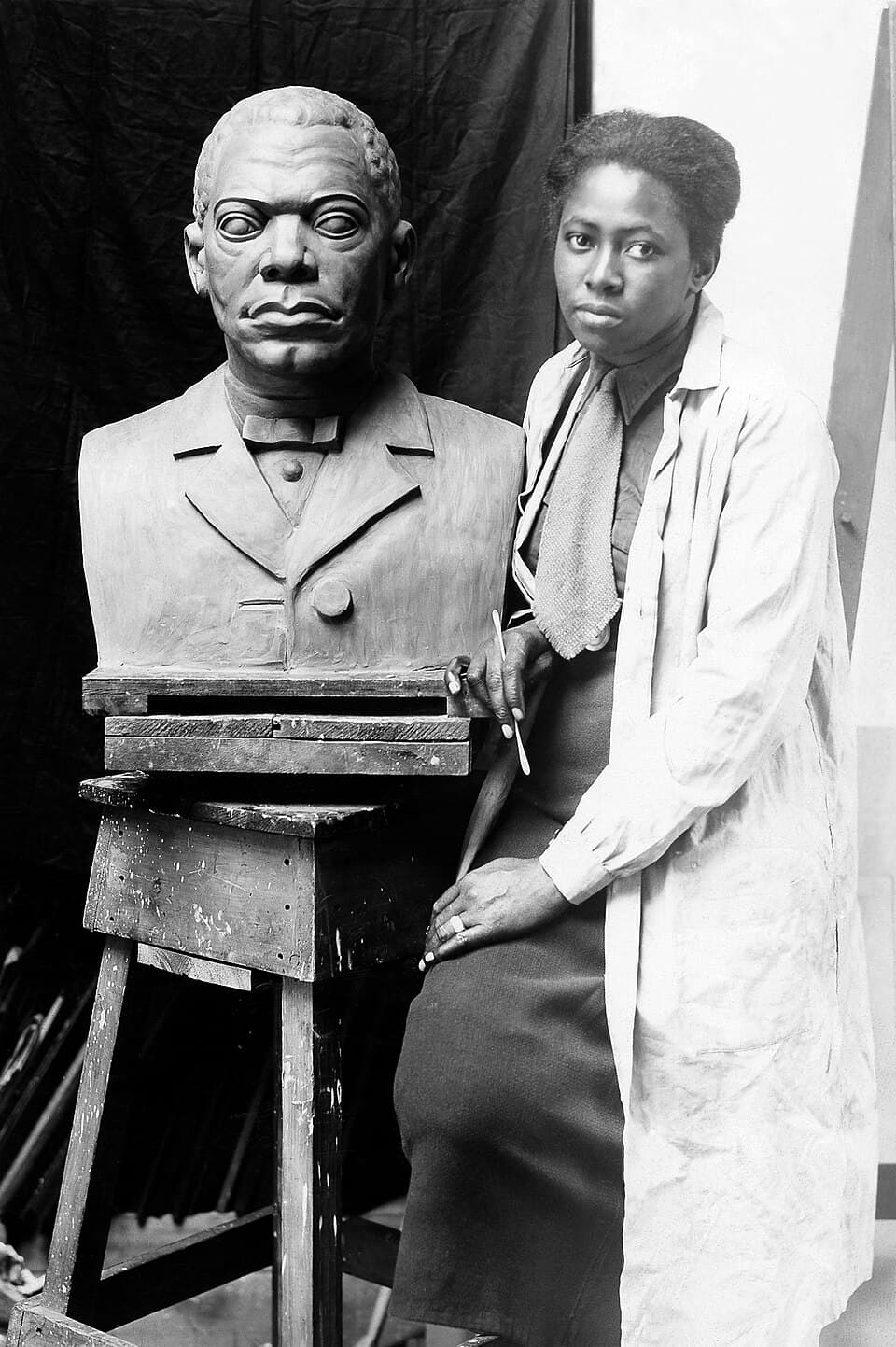
American · Arts · Activism
Selma Burke
December 31, 1900 – August 29, 1995
Early Life and Background
Selma Hortense Burke was born on December 31, 1900, in the small town of Mooresville, North Carolina, into a large African American family headed by Methodist minister Rev. Neil Burke and Mary Jackson Burke.[1][4] She was the seventh of ten children, raised in the segregated Jim Crow South where Black communities faced limited educational and professional opportunities.[1][4] As a child, Burke discovered an early fascination with three-dimensional form by playing along a creek and riverbanks near her home, shaping soft clay and mud into small animals and figures.[1][3][4] She later recalled that working with clay in 1907—"It was there that I discovered me"—marked the beginning of her self-understanding as an artist.[8]
Despite her obvious artistic aptitude, Burke’s family, especially her mother, encouraged her to pursue a more secure occupation due to the economic precarity Black women faced at the time.[3][8] She attended what is now Winston-Salem State University (then Slater Industrial Academy/Slater Normal School), where she studied and ultimately earned a degree that prepared her for nursing.[3][4][11] She continued her training at St. Agnes Hospital School of Nursing in Raleigh, North Carolina, a crucial institution for African American medical education in the early twentieth century.[4][11] This combination of rural upbringing, religious household, and formal training in a Black educational infrastructure shaped Burke’s resilience and discipline, even as her creative ambitions grew.
Education, Nursing, and Move to New York
After completing her undergraduate studies, Burke qualified as a nurse and began practicing professionally.[3][4][11] She worked as a private nurse for a wealthy heiress in New York City, a position that introduced her to urban life and provided financial stability.[3][4] The move from North Carolina to New York occurred in the 1920s, at a time when many African Americans were relocating northward during the Great Migration, seeking opportunities and relative freedom from Southern racial violence.[1][5][8] In New York, she encountered the vibrant milieu of the Harlem Renaissance, a flourishing of Black literature, music, and visual arts that deeply influenced her.[1][3][5][8]
While working as a nurse, Burke began to study art seriously, taking sculpture classes at institutions such as the Art Students League and engaging with the Works Progress Administration (WPA) arts projects.[3][4][8] She studied and later taught under the guidance of sculptor Augusta Savage at the Harlem Community Art Center, an important hub for Black artists including Jacob Lawrence and Gwendolyn Knight.[3][4] Burke also pursued higher education, eventually earning an MFA from Columbia University in 1941, building on earlier studies and degrees.[3][4] Her Columbia training provided technical mastery and academic credentialing that would support her future teaching and commissions.
European Study and Artistic Development
During the late 1930s, Burke expanded her horizons by traveling to Europe, primarily Vienna and Paris, supported by fellowships from organizations such as the Rosenwald and Boehler foundations.[1][4][7] In Europe she studied with prominent artists including Henri Matisse and Aristide Maillol, gaining exposure to modernist sculpture and European traditions of figurative art.[1][3][4] The experience sharpened her understanding of form, mass, and the expressive potential of three-dimensional portraiture.
Burke’s time abroad coincided with the rise of fascism and mounting tensions that would soon erupt into World War II, and she returned to the United States by 1938.[1][4] Back in New York, she resumed her sculptural practice with increased confidence and sophistication, integrating modernist influences into her depictions of Black subjects and notable public figures. She began producing works in materials such as alabaster, bronze, brass, and stone, focusing on portraits and reliefs that captured character and dignity rather than mere likeness.[3][7] Her growing reputation placed her among the few African American women to gain visibility in the Harlem Renaissance and in wider American art circles.[2][3]
Harlem Renaissance and the Selma Burke School of Sculpture
In New York during the 1930s and early 1940s, Burke was increasingly recognized as a participant in the Harlem Renaissance, though visual arts were less publicized than literature and music.[2][3][5] She taught at the Harlem Community Art Center, working under Augusta Savage and mentoring younger artists.[3][4] Committed to expanding access to art education, Burke opened the Selma Burke School of Sculpture in New York City in the early 1940s, creating a space where Black artists and children could learn modeling and carving techniques.[1][2][3] The school reflected her belief that sculpture could be both a personal vocation and a communal resource.
Burke’s artistic development during this period involved both public and private commissions. She produced portrait busts and reliefs of cultural figures and everyday people, emphasizing the individuality of Black subjects at a time when mainstream art often ignored or stereotyped them.[3][7][9] Her work aligned with broader Harlem Renaissance goals of racial pride and cultural affirmation, yet her focus on three-dimensional representation distinguished her from many contemporaries who worked primarily in painting and printmaking.
Military Service and the FDR Commission
Following the entry of the United States into World War II, Burke enlisted in the U.S. Navy, joining the Women Accepted for Volunteer Emergency Service (WAVES) and becoming one of the first African American women to enroll.[1][7][11] Her assignment involved driving a truck at the Brooklyn Navy Yard, where she sustained a back injury on the job.[10][11] During her recuperation, she turned her energy back toward sculpture and entered a competition for a bronze portrait relief of President Franklin D. Roosevelt to be installed at the Recorder of Deeds Building in Washington, D.C.[1][4][10]
On March 31, 1943, Burke was announced as the winner of the District of Columbia Fine Arts Commission’s competition for the Roosevelt plaque.[10] Dissatisfied with working from photographs alone, she wrote to the White House and requested an opportunity to sketch the president from life. Roosevelt agreed, and Burke conducted a sitting, making multiple drawings that captured his profile and expression.[3][4][10] These sketches formed the basis for the clay model she completed in 1943.[1][3]
The finished bronze relief, inscribed "Franklin Delano Roosevelt 1882–1945 – The Four Freedoms," was unveiled on September 24, 1945, at the Recorder of Deeds Building in Washington, D.C., in a ceremony attended by President Harry S. Truman.[4][10] The work associated Roosevelt with the "Four Freedoms" he had articulated in his 1941 State of the Union address and established Burke’s reputation as an artist capable of handling major national subjects. Her status as a Black woman sculptor making a presidential portrait for a federal building was highly unusual in the mid-twentieth century.
Connection to the Roosevelt Dime
In 1945, the U.S. Mint issued a new dime bearing the profile of Franklin D. Roosevelt, designed by Mint Chief Engraver John R. Sinnock.[1][3][10] Over time, scholars, art historians, and commentators have argued that the coin’s profile closely resembles Burke’s earlier relief and that her sculpture served as a model or inspiration for the Mint design.[1][2][3][9][10] While official Mint documentation credits Sinnock and does not formally acknowledge Burke, the resemblance has become an important part of her artistic legacy.
According to the National Women’s History Museum and other sources, Burke is widely regarded as "the artist behind President Franklin Roosevelt’s image on the dime," even if her contribution was uncredited in official narratives.[1][2][3][9][10] This debate underscores issues of authorship, recognition, and the marginalization of Black women’s work in national symbolism. The connection between Burke’s plaque and the dime places her work in the everyday material culture of the United States, as millions of coins circulate bearing a profile that many view as rooted in her sculptural vision.
Teaching Career and the Selma Burke Art Center
Alongside her own practice, Burke devoted much of her career to arts education. After completing her MFA at Columbia, she taught at the Harlem Community Art Center and later at institutions such as the New York Phoenix School of Design and Livingston College of Rutgers University.[1][3][5] Her pedagogical approach emphasized both technical proficiency and the importance of representing Black subjects with dignity.
In the late 1960s, Burke extended her educational work to Pittsburgh, Pennsylvania, where she founded and ran the Selma Burke Art Center, an institution dedicated to community arts and training.[1][3] The Center opened in 1979 under her name and operated as a hub for exhibitions, classes, and youth programs.[1] Burke directed the center from 1968 until its closure in 1981, advocating for accessible art education and emphasizing sculpture as a powerful mode of self-expression.[3] Through these schools and centers, she mentored numerous students and created pathways into the arts for Black communities that had historically been excluded from formal institutions.
Major Works and Public Commissions
Beyond the Roosevelt plaque, Burke created a range of important sculptures and public monuments. She produced portraits and busts of leading African American figures, including Duke Ellington, Martin Luther King Jr., and Booker T. Washington, along with works depicting everyday people.[3][5][7] Many of these pieces are held in museum collections such as the Smithsonian American Art Museum, the Studio Museum in Harlem, and regional institutions.[2][3][7]
Burke’s last monumental work was a statue of Martin Luther King Jr. installed in Marshall Park, Charlotte, North Carolina, completed around 1980.[4] The sculpture contributes to the landscape of civil rights memorials by placing a Black sculptor’s interpretation of King in a prominent public space. Her depictions of Black leaders emphasized humanity and strength, countering both the absence of Black subjects in mainstream monuments and stereotyped imagery elsewhere.
Throughout her career, Burke worked in various media, including alabaster, stone, brass, and bronze.[3][7] Her style combined modernist simplicity with close attention to facial features and posture, creating portraits that were both recognizable and psychologically resonant. Works like Woman and Child, held by the Studio Museum in Harlem, reveal her interest in familial relationships and everyday moments in Black life.[3]
Awards, Honors, and Recognition
Burke’s contributions were gradually recognized through awards and honorary degrees, particularly from the 1970s onward. She received a Lifetime Achievement Award from the Women’s Caucus for Art in 1979, acknowledging her impact as a sculptor and educator.[3] In 1983, she was honored with a Candace Award from the National Coalition of 100 Black Women, an organization that celebrates African American women’s achievements across professional fields.[3]
In 1988, Spelman College, a historically Black women’s college, awarded Burke an honorary Doctorate of Humane Letters, recognizing her role as an artist, teacher, and advocate for Black representation in the arts.[3][7] Museums and galleries also mounted exhibitions of her work, and she appeared in collections and catalogues dedicated to African American and women artists. The Smithsonian American Art Museum, for example, includes her in its Luce Artist Biography series, emphasizing her significance in twentieth-century American sculpture.[2]
In 1994, the U.S. Congressional Record published a tribute that highlighted Burke’s Roosevelt plaque and noted scholarly claims that her relief formed the basis for the image on the dime.[10] This congressional acknowledgment, although belated, inserted her name into official documentation of national art and currency history, further solidifying her place in women’s and African American cultural narratives.
Personal Life
Details of Burke’s personal life are less extensively documented than her professional achievements, but available sources note that she lived and worked for many years in New York City and later in Pennsylvania.[2][3][11] She was at one point married to the Jamaican-born writer Claude McKay, a prominent literary figure of the Harlem Renaissance; their union has been described as "rocky," and the marriage was brief.[11] The relationship connected her to the literary wing of the Harlem Renaissance, although her primary focus remained on visual art and education.
Burke balanced personal challenges with a demanding schedule of teaching, creating, and administrative work. Her role as an arts administrator at the Selma Burke Art Center and her commitment to community arts suggest that she saw her life’s purpose as extending beyond individual career advancement to collective empowerment. She did not become widely wealthy from her work, reflecting the broader economic realities for Black women artists in the twentieth century, but she carved out spaces in which art and community could coexist.
Later Life and Death
In her later years, Burke continued living in New Hope, Pennsylvania, while maintaining ties to artistic communities and institutions that celebrated her work.[2][4][7] Even as she aged, she remained engaged with discussions about the recognition of Black women artists and the importance of sculpture in public memory.
On August 29, 1995, Selma Burke died in New Hope at the age of ninety-four.[1][2][4] Obituaries and tributes emphasized her pioneering status as an African American woman sculptor whose work reached from Harlem community centers to federal buildings in Washington, D.C. Her death marked the end of a long career that had seen significant shifts in American society—from Jim Crow segregation through the civil rights movement and into the late twentieth century.
Legacy and Historical Impact
Selma Burke’s legacy rests on multiple pillars: her artistic innovation, her public commissions, her teaching and institution-building, and her contested but influential role in the imagery of U.S. currency. As one of the very few African American women to gain national attention as a sculptor in the mid-twentieth century, she demonstrated that Black women could shape the visual language of leadership and freedom.[2][3]
Her portrait relief of Franklin D. Roosevelt, and its association with the dime, has become a key case study in discussions of artistic credit and the erasure of Black women’s contributions. Whether or not formally acknowledged by the U.S. Mint, Burke’s work informed a profile seen daily by millions of people.[1][2][3][9][10] Her monuments to figures like Martin Luther King Jr. and Duke Ellington contribute to a broader landscape of Black public memory, placing African American heroes into civic spaces often dominated by white historical figures.
As an educator, Burke’s impact radiated through the Selma Burke School of Sculpture in New York and the Selma Burke Art Center in Pittsburgh, institutions that offered instruction, exhibition opportunities, and community programs.[1][2][3] Her insistence that children and emerging artists, particularly from Black communities, have access to sculpture training helped challenge structural barriers in the arts.
Scholars and institutions including the National Women’s History Museum, the Smithsonian, the Studio Museum in Harlem, and university museums now include Burke in their narratives of American art, women’s history, and African American cultural production.[1][2][3][7] She is remembered not only for specific works but for her role in opening doors—often without full credit or recognition at the time—for later generations of Black women sculptors and art educators.
In women’s history, Burke stands as a figure who navigated multiple intersecting oppressions—race, gender, class—yet succeeded in leaving an indelible mark on national iconography and public sculpture. Her life story continues to inspire reexaminations of who is credited with shaping American visual culture and highlights the need to recover and center the contributions of Black women in the arts.
Dated achievements
4 indexed.
- Dec311900Arts
Birth of Selma Burke
Selma Hortense Burke was born in Mooresville, North Carolina, the seventh of ten children of Rev. Neil Burke and Mary Jackson Burke.
View details Selma Burke: Renowned for FDR Portrait on the Dime - Mar311943Arts
Wins Fine Arts Commission for FDR plaque
Selma Burke won the District of Columbia Fine Arts Commission competition to create a bronze plaque of President FDR.